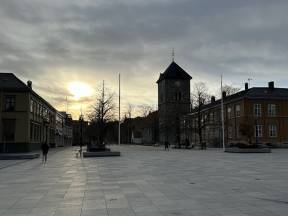
This walk through the medieval streets of Trondheim begins before Christianity arrived in Norway. We're in the Viking Age, and the city wasn't called Trondheim but Nidaros.
We'll travel back in time to try to understand how the people who lived here back then lived their lifes. What did it look like here where today there are luxury residences, shopping centers, bars, and restaurants?
There aren't many traces left of them, but archaeologists have excavated, and historians have searched through books, sagas, and oral tales.
Perhaps we can get a little closer to those who lived here by the riverbank and laid the foundation for the city that stands here today.
To find more content and listen to free audio guides, download the Guide To Go app.
MEDIEVAL CITY WALK TRONDHEIM
Points of interest
Welcome
This walk through the medieval streets of Trondheim begins before Christianity arrived in Norway. We're in the Viking Age, and the city wasn't called Trondheim but Nidaros. We'll travel back in time to try to understand how the people who lived here back then lived their lifes. What did it look like here where today there are luxury residences, shopping centers, bars, and restaurants? There aren't many traces left of them, but archaeologists have excavated, and historians have searched through books, sagas, and oral tales. Perhaps we can get a little closer to those who lived here by the riverbank and laid the foundation for the city that stands here today.
Maritime Museum: The Harbour
Here Next to the Maritime Museum, we stand at the very foundation of why we have a city here, The River Port. It's a natural harbor where the fjord meets the river and is considered the safest harbor in this part of the Trondheim Fjord. According to the saga tradition, Nidaros was founded by King Olav Tryggvason in 997, but archaeological finds indicate there was settlement here long before that, and that trade was taking place at the river mouth from around 950 AD. If we turn towards the fjord, the hill we see to the east is Ladehammeren. Behind it lies Lade farm, the main estate of the Earls of Lade.
They were rulers over the entire historical Trøndelag during the Viking Age, which included the eight original Trøndelag counties and stretched north to Namdalen, west to Nordmøre, and to the outer edge of Fosen. When the Earls settled at Lade, they gained control over the trading place here at Elvehavna, and they also controlled an important “Hov” or pagan temple located at Lade. A “hov” was a sacred place in pre-Christian times, where the gods Thor and Odin were worshipped, along with the other gods of Norse mythology.
The Earls were accepted rulers in the Viking Age, but their power would soon be challenged by the Christian ideas that came from the south, soon to replace the traditional beliefs and way of life.
Brattørveita
As we stand here, we must imagine that all the buildings between us and the fjord are gone! Over the thousand years that have passed, the land has risen, and landfills have made it possible to expand the city outward into the fjord. In the Middle Ages, we would have been standing on the beach where we stand now.
In the Viking Age and later in the Middle Ages, the "Øyrating" was originally held here. A thing site was where laws and rules were announced before we had separate institutions for this. If someone were to enter into an agreement, for example, if someone were to marry or take over a property, it had to be announced at the “Ting” before it was considered valid. Punishments were also announced at the “Ting”. It was the city's assembly hall where the free men of the city gathered, including the king's representative.
Nidaros' earliest laws, written down in 1274, stated that all free men were required to attend the “Ting” and could be fined if they didn't. Slaves and women were not allowed to attend, and they had no rights to speak or vote. It wasn't until later in the Middle Ages that the “Ting’s” importance diminished, and the town hall, council, and judicial system took over its functions.
The Øyratinget was also a homage assembly, considered the foremost assembly of homage. All Norwegian kings had to be hailed here before being recognized as kings until the 1200s. This speaks volumes about the importance of Nidaros in the early and first part of the High Middle Ages (1130-1350). The Øyratinget was later moved up to the cathedral cemetery.
As we gaze out over the fjord from where we stand today, we see that the city extends out over the canal. This area was filled in and developed towards the end of the 1800s.
"Veit" is the old Norwegian word for road, meaning a narrow road. The names are retained on the old roads in Nidaros. Brattøra was originally the name of the sandy beaches here. Many remnants of forges have also been found here. It was also here on Brattøra that boats were built and maintained.
Krambugata
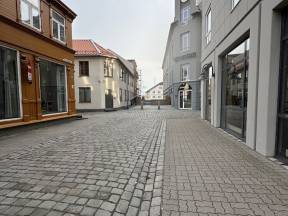
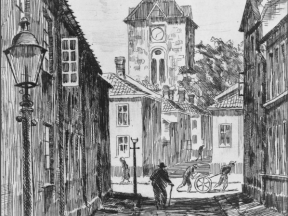
We are now standing in Krambugata, which was the main street of the Middle Ages in Trondheim: Kaupmannastrete. This was the city's most important trading street. It may have functioned as a market square, as no square has been found in medieval Trondheim. Trade took place from open trading booths with a folding flap out onto the street, which served as a counter.
The street was paved with planks, and in the middle, water flowed in a ditch under the paving. This ditch was often blocked, and the dirty drainage water polluted the groundwater, making the well water unsuitable for drinking. On the east side of the street were the largest townhouses. These were located on plots that had been regulated as early as the 900s. Property boundaries remained fixed until the regulation after the great city fire in 1681.
The properties stretched from the street down to the Nidelva River, where the farms ended at a wharf. The farms consisted of several houses. The residential houses were usually three-room parlors and consisted of a vestibule with an entrance door, a living room with a fireplace or smoke oven, and a "cove," which was often used as a bedroom or storage room. In addition, there were loft buildings, storage rooms for goods, and for the animals.
There were also cages, barns, and stables on the small properties, and there could also be separate outhouses.
Some farms also had inns. Trade took place in the city by the riverbank, and trade connections stretched far both from the north, south, and east. The wealthy manors further inland and northward in the fjord brought timber, iron, valuable skins, and bones, which were important commodities. Dried fish was the most important trade item from the north, and luxury goods such as glass, pearls, wine, and other items came from the south through trade routes from the continent. Krambugata retained its medieval course after the city fire in 1681.
Illustration from NTNU Scientific museum Medieval exhibition: Scene from the medieval street
Lilletorvet Elsa Laula Renberg Square
We are now standing in what must have been a central place in the city. In the streets and squares, market trading took place, where goods were sold from small booths. Excavations from medieval streets suggest that the trading place in Nidaros was a meeting point for people from different places. Both skeletal material from the cemeteries and finds from the trading places indicate that Nidaros had international contacts.
There is a significant Sami presence in the archaeological material from the city ground. The Sami traditionally engaged in reindeer husbandry in the mountains and fishing along the coast, and they also visited the cities for trading.
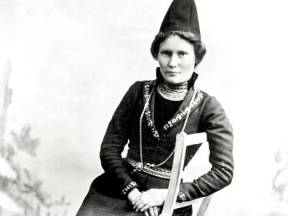
The Sami culture has its own mythology, and Sami influence is known from the archaeological material from the medieval city. They are considered an indigenous people of Norway. The norse sagas mention the Sami as a people with great knowledge and special magical abilities, often consulted for advice by the Norwegian kings. Sami culture has been subjected to numerous abuses through taxation and deprivation of land, water, and grazing areas. The assimilation policy of the Sami intensified in the 1700s and 1800s, marking a dark chapter in Norway's history. The place where we stand is now called Elsa Laula Renbergs plass, a tribute to the woman who, in 1917, convened a large Sami meeting in Trondheim, laying the foundation for what we now know as the Sami Parliament.
Church Ruins in Krambugata
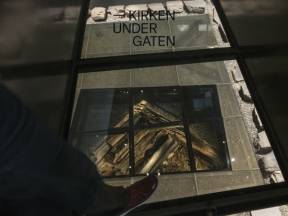
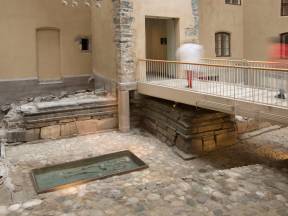
We are now at the ruins of a very special discovery. There are a total of 19 church names registered in the Middle Ages in the city. Some of these may be the same church. These church ruins were found in 2016. It was initially believed that this was the city's oldest church, St. Clemens church, which was supposedly built by King Olav Tryggvason around 997 and destroyed in 1015.
This later turned out not to be the case. The first church on the site dates back to the second half of the 1000s. This was a small wooden church. The church was destroyed by fire several times but was rebuilt each time. It was common for wooden churches that were destroyed to be rebuilt in stone, but this did not happen with this one, which was rebuilt in wood each time. In size, the church resembles the private churches from the 900s. The church was last destroyed in a fire in the 1300s, perhaps in the city fire in 1344. It was not rebuilt, but a protective shed was erected over the preserved altar.
Peter Egges Square
On the square where we are now standing, there has been settlement since the 10th century. The cultural layers were very thick, and a multitude of archaeological finds have been made here.
Large parts of the area were excavated archaeologically from 1970 to 1985. Several skeletons were found, revealing much about both diet and living conditions in the Middle Ages. Many people suffered from various injuries and diseases, and the skeletons bear the marks of lives filled with heavy physical labor. Gout was common.
Although dental caries almost did not exist, the teeth show significant wear. The diet typically consisted of flour-based food, containing a lot of stone dust, which wore down the teeth. Many teeth had large cavities, and many suffered from painful dental abscesses.
There were many traces of craftsmanship in this area. Craftsmen were an important part of urban society, and traces of metal, bone, and leather production were found, made by comb makers, tailors, and shoemakers. There were also likely individuals working with walrus ivory.
Medieval buildings were constructed using both log and timber framing techniques. A reconstructed part of the city can be seen in the medieval exhibition at the Science Museum. Chess pieces, jewellery, and many traces of trade have been found in this part of the city. Three Sami bone spoons were also found here. Where the Public library stands now, eight objects with runic inscriptions were found as well.
Ruins in the Folkebiblioteket
Her eat the Public Library, there are ruins of a church and a Franciscan monastery. When the Franciscan monks established themselves in the city, they took over one of the city's existing churches, against which the monastery was built.
The Franciscan Order, also called the Grey Friars because of the color of their habits, was founded as a mendicant order by St. Francis of Assisi in the early 13th century. The order quickly spread widely, and Franciscan monasteries were founded throughout Europe during the 13th century.
The monastery was built south of the church. It has been assumed to have been founded around the year 1300, but it is first mentioned in written sources in 1466, and it may not have been very old by then. We know little about the history of the monastery. The monastery probably burned down in 1531, and it is unknown if it was rebuilt. The church seems to have been converted into a stone house, which later housed the city hall.
Findings from the monastery have been foun south of the Folkebiblioteket, Public library, outside Kongens gate. Finds included, among other things, bronze pots, hand basins, sculpture fragments, and more.
Skipakrok
Here, where we stand now, early in the Middle Ages, we would have been by the riverside of what was called Skipakrok, a harbor located in a bay on the west side of the Nidelven River.
For a long time, there was a theory that Skipakrok was further north in the city, at Elsa Laula Renbergs plass. Recent research indicates that Skipakrok was a bay extending from the Nidelva River into what is now Kongens gate and curved down into the area where the present-day Søndre gate is located.
Skipakrok was the best harbor in Nidaros, and a safe anchorage is mentioned several times in the sagas. Here lay the harbor used during the Øyrating assembly, and here was the first harbor for Kaupangen in Nidaros. According to Snorre, Olav Tryggvason established a harbor at Skipakrok in 997. There, he also built a royal residence and a church. Magnus Lagabøte's city law of 1276 mentions “Kroken”, which is probably identical to Skipakrok.
In the year 1000, the water level in the Nidelva River was 5.5 meters higher than it is today. The river was much wider than it is now. This meant that Skipakrok was about two meters deep at mean high water level and therefore navigable even at low tide.
As land uplift increased, the harbor became unusable. It was also filled with waste from the city and was eventually completely obliterated. Ships then anchored in the Nidelva River. King Håkon 5 Magnusson (1299-1319) prohibited dumping waste, bark, or stone in the river in 1313 and imposed fines on those who did.
Illustration: www.nrk.no Morten Andersen og Tuva Tagseth
St.Jørgensveita The Church Landscape
Trondheim had many churches in the Middle Ages, although not all were in use simultaneously. Many of these were located near St. Jørgensveita, where we now find ourselves. According to the saga, the oldest church was Olav Tryggvason's St. Clemens Church in the first Kings recident (Kongsgården).
Trondheim was Norway's ecclesiastical center, and the city eventually acquired many parish churches and churches with various other functions, in addition to those belonging to the monasteries and chapels in the Archbishop's Palace and Kongsgården. The latter were intended for daily use by the archbishop, his retinue, the royal family, the lord, and the royal retinue. In 1276, there were nine churches in the city, but the number may have been larger.
During significant events and religious holidays, St. Olav's shrine, which otherwise stood in Nidaros Cathedral, was carried around to the various churches in the city. The church bells rang, and we can imagine how the churches truly created a church landscape.
The most prominent medieval church, and still the city's largest attraction, is the Cathedral, or Nidaros Cathedral. Otherwise, only Our Lady's Church of the medieval churches in the city center has been preserved. Outside the city center, there are Byneset Church and Lade Church, as well as Haltdalen stave church, which was moved to Sverresborg, Trøndelag Folk Museum in more recent times.
Church Ruins at the Bank
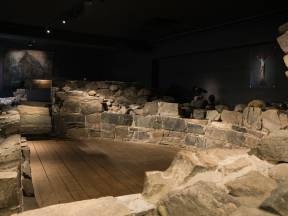
The ruin before us here is quite special. In the Middle Ages, there stood a stone church on this site. The church was in use until it burned down sometime between 1430 and 1531.
Beneath the church ruins, remains of a wooden structure from the first half of the 11th century were found. These may be remnants of a wooden church that existed here before the stone church was built. The stone church had a crypt, which is very rare in Norway. The crypt may have had an important liturgical function.
It has not been definitively confirmed which church this was, but the crypt may have had a function in a saint cult. It was previously believed that the ruins were from the Church of St. Gregory, but later research rejects this. There has been speculation that this is the ruin of St. Olaf's Church mentioned in the sagas.
Church of our Lady (Vår frues kirke)
We are now standing in front of the Church of Our Lady, which is one of two remaining medieval churches in Trondheim. The eastern part of the church dates back to the Middle Ages. The western half of the nave is from the 17th century, and the tower is from the 1750s.
The Church of Our Lady is the city's younger Mariakirke. It is first mentioned in 1206 and is recorded as a parish church in 1280. After 1578, the church became the city's only church alongside the Nidaros Cathedral.
The eastern half of the church was built in the late 12th century. An unusual feature of the medieval church is that the builder is known; his name was Bjørn Sigvardsson, according to an inscription on the east wall of the choir. Another unusual feature is that the church is very wide, indicating that it may have been a triple-aisled church in medieval times.
Tora
This is Tora. She died as an elderly woman in the first half of the 14th century. She has been recreated from the skeleton excavated at the Franciscans' cemetery at the site of the public library in Trondheim. She must have been born in the latter half of the 13th century and was an "old lady" at more than 65 years old when she died.
Tora grew up in a prosperous period for the city. It was the archbishop's city, a pilgrimage site, an administrative center, and a significant trading city. Additionally, the city was a center for crafts of all kinds. Everything from blacksmiths to specialized craftsmen who made exquisite things in walrus ivory.
Tora was buried in the mendicant monks' cemetery. This certainly does not mean that she had to belong to the lowest ranks of society. The Franciscans charged well for burials, so it is likely that she belonged to the city's prosperous merchant class. This meant that she grew up with enough resources in the family to have a long and good life. There were significant changes in the city, the country, and the world during her lifetime. From the mid-14th century, the plague came to the country, initiating a downturn, although she may not have witnessed much of this. Tora became an old lady. She lived at least 15 years longer than the average lifespan for women.
From Viking Age to Christianity
The Vikings are known for their brutal raiding expeditions where they plundered treasures and people whom they sold as slaves. But most people were probably peaceful farmers and skilled seafarers, craftsmen, and traders during the Viking Age. Both raiding and peaceful trade increased contact with foreign lands, introducing new ideas and cultural influences. Knowledge of a new God, with values different from the Norse ones, was likely well established in some areas of the country by the end of the Viking Age. Olav Haraldsson was a Viking king who, after his travels on the continent, became Christian and attempted to Christianize Norway during his reign from 1015 to 1028. He had to flee the country in 1028 but returned to Norway in 1030 to assert
his right as king and make Norway a Christian land. Here, he encountered resistance and was killed in the Battle of Stiklestad on July 29, 1030. The battle and his death have become a landmark date for Norway, as it retrospectively marked the date when Norway became a Christian country. According to legend, his body was transported to Nidaros by boat on the fjord and brought here where we stand, and it is said that his coffin was buried somewhere along the riverbank of the Nidelva. Many myths emerged around Olav after his death. He was declared a saint on August 3, 1031, and thereafter referred to as Olav the Holy, Norway's eternal king and national saint.
Norway's national shrine, Nidaros Cathedral, was built as his burial church. With Olav's fall at Stiklestad, Christianity had taken root in Norway. His death marked the transition from the Viking Age to the Middle Ages. In the centuries that followed, the city flourished as a religious center but also as a meeting place and trading hub.
Thomas Angells house
We are now standing at the site of the Dominican Monastery, where Thomas Angell's House now stands. The monastery was also known as the Black Friars' Monastery, after the monks' black religious habit, or the Preaching Friars' Monastery, after the official name of the Dominican Order, Ordo Fratrum Praedicatorum. The Dominicans were a mendicant order, founded in 1215 by St. Dominic, and had a special responsibility for preaching.
Most of the monks were ordained priests. The order quickly spread, and the monastery in Trondheim is said to have been founded in 1221 by the monk Salomon from Århus, supported by Duke Skule Bårdsson. It is possible that the duke financed the establishment of the monastery. The monastery was dissolved in the Reformation of 1537 when Catholicism was replaced by Protestantism here in Norway. Monastic life was abolished, and the monks were expelled.
Ruins of the monastery have been found in Kannikestrete, and towards Kjøpmannsgata, there is a church ruin that may be associated with the monastery. The monastery took over an existing church. This could be St. Peter's Church, which is only mentioned in the city's laws. One theory is that the Dominicans took over St. Peter's Church, and it became the Dominican Monastery's church.
Nullsteinen (Zero Stone)
We are now standing at “The Zero Stone”, which is the goal stone of the pilgrims. Just a few years after Olav was declared holy, people began to visit his grave to seek salvation and practice penance. Pilgrimages were already an established practice in the Christian areas further south, so it did not take long before the first pilgrims came from afar to visit the new shrine. Nidaros Cathedral became the most important pilgrimage destination in Norway during the Middle Ages, although the influx of pilgrims was probably not as large as has sometimes been claimed. There were an estimated 2-3000 people living in Nidaros in the 1300s; even a few hundred pilgrims would have made a significant presence in the cityscape.
According to Adam of Bremen, the first pilgrimages to St. Olav's grave took place before the year 1050. He describes how one arrives in Trondheim by sea, which was probably the most common means of travel. We must assume that there were both accommodations and eateries, infirmaries, and other infrastructure in the buildings around Nidaros Cathedral that housed the pilgrims. It is known that criminals were sentenced to walk to Nidaros to seek penance and forgiveness there. According to the Saga of Sverre, pilgrims coming from the south used to kneel when they reached Feginsbrekka, which must have been near the top of today's Steinberget, the place where one could see Nidaros Cathedral for the first time.
Pilgrimage was banned when Norway became Protestant after the Reformation in 1537 but has been revived again, now as a practice for recreation, nature, and cultural experiences. Today, there are 9 marked St. Olav's Ways in Norway connected to St. Olav's Routes in Sweden, Finland, and Denmark. The St. Olav's Ways to Trondheim are part of the European cultural routes. Regardless of which route you take to the city, the journey ends here at Nullsteinen, the milestone that indicates you have finally reached the destination.
The Archbishop's Palace
We are now in the midst of the Archbishop's Palace, which was the residence of the archbishop and, after the Reformation, the king's residence in Trondheim.
The complex was expanded after the archbishopric was established in 1152, and it was turned into a fortified residence surrounded by a ring wall that enclosed a larger area than what we see today. The late medieval archbishops further expanded the complex. The palace was always an administrative center, where a large portion of the archbishop's tax revenues were collected.
In the late Middle Ages, the palace's role as an administrative center was further strengthened. During the Union of Kalmar from 1397 onwards, when the king was mostly outside Norway's borders, the archbishop became the country's most powerful domestic figure. Taxes and fees were paid in kind, and large buildings were needed to store the vast quantities of goods (especially butter and fish) that were brought in.
Nidaros Cathedral
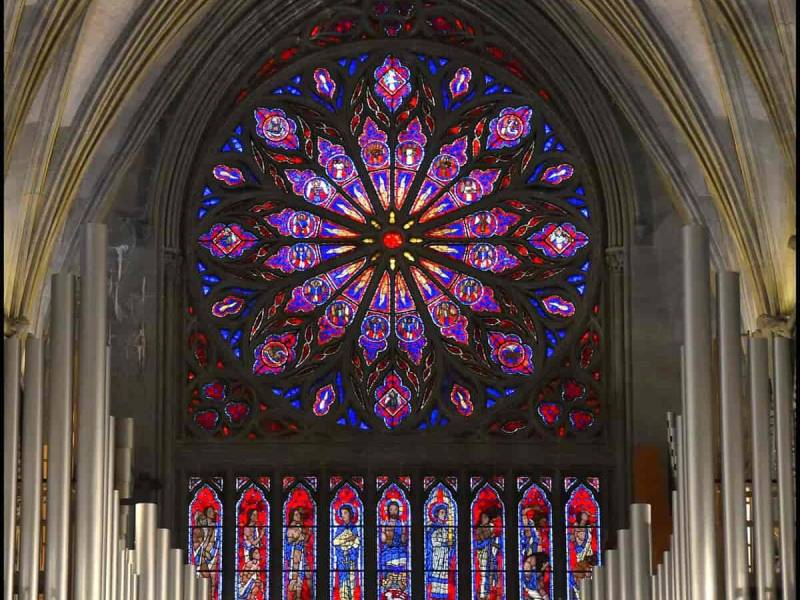
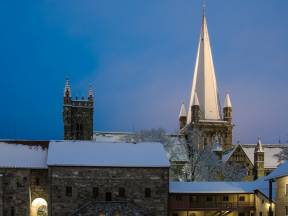
We are now at Nidaros Cathedral, Trondheim's Cathedral and Norway's national sanctuary. The church is one of Norway's foremost architectural monuments from the Middle Ages. It was the metropolitan church for the archbishop in Catholic times, dedicated to the Trinity. It is the burial church of St. Olav and St. Øystein and the coronation, anointing, and consecration church of the Norwegian kings.
Throughout the Middle Ages, the cathedral became a popular pilgrimage site as St. Olav became an increasingly popular saint across much of Northern Europe.
The cathedral is a large cruciform church with a nave, choir, transepts, and a central tower over the crossing. The building material is soapstone and green slate, mainly quarried in Trøndelag. The church was constructed in various forms of late Romanesque and Gothic styles, with Gothic being the dominant architectural style. The cathedral is the largest medieval building in the Nordic region.
The choir is terminated in the east by an octagonal structure (the octagon), with three small chapels along the outer walls. According to legend, this is where Olav's grave lies. On the north side of the church is the chapter house, where the cathedral chapter likely held its meetings from around 1300 onwards.
Kalvskinnet
Kalvskinnet is a part of the Midtown, bordered by Prinsens gate, Kongens gate, Dronningens bastion, and the Nidelva river. Archaeological findings from the Viking Age have been discovered here. Along with Nidarnes, the current Midtown, it likely belonged to the earls of Lade and later the king. In ancient sources, such as the Saga of Sverre, the area is called Akrin, meaning "the field." The Battle of Kalvskinnet, where Erling Skakke fell, was fought here in 1179. Kalvskinnet possibly became part of the church's property in the Middle Ages, and after the Reformation, it was transferred to the king.
The name Kalvskinnet is first mentioned in 1556 and is unexplained. It may originate from 'kalskin,' a dialect term for sparsely vegetated fields on sandy soil, fitting the area well. Another possible explanation is that the area was valued at one calf's hide in land rent, known as a "kalveskinn."
The medieval exhibition
The medieval exhibition here at the the science museum, Vitenskapsmuseet, on Kalvskinnet, showcases aspects of the city, Trondheim, as it was in the Middle Ages. Here, you'll find a reconstruction of the city's main trading street, Kaupmannastretet. The exhibition presents houses and streets in slightly reduced scale.
The exhibition is based on building remains and objects found during the many archaeological excavations in the medieval city. There is a strong focus on everyday life in the Middle Ages through the display of items from work, leisure, and play. Here, you'll see tools, shoes, game pieces, toys, bone skates, lamps, and household items. Among the toys is a wooden sword inscribed with the name "Ivar" in runes.
In the collection, there are exquisite silver crucifixes and even a polished rock crystal that likely adorned St. Olav's shrine. This crystal was found beneath the floor of the archbishop's palace at Steinvikholm. Also on display are more mundane items such as pieces of fabric found in the city's latrines.
The exhibition is extensive and informative, offering a wealth of artifacts from the treasure trove that is Trondheim's underground. It provides a detailed insight into life in the city during the Middle Ages.
The Kuli Stone
Kulisteinen is the name of this runestone that originally stood on the island of Kuli, near the old district governor's seat Veøy in Smøla municipality. This part of Nordmøre is an area where Christianity early gained ground. On one side of the stone, we see a cross, and on the two short sides, there is a longer runic inscription. The stone has damage at the top, so the inscription may have been longer.
This runic inscription is the oldest where the name "Norway" is used in the country, and the stone has therefore been called "Norway's baptismal certificate". It is also evidence that some people in the Viking Age began to follow Christianity. The stone has 80 preserved runic characters. These are interpreted as: "Tore and Halvard raised this stone after Ulfljot Twelve winters had Christianity been in Norway." So, the stone is a memorial stone for Ulfljot. In many cases, such stones are used as property markers, where those who raised it tell that they have taken inheritance after the one the stone is erected in memory of.
Kulisteinen has previously been dated to the year 1034, based on what we know about when Christianity came to the country. However, later research has suggested that the stone should be dated all the way back to the mid-900s. The stone is registered in Norway's documentary heritage, the Norwegian part of UNESCO's Memory of the World register.
Town square. The decline
We have now walked through medieval Trondheim, which was a prosperous time, but it wouldn't last. It has been assumed that Norway's decline began with the arrival of the Black Death in 1349. However, there are signs of decline before this both in Norway and in other European countries. For example, some farms were abandoned already from the 1320s, which may be due to climate change. The plague hit Norway for the first time in 1349.
This became a watershed, and a long period of growth came to an abrupt end. However, we do not know how many died in Trondheim or in the rest of Norway in the first wave of the plague. The population in Norway was reduced from just over 500,000 around 1340 to around 200,000 around 1500. The decline was due to the repeated plague attacks throughout the period, but we do not know how the population development was in the different periods.
Many farms were abandoned as a result of the population decline over time. In Trøndelag as elsewhere, this resulted in reduced income for the landowners, who owned most of the land in the area. The largest of these was the archbishop. However, the city remained one of the country's most important not only religious but also political, economic, and cultural centers in the late Middle Ages due to the archbishopric. The archbishopric could, with a modern expression, be called a cornerstone enterprise.
Many left farming and earned a living from fishing. This led to good economic conditions on the coast. At the Reformation in 1537, the last archbishop, Olav Engelbrektsson, was expelled, and Norway was politically subordinated to Denmark and made Protestant.
It is time to come back to our own time, and it is no better place to do that than here at the town modern city square. This is a vibrant meetingplace where all generations still meet, where farmers from the farmland come to provide their goods and where concerts, christmas markets and festivals still happen on this historic grounds.