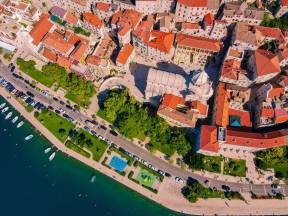
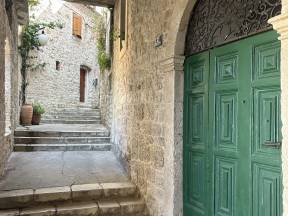
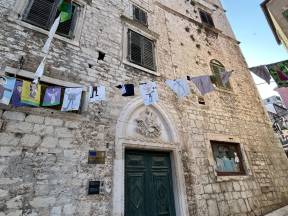
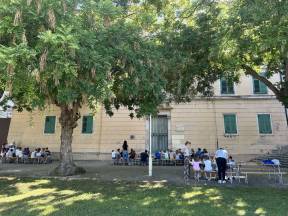
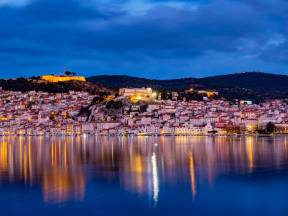
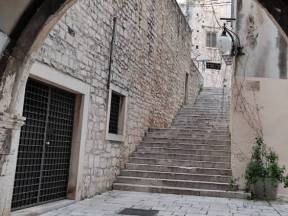
Šibenik is a city on the Adriatic coast, known as the oldest Croatian city founded by Croats. It was first mentioned in 1066. It is notable for the Cathedral of St. James, which is under UNESCO protection, and numerous fortresses. Šibenik was the first city in the world with public lighting on alternating current. There are two national parks nearby, which further increases its importance as a cultural and tourist center.
Audio guides available in:
Slovenian, Slovakian, Hrvatski, 中文, Español, Français, 日本語, Nederlands, Português, русский, Arabic, Українськa, Hungarian, 한글 , Svenska, Dansk, Suomalainen, Czech, English (American), Deutsch , Italiano, Polski, English (British)
To find more content and listen to free audio guides, download the Guide To Go app.
Šibenik
Points of interest
St. James Cathedral
You are standing in front of the Cathedral of St. James in Šibenik, built from 1431 to 1536 as the central sacral building of the city, which was then under Venetian rule. Initially, it followed Gothic patterns, but the approach changed during construction. With the arrival of Juraj Dalmatinac, new technical and design solutions were introduced into the project, resulting in a fusion of Gothic and Renaissance.
The entire building was built without the use of wood and plaster. The stone needed for construction was brought from Brač, Rab and Korčula. Of particular interest is the way in which the stone slabs on the roof and dome were laid – without any binder, only by precise stacking. This technical excellence is one of the reasons why the cathedral was included in the UNESCO World Heritage List in 2000.
The external frieze of the apse has 71 or 74 human heads carved, depending on the sources. It is believed that they depict real people from Šibenik at the time of construction, perhaps donors or prominent citizens, while local tradition also speaks of those who did not want to participate in the construction and are depicted with caricatured facial expressions. On the northern portal there is the so-called Lion's Gate with depictions of Adam and Eve above statues of lions, and in the interior, the baptistery located under the southern apse, built in 1443, stands out in particular.
On the dome are sculptures of St. Mark, St. James and St. Michael, arranged according to the directions and symbols of the city's protection. After the death of Juraj Dalmatinac, the work was taken over by Nikola Firentinac, who completed the upper parts in the Renaissance spirit, while retaining the basic ideas of his predecessor. One of the rarities in church architecture of that period is the complete coincidence of the external and internal forms of the building, which in this case was consistently implemented.
In front of the main entrance there is a bronze statue of Juraj Dalmatinac, the work of sculptor Ivan Meštrović. Inside are the sarcophagi of individual bishops and valuable objects from the time of construction.
Although the cathedral has suffered war damage throughout its history, it has retained its original structure and appearance.
City hall
In front of you is the Šibenik City Hall, built in the mid-16th century on the southern side of what is now the Republic of Croatia Square. It served as the seat of the city government when Šibenik was under the rule of the Venetian Republic, but with a local government that had a certain level of autonomy. The construction itself was completed in 1542. There is no direct evidence of the author of the project, but it is assumed that it was influenced by the school of Michele Sanmicheli.
The building is two-story, with the ground floor open to the square by a series of arches supported by stone columns. This type of ground floor was used as a space for public gatherings, trade and occasional sessions. On the first floor were rooms where city decisions were made, archives were kept and guests were received.
The facade is simple, without unnecessary decorations, but proportionally balanced, in accordance with Renaissance principles. The building was severely damaged in 1943 in an Allied bombing. The renovation was carried out after the war, according to available documentation and old photographs. This reconstructed the exterior appearance, while the interior was adapted to new functions.
Today, the building no longer serves as a town hall, but is still in public use. Given its position on the main square, opposite the Cathedral of St. James, it represents an important segment of the historical urban structure of the city.
Republic Square
You are located near the Republic Square, in the very center of the historic center of Šibenik, right next to the Cathedral of St. James, the City Hall and the former Rector's Palace. This is an area that has had an administrative, ecclesiastical and public function for centuries, and its form and surroundings are the result of urban development during the late Middle Ages and early modern times.
The square was shaped during the 15th and 16th centuries, in the context of intensive construction and expansion of public spaces under Venetian rule. Its eastern side is bordered by the facade of the cathedral, while the western side is closed by the City Hall, built in 1533. South of the square was the Rector's Palace complex, which was later rebuilt and adapted to new facilities, including a penitentiary, administrative offices and other functions.
The paving of the square is made of stone, modeled after similar public spaces in Dalmatian cities of that time. The square did not have a decorative purpose – it was a working and functional space where council sessions, religious ceremonies, the exchange of goods and everyday public life took place. The position of the square in relation to the cathedral and the town hall enabled a direct connection between the church and secular authorities.
The name Republic Square was introduced in the 20th century, after the country gained independence. Before that, the square was known simply as “in front of the cathedral” or “council square”, depending on the context and period. Although relatively small in size, the square area has a high cultural and historical value due to the fact that it gathers key objects of Šibenik’s history.
Today it is also used as a public stage, but the basic structure and functional layout of the space have remained unchanged from their original form.
Kalelarga
You are on King Tomislav Street, known to everyone in Šibenik as Kalelarga. It is not just another street in the old town – it is the main one, the one that has connected the center of life since time immemorial, from Poljana to the Cathedral of St. James.
Kalelarga was not created by chance. It was laid out back in the Middle Ages, when the city was growing within the walls and when it was important for one street to connect the most important things: the church, the government and everyday life. Its name comes from the Italian term calle larga, which means “wide street”, but don’t expect a grand avenue – it was just wider than the other narrow and winding streets that surrounded it.
It was once paved with stone, with the ground floor full of shops and craft workshops, while the upper floors were the homes of Šibenik’s noble and bourgeois families. Over time, the houses expanded, the entrances were upgraded, and new passages opened between them to the side streets. Although it is now named after King Tomislav, it was not until the late 19th or early 20th century that it received its name, at a time when cities were increasingly naming streets after historical figures. Until then, it had no official name, but its significance was unquestioned.
If you look carefully as you walk along it, you will notice traces of many periods. Some details still bear the stamp of the Renaissance and Baroque – stone consoles, old portals, window frames that have withstood the centuries. During the 20th century, most of the facades were renovated, and the ground-floor parts were adapted to new functions.
However, despite the changes, Kalelarga has not lost its recognizable route.
Pellegrini Tambača Palace
In front of you is the Pellegrini Tambača Palace, located right next to the Cathedral of St. James, on the Four Wells Square. This palace has a story that is not easily forgotten – from a noble seat, through a family home, to the status of a protected cultural monument.
The Pellegrini family, originally from Venice, arrived in Šibenik at the beginning of the 16th century. According to some records, their ancestor Pellegrino Dobretić took on the surname Pellegrini as early as 1480. Their coat of arms with a dove and an olive branch clearly shows their noble status. They lived in Šibenik until the end of the 19th century.
The palace was created by merging several medieval houses, and it is interesting that part of it was built on the old city walls from the 15th century. In the 16th century, the Pellegrini family added to the existing buildings and created the palace as we know it today. Even more interestingly, it was once home to the stonemason workshop of Juraj Dalmatinac, a master who left an indelible mark on the Šibenik Cathedral.
After the last member of the Pellegrini family passed away, the palace passed into the hands of the Tambača family in 1898. Jakov Filip Tambača and his brother, canon don Grgo Tambača, converted the palace into a family home. The Tambačes were famous winegrowers, and their Šibenik Maraština, an indigenous dessert wine, was a real local hit. In the large cellar under the palace, the equipment for winemaking was kept, including a torkule and a grape-crushing machine.
The palace was not only a home – it also had an important social role. It was here that the Šibenik Music, the oldest active musical society in Croatia, was founded in 1848. Another historic moment occurred in 1875, when Emperor Franz Joseph I stayed in the palace during his visit to Šibenik.
Today, the palace is a protected cultural monument, and its past continues to attract the curious.
Rossini Palace
The Rossini Palace is located near you. The Rossini Palace is not named for its architectural uniqueness, but because of the family that left a real mark on it. The Rossinis were a wealthy Šibenik family, originally from Italy, whose members had been involved in trade and law for several generations. At a time when Šibenik was under the Venetian Republic, one branch of the Rossini family was granted city citizenship and quickly positioned itself as part of the local elite.
The house that we know today as their palace was actually their long-term residence, but also a place of business. The most famous member of this family was Francesco Rossini, a lawyer and city councilor in the 18th century, who is mentioned in historical sources as a mediator in a series of disputes between Šibenik families and Venetian administrators. It was from this palace that he corresponded with the authorities in Zadar and Venice for years, keeping copies of letters and decisions in a private archive that is now partly lost and partly preserved in fragments in the Šibenik Museum.
The palace was not only a family home, but also a gathering place. In the late 18th century, private concerts and dinners were held here, where members of the Šibenik intelligentsia gathered. One record from 1793 mentions a musical performance by a young violinist from Zadar who was personally invited by Francesco Rossini to play “something Italian”.
After the Rossinis lost their political influence in the early 19th century, the palace changed hands. During the Austrian rule, it was used as an office space, and was partially damaged in World War II. The renovation that followed in the 1950s was functional – the interiors were repurposed, and the facade was only minimally restored to its original state.
Few people know that part of the family archive is still buried under the stone slabs of the courtyard, which has never been fully excavated. Local legend has it that one of the Rossinis, furious over political defeat, personally bricked a suitcase with documents into the courtyard wall in 1806. Whether this is true is unknown, because no one has ever confirmed it through excavation – but the wall is there, as is the story.
Rector’s Palace (Šibenik City Museum)
Nearby is the Rector’s Palace, now housed in the City Museum, once the center of the city's political and administrative power. Since the 13th century, when the city under Venetian control gained its own princes, the palace has been the place where decisions were made that shaped the daily lives of the people of Šibenik.
Located next to the Cathedral of St. James, the palace clearly emphasized political strength and stability in a turbulent period. The Venetian government sought not only to govern, but also to demonstrate its power. Rector came from Venice to maintain order and control over the city, and the palace was the center of these efforts. It was here that decisions were made about public order, trade relations, defense measures, and laws that shaped Šibenik's social framework.
Throughout all these years, the palace became a symbol of the establishment of power, and its rooms were the scene of political changes and moments of crisis. Over time, after the fall of the Venetian Republic in 1797, its function changed. During the 19th century, the palace passed into the hands of new authorities who adapted the space to new needs – from administrative offices to cultural institutions. However, its connection to its past role did not disappear.
When the City Museum was founded in 1925, the palace was given a new mission – the preservation and presentation of the history of Šibenik. Since then, archaeological finds, art collections and historical documents have been collected within its walls. The City Museum has continued to preserve valuable heritage, while also maintaining a connection with the palace’s past function, shifting the focus from political power to preserving knowledge about the city’s history.
Today, the Rector’s Palace, through exhibitions and cultural events, connects the past with the future. Its story is no longer just political, but has become a story of cultural heritage that bears witness to the long history of a city.
Through the museum premises, visitors have the opportunity to learn about the everyday life of the people of Šibenik throughout history and witness how the city and its people have been shaped through reigns, wars, changes and adaptations.
Bishop's Palace
You are currently near the Bishop's Palace, between the Cathedral of St. James and John Paul II Square, in the very center of the former city center.
Its origins are linked to the Middle Ages, when Šibenik, as the seat of the newly founded diocese, needed a building worthy of the church authorities and its management of city and church affairs. The original building was built in the 15th century, at a time when Šibenik was rapidly developing and sought to have its public spaces and institutions in line with its new political and religious status.
The palace was not built all at once, but in phases, in accordance with the possibilities and needs of the diocese. Over the centuries, it underwent additions, adaptations and reinforcements, but its basic function remained the same - the seat of the bishop and the administrative center of church affairs. The building is designed as a combination of Gothic and Renaissance elements, which is typical of the architectural practices of Dalmatia in the late Middle Ages and early modern period.
It is organized around an inner courtyard, according to the pattern of urban palaces of that time. The outer walls are simple and functional, with only a few decorations on the windows and portals, reflecting the combination of the need for representativeness and the reality of life under frequent threats of conflict. Particular attention is drawn to details such as the courtyard arches and window treatments, which, although discreet, are signs of adaptation to Renaissance tastes.
The interior contained rooms with various functions – from the bishop's private chambers, through office spaces, to meeting rooms with church and city representatives. Some of the rooms were decorated with wall paintings and richer stone decorations, but most of the palace remained modest in decoration.
Throughout history, the palace was a place where important decisions were made, both religious and secular, because the bishop in medieval and early modern Šibenik had a strong influence on city processes.
During the Ottoman threats and the Venetian-Turkish wars, the Bishop's Palace also served as a safe haven for the documents and valuables of the diocese. In the 19th century, as social and political relations changed, the palace lost part of its original function. Although the bishop's office remained, the growing administration required new premises, and the old building increasingly took on the characteristics of a monument rather than an active center of power.
Today, the Bishop's Palace is not fully accessible to the public, but its presence alongside the cathedral itself remains an important part of the spatial and historical unity of the old core of Šibenik.
Church and Monastery of St. Dominic
You are standing in front of the Church and Monastery of St. Dominic, a place with more layers of history than it seems at first glance. The Dominican monastery was founded in the 14th century, at a time when this part of Šibenik was almost on the outskirts of the city, far from today's hustle and bustle. The Dominicans did not come here by chance - their order was spreading throughout Dalmatia at that time. The authorities supported them because, in addition to preaching, they often acted as mediators in conflicts, notaries, advisors and confessors of the most influential people in the city.
The Church of St. Dominic was built simply, without luxury, which was a typical Dominican style. They did not care about monumentality, but about the content and the message they conveyed. In the 15th and 16th centuries, the monastery was a real intellectual center of Šibenik. It housed a school, a rich library, and the scriptorium where valuable manuscripts were copied was famous throughout the region. Some Dominicans also participated in the running of the city administration or advised the Šibenik princes - which shows how influential they were behind the scenes.
When the Ottomans began to threaten, the monastery became part of the city's defensive zone. It was damaged several times, and after a major earthquake in 1667, it was rebuilt, but with a slightly altered appearance. With the arrival of the French in the early 19th century, the monastery was temporarily closed, and although it was later restored, it never again had the power and influence it had before.
In the second half of the 20th century, the monastery building took on new roles - part of the space is used for social and cultural events, while today there is no classic monastic life here anymore.
Interesting fact: Some of the oldest manuscripts in Šibenik were kept in the monastery library, and there is a record that the Dominicans were among the first in the city to introduce public lectures and debates, which was quite advanced at the time. Thus, without much fanfare, they left a mark that is still felt in Šibenik's history today.
Church of St. John
The Church of St. John in Šibenik is no ordinary church – it is located in a key location in the old city center, and its history hides interesting stories. It was built during the 15th century, under the old name of the Church of the Holy Trinity, and its role went beyond the ordinary religious function because it was a sign of belonging to the influential brotherhoods that shaped the social life of the city.
The architecture combines Gothic and Renaissance elements – a single-nave space, simple altars and minimal decoration reveal the evolution of the style, and on the south side there is a staircase decorated with a late Gothic bas-relief, which is the work of the famous Ivan Pribislavić. The bell tower has a Renaissance window by Nikola Firentinac, above which is a relief with a lamb and an angel, a masterpiece of Dalmatian sculpture.
The bell tower itself also hides a Turkish clock with one hand, brought from Drniš after the liberation.
Also worth mentioning is the sculpture of St. Nicholas above the main entrance, the work of a Bonin master from Milan.
And lest all this be just history – they used to put sails on the church to provide shade for the gathered citizens during the summer heat.
John Paul II Square.
You are in Ivan Pavla II Square, also known as Cathedral Square, one of the most important places in the old city center of Šibenik. The square was formed gradually between the 15th and 17th centuries, while the area around the Cathedral of St. James was expanding. The terrain conditions were demanding due to the natural steepness, so a supporting structure with arcades was built on the eastern side, which enabled the creation of a flat surface area and supported buildings such as the City Hall.
The name Ivan Pavla II Square was introduced in 2003, after the Pope's visit to Šibenik. Before that, the square was known as "in front of the cathedral" or "Cathedral Square". The area around the square consists of old stone houses of former Šibenik noble families, and the narrow passages and facades testify to the layered development of the city.
The square is paved with stone that has been renovated several times over the years to preserve its historical appearance. Today, the square is a place where cultural and religious events are held, among the most significant being the International Children's Festival, which transforms Šibenik into a space for children's art and entertainment every year.
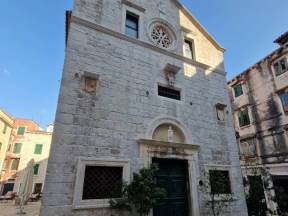
New Church (St. Mary's)
In front of you is the New Church, also known as the Church of St. Mary, which was created as an integral part of the Benedictine monastery located next to the Cathedral of St. James. Construction began in the early 17th century, at a time when the monastery was already a functional and influential institution in the city. The Benedictine nuns had the right to their own liturgical space, and this church served exactly that purpose – as a closed monastery chapel without access to the public.
Monastery churches were built for indoor use. The interior was adapted to the rules of the order – with a lattice partition that separated the nuns from the altar and the priest, without the possibility of direct contact. The priest entered from the outside, said mass and left. The nuns remained invisible. In architectural terms, it is a simple, properly proportioned space without major decorative elements. Function was more important than impression.
At that time, the Benedictine order already had established standards for such spaces – modest, closed, strict. The role of the church was clear: a daily rhythm of prayer and worship for the members of the monastery.
The nuns mostly came from local noble families, and the monastery was one of the places where women could stay outside the marriage system, but still within the control of social structures. Joining the order was not always the result of a spiritual calling – sometimes it was a solution for a surplus of daughters in a family without a sufficient dowry.
During World War II, the church suffered damage in the Allied bombing in 1943. After the war, the order was never rebuilt, the monastery was abolished, and the church space was left without its original function.
Today, the church is used occasionally for exhibitions and cultural events, without a permanent sacral purpose. The new church is not a prominent building in the city skyline, but as part of the former monastery complex, it testifies to the closed systems of spiritual and social life of women in early Šibenik.
Church of the Holy Spirit
The church you are standing in front of may look modest, but it hides more stories than you might think at first glance. It was built in the early 17th century and was led by the famous master Ivan Skoko. This church shows how Šibenik was moving from the Renaissance to the early Baroque period. However, the real surprises were only discovered during the renovation in the 1990s: a Romanesque portal and a semicircular sanctuary from the 13th century were discovered. This means that this place was holy long before the current church was built, and the previous building disappeared in a great fire in 1458.
Although not as luxurious as other Šibenik churches, St. Spirit had a special role in the life of the city. The brotherhood of the same name, one of the four most important in Šibenik, is responsible for this. The brotherhood operated from a house that was connected to the church on the first floor by a bridge – a rather unusual solution that would attract the attention of every passerby today. Its members cared for the poor and the sick, and they gathered mostly ordinary citizens, which is why they were under the watchful eye of the Venetian authorities. The brotherhood claims to have existed since 1022, but there is no solid archaeological evidence for this.
What makes this church even more interesting is the fact that it was the first new parish church built after the famous Cathedral of St. James. This marked a new direction in Šibenik's urban planning. It survived numerous earthquakes and wartime destruction, and today it is not only a place of prayer - concerts are also held here, which gives it a completely new role in the city's life.
You may not have known: the brotherhood's archives hold some of the oldest lists of poor citizens of Šibenik, which is a real treasure for historians and researchers of the city's past.
Church of Our Lady Outside the City
You are standing in front of the Church of Our Lady Outside the City, a church that has almost disappeared into the hustle and bustle of the city today, but in the 17th century it was a lonely building on the outskirts of what was then Šibenik. Its name is no metaphor – it is a literal reference to the time when there was a field here, and the church served as the first sign of a settlement outside the city walls. Construction began in 1604 at the instigation of the Jesuits, but the key role was played by Nikola Tomasseo, grandfather of the famous philologist Nikola Tommaseo, who used his money and influence to secure the land and construction.
The original church was simple, with a wooden roof, but it immediately became a gathering place – not only for masses, but also for public reconciliations between feuding families, which was extremely important for peace in the small community at that time. The role of the church was both a social and spatial buffer zone between the city elite and the newly arrived villagers.
After the Jesuits were expelled at the end of the 17th century, the church was taken over by diocesan priests, who then added a bell tower, installed a stone ceiling, and brought in new altar equipment. Among the donors is Petar Šižgorić, a fishmonger, who left in his will that a mass for the repose of his soul be celebrated every year “as long as the stone stands”.
The church was badly damaged in the Allied bombing in 1943, but was restored and is now back in use. Interestingly, many passers-by have no idea about the turbulent past of this place, nor that public reconciliation and forgiveness were once held here.
In front of the Church of Our Lady Outside the City in Šibenik, there is a park with a fountain in which fish and turtles live. The fountain contains a natural tufa rock that has gradually grown larger. In the water are red-eared and yellow-eared turtles, as well as freshwater fish, some of which were once pets.
Another interesting fact: the parish of Our Lady Outside the City dates back to 1298, when the Šibenik diocese was founded, and for centuries the area has been a gathering place for believers from the surrounding villages and fields. Throughout history, the church has been a center for public sermons, but also the place where the Franciscans from Visovac brought the venerated image of the Mother of God, which is still in the church today. Recently, the church has also attracted attention with its unusual nativity scene, which has caused controversy in the city – it was divided into two sides, with atypical figures and the inscription "You choose".
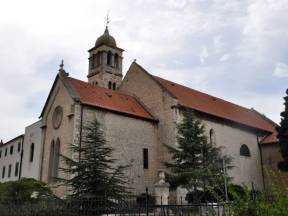
Church and Monastery of St. Francis
In front of you is the church and monastery of St. Francis. The complex is named after the Franciscans who arrived in Šibenik in the 13th century, and the current building was built in the 14th century, with several additions and alterations over the centuries. But more important than the construction phases is the role the monastery played in the history of the city – and not only in a religious context.
The Monastery of St. Francis was one of the key places for the preservation of literacy and education in Šibenik. For centuries, manuscripts were copied, chronicles were kept and documents were kept in its premises. It was here that the oldest preserved document written in the Croatian language in Latin was found – the Šibenik Prayer from the 14th century. It is a short religious text, but its value lies in the language: it was written in the everyday Šibenik speech of that time, and not in Latin, which was the norm for official and church documents.
The monastery library was of a closed type, accessible only to clerics and educated members of the local elite. In the 18th century, it contained more than 300 manuscripts, including theological treatises, but also works on logic, astronomy and medicine. Part of this collection is now kept in the National and University Library in Zagreb, while part remained in the monastery.
The Franciscans who worked in Šibenik often found themselves caught between church obedience and local political interests. One of the most famous was Friar Lovro Bilić, who in the second half of the 18th century engaged in polemics with the Venetian authorities over attempts to tax the monastery. In a letter to the governor of Zadar from 1769, he stated that “everything we have serves for doctrine and prayer – and nothing for trade”. The dispute ended without formal taxation, but the monastery’s relationship with the authorities remained tense. During the French and later Austrian rule, the monastery was not abolished, but it was under strict supervision.
It suffered minor damage during World War II, and after the war it continued to operate as a church institution. Today it is active and open to visitors, and in addition to its religious contents, it also offers access to part of the library.
One of the more interesting stories related to the Monastery of St. Francis relates to an event from the 16th century, when the monastery was also the center of intellectual life in Šibenik. Namely, at that time, Franjo Ivić, one of the most important theologians and philosophers of that time, who influenced the religious and cultural development of the city, also stayed there. In his writings, Ivić discussed the doctrine of the Immaculate Conception, which caused great controversy among the local population and church authorities. Interestingly, because of his works, which were controversial at the time, the monastery became a place of important theological discussions and conflicts.
The Church and Monastery of St. Francis are not a symbol of monumentality – but of permanence. Without great decorations, but with continuity of roles: spiritual, educational and archival.
The building you see today stands in the same place and has served the same purpose for more than 600 years – with the same stone threshold at the entrance.
Monument to King Petar Krešimir IV.
In front of you is a monument to King Petar Krešimir IV, erected in 1995 on the Šibenik waterfront, not far from Poljana. The author of the statue is the sculptor Kruno Bošnjak, and the bronze figure depicts the king in an upright position, with a sword in his hand and a gaze directed towards the sea. Although it is a modern monument, it is directly associated with a person who played a key role in Croatian medieval history and a strong connection with the very identity of Šibenik.
Petar Krešimir IV ruled Croatia from 1058 to 1074 and is considered one of the most important Croatian rulers. During his reign, royal authority was strengthened, state territories were expanded and strong relations with the church were established. The most important document for Šibenik is from 1066, in which the king first mentions Šibenik in writing. Although it does not explicitly declare it a city, the document lists Šibenik as the place of residence of the king, which gives it strong legal and symbolic significance. This is a charter by which the king donated land to the Benedictine monastery of St. Mary in Zadar, and it is this document that goes down in history as the first written trace of Šibenik. For this reason, Šibenik is called “Krešimir’s city” for a reason.
The monument was erected on the occasion of the 900th anniversary of the first mention of Šibenik. Although the anniversary was officially marked in 1966, the idea of erecting a permanent monument was renewed after Croatia gained independence. The location of the monument is not accidental – it is located exactly between the historic core and the sea, on a symbolic line that connects the city’s past, its space and its belonging to the Mediterranean world.
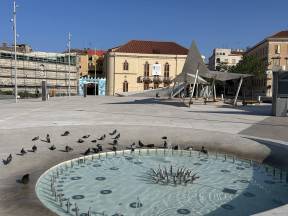
Meadow
Poljana in Šibenik served as the political, social and cultural centre of the city for many years. The current shape of the square was created in the 19th century by the development of the area on the eastern side, when old houses and fortifications were removed to open up the city and create a public space. The name Poljana comes from the designation for a flat, open area, which marked the end of the very compact medieval city structure. On the south side of the square is the National Theatre, opened in 1870, one of the oldest theatre buildings in Croatia. Nearby are the buildings of the former City Hall, as well as several palaces from the 19th and early 20th centuries.
Remains of a Roman aqueduct, late antique walls and early medieval layers have been discovered under the square, which confirms the long continuous settlement of the area. Today, Poljana is modernly arranged as a pedestrian zone, and there is an underground garage underneath. There are glass panels on the surface of the square that provide a view of the archaeological finds underground.
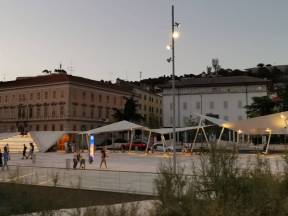
Poljana is not only a historical site; Various events, fairs and concerts are held here throughout the year. In winter, an ice rink is often set up and brings the square to life in the colder months.
During the warmer seasons, Poljana becomes a place for open cultural programs and children's workshops.
City Library "Juraj Šižgorić"
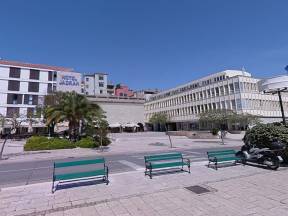
In front of you is the Juraj Šižgorić City Library, a modern institution housed in a former department store from the 1970s, whose appearance is a symbol of socialist urbanism – functional, concrete, with large glass panels. However, the name of the library takes us far back in time, to the 15th century, to the time of one of the most important humanists from Šibenik – Juraj Šižgorić.
Juraj Šižgorić was a poet, lawyer and church official who, as one of the first Croatian authors, systematically wrote in Latin in the spirit of the Renaissance. His works, including the first printed book by a Croatian author in Latin, reflect the intellectual and cultural flourishing of Šibenik during that turbulent time. Šižgorić was also a lawyer and a doctor of canon law, and as a priest he played a significant role in the church and social events of the city, connected with the local nobility and church authorities.
The library opened in 2005, when the city's book collection finally found its centralized home, with reading rooms, a children's section, and multimedia spaces. It houses rich collections of local authors, archive copies of newspapers covering almost the entire 20th century, and rare publications related to the history of Šibenik and the surrounding area. But what makes the library special is the informal collection of personal records of Šibenik residents – diaries, notes, amateur poems, and memoirs – that the staff began to collect in order to preserve fragments of private history that would otherwise not end up in official archives.
Although the library building does not impress with its monumentality, its role is unquestionable – it is a place where the knowledge, history, and memories of Šibenik are preserved, a space where the past and the present intertwine through words and documents.
Medieval Mediterranean garden
You are currently in front of the Medieval Mediterranean Garden. It is the first garden of its kind in a modern context, reconstructed according to medieval principles and in accordance with the authentic plant species that were grown at that time.
It is located within the Monastery of St. Lawrence, in a quiet part of the old town center, off the main roads and streets on the site of the former monastery garden that was closed to the public for centuries. The garden was opened in 2007, and the project was designed and led by architect Dragutin Kiš, in collaboration with numerous experts in the fields of history, botany and conservation. It is based on models from the late Middle Ages, when gardens alongside monasteries also served as spaces for useful cultivation – medicinal herbs, spices, food crops and ornamental plants.
In spatial terms, the garden is organized according to the principles of symmetry, with four rectangular flower beds that intersect in the central axis. This cruciform layout is characteristic of monastic gardens of the period, with the center often containing a well or other symbolic element – in this case a stone well. The paths are simply paved, and the plants are arranged according to function: medicinal plants, aromatic herbs and symbolic species that also had spiritual meaning.
The garden includes species such as lavender, sage, rosemary, wormwood, myrtle and mint, but also roses, grapevines and figs, which were an integral part of the daily life of the monastic community. Although it is a reconstruction, the selection of plants was carefully guided by historical documents, monastic records and old herbariums.
The garden is open to the public and also acts as an educational space with the aim of bringing medieval culture closer to everyday life through a concrete, tangible and visually clear presentation.
In addition to its historical and educational function, the garden is also an example of the successful revitalization of a neglected urban area within a protected cultural entity.
Šibenik waterfront
You are on the Šibenik waterfront, which was not created for walking, but for docking. It was the functional edge of the city – a place for unloading, loading, anchoring and control.
The first versions of the waterfront were wooden, low and prone to damage. The stone we see today only began to be installed in the 19th century, during the Austrian administration, when an urban plan for the expansion of the coastal part of the city was adopted. The waterfront is not just a promenade – it was a place of daily city traffic for an entire century. Fish was sold here directly from the docks, mail steamers from Split and Zadar arrived here, and until the 1960s, ships with goods for the market also docked here.
The daily rhythm of the waterfront did not depend on the season, but on the tide and the schedule of arrivals. There were three precisely defined docking places: one for mail ships, one for goods, and one “free” one – which was used by those without a permit, usually early in the morning.
City police officers regularly recorded the registrations of these boats and reported them, but actual fines were rare. It was a space in which a certain degree of improvisation was tolerated – as long as traffic flowed.
The waterfront was also a departure point. During the 20th century, especially between the two world wars, families gathered here to see off their members to America or Australia. Many of the last family photos from that period were taken on this stone plateau, with suitcases and neutral looks towards the lens.
Today, the waterfront no longer has such a function. Traffic has moved to other points, and ships for more distant destinations no longer dock here. But the basic structure of the space has remained the same. It is still a long, open line of contact between the city and the sea. With a changed function, but with the same flow of people – only now without suitcases, without nets and without goods.
City gate
You are standing in front of the former main entrance to Šibenik – the land city gate, located under the fortress of St. Michael. In the Middle Ages, this was the only entrance to the city from the mainland, strictly guarded and strongly fortified. The gate allowed entry to travelers, merchants and the army, but at the same time represented the first line of defense. Located at a strategic point where the terrain naturally narrows, it allowed for effective access control.
The first gate was built in the 13th century, when Šibenik gained the status of an independent commune. At that time, the city was gradually enclosed by walls that followed the topography of the terrain, and the main land entrance was formed at the most naturally suitable place for defense. In the following centuries, especially from the 15th century onwards, the gate was expanded and further strengthened, in line with changes in warfare and the appearance of firearms. The gate had a vestibule, a defensive bridge, a movable mechanism for raising and lowering, and side towers that allowed for flanking fire. It was guarded from above by the fortress of St. Michael, creating a defensive unit that allowed for the rapid diversion of troops and equipment in the event of an attack. Closing the gate was part of everyday security practice – the entrance was locked every night, and the key was kept by the city guard.
In more peaceful times, the gate also served as a point for controlling goods and collecting customs duties, which was an important part of the city's economy. Above the passage itself was a relief with a Venetian lion, a symbol of the government at the time, which also had the function of intimidation and legitimizing control.
Over time, as the city expanded beyond the original walls and methods of warfare changed, the gate lost its military function. Its role gradually weakened, and the building materials from the surrounding defensive structures were used for other purposes.
Today, only parts of the passage and fragments of the structure have been preserved, but their position and remains clearly testify to the former importance of this point in the city's defensive image.
St. Anthony's Canal
The St. Anthony Channel is located right next to Šibenik, but it was not created by any planning – it is simply a natural sea passage that has been crucial for the city for centuries. This channel connects the Šibenik Bay with the open sea and was once the only way for ships to reach the port and the city. Because of this, it was constantly monitored by the military and civil authorities. The first serious control was introduced in the 15th century, when the Venetians realized that open access to Šibenik by sea was a security problem. Before that, the channel was just a narrow sea route surrounded by rocks, without any fortifications or buildings.
Everything changed when the Fortress of St. Nicholas was built. From then on, no larger ship could pass through the channel without being under the control of the cannons from the fortress. However, the channel was not only used by the military. Fishing boats, merchant ships, and boats with wood and agricultural products passed through it every day. In the 17th century, there are records of merchants trying to avoid control and not pay taxes. An interesting case from 1679 tells of brothers from Zlarin who tried to pass through the canal at night without a permit and were caught for smuggling wine. This ended with a trial and reinforcement of the guard in the fortress.
The canal has also been important in recent history, especially during the Homeland War, when access from the sea was under special surveillance. Although it was never closed by physical barriers, it was always under control. Šibenik knew that whoever holds the canal holds the city.
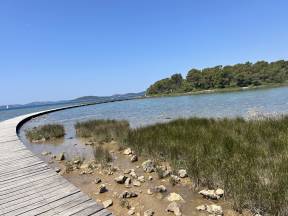
Today, the St. Anthony Canal is much more than a historical corridor. Along the promenade that runs through the canal, the shore has also been landscaped, and the place has become popular for walking, cycling and enjoying the view of the city and the UNESCO-protected St. Nicholas Fortress. The promenade is about 4.4 kilometers long and from several places offers fantastic views of Šibenik and the archipelago.
Fortress of St. Michael
In the very heart of Šibenik, on a hill above the harbor, you stand at the fortress of St. Michael – the place where the city was actually founded. It is not just a symbolic beginning, but literally the first organized settlement back in the 11th century. The fortress did not just stand there as a decoration, but also had an important role: it controlled the entrance to the canal and served as a safe shelter in case of attack. Interestingly, the city grew around the fortress, and not the other way around, which is a rarity in the history of cities.
The name of the fortress comes from the church of St. Michael, which once stood within its walls. This church was not only a place of prayer – it also served as a weapons warehouse. One of the most unusual events recorded in the history of the fortress occurred in the 15th century, when the church exploded. However, it was not an enemy attack, but a lightning strike! At that time, gunpowder warehouses and the church shared the same space, which showed how dangerous this combination could be.
Although the fortress was not the scene of major battles, its role was crucial in prevention. It sent signals about the arrival of ships, warned of fires, and monitored the surrounding villages. It also occasionally served as a prison for those who disturbed order but were not serious criminals. There is a record from 1647 about a prisoner who allegedly carved verses on rocks in his cell. To this day, it is not clear whether he actually did it or whether someone later left these inscriptions in his name. Some of these carved signs can still be seen in the western part of the fortress, but they are not officially documented.
The fortress was strengthened several times over the centuries, but it never acquired the luxurious appearance of Venetian fortresses in other cities. It was simple, functional, and adapted to local needs. The defense system was directed towards the hinterland and the sea, but there was no space for a larger military garrison, which is why the fortress did not play a key role in major wars.
Today, the fortress of St. Michael's Church has changed completely – it has become a concert stage and cultural space. Although its function has changed, the basic layout has remained the same. The walls that once served as a defense are now a place from which the audience can enjoy music and events.
Barone Fortress (Šubićevac)
In front of you is the Barone Fortress, located 90 meters above the sea, on a hill that was once called Vidakuša. It was built in 1646, in just 58 days, while the people of Šibenik worked side by side with the soldiers for days under the threat of the Ottoman army. They did not know if they would survive, but they knew that without this fortress the city had no chance. Barone was not the largest, but it was crucial: from it you could see every approach to the city, every movement of the enemy, and its position meant that it could warn of any attack in good time.
The largest attack on Šibenik took place shortly after its construction – 25 to 30 thousand Ottoman soldiers arrived at the city, but thanks to Barone and the unity of the inhabitants, the city was defended. The fortress was later expanded and strengthened, and the governor Antonio Bernardo was responsible for this – then half-bastions and a new entrance were added, and the interior was additionally fortified with earthen embankments to withstand cannon shots.
Barone was not only used for defense – it was also a military magazine, a gunpowder warehouse, and accommodation for soldiers and commanders. Interestingly, lead gunpowder from various periods has been found on the fortress, which shows how long it was in military use. The name Barone was given to the fortress after Baron Christoph Martin von Degenfeld, the commander of Šibenik's defense, while the other Šibenik fortresses are named after the churches near which they were built.
During the Napoleonic Wars, in 1806, Barone remained intact while other fortresses were damaged or destroyed – which speaks of its durability and strategic importance. After losing its military function, the fortress fell into oblivion for a while, but it did not disappear from the city's history.
It was restored in 2014 and today it is an innovative, interactive museum with augmented reality technology: visitors can experience the sights and sounds of the past with the help of AR devices, as if they were in the middle of the battle for Šibenik. Today, Barone is a place for meetings, concerts, exhibitions and cultural events, and it offers one of the most beautiful views of Šibenik and the archipelago.
St. John's Fortress
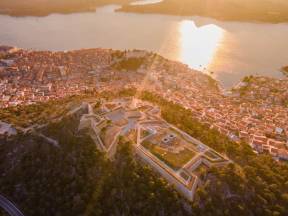
You are standing in front of the fortress of St. John, also known as Tanaja. It was built in extraordinary circumstances and under pressure rarely seen in construction projects of that time. The year is 1646. Šibenik is under threat from the Ottoman army, and a clear message comes from Venice – the city must ensure its own defense.
The decision to build a new fortress was made quickly, and the execution was even faster: it took the people of Šibenik only 58 days to build a line on the hill above the city that would cut off the path of anyone who would try to attack from the land. The key man behind the organization was Antonio Leni, a military engineer in the service of the Venetian Republic. His design was simple but effective: a star-shaped fortress, with ditches and bastions, placed exactly at the point from which any movement towards the city could be controlled. But the construction itself was not a technical story – it was political and social. People from all over the Šibenik area, including women and children, worked side by side. The city magistrate notes that even some commercial ventures were temporarily halted due to the works, because every pair of hands was needed up on the hill.
The fortress was named after the church of St. John, which was located nearby, but from the very beginning the building itself had a function much broader than spiritual. The very next year, 1647, the Ottomans arrived and came across this newly built defensive line. The siege was strong, but unsuccessful. Šibenik remained unconquered, and Tanaja entered its first role in the military history of the city.
After the danger from the Ottomans passed, the fortress was in semi-active function for years. Occasionally soldiers stayed in it, occasionally it served as an observation post, but most often it simply stood there – monumental and empty.
In the 19th century, under the Austrians, there were plans to demolish it because it no longer had strategic value. Fortunately, this was abandoned due to costs. During World War II, the German army temporarily used it as an observation post. At the end of the century, the fortress was abandoned and abandoned to nature, but local enthusiasts and historians did not let its story end in weeds.
Today, restored, but without losing the rawness with which it was originally designed, Tanaja is not only a place with a view, but also a concrete monument to a very tense moment in Šibenik's history - the moment when the entire city said "we will do it ourselves" and literally walled off its freedom in 58 days.
St. Nicholas Fortress
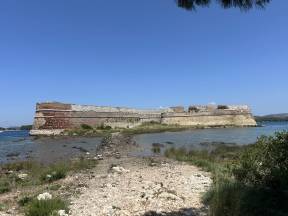
You are currently standing in front of the Fortress of St. Nicholas. When the Ottomans burned down the Šibenik Monastery of St. Nicholas on the islet of Ljuljevac in 1537, the local authorities and the Venetian command realized that the defense system had to be transferred from the land to the sea. At that moment, the construction of the Fortress of St. Nicholas began – not because someone wanted to show off Venice’s power, but because the city was really under threat.
The project was taken over by the Venetian military engineer Michele Sanmicheli, who chose the narrow sea passage at the entrance to the St. Anthony Channel as the location. The intention was clear: to control any ship that tried to enter the Šibenik harbor. The fortress was built exclusively for artillery – everything in it was subordinated to defense from the sea. There are no classic towers, no lofty bastions for infantry – just a low, solid rampart with cannon positions facing due south. Already in its first year of use, the fortress fulfilled its purpose. In 1540, a group of armed ships attempted to sneak into the bay unnoticed, but were stopped by gunfire from the fortress. There is no record of any major damage, but there is a note that a gunner from Šibenik was killed on that occasion – the first known soldier to die there in the service of the city.
Unlike other Šibenik fortresses that have changed hands throughout history, the fortress of St. Nicholas never fell in battle. It changed hands – from the Venetians, to the French and Austrians, to Yugoslavia – but its military function remained almost uninterrupted until the mid-20th century. At one point, it was even a closed military facility that could not be approached without special permission.
There are testimonies from local fishermen from the 1960s who knew that if they accidentally rowed too close, they could be greeted with a warning or have their nets confiscated. Despite centuries of use, the fortress was never converted into residential space or the seat of government. There was no need, because it was never a symbol — it was a tool.
Today it is most often mentioned as a UNESCO heritage site, but what gives it weight is not its international status, but the fact that it has actually guarded the city for generations.
Pavle Subic Square
You are in a place where city life is bustling today, but the name of the square takes us back to the Middle Ages, a time when the power of the Croatian noble family Šubić from Bribir shaped the fate of Dalmatia. Pavao Šubić, after whom the square is named, was a powerful ruler in the late 13th and early 14th centuries, almost as an independent prince who ruled over a large part of the region while the Hungarian-Croatian crown had only formal authority. His support for the Catholic Church helped Šibenik gain a bishopric in 1298, which brought the city additional political importance.
Although Šibenik was not directly ruled by the Šubićs like Bribir or Skradin, their influence was strong. The Šubićs issued charters and appointed church officials, and Pavao Šubić, for example, granted Skradin the status of a free city, which was reenacted in medieval costumes in Skradin as part of the celebration of the 700th anniversary of his death.
The square you are in today was not always the city center. In the 19th century, there were stables, houses and workshops here, and only in the mid-20th century was the area urbanized and adapted to traffic. The square got its name in the 1990s, at a time when historical names and identities were being restored after political changes.
Although there is no monument to Pavle Šubić on the square, its name reminds us of the time when great men like him shaped the history of Dalmatia. Šibenik has been the scene of numerous important events over the centuries, from Venetian rule and defense against the Ottomans, to economic and cultural flourishing under the influence of great men like Pavle Šubić and later city leaders.
Interestingly, Šibenik was one of the first cities in the world with public lighting powered by alternating current thanks to the hydroelectric power plant on the Krka River, built in the late 19th century, which shows how the city has historically combined medieval tradition and modern development.
Pavle Šubić Square is today a place where everyday city life meets deep history, and the name of this great man remains a symbol of the power and influence that shaped not only Šibenik but also the entire history of Dalmatia.