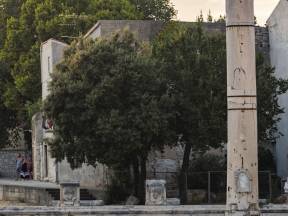
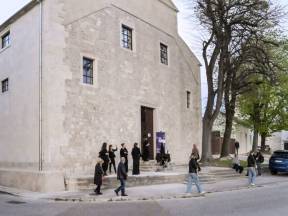
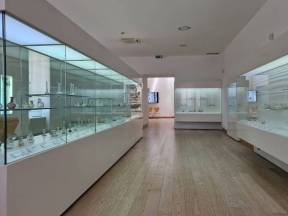
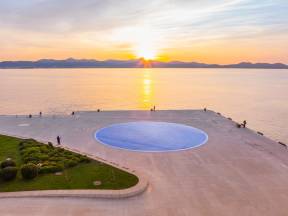
Welcome to Zadar – a city where millennia of history meets innovative art and Mediterranean spirit! Zadar enchants visitors with its Roman forum, medieval churches and unique installations such as the Sea Organ and the Greeting to the Sun. Here you can enjoy spectacular sunsets celebrated by Alfred Hitchcock himself, sample superb Dalmatian cuisine and explore numerous islands and national parks nearby.
Audio guides available in:
Deutsch , Français, 日本語, Italiano, 한글 , 中文, Español, Hungarian, Arabic, Polski, Nederlands, русский, Українськa, Svenska, Dansk, Português, Czech, Suomalainen, English (American), Slovenian, Slovakian, Hrvatski, English (British)
To find more content and listen to free audio guides, download the Guide To Go app.
Zadar
Points of interest
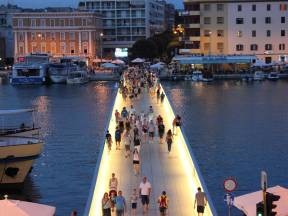
Mainland-peninsula bridge
The bridge you are currently walking on connects the Zadar peninsula with the mainland and has a story full of twists and turns and interesting moments. The first permanent bridge was built in 1928 during the Italian rule, with the aim of connecting the city and facilitating the planned tram line to the suburban settlements. It was wide, decorated with luxurious lighting and an iron fence, and also had a modern opening mechanism so that ships could sail into Jazine. The bridge became the center of a new, representative street that led from the People's Square, and the surrounding architecture and city gates were adapted to its axis.
During World War II, in 1944, the bridge was destroyed by an airplane bomb. The people of Zadar then received a temporary solution – a wooden pontoon bridge on iron barrels, opened in 1949. This "barrel bridge" was a challenge to cross in the bora and waves, but the citizens quickly fell in love with it. Thousands of people crossed the bridge every day, and in ten years it is estimated that it was crossed tens of millions of times. Maintenance was simple – replacing planks and barrels, and the bridge was periodically renovated and paved to make it safer.
Today's City Bridge was built according to a design by Vojislav Draganić and was officially opened on May 12, 1962. When it was opened, the bridge was only raised for the passage of ships, although that was its intended function. The new bridge is wide, sturdy and intended primarily for pedestrians, and it quickly became one of the most recognizable symbols of Zadar.
Land gate
Welcome to the Land Gate, one of the most impressive testimonies of Venetian Renaissance architecture in Croatia. This gate, also known as Porta terraferma, was built in 1543 according to the design of the Italian architect Michele Sanmicheli, and is located in the southern part of the old town, along the shore of Foša, the former city port. Originally the main entrance to the city, it now serves as a bridge between history and the everyday life of Zadar.
The Venetian authorities in Dalmatia were faced with the threat of Ottoman attacks, so they decided to strengthen the defense system of Zadar. In addition to building new bastions and ramparts, Sanmicheli also designed the Land Gate as a triumphal entrance to the city. The gate was located next to the existing bridge over Foša, which allowed for better access control and increased the security of the city. It consists of a large triumphal arch in the middle, intended for vehicles, and two smaller arches on the sides for pedestrians. The facade features statues of St. Chrysogonus, the patron saint of Zadar, and the lion of St. Mark, the symbol of the Venetian Republic. Interestingly, the lion is holding an open book, indicating that the gate was built in times of peace.
The Land Gate is not only an architectural monument, but also a cultural heritage. In 2017, it was included in the UNESCO World Heritage List as part of the defense systems of the Republic of Venice in the period from the 15th to the 17th centuries.
City walls
You are near a Renaissance fortification in the eastern Adriatic. For centuries, these walls served exclusively defensive purposes. Throughout history, their appearance has changed, been extended, and adapted, but their basic purpose has remained the same – protecting the city from external threats.
Although the city had walls as early as ancient times and the Middle Ages, the ones we know today are largely the result of Venetian construction from the 16th century. During this period, under the threat of Ottoman conquest, the Venetian Republic invested significant resources in the defense of its Dalmatian possessions, and Zadar, as the capital of Dalmatia, became the center of these works. The Venetians wanted to make the city an impregnable fortress, and the ramparts they built served precisely that purpose. They were designed according to the most advanced principles of military architecture of the time, especially adapted to defense against artillery fire, which was a key difference compared to the older medieval walls.
Over time, as the threat of Ottoman attacks diminished and military technology advanced, the defensive function of the ramparts began to lose its importance. During the 19th century, under Austrian rule, part of the walls was demolished to allow for urban development of the city. Despite this, a large part of the Venetian fortification system remained intact, especially in the southeastern part of the peninsula.
In the 20th century, especially after the destruction during World War II, the perception of the ramparts began to change - from being an outdated military structure, they became recognized as an important part of cultural and historical heritage. Through numerous renovation and revitalization projects, the city of Zadar has made efforts to restore the preserved parts and make them accessible to the public.
Today, visitors can walk along the renovated promenade that runs along the ramparts, enjoy the view of the harbor and the interior of the old city center. In 2017, the Zadar ramparts became part of the UNESCO World Heritage Site, as part of the transnational inscription "Venetian Defensive Fortifications between the 16th and 17th Centuries".
Queen Jelena Madijevka's Park
You are in a park opened on September 16, 1829, which is the first public park in Dalmatia and a true gem of Zadar's history. Its construction was initiated by Baron Franz Ludwig von Welden, the Austrian military governor of Zadar, who also had a passion for botanical gardens. In this area, which had previously been neglected, Welden wanted to create a space for relaxation and walks, but also a place where cultural activities and social life would develop.
The park was designed in the spirit of romanticism, with elements of different styles and cultures. Within the park there were buildings such as a Moorish cafe, a Chinese pagoda, a Greek temple, an exedra, an artificial grotto, an obelisk and other objects that contributed to the atmosphere and made the park very specific for that time. These architectural details were later destroyed, but the park still remained a place for walks and gatherings.
Although the park underwent various changes during the 19th and 20th centuries, especially after World War II when many buildings were destroyed, in recent decades, extensive renovation and revitalization works have been undertaken. It has only recently reopened to visitors. Although it has lost some of its original buildings, it still retains its role as the green heart of the city.
Today, the Queen Jelena Madijevka Park has around 282 plant species, including many Mediterranean plants, and many of them have plaques with Latin, Croatian and English names, making it a botanical garden as well.
Five Wells Square
You are in the Five Wells Square, which may at first glance look like an ordinary square with a few old stone wells, but the story is more interesting. The square was built in the 16th century, at a time when the city was under constant threat from Ottoman attacks. The Venetian government decided to use this place as a storage place for drinking water.
In addition to the wells themselves, a huge underground cistern was built, and water was brought to it from Lake Vrana via an aqueduct - it is important to note that parts of this aqueduct have been preserved to this day, and are visible around the square. Five decorated wells were built on the surface, after which the square got its name. Although the square is called "five wells", four wells have been preserved today. The fifth well disappeared during later interventions. During the siege, when the city's water supplies were crucial for survival, thanks to this cistern, the people of Zadar were able to withstand even the longest attacks without fear of thirst.
Today, Five Wells Square is a space for meetings and culture. It often hosts art events, such as the traditional gathering of members of the Croatian Art Society Zadar called "Painters on the Square", where artists paint outdoors during the summer, inspired by history and the surroundings, and exhibit their works of art. In winter, this square is one of the centers of Zadar's Advent - with houses, lights, and music.
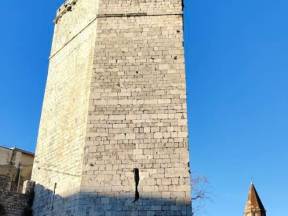
Captain's Tower
You are standing next to the Captain's Tower, the only surviving tower of the former medieval defense system. This massive, square tower was built in the 13th century, at a time when the city was under Venetian rule and when defense against attacks from land and sea was crucial for survival. The tower served as the main guard and defense post that controlled the southeastern approach to the city, but also as a place from which traffic could be monitored from the direction of the current land entrance. The tower's walls are more than two meters thick, and its height of 26 meters made it an ideal observation post.
In the 15th and 16th centuries, when the threat of the Ottoman Empire became omnipresent, the city walls and defense system around the tower were further strengthened. At that stage, the Captain's Tower was integrated into a new fortification complex, and a deep ditch was dug in front of it – exactly on the site of today's Five Wells Square – to further protect access to the walls.
Although the tower is called "Captain's Tower", this name was not used immediately. At first, it was simply known as "the tower". The name "Captain's Tower" refers to the fact that the tower was located in the immediate vicinity of the captain's building, and the captain was the military commander of the city.
The interior of the tower housed various military and administrative rooms in later centuries, and also served as a warehouse. During the Austrian administration, in the 19th century, it underwent minor conversion, but remained in function as part of the military infrastructure of the time.
After World War II, the tower lost its military function, and it is interesting that it was also used as a prison in the past, although this function was not primary. Today, the Captain's Tower is a protected cultural property, and is occasionally used for exhibitions and cultural events.
Petar Zoranić Square
Petar Zoranić Square is located in the old town centre, surrounded by important historical buildings such as the Governor's Palace and numerous Renaissance fortifications. It is named after Petar Zoranić, a 16th-century Croatian poet best known for his work "The Mountains", and this square is a tribute to his cultural and literary heritage. Petar Zoranić is one of the most important Croatian Renaissance writers, and his most famous work, "The Mountains", is considered the first Croatian novel. Through this book, Zoranić combined poetry, philosophy and social commentary, creating an allegorical depiction of Croatian society. Zoranić linked his life and literary work to Zadar, where he often stayed and received his education.
Throughout the Middle Ages, the square had a more modest form, while during Venetian rule in the 16th century, significant changes were made, and it began to take on the form of a public space as we know it today.
The renovation of the square began in 2013, with the aim of revitalizing a public space that connects the city's history with its contemporary function. The renovation project included paving the square, planting new green areas, and integrating archaeological sites that were discovered during the works. One of the most important archaeological finds was a stone sarcophagus containing the bones of a local monk, dated between 750 and 850 AD, which is now displayed in the square's glass case, allowing visitors to see the history of Zadar firsthand.
Today, this place is a popular gathering place and the center of social activities in Zadar. Surrounded by cafes and restaurants, the square has become a place where cultural events, concerts, and other public performances are often held.
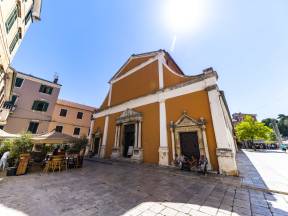
Church of St. Simeon
The Church of St. Simeon in Zadar did not always bear this name – it was originally dedicated to St. Stephen and is one of the oldest churches in Dalmatia, with roots dating back to the 5th century. This means that the area where the Church of St. Simeon stands today has been a sanctuary for more than a thousand and a half years. The church has changed its appearance several times throughout its history: from an early Christian basilica, through a Gothic building, to its current Baroque appearance, which it acquired after major renovations in the 18th century.
One of the most important moments in the history of the church occurred in the 13th century, when the relics of St. Simeon arrived in Zadar in a very unusual way. According to legend, a Venetian crusader, returning from the Holy Land, landed in Zadar due to a storm, hiding that he was carrying the body of St. Simeon with him. When he fell ill, the secret was revealed, and the relics remained in Zadar. This story has a sequel: during World War II, the Italians allegedly tried to transport the relics to Italy, but the boat could not leave the harbor, which the people of Zadar experienced as a miracle.
The greatest treasure of the church is the Ark of St. Simon, a masterpiece of medieval goldsmithing from 1380, made of silver and gilded, weighing as much as 355 kilograms. The Ark was made by a team led by the goldsmith master Francis of Milan, and was commissioned by Queen Elizabeth Kotromanić, wife of the Hungarian-Croatian king Louis of Anjou. The Ark depicts scenes from the daily life of Zadar at that time, as well as numerous miracles of St. Simon, which makes it not only a religious, but also a historical document.
Another interesting fact: the two bronze angels holding the Ark were cast from bronze from captured Turkish cannons, symbolizing the victory of Christianity over Islam at that time. Every year on October 8th, the church holds a grand celebration in honor of St. Simon, and the relics are exhibited to the faithful and visitors.
If you pass by the church, pay attention to the bell tower built in 1707 - on its top there is a statue of St. Simon, and the bell rings every day at noon to remind us of the city's patron saint. South of the church stands an 18th-century Roman column, made up of the remains of an ancient city temple, which further confirms how connected this place is to different periods of history.
People's Square
People's Square was the main city center even in Roman times, and all important roads led right here. Although today you won't find stone remains of the Roman forum at every turn, it's enough to know that you're walking on the same foundations that the ancient Romans walked on.
It only got its name People's Square in the 19th century, when it became the main place of city administration and politics. However, even in the Middle Ages, it was the heart of city life - it was here that people traded, discussed, and gathered. Interestingly, public announcements of important news were also held on this square, so citizens were the first to find out what was happening in the city and its surroundings.
The square underwent a special transformation in the 16th century, during the Venetian era. The City Hall was built then, which still attracts attention with its Renaissance portal. On the north side of the square is the Church of St. Mary, and it is interesting that both buildings have survived numerous historical challenges, including devastating wars.
Today, concerts, exhibitions and various festivals are held on the People's Square, and locals will tell you that this is the best place to have a coffee and watch the city life.
And finally, a little-known fact: in 1964, the first Zadar café with a terrace opened on the square, which was a real sensation at the time!
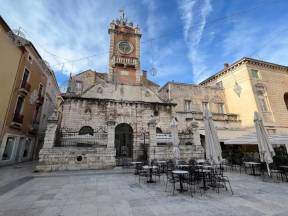
City guard
The City Guard was a place where key decisions were made, where guards monitored the city's security on a daily basis, and where the most important people in society at the time gathered. It was built in the 16th century, when Venice ruled these areas, and has been in continuous service to the city ever since.
What gives the City Guard a special significance is its bell tower. From it, you can still see the view of Trg Petra Zoranića, the Zadar harbor, and on clear days, the view reaches all the way to the islands in the Zadar archipelago. Interestingly, the bell tower once served as an observation post, so the guards could spot any ships arriving or potential danger in time.
The building was built in the Venetian style, which is best seen in its strong walls and defensive elements. It was originally a military station, and on the first floor there were rooms for guards and city officials. In the courtyard, you can still see the stone slabs that originally served as part of the defense system.
Throughout history, the City Watch has changed its purpose. During the Austro-Hungarian Empire, it was converted into city offices, and interestingly, it was also used for occasional public meetings. Today, it is a place where exhibitions, cultural events, and various manifestations are held.
You may not have known – the City Watch also housed the city clock, which was important for the daily lives of the residents. The clock was so precise that all city activities were governed by it, from the opening of the market to the closing of the city gates.
Prince's Palace
You are standing in front of the Prince's Palace, which, although first mentioned in written documents in 1288 as a "municipal palace", traces of life in this place go back much further into history. Archaeological research on the Prince's Palace has revealed the remains of Roman and late antique buildings, which means that this area was inhabited even when the Romans ruled Dalmatia.
During the Middle Ages, the palace became the heart of Zadar's administration. In the 14th and 15th centuries, city council sessions were held here - important decisions were made that shaped the life of the city. In the 16th century, the palace was converted into a courtroom, and later in the 18th century it became a theater, and in the 19th century it also served as a dance and entertainment hall. This was not a space closed to the public - people came here to listen, discuss, laugh and applaud.
The classicist architect Frane Zavoreo gave it its recognizable appearance in the 19th century. If you look at its facade, you will notice balance, elegance, symmetrical lines, and harmony. If you go inside, you will be greeted by an atrium with arcades that almost invites you to walk and look around. There is also the main Concert Hall – a space that has changed its purpose over the centuries, but has always retained the spirit of gathering and togetherness.
In the 20th century, the Rector's Palace was a Cultural Center. It housed the City Library, the Music and Ballet School, the Petar Zoranić Singing Society, and Radio Zadar. It was a place of knowledge, art, and the voice of the community. However, its course did not flow without interruption. During the Homeland War in 1991, the palace was severely damaged in shelling. It was a painful moment – not only because of the loss of the building, but also because of the attack on the symbol of the city's cultural identity.
But like the city itself, the palace survived and rose again. Renovation began in 1999, and in 2014 the palace was reopened.
Kalelarga
Kalelarga is the most famous street in Zadar and is considered the main thoroughfare within the old town. The name comes from the Latin word callis (street) and the Old Slavic larga (long), meaning "long street". This street stretches from the eastern gate towards the sea, has historically been the center of city life, and today is one of the most famous parts of Zadar.
In times past, when many streets in old Zadar were narrow and crowded, Kalelarga was relatively wider in comparison. Although it may not seem "wide" in the modern sense today, in the context of medieval and earlier times, it was wide enough to allow for easier movement of people and horse-drawn carriages. Because of this, Kalelarga was nicknamed "The Wide Street".
Kalelarga existed even in Roman times, when Zadar was an important Roman city, and the street then connected the Roman forum with the city gates. Throughout history, the street has been a center of events. Today, Kalelarga maintains its status as the center of social life in Zadar.
The street is paved with stone, with numerous buildings dating from different historical periods, from Roman to Venetian. Many of the buildings along Kalelarga are built in Romanesque, Gothic and Baroque styles.
In times past, Kalelarga was the main shopping street of Zadar. Merchants offered a variety of products, from food and spices to fabrics and art, and the street was a lively market. People of all social classes gathered here, from nobles to ordinary citizens. Today, Kalelarga is still the main traffic hub of the old town, but due to its cultural and historical values, it has also become a popular destination for tourists.
St. Michael's Church
The Church of St. Michael in Zadar was first mentioned in 1150 and has since been one of the main gathering places for believers in the city. Although it has been renovated several times over the centuries, it has preserved its distinctive Romanesque appearance and simplicity, which is a rarity among Zadar churches. Interestingly, during the last renovation, frescoes from the 15th century were discovered, which is an important discovery because it was long believed that there were not many churches in Dalmatia with preserved wall paintings from that period.
The church is dedicated to the Archangel Michael, the patron saint of the city, who is known in Christian tradition as a fighter against evil and the protector of the innocent. His figure can often be seen on the facade of the church, usually depicted with a sword and in a victorious pose. It is this symbolism that has attracted the attention of believers and passers-by throughout history.
During the Middle Ages, the Church of St. Michael was the parish church and the seat of numerous brotherhoods, such as the Brotherhood of Our Lady of the Snows. Due to its elevated position, it offered an extraordinary view of the city, and also served as an important landmark. The church houses a large painted crucifix from the 13th century, one of the most valuable works of art in Zadar, which is a model of the Croatian votive cross of Christ crucified.
Interestingly, the church was also known throughout history as the “confessional house of the city” because the Franciscan friars of the third order of Glagolitic were constantly available for confessions of believers. Today, it is the largest confessional of the Archdiocese of Zadar.
Despite numerous restorations, the church has remained an important cultural and religious point. The interior of the church displays all the historical artistic styles that have changed over the centuries – from Romanesque lines, through Gothic and Baroque windows, to the neo-Gothic details that are visible today. During the renovation, as many as 19 different openings in the walls were found, which testifies to numerous additions and changes throughout history.
Church of St. Chrysogonus
The story of the Church of St. Chrysogonus begins in the 10th century, on the site of a former Roman emporium. Although it took on its present appearance in 1175, when it was consecrated by the first Archbishop of Zadar, Lampridija, the church is actually the only remaining part of the former large Benedictine monastery, the oldest such monastery in Croatia, first mentioned in 918. Interestingly, the monastery was so important over the centuries that it received estates from kings, and it housed a scriptorium from which important documents and books for the entire region were published.
The church is a three-nave basilica with three semicircular apses and is a typical representative of Romanesque architecture, but over time it has also absorbed Gothic and Baroque elements, which can be seen in the interior details and frescoes. The church's bell tower, although today a recognizable symbol of Zadar, was never completed - construction began in 1485 and stopped in 1546, so it remained an "unfinished" witness to the city's turbulent history.
Saint Chrysogonus, to whom the church is dedicated, was a Roman knight and nobleman from the 3rd century, famous for refusing Diocletian's offer of a high position and remaining faithful to Christianity, for which he was executed - legend has it that he was beheaded and his body thrown into the sea. According to tradition, his body was miraculously found and transferred from Aquileia to Zadar, where he became one of the main protectors of the city. His image is today found on the coat of arms, flag and numerous Zadar monuments, and Zadar residents often imagine him as a knight on horseback with a cross.
One of the most interesting details is that in the church of St. Chrysophanes was also secretly buried here, after she was murdered in 1387 – her body remained there for three years before being transferred to Hungary. In addition, the church has been damaged several times throughout history, most notably in World War II, but it has always been restored and today houses valuable works of art, frescoes and statues from different periods.
Although not as well known as the Church of St. Donatus, a visit to the Church of St. Chrysophanes is a special experience – here you can experience the history of Zadar in an authentic and peaceful way, exploring one of the oldest sacral spaces on the Adriatic. Also, according to some interpretations, the window in the southern apse of the church was positioned so that sunlight would shine into the chapel in a special way on the day of the celebration of St. Chrysophanes, which shows how much attention was paid to detail by medieval builders.
Benedictine monastery of St. Maria
Founded in the early Middle Ages, specifically in the 11th century, the Monastery of St. Mary was the center of the Benedictine monastic community.
The monastery is dedicated to the mother of Jesus Christ, and was under the protection of the Benedictine order, which is known for its dedication to prayer, work, and learning. The Benedictine order had a great influence on the spread of Christian culture in the Middle Ages, and Zadar was an important center for the development of this order on the eastern coast of the Adriatic. The Monastery of St. Mary was a place of spirituality and education, and in addition, it played a significant role in the preservation and transmission of knowledge, as the monks often copied and translated religious and secular scriptures.
Throughout history, the monastery has been damaged and rebuilt several times, especially after attacks and earthquakes, but it has retained its spiritual and cultural importance. This building was a place of meditation and prayer, but it also had other functions, including economic and educational.
Inside the monastery, visitors can today see some of the oldest parts of the city, including preserved frescoes and other religious artifacts, which testify to its rich history, which you can learn more about at the "Gold and Silver of Zadar" exhibition inside the monastery.
Permanent exhibition of church art
This exhibition, which you are now standing next to, is the result of cooperation between the Archdiocese of Zadar, the City of Zadar, the Croatian Academy of Sciences and Arts, and the Benedictine Nuns of St. Mary. The Archdiocese manages the exhibition through an appointed director, while the Benedictine Nuns are responsible for managing and maintaining the exhibition according to internal regulations.
The exhibition brings together a rich collection of sacred art, including gold and silver objects that are part of the cultural heritage of Zadar, and which have played an important role in religious life and ceremonies throughout history.
The exhibition is dedicated to presenting excellent works of gold and silver art, which were created from the Middle Ages to modern times. Among the exhibited objects are reliquaries, chalices, monstrances, rosaries and other liturgical objects, each of which tells its own unique story about Zadar's tradition and cultural heritage. The objects were often donated to churches or made for specific religious occasions, and their production was often entrusted to masters from Venetian workshops, which gives them special historical and artistic significance.
All these objects testify to the wealth of Zadar as an important religious center in the Middle Ages and the modern era. Gold and silver art were important elements in the liturgy and served as symbols of divine power. The wealth and skill in the production of these objects also reflect the high cultural and artistic standards that existed in Zadar during these periods.
The permanent exhibition of church art "Gold and Silver of Zadar" is open to all visitors. The exhibition is located in the Church of St. Mary.
Archaeological Museum
You are standing in front of the Archaeological Museum building, located next to the Church of St. Anastasia. The museum was founded in 1832 and is one of the oldest in Croatia. It houses more than a hundred thousand objects that trace the development of life in this area from prehistoric times to the end of the Middle Ages. Although it is not luxurious or monumentally large on the outside, inside it hides worlds that existed here thousands of years before us.
On the ground floor, the Middle Ages greet you. In the display case, old weapons shine, then jewelry, parts of church furniture, everyday objects that belonged to people from the period between the 7th and 12th centuries. Everything exudes the life of early Croats – what their tombs looked like, how they were arranged, what they believed in, how they built churches and communities.
On the first floor is the Roman collection. Although part of the exhibition is under renovation, the remains from the Roman period still speak clearly. Mosaics, stone inscriptions, remains of everyday utensils and decoration testify to the life of people in ancient Zadar – then Jader.
Prehistory awaits you on the second floor. The oldest objects – stone tools, pots, skeletons and jewelry from the Paleolithic, Neolithic and Bronze Ages.
The museum also takes care of maritime heritage – through the Department of Underwater Archaeology, shipwrecks, amphorae and everything that the sea has preserved for centuries are explored.
Special emphasis is placed on local finds from the wider region: Nin, Asseria (today's Podgrađe near Benkovac), Iader, Burnum, and many other sites are presented through thematic units.
The Archaeological Museum also actively participates in archaeological research, education and popularization of knowledge through workshops, expert lectures, visiting exhibitions and international cooperation. A special department dedicated to underwater archaeology continuously explores shipwrecks and port sites along the Adriatic, and the valuable results of these researches are regularly presented to the public.
Church of St. Donatus
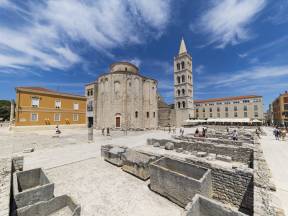
The Church of St. Donatus in Zadar is one of the most recognizable buildings not only in Zadar, but also in the whole of Croatia. It is located in the very heart of the old city center, on a peninsula, right on the remains of the largest Roman forum on the eastern coast of the Adriatic. For this reason, parts of ancient columns, cornices and altars were built into its foundations and walls, and some of them bear inscriptions dedicated to Roman deities such as Juno.
The church was built in the 9th century, and its circular floor plan with a double ring makes it unique in Croatia and very rare in Europe. It is 27 meters high and 22 meters wide, making it an imposing building for that time. It was originally dedicated to the Holy Trinity, and only since the 15th century has it been named after Bishop Donatus, who, according to tradition, was most responsible for its construction. Interestingly, the church was first mentioned in the 10th century in the work of the Byzantine emperor Constantine Porphyrogenitus "On the Governance of the State".
Throughout history, the church has changed its functions: from a sacred space, to a warehouse and mint during the Venetian Republic, to an archaeological museum from the end of the 19th century until 1954. Since then, it has been known as a concert hall, primarily for its exceptional acoustics. Since 1960, it has hosted the international festival "Musical Evenings at St. Donatus", which brings together top musicians from Croatia and the world, and the program includes medieval, Renaissance, Baroque and contemporary music. This year, the festival celebrates its 65th edition and brings a variety of musical styles, from classical music to jazz and multimedia performances.
A few more useful details: the church no longer has a sacred function, and masses have not been held in it for more than 250 years. It is not under the jurisdiction of the Archdiocese of Zadar, but is a museum space managed by the Zadar Archaeological Museum. The interior has three entrances and a gallery on the first floor, and during the 18th century renovation, windows on the first floor were added and part of the annexes were removed.
The Church of St. Donatus also survived the Allied bombing in World War II, while many other Zadar monuments were destroyed at that time. Today, it is an unmissable attraction for anyone who wants to learn about the history and culture of Zadar, and with the help of a virtual walk, it is possible to experience what it looked like in different historical periods.
Roman Forum
The Forum in Zadar is one of the most important archaeological sites in Dalmatia. It was built in the 1st century BC, when Zadar was a Roman city under the name Iader. The Forum was the main square and the center of political, social and religious life of the city, but also the starting point from which all streets and the layout of the city were determined.
The square is rectangular in shape, measuring about 90 x 45 meters, making it the largest Roman forum on the eastern coast of the Adriatic. It was surrounded by public buildings - a basilica, temples, porticos and administrative spaces. The square featured columns, inscriptions dedicated to gods and rulers, and altars. The main entrance was on the south side, through a large portico.
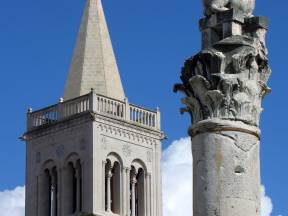
On the north side of the square are the remains of the templums of Jupiter, Juno and Minerva. Parts of the foundations and several columns have been preserved. One of the two monumental columns still stands in its original place today. In the Middle Ages, criminals were tied to this column, and traces of the chains are still visible.
Stone altars and inscriptions with the names of Roman emperors, including Emperor Augustus, have been found in the Forum. A relief of the god Mercury has also been found, indicating that trade was developed here. Remains of a Roman sewage system have been discovered beneath the square, confirming the advanced infrastructure of the city.
After the arrival of Christianity, the Church of St. Donatus was built on the foundations of the forum. The original slabs of the Roman square are still visible beneath the church. The Forum is still a gathering place today, and public events are held there in the summer.
Archaeological excavations of the forum began in the mid-20th century and are still ongoing. Artifacts found in this area are exhibited in the Archaeological Museum in Zadar.
Pillar of shame
You are standing next to one of the few preserved pillars of shame in Croatia, and its importance lies in the fact that in the Middle Ages it was the central place of public condemnation. At first glance, it looks like an ordinary stone, but the Pillar of Shame was a place where people had to stand in front of everyone for minor offenses, exposed to the views and comments of passers-by.
This stone, about 6 meters high and made of white stone, is located on Green Square right next to the Roman Forum, which gives it additional historical weight. It was erected in the 16th century and served to expose those who, for example, stole or cheated. The pillar was engraved with inscriptions describing the offense and the punishment, and passers-by were free to show their dissatisfaction - sometimes even by throwing rotten fruit or stones at the condemned, which often ended in serious injuries and even death.
The pillar was not only a symbol of shame, but also the power of local authorities - it showed who had the right to judge and punish. After such a punishment, convicts often lost their social standing and could no longer participate normally in community life.
Interestingly, such pillars were common in cities on the Adriatic, and the most famous examples, apart from this one in Zadar, are in Salež near Buzet and once stood on St. Mark's Square in Zagreb.
In addition to the inscription, the pillar is carved with lion head motifs, typical of that era. Although the pillar itself has survived the centuries, the surrounding buildings have changed or disappeared. In the 20th century, the pillar was restored and today it is an indispensable point for visitors, but also a reminder of how punishments were once carried out and order was maintained.
One interesting fact: the expression "to put on the pillar of shame", which is still used today when we want to publicly shame someone, originates from this medieval practice - at that time it was an official punishment, not just a metaphor.
Although it is difficult to imagine such a method of punishment today, the pillar of shame shows how important public respect for the law was and how communities throughout history sought to maintain order and discipline.
Cathedral of St. Anastasia
The Cathedral of St. Anastasia, located right next to you on St. Anastasia Square, is not only the largest church in Dalmatia, but also a true historical wonder that has survived centuries of change and destruction. It was named after the early Christian martyr Anastasia, known as Anastasia, whose relics are kept in a sarcophagus on the altar in the northern apse of the cathedral. Interestingly, it was the Bishop of Zadar, Donatus, who brought her relics from Constantinople in the early 9th century, which was the reason for the church to be named after her.
Although little is known about the life of St. Anastasia, it is known that she was a victim of the persecution of Christians under Emperor Diocletian. Legend has it that she was from Zadar and that she suffered martyrdom for her faith, and her story still inspires many believers and visitors today.
The cathedral as we see it today began to be built in the 12th century on the foundations of an even older church from the 5th century. Its construction and expansion lasted throughout the 12th and 13th centuries, and it was especially renovated after it was severely damaged in the Crusader siege of Zadar in 1202. Interestingly, according to some historical sources, the extension of the cathedral was not solely due to damage, but also due to the desire to further expand and enrich the sacred space, which was a rare case at that time.
The facade of the cathedral is simple but powerful, with a portal richly decorated with reliefs. On the main portal there is a Gothic relief of the Virgin and Child from 1324, and next to it are also depicted St. Anastasia and St. Chrysostom. A special feature of the facade are the figures of a lion and a bull on the edges, symbols of the evangelists Mark and Luke, which makes this cathedral unique in Dalmatia.
The interior is divided into three naves, and above the side naves there is a gallery, which is a rarity among churches of that era – one of the galleries is even open to the outer facade, which further emphasizes the richness of the architectural expression. Below the presbytery is the crypt – an underground church with the relics of St. Anastasia, and in the southern nave there is the entrance to the sacristy, the former chapel of St. Barbara, where a floor mosaic from the 5th century can still be seen today.
Another interesting fact: the cathedral bell tower was built on two occasions, in the 15th and 19th centuries, mostly in the neo-Romanesque style. The cathedral is not only a religious center, but also a place of rich cultural heritage, with numerous altars, frescoes and historical inscriptions carved into stone that testify to Zadar’s turbulent past.
If you thought you had seen it all, know that the cathedral also houses an octagonal baptismal font from the 12th century, and the baptistery was only restored in 1989 after being damaged in World War II. The recognizable octagonal floor plan symbolizes the figure eight as a sign of a new beginning and Christian renewal – the number eight in Christian symbolism signifies eternal life and resurrection.
Church of St. Nicholas
You are standing in front of a church built in the 13th century and dedicated to St. Nicholas, the patron saint of sailors and merchants, who was highly revered in the medieval maritime world. This example of Romanesque architecture has a simple but powerful appearance, with a bell tower rising above the city.
The original construction of the church began in 1225, when the Dominican order decided to build its monastery and church dedicated to St. Nicholas, at a time when the Dominicans were becoming important on the eastern Adriatic coast. Zadar was then under the influence of the Venetian Republic, and the church also served as the center of the city's spiritual life.
Over the centuries, the Church of St. Nicholas has undergone numerous renovations and alterations. In the 16th century, during the Renaissance renovation, new statues and altars were added, and the church was enriched with works of art from that period. The interior of the church is today decorated with Baroque details, and among the most valuable works of art is a painting of St. Nicholas, which dates back to the 14th century.
The Church of St. Nicholas was also an important point for the spiritual life of the city during the Venetian rule, especially for sailors who considered it a protector on their journeys. Over the centuries, the church was a place of mass, but also an important cultural point for Zadar, which at that time was a key maritime center.
Today, the Church of St. Nicholas is open to visitors who want to learn more about the history of Zadar, Renaissance architecture and the importance of the Dominican order.
Church of St. Francis
You are in the Church of St. Francis, which was built around 1221 by the Franciscan Order and consecrated in 1282 by the Archbishop of Zadar, Lovro Periandar. From the very beginning, it had the status of a basilica, which was rare and significant at the time. The architecture of the Church of St. Francis is typical of monastic Gothic churches – a single-nave space with a slightly raised sanctuary. Over the centuries, the church has undergone changes, but significant elements of medieval art and architecture have been preserved.
Behind the main altar is the former sanctuary with choir stalls decorated with rich carvings in the Floral Gothic style from 1394, the work of Giacomo da Borghese from Sansepolcro. The sacristy is of particular historical significance, where the Peace of Zadar was signed in 1358 between the Republic of Venice and the Hungarian-Croatian King Louis of Anjou. With this peace, the Venetian Republic gave up its claims to Dalmatia, which had a great influence on the history of the region.
The monastery houses a Renaissance cloister from 1556, known for its rich library and art collection. Among the valuable exhibits in the treasury is a painted crucifix from the 12th century. Throughout history, the monastery has been an important spiritual center, and the Franciscan College was active there. It is also where Blessed Jakov Zadranin, known for his holiness, received his first monastic formation.
The monastery and church are located in the western part of the Zadar peninsula, near the Sea Organ and the waterfront, and have played an important role in the religious and social life of the city throughout history. During Austrian rule, part of the walls around the monastery were demolished to build roads, which changed the appearance of the complex.
According to legend, the monastery received the land thanks to a miracle performed by Saint Francis of Assisi in Zadar, where he allegedly healed a Benedictine nun. This story further highlights the importance of this place in the history of the Franciscan order.
Church of Our Lady of Health
The Church of Our Lady of Health in Zadar was built in the 17th century, during the Baroque period. It is dedicated to Our Lady of Health, the patroness of health and family. Construction began in 1629 at the initiative of Zadar citizens who wanted a place to pray, especially due to the frequent epidemics of plague. Health was a major theme at the time, as diseases such as plague often claimed lives, and faith in protection was strong.
The church has a Baroque architectural style with rich decorations, frescoes, and sculptures. Although not large, the interior is decorated with valuable works of art, including a Baroque altar with a statue of Our Lady of Health. Inside, there are gold details and stained glass, and the altar and relics demonstrate the piety of the people of Zadar and the tradition of praying for health.
Interestingly, a painting of Our Lady of Kaštela from 1447, a work by Blaž Zadranin, was once kept above the main altar. Today, the original is in the collection of church art, and a copy is in the church. The church was badly damaged in World War II, but was rebuilt in 1990 according to the original plans.
In 1752, a great fire broke out in Zadar, and the citizens prayed to Our Lady of Health. According to tradition, the fire was extinguished, and every year on November 21st, a procession is held and fritters are distributed. Saint Leopold Bogdan Mandić celebrated mass in the church for three years.
St. Dominic's Church
You are standing in front of one of the oldest Gothic buildings in Dalmatia. The church and monastery were founded in 1221, just a few years after the Dominican order was recognized. According to tradition, the foundation of the monastery was initiated by St. Dominic himself during his travels through Italy and Dalmatia.
The architecture of the church is simple and functional, which is in keeping with the modesty of the Dominican order. It was built in the early Gothic style, with a rectangular floor plan and no lavish decoration. The facade is flat, without prominent decorations, and above the entrance there is a simple stone frame with a lunette. The bell tower, which has been rebuilt several times throughout history, attracts special attention.
The interior of the church is single-nave, with a prominent presbytery and several side chapels. Fragments of 14th-century frescoes can be seen in the space, which testify to an earlier cycle of wall painting. The main altar is decorated simply, with a Dominican cross and reliefs of the order's saints.
The Church of St. Dominic is also significant for its historical role. It was here that the Peace of Zadar was signed in 1358 between the Republic of Venice and the Hungarian-Croatian King Louis I, ending Venetian rule over part of the eastern Adriatic coast. This event marked a turning point in regional history and confirms the importance of this place not only in the religious but also in the political life of medieval Zadar.
Today, the church and monastery belong to the Dominican community and are open to visitors, believers and researchers who want to learn about one of the longest-standing monastic traditions in Zadar.
Museum of Ancient Glass
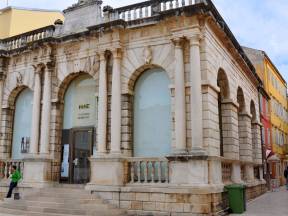
The museum in front of you offers visitors a unique opportunity to learn about the history and technology of glassmaking throughout the centuries. This museum complex, founded in 2009, is unique in Croatia and one of the few places in Europe dedicated exclusively to ancient glass. It is located in the Milesi Palace, an 18th-century building that has been carefully restored to preserve its historical heritage.
The museum contains a rich collection of glass artifacts dating back to the Roman period and other ancient civilizations, and the collection includes items such as glass bottles, vessels, decorative objects, and glass figurines.
Zadar was an important commercial and maritime center, and thanks to its proximity to Mediterranean trade routes, glass objects came and went through this city. Although glass was rare and expensive in the ancient world, the production of glass objects was sophisticated, and glass works were often a symbol of status. Today, in this museum we can see numerous objects that were used for everyday needs, but also for decoration and ritual purposes. One of the most famous objects in the museum's collection is a golden glass relief depicting gods and symbols of the time, as well as numerous bottles and bowls used in rituals.
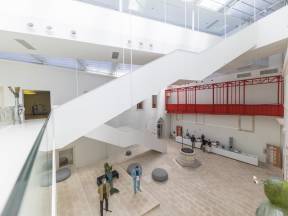
The museum also contains numerous reconstructions of glass workshops, which allows visitors to better understand the process of glass production in antiquity. In addition, the museum's display offers interactive exhibitions that explain how glass objects were shaped and decorated, including the technique of glassblowing.
The museum also organizes thematic exhibitions that explore the history of glassmaking, not only in the Zadar region, but also in the wider context of the Mediterranean and the Roman Empire.
Waterfront
You are on the Zadar waterfront, officially called the Obala kralja Petar Krešimir IV. This is a promenade that follows the southwestern edge of the old town of Zadar and is an unmissable place for anyone who comes to the city.
The waterfront connects the city with the sea and opens up a view of the Zadar Channel, and on the horizon you can clearly see the islands of Ugljan and Pašman.
Throughout history, the waterfront has changed its role. During the Venetian era, there were defensive walls here that protected the city. These walls were demolished in the 19th century, which allowed the area to become open to the sea, just as we know it today. After World War II, the waterfront was renovated, and during the renovation, care was taken to preserve the historical appearance and connection of the old town with the sea.
The current appearance of the waterfront was shaped at the beginning of the 20th century, during the Austro-Hungarian Empire. Then the coastal wall was built, pine trees were planted and the first benches were installed. The waterfront thus became a place for walking and socializing, and over time it grew into the center of city life.
On the southern part of the waterfront is the Sea Organ, a unique instrument that plays under the influence of the waves. Right next to it is the Greeting to the Sun, an installation that accompanies the sunset with light effects. Interestingly, Alfred Hitchcock, during his stay in Zadar, stated that he saw the most beautiful sunset in the world right here.
Sea organ
The Sea Organ in Zadar is an installation that uses the waves of the sea to create sounds. Designed by architect Nikola Bašić in 2005, it is now one of the most recognizable landmarks in Zadar. The organ consists of stone slabs with openings and a series of underwater pipes of different lengths and widths, located in three rows under the waterfront.
When waves hit the shore, water and air pass through these pipes and produce tones. The sound changes depending on the size and strength of the waves, so it is different every time. Larger waves bring deeper and stronger tones, while smaller waves bring quieter sounds. Walking along the waterfront, you can hear the music created by the sea itself spreading from the openings in the stone slabs.
This installation is a combination of architecture, technology and nature, and Zadar is known for it even outside of Croatia. In 2006, the organ won the European Award for Urban Public Space.
Right next to them is Greeting to the Sun, another interesting installation that uses solar panels for lighting effects after sunset.
Greetings to the Sun
Greeting to the Sun in Zadar is an installation that immediately attracts attention with its large circle of solar panels, placed right next to the Sea Organ. It was designed by Nikola Bašić in 2008, and the circle has a diameter of about 22 meters.
During the day, the panels collect solar energy, and as soon as it gets dark, the installation begins to glow in various colors that change according to the sunset. Interestingly, it looks different every evening because the lighting effects depend on the weather conditions.
Greeting to the Sun is not just for viewing – it also has a symbolic meaning because it connects people, nature and technology. Alfred Hitchcock declared the Zadar sunset the most beautiful in the world, which further attracts visitors.
Another interesting fact: you can follow the light experience of Greeting to the Sun while listening to the sounds of the Sea Organ at the same time, because the installations are connected. There is a paved promenade around the circle where people often gather, socialize and take photos.
City port
You are in a place that has historically been a key point for trade, maritime traffic and connections with the Adriatic islands. Zadar, thanks to its strategic position, has a long maritime tradition. The port was already an important hub for ships connecting Zadar with Rome, the Venetian territory and other parts of the Mediterranean in ancient times. During the Venetian Republic in the 15th century, the port was expanded and modernized, becoming the center of maritime traffic under the Venetians. During Venetian rule, Zadar was a key port in the defense of the eastern Adriatic coast.
In the 19th century, under Austrian rule, the port continued to grow and develop, becoming an important transport hub. At that time, facilities for receiving ships were built, and the city expanded towards the coast. After World War II, the port was rebuilt due to extensive war damage, and by the 1970s it began to experience modernization of the infrastructure, which enabled a faster flow of passengers and cargo.
Today, the city port of Jazine is mainly focused on local passenger traffic. From the shore you can see the ships connecting Zadar with the Zadar islands such as Ugljan, Pašman, Rava, Pag and Ist. In addition, the port also accepts tourist boats, fishing boats and private yachts. Unlike in the past, when it was mainly a cargo port, today it serves almost exclusively for passenger traffic.
In addition to this modern function, the port of Zadar is also connected to the ferry port of Gaženica, which accepts international ferries, and the bus station in the immediate vicinity makes this location even more important in intercity and international transport.
The port itself is located along the Liburnian coast, and the modern marina and docks make it a center for both local islanders and numerous tourists visiting Zadar.
Arsenal
The Arsenal you are standing next to is not just another historical building – it is a place with more life than you might expect at first glance. Located along the city walls and the Muraj promenade, on Trg Tri bunara, the Arsenal was built in the 16th century as a warehouse for the Venetian fleet. Interestingly, it was expanded in 1752 under the governorship of Jeronimo Maria Balbi, and this information is still engraved on a plaque on the facade of the building.
Throughout history, the Arsenal was a center of shipbuilding, weapons and equipment production, but also trade – all of which were crucial to Venice’s power in the Adriatic. The facade is simple but powerful, with large stone arches on the lower floors, which once concealed ship parts and weapons. Interestingly, the original roof had two luminaries decorated with Baroque volutes, but these were removed in the 19th century, when the current gabled roof was added.
The interior of the Arsenal today is completely different from what you would expect from an old military building. The space is huge, with high ceilings and lots of natural light, making it perfect for concerts, exhibitions and various events. The main hall is spacious, and the large wooden doors and windows give it a special character.
After World War II, the Arsenal changed its purpose – it was a warehouse, a shop, and since 2005 it has been converted into a multimedia center. Today it is a place where concerts, exhibitions, theater performances, weddings and conferences are held, all in as much as 1,800 square meters of functional space. Interestingly, the Arsenal was conceived as a "closed city square" – a place to meet and socialize, just like city centers used to be.
In addition to a rich cultural program, the Arsenal is also known for its gastronomic offer – here you can drink a coffee, have a good meal or enjoy local wines, which makes it one of the rare places in Zadar where you can dine and experience a concert under the same roof. If you are looking for the perfect venue for a wedding or special celebration, Arsenal is often the first choice due to its unique combination of history and modern amenities.
Another interesting fact – Arsenal is located right next to the famous Zadar attractions Sea Organ and Greeting to the Sun, making it an ideal spot for a walk or an evening out.