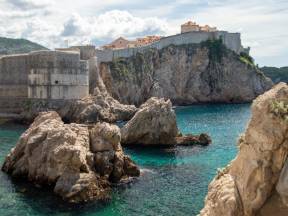
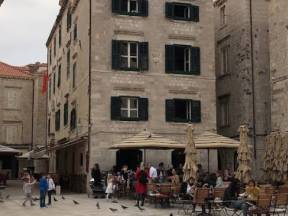
Dubrovnik has a population of around 40,000 and is known as one of the best-preserved medieval cities in the Mediterranean. Its walls, almost two kilometers long, surround the old city center, which is under the protection of UNESCO. The city was once the seat of the Republic of Dubrovnik, an independent maritime and trading power that successfully balanced between the great powers for centuries. It has gained particular popularity in recent times as the main filming location for the series Game of Thrones.
Audio guides available in:
Czech, Deutsch , Polski, Nederlands, Hungarian, Slovakian, Hrvatski, 中文, Español, 日本語, Italiano, Arabic, Dansk, English (British), Français, Slovenian, English (American), русский, Українськa, 한글 , Svenska, Português, Suomalainen
To find more content and listen to free audio guides, download the Guide To Go app.
Dubrovnik
Points of interest
Pile Gate
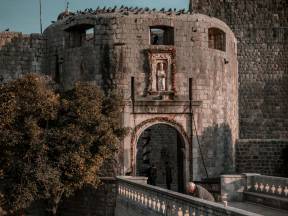
The Pile Gate is the main western entrance to the historic center of Dubrovnik and is one of the most recognizable places in the city. It was named after the settlement of Pile, whose name derives from the Greek word for gate, “pilai”. When you approach the old town from the mainland, you immediately notice its massive stone structure – the result of a carefully designed defense system. The gate actually consists of two levels: the outer, Renaissance gate was built in 1537, and the inner, with a Gothic arch, dates back to 1460, a time when the city’s security was paramount. The bridge leading to the gate used to be wooden and drawbridged – it would be raised every night with a solemn ceremony, and the keys to the city would be handed over to the Duke of Dubrovnik as a sign of concern for the safety of the residents. Today, this bridge spans the former moat, which is now a green belt, but it is still clear how carefully the defense was planned.
Above both entrances are sculptures of St. Blaise, the patron saint of the city: the outer sculpture is of Renaissance origin, while the inner one is by the great Ivan Meštrović. Near the bridge and the gate, old military towers rise, and from the Rijeka bridge, the view opens up to the monumental Lovrijenac fortress, which is another symbol of Dubrovnik's resistance and freedom. During the time of the Dubrovnik Republic, entry through the gate was strictly controlled - no one could enter without permission, and the elaborate system of staircases and bridges made attacks by unwanted guests even more difficult.
This gate is a witness to some of the most important events in Dubrovnik's history. It was through this that Napoleon's military machine entered in 1806, which brought the Dubrovnik Republic to an end. Although it has undergone numerous renovations over the centuries, the Pile Gate has remained the main city entrance and a symbol of preserving identity, freedom and hospitality. Today, they are an indispensable orientation point, a meeting place, a starting point for exploring landmarks, and a popular film set, with thousands of visitors passing through them every day, just as merchants, diplomats, and travelers have entered through them for centuries.
Small Onofrio's Fountain
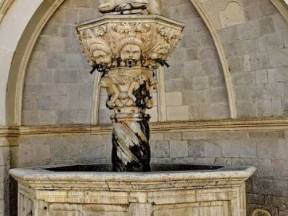
The Small Onofrio's Fountain is not just a decoration at the eastern end of Stradun, but a true reminder of how advanced a city Dubrovnik was back in the 15th century. It was built in 1438 according to the idea of the Neapolitan architect Onofrio della Cave, who also designed the Great Onofrio's Fountain. The Small Fountain was a key source of drinking water for residents and merchants, especially for the market on Trg Luža, and immediately became a part of the city's daily life.
Located in a niche in the wall of the former Main Guard, the fountain is made of stone, and its octagonal basin is decorated with reliefs of boys, dolphins and shells. At the top are kneeling boys with water flowing through their hands. These motifs show a blend of Gothic and Renaissance, and the stonework was done by Pietro di Martino from Milan.
One interesting fact that you may not have known: the water that came to the Small Onofrio's Fountain traveled as far as 12 kilometers from the Šumet spring in Rijeka dubrovačka, through the then revolutionary city waterworks. This waterworks was more than 11 kilometers long and passed through the lower slopes of Srđ, and the reservoir from which the water flowed also powered the mills near Minčeta.
The fountain also had a social role - in the Middle Ages it was used exclusively by Christians, while the Dubrovnik Jews had their own fountain, which was later moved to Brsalje. This division clearly shows what the relations between the different communities in Dubrovnik were like at that time.
Over the centuries, the fountain has been damaged several times, but it has always been restored. The last major renovation was in 1996, after the Homeland War, when it was restored to its original appearance. Today, the Small Onofrio's Fountain is a frequent motif on postcards and an unavoidable gathering place, especially during the Dubrovnik Summer Festival.
Another interesting fact: a new renovation of the fountain due to corrosion and scale in the installations began in early 2025. The work includes a thorough cleaning of the pipelines, replacement of damaged parts, and restoration of stone details, all under the strict supervision of conservators, so that this historic fountain can continue to be the pride of Dubrovnik.
Main street Stradun
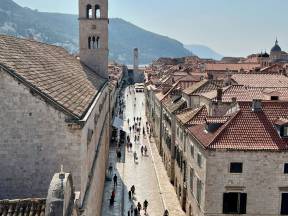
Stradun is the heart of old Dubrovnik – the main street, about 300 meters long, connecting the two most important city entrances: the Pile Gate in the west and the Ploče Gate in the east. What is now an indispensable promenade was created back in the 9th century, when the people of Dubrovnik filled in the sea channel that once divided two settlements – Ragusa and Dubrava. This is how Dubrovnik as we know it today was created.
Walking along Stradun, you walk on large stone slabs that are so smooth that the people of Dubrovnik call them "salon street". After the great earthquake of 1667, the entire street was rebuilt in the Baroque style, and every detail of the construction was strictly regulated: shops on the ground floor, apartments on the upper floors, and kitchens and storage rooms in the attic – all for fire safety.
At the beginning and end of Stradun are two famous fountains – the Great and Small Onofrio's Fountain – and two bell towers: the city and the Franciscan. The biggest events are held here, such as the procession for the Feast of St. Blaise, and the New Year's Eve on Stradun is regularly ranked among the most popular in Europe.
The name "Stradun" comes from the Venetian term for a long street, while locals often use the name "Placa", which comes from the Latin word for street or square. Interestingly, Stradun has also been the location for filming scenes of popular world series and films, including "Game of Thrones", which further increased its popularity among tourists.
Onofrio's Fountain
At the very beginning of Stradun, right next to the entrance to the old town, stands Onofrio's Fountain – a place that has attracted attention and gathered people for centuries. It was built in 1438 by Onofrio della Cava from Naples, as part of a revolutionary project that provided Dubrovnik with drinking water from the Šumet spring in Rijeka dubrovačka, 12 kilometers away. This undertaking was so advanced that at the time there was no similar example in Europe.
At first glance, the fountain may seem like just another decoration on the street, but its role was crucial to the daily life of the city. Water flowed from 16 stone faces, the so-called masquerons, and each face has its own story and symbolism – from mythological motifs to historical figures. Interestingly, during restorations, the masquerons often had to be reconstructed based on preserved parts, because there were no old photographs that would accurately depict their original appearance.
The fountain was not only a source of water, but also a central gathering place. Here, citizens met, exchanged news, and negotiated business. In Dubrovnik's history, Onofrio's Fountain was so important that it is even mentioned in famous literary works, such as the Renaissance comedy "Novela od Stanca" by Marin Držić.
One interesting fact that you may not know: a small stone dog, a dog, a symbolic guardian of the water, once stood on the fountain. It even survived the devastating earthquake of 1667, but in the 19th century it fell and broke. Today, the original is kept in a museum, and a replica has adorned the fountain again since 2016.
After the great earthquake of 1667, the fountain lost some of its original monumentality, but it has always been restored and preserved as a symbol of the city.
And today, as tourists and residents seek refreshment under its shade, the fountain continues its story - connecting Dubrovnik's past and present.
Church of St. Saviour
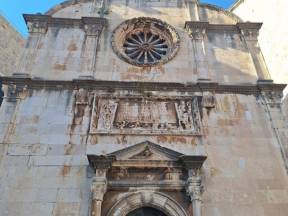
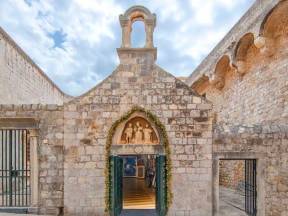
The Church of St. Saviour was built in 1520 as a token of gratitude for surviving the Ottoman Empire's attack on Dubrovnik. Its simple Renaissance façade, reflecting the architectural principles of balance and symmetry, stands out for its minimalist approach without rich decorations, which makes it different from many other Dubrovnik churches. The façade is spacious and regularly shaped, with clear lines that suggest functionality and modesty.
The interior of the church follows a similar approach – simple yet elegant. The most prominent element of the interior is the wooden altar, the work of the Dubrovnik master Nikola Božidarević. The altar is modest in its design, but precise in every detail. Its paintings and statues depict religious motifs, and among the most famous is the image of Christ, which played a significant role in the history of the church. In addition to the altar, the church contains several other statues and paintings depicting important religious symbols.
The Church of St. The Church of the Savior reflects the history of Dubrovnik – it was built at a time when the city survived a major attack, and its function was not only religious, but also symbolic.
Fortress Bokar
You are on the western side of the Dubrovnik walls, where the Bokar Tower is located, a fortress that for more than four centuries guarded the city from attacks from the sea. Its construction took more than a hundred years – it was started in 1461 and completed only in 1570, according to the designs of the famous Florentine architect Michelozzo Michelozzi. Bokar is recognizable by its horseshoe shape and massive stone cornices, and is considered a top example of Renaissance military architecture in Dubrovnik.
The task of the tower was clear: to protect the entrance through the Pile Gate, the bridge and the city moat, and to prevent the enemy from landing in the Pile harbor. The thick walls allowed for the placement of cannons, and inside there was a casemate for storing ammunition and smaller cannons. As early as the 15th century, the ranges of cannons towards the sea were tested from Bokar – which was an innovation at the time. The tower's platform was also used for artillery exercises, important for the constant readiness of the defense.
Bokar was part of a complex defense system with the Minčeta and Revelin towers, with Minčeta guarding the land approach to the city, and Bokar the sea approach. In addition to being functional, the Bokar tower is also distinguished by its harmonious architectural details, which is why it is still one of the most beautiful fortresses in the region today.
One interesting fact that you may not have known: in the past, the Bokar tower was also called Zvjezdan or Brsalja tower, after the shooting range that was nearby. According to local legend, the spirit of the old guard still watches in the tower, which further enhances its mysticism.
The largest modifications to the tower were carried out in 1570, when military engineer Antonio Ferramolino further strengthened the walls and adapted them to new artillery requirements, so Bokar remained functional until the end of the Dubrovnik Republic.
Fortress Lovrijenac
The Lovrijenac Fortress stands on a 37-meter-high cliff above the sea, outside the western walls of Dubrovnik, and is known as the “Gibraltar of Dubrovnik” due to its key defensive role. The first official record of the fortress dates back to 1301, but there is evidence that construction began earlier. Lovrijenac was built to protect the city from attacks from land and sea, especially from the Venetian Republic, with whom Dubrovnik was in frequent conflict.
According to legend, the people of Dubrovnik learned that the Venetians were planning to build their own fortress on the same site to control the city. In just three months in 1018, the people of Dubrovnik managed to build Lovrijenac, arm it, and thus prevent the Venetians from taking control. When the Venetian ships arrived with the construction materials, they had to return home with their work unfinished. This swift action turned Lovrijenac into a symbol of Dubrovnik’s freedom and determination.
The fortress has a triangular shape and three levels. The walls facing the sea are as thick as 12 meters, while those facing the city are thinner, about 60 centimeters, which made it easier to break out of the city in case the fortress fell into enemy hands. The entrance to the fortress is made up of two bridges, and above the gate is the inscription "Non Bene Pro Toto Libertas Venditur Auro" - "Freedom is not sold for all the treasures of the world".
The interior of Lovrijenac hides a Renaissance courtyard with three terraces and a cistern for drinking water. Cannons were placed on the highest terrace to defend access to the sea and the city. Over the centuries, the fortress was strengthened several times and adapted to new military technologies, and after the great earthquake of 1667, the renovation lasted until the end of the 17th century.
After the fall of the Dubrovnik Republic, Lovrijenac was converted into a barracks, and in the 19th century the Austrians further adapted it to their needs. During World War II, it served as a prison, and after the war, it was rebuilt and today it is one of the main venues of the Dubrovnik Summer Festival. The most famous play performed here is Shakespeare's Hamlet, and world-famous actors such as Derek Jacobi, Daniel Day-Lewis and Goran Višnjić have also performed at Lovrijenac.
Pine trees have been planted at the foot of the fortress, in memory of the PEN Congress in 1933. Throughout history, Lovrijenac has been both a military fortress and a place for cultural events, but also a symbol of freedom and resistance.
An interesting fact that you may not have known: Lovrijenac was also a film star - in the popular series "Game of Thrones" he embodied the Red Keep in King's Landing. In addition, there is a legend about a cannon called "The Lizard" that fell into the sea under the fortress in 1814 and has not been found to this day, although divers have tried to locate it several times.
Orlando's Pillar
Orlando's Column is not only the oldest public sculpture in Dubrovnik, but also the only secular monument dedicated to a real person in that city until modern times. It was erected in 1418 and carved by the Italian sculptor Bonino da Milano with the help of the local master Antun Dubrovnik. The column depicts the knight Orlando (Roland) in full military gear, with his sword raised to the sky, which is immediately clear to anyone who passes by Stradun - this is a symbol of Dubrovnik's freedom and independence.
However, Orlando was not just a decoration. At its base is carved the official measure of the Dubrovnik cubit (51.2 cm), according to which fabrics and goods were measured at the market. This was a way to ensure that trade was fair and that no one cheated on length. The column was also the place where important city decisions were announced, and judgments were read from it, so citizens always knew what was happening in the Republic.
Orlando's Column also had a dark side – it served as a pillar of shame. The accused were tied to it, exposed to public ridicule, and sometimes physical punishment. All this took place in full view of passers-by, as a warning to anyone who might think of breaking the law.
Interestingly, such a column was not common in the Mediterranean – similar Roland's columns are found mainly in Germany, and outside of it there are only four such monuments, including the one in Dubrovnik. The people of Dubrovnik also erected it as a response to Venetian symbols of power, wanting to emphasize their independence and belonging to the European cultural circle.
The column suffered numerous damages over the centuries. The worst happened in 1825 when it was knocked down by a strong storm – then it was stored in the Rector's Palace and only in 1878 was it returned to Stradun, but facing north, not east as originally. The sword that Orlando holds today is not the original; Due to damage and vandalism, replicas have been made several times, and there is also a replacement sword that can be quickly installed if needed.
Today, different flags are occasionally flown on Orlando's Column - during the Feast of St. Blaise, a banner with the image of the saint, and during the Dubrovnik Summer Festival, the Libertas banner, further emphasizing its role as a symbol of freedom.
Main Square
The main square in Dubrovnik is known as Luža, a name that comes from the Italian word loggia and denotes an open city space for gathering and trade. Luža has been the heart of public and social life since the Middle Ages, located along the northern wall of the church of St. Blaise, the patron saint of the city. It was built in the mid-14th century, and served as a place for meetings, exchanging news, trading, and holding various public events.
According to the description by Filip de Diversis from 1440, Luža was spacious and almost rectangular, surrounded by a low wall with two entrances. The interior had stone seats with wooden planks, and in the center was a smaller covered luža, paved with red and white stones, where nobles and foreigners gathered. The coats of arms of important foreign rulers who passed through Dubrovnik on their way to the Holy Land were placed on the walls and beams, which showed the international importance of the city as a trading and diplomatic port.
The square was also the place where the changing of the city guard took place, and nearby were the customs house, market, shipyard and fish market. This square was the center of life for Dubrovnik merchants and sailors, and its importance is also reflected in the fact that it was also home to the city bell tower with a 15th-century clock, which served as an alarm and reminder of important events. In the 18th century, during the construction of the new Baroque church of St. Blaise, the medieval square was demolished.
Today it serves as a meeting place for tourists and locals.
Church of St. Blaise
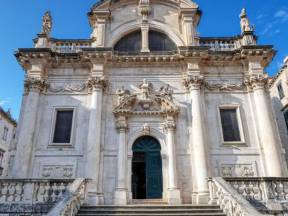
The Church of St. Blaise in Dubrovnik was built between 1706 and 1715, exactly on the site of an older Romanesque church that had been destroyed by fire. The project was commissioned by the Venetian architect Marino Gropelli, and the result is one of the most recognizable examples of Venetian Baroque in the entire city. Interestingly, Gropelli was better known as a sculptor than a builder, which is evident in the wealth of sculptural details on the church.
The church's ground plan is shaped like a Greek cross, with four equal arms and a large central dome that dominates the main space. The dome is so high that it is visible from almost every corner of the old city center, and the entire church is located on a raised pedestal, which further enhances its presence in the urban space.
The most important relic in the church is the 15th-century silver statue of St. Blaise. This statue depicts the patron saint of Dubrovnik holding a model of the city, but what is particularly interesting is that the model depicts Dubrovnik before the devastating earthquake of 1667. The statue survived both the earthquake and the fire, while all the other statues made of gold, silver and brass were melted down – the people of Dubrovnik considered this a true miracle. After the fire, the statue was temporarily placed in the Church of St. Nicholas, and in 1715 it was returned to its place in the new church.
The veneration of St. Blaise in Dubrovnik dates back to the 10th century, and according to legend, St. Blaise saved the city from a Venetian siege in 971 by appearing to a local priest and warning him of an attack. Since then, he has become not only the patron saint of Dubrovnik, but also a symbol of security and unity.
The Feast of St. Blaise, which is held every year on February 3, is the most important Dubrovnik holiday and is inscribed on the UNESCO list of Intangible World Heritage. During the Festa, the entire city and its surroundings participate in processions, masses and traditional customs. A special feature of the Festa is the so-called "Sloboština St. Blaise" - a period when everyone, even convicts and exiles, could freely come to the city without fear of punishment, which further strengthened the sense of community.
Another interesting fact: during the Festa, a traditional weapon called a trombone is used, which is fired in honor of the saint, and after the procession, the standard bearers take the blessing to their villages, so that those who could not come to the city can also feel a part of the festivities.
Sponza Palace
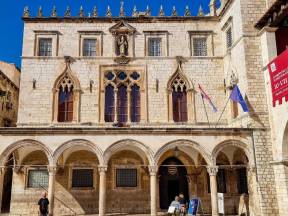
The Sponza Palace, also known as Divona, was built between 1516 and 1520 according to a design by the Dubrovnik engineer Paskoj Miličević. It is located in the northeastern part of the main city square, Placa, and represents a combination of Gothic and Renaissance architectural elements, which gives it a recognizable and distinctive appearance. The facade of the palace exudes harmony and details reminiscent of lace in stone, and the stonework was carried out by the Andrijić brothers, famous craftsmen from Korčula.
The palace originally served as a customs house - a place where goods arriving in Dubrovnik from all over the world were cleared. At that time, Dubrovnik was a trading power, and Sponza was the center of economic life. The inner courtyard with arcades was the liveliest trading center and a meeting place for business people. In one part of the palace there was also the state mint, founded in the 14th century, which operated continuously in Sponza until the fall of the Republic.
It also housed the state treasury, the armory, and workshops of craftsmen, and later became the cultural center of Dubrovnik. At the end of the 16th century, the first literary institution was founded in the palace – the Academy of the Agreeable, where the most educated citizens of Dubrovnik gathered to discuss literature, art, and science. The first school in the city was also organized in Sponza, which further confirms its multiple role in social life.
On the main wall of the inner courtyard there is an inscription in Latin: “FALLERE NOSTRA VETANT; ET FALLI PONDERE: MEQVE PONDERC CVM MERCES PONDERAT IPSE DEUS”, which translates to: “Our weights do not allow for cheating or being deceived, and when I measure goods, God himself measures me.” This inscription reflects strict control and honesty in commercial affairs, which was crucial for the reputation and prosperity of the Dubrovnik Republic.
The palace has survived many challenges over the centuries, including earthquakes and wars, and today houses the Historical Archives of Dubrovnik, one of the richest archives in Europe. The building has also undergone recent structural renovations to preserve it for future generations.
Sponza is still a vibrant place in the heart of Dubrovnik. Its atrium is often the stage for cultural events, exhibitions and concerts, especially during the Dubrovnik Summer Festival.
City bell tower
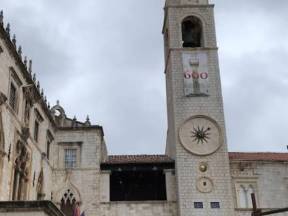
The Dubrovnik city bell tower has been renovated several times over the centuries, especially after the devastating earthquake of 1667 and damage during the Homeland War. At 31 meters high, the bell tower dominates the city skyline and is recognizable by its two bronze statues – Maro and Baro, also known as the Rattlesnake – who strike a large bell with hammers every hour at the top of the tower. This mechanism dates back to 1478.
Maro and Baro, about two meters tall, are made of bronze, and their mechanism allows them to strike the bell alternately. They were named after the local dialect, and their unusual appearance and movements have always captured the attention of curious visitors. There are numerous legends about them – according to one, they were named after the blacksmith brothers who made them, while another suggests that the names were inspired by the sound they produce, similar to the ringing of a bell.
The large bell, made in Dubrovnik, weighs around 2,000 kilograms and has had multiple roles throughout history. In addition to marking the beginning and end of the working day, it also served as an alarm signal in the event of fire, enemy attack or other dangers. Its sound could be heard for miles, which was crucial for the safety and organization of city life.
The interior of the bell tower once served as a guardhouse, and important announcements and government decisions were transmitted from its top.
Although the interior of the bell tower is not open to the general public today, guided tours are occasionally organized that allow visitors to climb to the top and examine the bell and its mechanism up close.
Rector's Palace
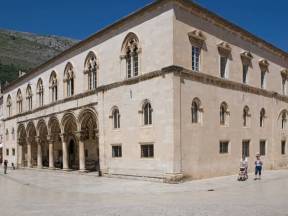
The Rector's Palace is the place where decisions were made for centuries that shaped the fate of the entire Republic. Built in the 15th century, the palace has undergone numerous renovations in Gothic, Renaissance and Baroque styles throughout history. The lower floor served as an armory, a gunpowder warehouse and a prison, which speaks of its role in the defense and administration of the city. It was the seat of the Rector, the highest executive authority of the Dubrovnik Republic, who governed the state from here.
The interior of the palace included the Great Council Hall, meeting and administrative rooms, as well as the residence of the Rector. The lower floor was intended for security functions, with rooms for weapons and a prison for detainees, while the upper floors were used for administrative and representative purposes. The palace was thus also a political center where key decisions were made.
It also had a defensive role, with thick stone walls and smaller windows adapted for defense. Throughout its history, it has suffered damage from fires and earthquakes, but has always been quickly restored. The latest major restorations have focused on preserving its original appearance and adapting it for a museum.
One interesting fact is the statue of Miho Pracat, a wealthy Dubrovnik shipowner whose bust is located in the atrium of the palace. He is the only citizen to whom the Republic erected a public monument, which is
also a kind of symbol of his importance and respect in society.
The palace also had a famous inscription above the entrance door: “Obliti privatorum publica curate” which means “Forget about the private, take care of the public” which reflects the spirit of republicanism and the official role of the palace.
Today, the Rector’s Palace functions as a museum that presents the history of the Dubrovnik Republic, the life of the Rector and the way the city-state is governed. The exhibitions include weapons, documents, art objects and furniture, providing an insight into the political and social life of Dubrovnik. Visitors can tour the representative rooms, the town hall and the dungeons in the lower part of the palace.
Cathedral of the Assumption of Mary
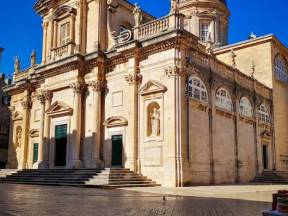
Built between 1671 and 1713, the Cathedral of the Assumption of the Virgin Mary in Dubrovnik stands on the foundations of an older Romanesque church that was destroyed in a devastating earthquake in 1667. The previous church, built from the 12th to the 14th centuries, was remarkable for its size and architecture.
According to legend, its construction was financed by the English king Richard the Lionheart, grateful for having survived a shipwreck off the island of Lokrum in 1192. Archaeological excavations beneath the current cathedral have uncovered the remains of two older churches, including one from the early Middle Ages, testifying to the long sacral tradition in this place.
The new cathedral is designed in the Baroque style, inspired by Roman architecture, with a Latin cross-shaped ground plan and an elegant dome rising from an octagonal tambour with windows, dominating the interior. The interior is adorned with the main altar with Titian's famous 16th-century "Assumption of the Virgin Mary", as well as the impressive altar of St. John of Nepomuk, made of rare purple marble.
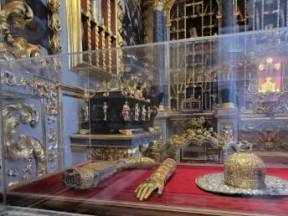
The cathedral's treasury houses a valuable collection of gold and silver reliquaries, crosses, church vessels and paintings by Italian, Flemish and Croatian masters. Of particular note is the relic of the head of St. Blaise from the 11th or 12th century, made in the shape of a Byzantine crown, decorated with enamels and precious stones - a masterpiece of Dubrovnik goldsmiths.
Cathedral treasury
The treasury next to you houses one of the richest collections of sacred objects in Croatia, testifying to the wealth and importance of Dubrovnik throughout the centuries. It houses more than 130 relics of saints dating from the 11th to the 19th centuries, among which are the most valuable relics of St. Blaise – the head, hand and foot, made in the 11th or 12th century in Dubrovnik goldsmiths’ workshops. The reliquary of the head of St. Blaise is shaped like a Byzantine imperial crown, decorated with enamels and precious stones, which demonstrates the high level of goldsmithing that Dubrovnik developed and exported to the whole of Europe.
In addition to the relics, the treasury also houses numerous gold and silver reliquaries, crosses, church vessels and art objects by Italian, Flemish and Croatian masters. Among them, the most notable is the swaddling clothes of Jesus, stored in a 16th-century silver casket, which is believed to have miraculous powers. According to legend, nuns would tear off pieces of the diaper from women in labor in the hope of protection and a happy birth, and these pieces would supposedly grow back on their own. The diaper is also known for the fact that, according to belief, it cannot burn.
A special place is also occupied by a piece of the Cross of Jesus, brought to Dubrovnik by Queen Margarita. This piece of wood was carved into a late Gothic crucifix from 1536, the work of the Dubrovnik goldsmith Jerolim Matov, who considered this honor exceptional. The treasury also houses paintings by famous painters, such as the "Madonna and Child" after Raphael, which further confirms the artistic value of the collection.
Although a large part of the treasury was destroyed in the earthquake of 1667, many objects were saved and are today exhibited in a space that provides visitors with an insight into the history and art of the Dubrovnik Republic. The treasury is open to visitors throughout the year, and it is possible to visit the crypt under the cathedral upon special request.
Dominican Monastery and Museum
The Dominican Monastery in Dubrovnik stands next to the city walls and the old port, and was founded in 1225, making it one of the oldest religious buildings in the city. It was originally outside the walls, but due to its defensive importance it was soon incorporated into the city system, so the people of Dubrovnik built it together starting in 1301. Interestingly, its location was so important that the city authorities officially invited citizens to help with the construction, with money and labor.
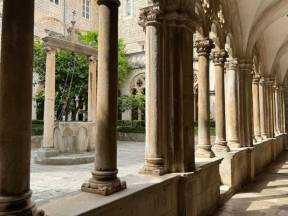
The complex includes the Gothic church of St. Dominic, a bell tower, a cloister and three monastery wings. The church of St. Dominic was the largest single-nave church on the eastern coast of the Adriatic, and the designs for it were made by Michelozzo di Bartolomeo, while the construction was led by local craftsmen. The cloister is special because of its combination of Gothic and Renaissance motifs, and in the middle there is a 16th-century well that could supply water not only to the monastery, but also to a good part of the city for three years. The design for the cloister was made by Masso di Bartolomeo from Florence, who was not actually an architect, but a sculptor and gunsmith.
The monastery was more than a religious center – already in the 16th century, the first public library and pharmacy in Dubrovnik were opened here, and in the 17th century, a free gymnasium accessible to all social classes was founded. The library was the first of its kind in this part of Europe, and today it houses 239 incunabula and numerous valuable manuscripts. Numerous brotherhoods operated in the monastery, including the oldest painting association in the Slavic regions, founded in 1492. This explains the wealth of artworks within the complex, among which stand out works by Dubrovnik masters Lovro Dobričević, Mihajlo Hamzić and Nikola Božidarević, as well as the large altarpiece of St. Magdalene from 1550, a work by the famous Titian.
It is particularly interesting that the church houses one of the largest painted crucifixes in Europe, a five-meter-high crucifix by Paolo Veneziano from 1350, which was erected as a vow against the plague epidemic. The museum, which has been open to the public since 1970, also houses a diptych by the Flemish master Hans Memling and works by Lorenzo di Credio.
Throughout its history, the monastery has suffered damage in the earthquake of 1667 and during the French occupation, but has been restored and adapted to new needs each time. Today, the museum houses a collection of over 200 incunabula, valuable manuscripts, paintings and objects of everyday life from different periods, providing an insight into the material culture of Dubrovnik through the centuries.
Another interesting fact: the oldest dated grave in the church dates back to 1315, and the name of the famous Dubrovnik builder Paskoj Miličević is inscribed on the church wall in gratitude for his contribution to the construction.
St. Dominic's Church
The Church of St. Dominic is located along the city walls, not far from the Ploče Gate, and is one of the most important Gothic buildings on the eastern coast of the Adriatic. Construction began in 1301 with great help from the citizens, and the church was consecrated in 1314. At that time, it was the largest single-nave church in this part of the Adriatic, with dimensions of 42 x 16 x 16 meters and high, smooth walls that give the space a sense of spaciousness and simplicity.
The church is single-nave, with a long nave and a pentagonal Gothic apse, separated from the rest of the space by three high Gothic arches. The exterior of the church is marked by square buttresses and a late Gothic portal on the southern facade, which is reached by a steep staircase. The portal and the figure of God the Father at the top were made by the Milanese master Bonino Jakovljev in 1418, together with stonemasons from Dubrovnik.
The interior of the church hides numerous works of art. Of particular note is the monumental crucifix by Paolo Veneziano from 1343, one of the largest painted crucifixes in Europe, which was commissioned as a vow against the plague epidemic. On the main altar is also the altarpiece "The Miracle of St. Dominic", painted by Vlaho Bukovac at the beginning of the 20th century. The church also houses an oil painting by Titian Vecelli from 1550, "St. Blaise with Mary Magdalene", and there are also works by Dubrovnik painters Nikola Božidarević, Lovro Dobričević and Mihajlo Hamzić.
It is interesting that the first public library in southeastern Europe was founded in the church of St. Dominic in the 16th century, and in the 17th century the first free gymnasium accessible to all classes of society. Many prominent Dubrovnik citizens are buried in the church: archbishops, noblemen, writers and craftsmen.
Another interesting fact: the monastery museum keeps the finger of St. Dominic, brought from Bologna in 1233, which makes this church an important place of pilgrimage.
Ploce Gate
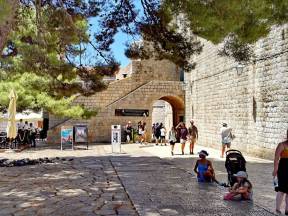
The Ploče Gate is the eastern entrance to the old city of Dubrovnik and one of the best-preserved parts of the city walls. This complex consists of inner and outer gates, connected by stone and wooden bridges that were a key point of the city's defense for centuries. The outer gate was built in 1450 according to the design of Simon della Cave, and the single-arch bridge was built a year earlier, modeled after the bridge at the Pile Gate. The wooden part of the bridge could be raised at night, which allowed for complete control of the entrance to the city and protection from attackers.
The inner gate is built in the Romanesque style, and above it is a statue of St. Blaise, the patron saint of Dubrovnik, whose figure was a symbol of the city's security and identity. During the Austrian rule in the 19th century, an additional, wider gate was built to facilitate the movement of people and goods.
Immediately above the inner gate rises the Asimon Tower, which further strengthened the defense and monitored the approach. In the immediate vicinity of the gate are two smaller churches - St. Luke and the Annunciation of the Virgin Mary. The Church of St. Luke now has an interesting new function: it has been converted into a gallery, which is a rarity among historic churches within the walls.
The area behind the gate is now known as Ploče, and this area has become popular due to its hotels, beaches, and easy access to the sea.
The Ploče Gate connects the old city with the Revelin Fortress, one of Dubrovnik’s most important defensive structures, and the main street, Stradun, which has historically been the city’s lifeblood.
Interestingly, Stradun was once a sea inlet that was only later filled in and transformed into the city’s main street, further attesting to the complex history of Dubrovnik.
Revelin Fortress
The Revelin Fortress is located at the eastern entrance to the Old Town of Dubrovnik, right next to the Ploče Gate, and it is clear at first glance why it was crucial in the defense of the city. The first requests for its construction appeared in 1449, and work began in 1463. The fortress owes its current form to the Italian engineer Antonio Ferramolin, whose plan from 1538 transformed Revelin into an almost impregnable quadrangular fortress with a sharp angle to the northeast. Construction according to this model was completed in 1551. The fortress was then surrounded by a deep moat and connected to the city by a stone bridge that could be raised if necessary.
Revelin was the first line of defense against Turkish attacks and played an important role in controlling the entrance to the harbor. After the devastating earthquake of 1667, the fortress remained almost intact and served as a temporary seat of government, while the state and cathedral treasuries were transferred there, which further confirms its importance. During archaeological excavations in the fortress, the remains of the workshops and furnace of the famous gunsmith Ivan Krstitelj Rabljanin, who made cannons and bells for the city, were found.
Today, Revelin is used as a venue for cultural and entertainment events, including concerts, exhibitions and events such as the Dubrovnik Summer Festival. The famous nightclub Culture Club Revelin also operates within the fortress, which regularly hosts world-famous musicians and DJs. The fortress has three entrances, and in the past it was surrounded by a moat on three sides and the sea on the fourth, which made it almost impregnable.
Old Port
Located beneath the city walls, this port developed during the Middle Ages as a key point for Dubrovnik's maritime trade and navigation. Already in the 15th century, it had a shape that has largely been preserved to this day, and its development followed the growth of Dubrovnik's maritime power and trade connections. It originally served as a dock for cargo and passenger ships, equipped with cranes for unloading goods and storage facilities.
Urban development is associated with the filling of the shallows between the mainland and the islets, which enabled the expansion of the area and the creation of the main city street, Stradun, which connects the port with the city center. The port was the epicenter of economic life for centuries, but its importance declined with the advent of larger ships, when commercial and passenger traffic was redirected to the port of Gruž, about two and a half kilometers away.
In addition to its commercial functions, the port was a place for ship repairs, storage of goods, and other maritime activities. Archaeological finds nearby confirm the long tradition of seafaring and trade in this area, with remains of Roman and medieval buildings.
Porporela
Located on the southeastern coast of the Pelješac peninsula, this is a small but historically significant port that has served as a port and haven for fishing and merchant ships for centuries. Although not as large as Dubrovnik's old port, its role in the local maritime tradition and economy was immensely important. Porporela was named after the Italian word "propera", meaning "dock" or "small pier", which clearly reflects its function.
It was built as a sheltered bay with a stone pier that served as a berth for smaller ships and boats, especially during the 15th and 16th centuries, when maritime trade and fishing in the Adriatic flourished. The stone used to build the pier was probably quarried from the surrounding rocks, and the construction itself demonstrates excellent knowledge of maritime conditions and construction techniques in the Middle Ages. Porporela was an indispensable port for local fishermen, but also for merchant crews who found shelter there from the bora and other inclement weather.
In the immediate vicinity of Porporela were warehouses for fish and marine goods, as well as workshops for repairing nets and ships. This port did not have a major military function, but it was part of a wider network of naval ports that enabled safe navigation and supply on the Adriatic.
Over the centuries, Porporela has undergone minor modifications and renovations, but has retained its original character as a small, functional port. In more recent times, although its role in commercial navigation has been replaced by modern ports, today it is used mainly for the docking of smaller vessels and tourist boats.
St. John's Fortress
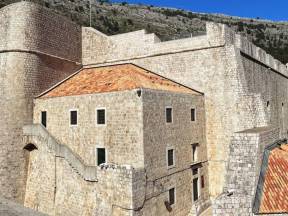
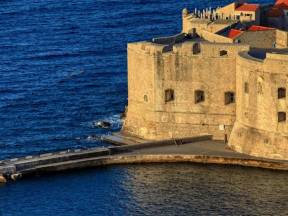
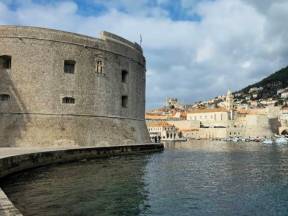
On the eastern side of the Dubrovnik walls, right next to the harbor, stands the fortress of St. John – a key point in the city’s defense from the sea. It was built in 1346 under the name “Fortress of the Mules”, and was later expanded and connected to the Gundulić Fortress according to the designs of the Dubrovnik engineer Paskoj Miličević. Since 1557, this semicircular structure has looked almost the same as it does today.
The fortress was built on a rock that emerges from the sea, which allowed for perfect control of the entrance to the harbor. On the south side, it protected the city harbor, while on the north side was guarded by the smaller fortress of St. Luke. A massive chain was once stretched between them – so strong that it could break the keel of any ship that tried to pass without permission. This chain guarded the entrance until the artificial island, the Kaše breakwater, was built in 1484, which further strengthened the harbor’s defenses.
The interior of the fortress was adapted to military needs: there were rooms for soldiers, gunpowder and cannon stores, and guardhouses from which each ship was monitored. In the 16th century, the fortress was additionally strengthened and raised, which made it possible to install more modern cannons.
Particularly interesting - the ground floor of the fortress is now home to the Aquarium, and the Maritime Museum on the upper floors. Part of the cultural treasures from the era of the Dubrovnik Republic are also kept here, and the fortress terrace is used as a stage for the Dubrovnik Summer Festival in the summer.
City walls
Welcome to the Dubrovnik City Walls. You are standing on one of the most famous and best-preserved defensive systems of medieval Europe. The walls completely surround the Old Town of Dubrovnik for almost two kilometers. They were built from the 13th to the 17th centuries, and their height reaches up to 25 meters. Their thickness varies - up to 6 meters towards the land, and between 1.5 and 3 meters towards the sea. The defense system includes 14 square towers, two round towers, two corner forts and four bastions.
In the 13th century, about 2,000 people lived within the walls, and by the 15th century, the number had increased to about 6,000. Since the city was not allowed to expand beyond the walls, the space inside them was limited and precious. The first fortress on this site was built in the 7th or 8th century, while the current appearance of the walls dates back to the 15th and 16th centuries. After the invention of gunpowder, the defense system was further strengthened to withstand artillery attacks. It was especially strengthened after important historical events, such as the fall of Constantinople in 1453, when the Minčeta Tower was built, the highest point of the walls overlooking the city.
One of the interesting things is that during the construction of the walls, everyone who entered the city was obliged to bring one stone, according to their physical strength, making the construction a joint effort of the entire community.
The walls have survived numerous sieges and natural disasters, including the earthquake of 1667 that destroyed most of the city, while the walls have remained almost intact. Today, they are a symbol of Dubrovnik and one of its most visited attractions. On average, more than 1.2 million people visit them annually.
Cable car Dubrovnik
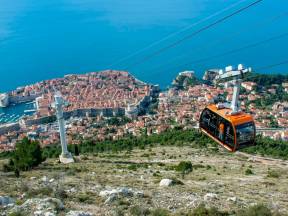
The Dubrovnik cable car is the only one of its kind on the Adriatic coast and connects the city to the top of Mount Srđ. It was opened in 1969 and immediately became a significant attraction, as it was the first cable car on the Adriatic intended for tourists. The first cabin could carry up to 15 passengers. Mount Srđ is of strategic importance as it served as a natural defensive point above Dubrovnik for centuries. During the Homeland War, the cable car was severely damaged; one cabin remained on the top, while the other was destroyed. The cable car was out of service for almost 20 years.
It was renovated and put back into operation in 2010, on the opening day of the Dubrovnik Summer Festival. The new cable car has two cabins, each with a capacity of 30 people, and can transport up to 1,000 people per hour in each direction. The ride takes about 4 minutes. At the top of Mount Srđ is the Imperial Fortress, built in the early 19th century during the French administration, which is now the Museum of the Homeland War. From the plateau in front of the fortress there is a view of the city, the Elaphite Islands and the open sea. Today, the cable car is one of the most visited tourist attractions in Dubrovnik.
Imperial Fortress
You are currently at the top of Srđ Hill, at the Imperial Fortress, built between 1806 and 1812 during the French administration, as a defense against Russian and Montenegrin forces. The project was led by General Auguste Marmont, and the stone for the construction was transported from Korčula.
After the fall of Napoleon, the fortress came under Austrian rule, which further fortified it and used it until the end of the 19th century. During the Homeland War in 1991, it became a key defensive stronghold in the defense of Dubrovnik, especially during the Battle of December 6. The fortress suffered damage at the time, but remained preserved.
Today, it houses the Museum of the Homeland War. Together with other defense structures on Srđ, it formed an important part of the fortification system, and due to its position above the UNESCO-listed city core, it had the greatest strategic importance.
Cross on Srđ
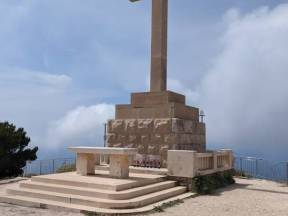
At the top of Srđ Hill, not far from the Imperial Fortress, we find ourselves near a large white stone cross – a symbol of faith, suffering and resilience of the Dubrovnik region. The first cross was erected in 1935 on the occasion of the 1900th anniversary of Christ’s passion, death and resurrection, as an expression of the spirituality of the local community and an important religious monument of that time.
During the Homeland War, Srđ Hill was one of the main defensive points in the defense of Dubrovnik. In the shelling of 1991, the original cross was completely destroyed, but the defenders erected a wooden cross in the following days – a sign that the spirit of defense would not surrender. After the war, thanks to the initiative of Bishop Želimir Puljić, the renovated stone cross was ceremonially erected on 12 October 1997, and blessed by Cardinal Franjo Kuharić. The remains of the destroyed cross have not been forgotten – in 2003 they were blessed by Pope John Paul II in Gruž and have been incorporated into new churches and altars throughout the Dubrovnik diocese. Renovation followed after the war, and in 1997 a new cross, made of white stone and about 10 meters high, was erected. The cross was erected on the same spot, as a sign of remembrance of the fallen defenders and a symbol of peace and freedom.
Today, the cross on Srđ is an important memorial and viewpoint, as its position offers a panoramic view of the Old Town of Dubrovnik, the Adriatic Sea and the surrounding islands.