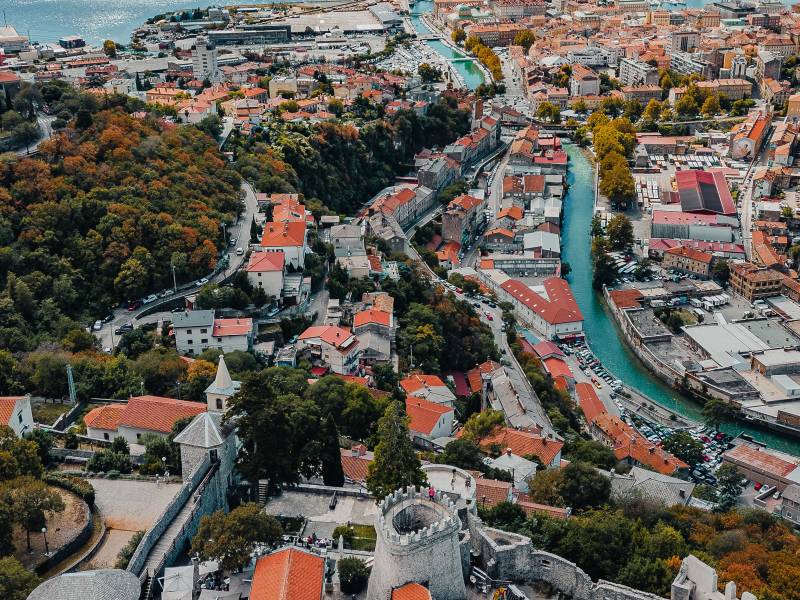
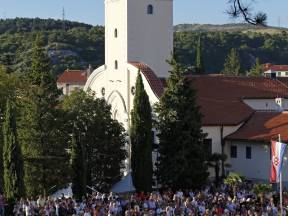
Rijeka is the third largest city in Croatia, with a population of around 110,000. It is located on the Kvarner Bay and is known as an important port and industrial center of the country. The city has a rich history that is reflected in various architectural styles, from Austro-Hungarian palaces to modern buildings. Rijeka hosts numerous cultural events, including the famous carnival that attracts thousands of visitors every year.
Audio guides available in:
中文, English (British), Deutsch , Hrvatski, Français, Dansk, Slovakian, Español, 日本語, Italiano, 한글 , Polski, Nederlands, русский, Українськa, Arabic, Svenska, Português, English (American), Suomalainen, Slovenian, Czech, Hungarian
To find more content and listen to free audio guides, download the Guide To Go app.
Rijeka
Points of interest
The fountain with the mill on Koblerov square
You are now in Ivan Koblera Square, in front of the fountain known as the “Old Mill”, which is a symbol of Rijeka’s industrial past and modern identity. Designed in 1974 as a monument to the Hartera paper factory, it depicts a mill – a mill used to process pulp into paper, stylized as a monumental turbine located in the center of the fountain’s decorative basin.
The reinterpretation of the fountain’s classic shape is combined with industrial symbolism – two large stone wheels (mill elements) stand parallel and are raised above a water tank, creating a strong visual impression that evokes the energy of the city and the industrial foundation of the “Paper City”.
The fountain was integrated into the large-scale landscaping of the square in 2014–2015: the renovation included the rehabilitation of underground installations against groundwater outbursts, paving with granite and Kastav grey, the installation of LED lighting inside the fountain’s steps, and new public lighting that highlights the fountain and the passage of the Ura under the city walls.
Although at first glance it looks like a picturesque urban art installation, the fountain actually reminds of Rijeka's technical prowess and its industrial character, and the constant presence of water makes it a favorite meeting place for locals and visitors.
An LED light strip is built into the edges of the fountain's steps, creating the effect of the blurred circular motion of a mill wheel at night. The "Stari kolodrob" fountain thus symbolically interprets the past production function and transforms it into an aesthetic element of the urban space, where industry becomes an art form.
City tower
The City Tower is located in the very heart of Korzo, Rijeka's main promenade. Although it is now seen as a picturesque landmark and symbol of Rijeka's urban identity, its history dates back to the Middle Ages, when it served as a city gate — a transit tower that marked the entrance to the then fortified city. It was probably built on the foundations of the late antique city gate, and over the centuries it has undergone numerous architectural modifications that have shaped its current appearance.
After the great earthquake of 1750, Empress Maria Theresa encouraged the reconstruction of the city, and as part of this process, the tower received a Baroque portal with relief busts of Emperors Leopold I and Charles VI, as a sign of gratitude for decisions that were important for the development of Rijeka, such as the proclamation of a free port. During the 18th and 19th centuries, it was further expanded by architects Antun Gnamb and Filibert Bazarig, which gave it its characteristic historicist appearance with a tambour and dome. The tower was protected as a cultural and historical monument in 1983.
One of the most interesting details of the tower is the relief of a double-headed eagle with the motto "INDEFICIENTER", which means "incessantly" or "inexhaustibly". This symbol of loyalty to the Habsburg Monarchy has a rich and turbulent history. During the 20th century, the fascists removed one of the eagle's heads in 1919, and after World War II, the communist authorities decided to remove the sculpture entirely. However, in 2017, ahead of the Rijeka - European Capital of Culture project, a new replica of the double-headed eagle was installed, made according to preserved archival designs. The sculpture is aluminum, 2.5 meters high, with a wingspan of 3 meters, and today it once again adorns the top of the tower, approximately 30 meters above the Korzo.
The interior of the tower hides an old clock mechanism from the 19th century, as well as a system for controlling public lighting and fountains. The passage under the tower leads to Rijeka's Old Town, and numerous memorial inscriptions and medieval stone details have been preserved alongside it. The city tower in Rijeka thus serves not only as a clock or a landmark in space, but also as a symbol of loyalty, history, political changes, and the city's enduring connection to its identity.
Roman arch/old gate
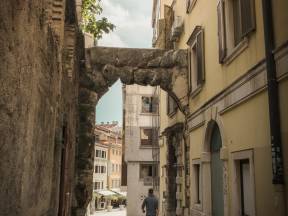
Now you have the Roman Arch, also known as the Old Gate in this area. This structure is not a triumphal arch as was initially assumed, but was the main entrance to the center of the late antique military-administrative complex, or rather the command post of the Roman fortress called Tarsatica. The Roman Arch was built sometime between the 3rd and 4th centuries, as part of the Liburnian Limes fortification system that protected the Roman borders from barbarian attacks.
This architectural monument is about 5.8 meters high and about 3.6 meters wide, and it was built of large stone blocks without any binding material, which contributed to its longevity. The Roman Arch is the oldest preserved architectural monument in Rijeka and testifies to the importance of the city in ancient times. Archaeological research has confirmed that the arch was the entrance to the military fortress (praetorium) and part of the walls that protected the city from the 3rd to the 5th centuries. This fort was a key part of the Claustra Alpium Iularum defense system, which connected the Rijeka area with the hinterland and protected Roman territories from enemies.
Today, the Old Gate is in poor condition, with visible damage and cracks in the stone blocks, which is why conservators have launched initiatives for its restoration and protection. Restoration and conservation works began in 2019, and are expected to continue and be fully restored.
Palaca Municipia (city hall)
In front of you is the Municipija Palace, the former seat of the Rijeka city government, which dominates the Rijeka Resolution Square with its elegant appearance. This building was the home of the city government from 1833 to 1945, bearing witness to the turbulent periods of the city's history and the changes of government that have marked Rijeka.
The palace's current appearance dates back to the second half of the 19th century, when it was redesigned in the spirit of Venetian classicism by the famous architect Dr. Filibert Bazarig. The three facades are particularly impressive, carefully composed and connected to the surrounding historical buildings - primarily the Baroque Church of St. Jerome and a series of classicist buildings on the square.
It is interesting that before this palace, the city government operated for centuries in the Palac Komuna, a Renaissance building across from the City Tower, which, in addition to its administrative function, also had a cultural function - it was here, among other things, that the famous composer Ivan pl. Zajc gave his first musical performance and received his lessons.
The Municipium Palace stands out for its elements of moderate scenography: the harmonious rhythm of shallow pilasters, triangular and segmental gables, and the horizontal cornice under the attic give it an elegant appearance and reflect a blend of Renaissance and Classicism. Key political decisions were made here and intense social life took place, especially during the period of dynamic changes during the 19th and 20th centuries.
Today, the palace no longer serves as the city hall, but it still bears witness to the rich tradition and identity of Rijeka.
Church of the Assumption of the Blessed Virgin Mary
The Church of the Assumption of the Blessed Virgin Mary – known among the people of Rijeka as Vela Crikva or Assunta – is one of the oldest and most complex sacral buildings in the city. Located in the historic core, this church shows how centuries, architectural styles and the rich cultural heritage of Rijeka intertwine in one place.
The church was built in the early Middle Ages on the foundations of Roman baths, whose hypocaust – an underfloor heating system – still lies hidden under the surrounding buildings. The first written traces of the church appear in the 15th century, and throughout history it has been damaged, renovated and extended several times. Of particular importance is the restoration after the demolition in 1509 and the large Baroque extension from the end of the 17th to the mid-18th century, when it was designed as a three-nave basilica richly decorated with stucco and altarpieces by renowned masters such as Michelazzi, Pasquale Lazzarini and Valentin Metzinger.
The church complex features the famous Leaning Tower, which emerged from an old medieval wall and was partly founded on the remains of late antique buildings. Due to different foundations and groundwater, its top is now tilted by about 40 cm from the vertical, making this building a recognizable symbol of Rijeka.
The Baroque interior of the church is particularly impressive with its numerous marble altars, among which the main altar by Jacopo Contiero stands out, as well as the triumphal arches and stucco work by Giulio Quadri. The sanctuary houses the tomb of the patrician Orlando family, and among the altar paintings, the altarpiece by Ivan Simonetti from 1852, a skillful replica of Titian's famous "Assunta", is important.
The value of this location was further confirmed by an archaeological discovery in 2020, when fragments of an ancient stone slab with a relief of two dolphins and the trident of the god Neptune were found under the church - symbols traditionally associated with the protection of sailors and early Christian customs on the Adriatic.
The church underwent numerous renovations throughout the 19th and 20th centuries, and the latest conservation works include the restoration of the vaults, the planned restoration of the new lapidary and the installation of a seismological device to protect the Leaning Tower.
Leaning Tower
You are standing in front of the Leaning Tower, whose history goes back far into the Middle Ages. This bell tower of the Church of the Assumption of the Blessed Virgin Mary attracts attention not only with its modest, Romanesque appearance, but also with its unusual slope, which is why the people of Rijeka proudly call it “leaning”.
The year 1377 is carved into the entrance to the tower, which means that this monument has withstood the test of time and challenges for more than six centuries. However, the tower is actually older – its original core was built even earlier as a steadfast guardian, one of the few preserved witnesses to the lost Old Town of Rijeka.
The tilt of the tower, which today is about 40 centimeters, was first accurately measured in 1920. The culprit for this unusual inclination is the underground stream Lešnjak, which has been undermining its foundations for years. Although tilted, experts tirelessly repeat that the structure is completely stable and safe for curious visitors.
The Leaning Tower has also survived devastating earthquakes, such as the one in 1750, after which it was partially demolished and rebuilt. Its current pointed roof and height were shaped in the 18th century, while its Romanesque appearance was restored in 1928. Built of massive stone blocks, it gave Rijeka an authentic example of medieval architecture.
Interestingly, the tower was the tallest in the former Old Town – even older than today's favorite city promenade, the Korzo.
St. Vitus Cathedral
You are now looking towards the Cathedral of St. Vitus, a Baroque rotunda of monumental proportions that has dominated the Rijeka landscape for centuries. Construction of the church began on June 15, 1638, and lasted, with interruptions, for almost a hundred years.
The project was conceived by the Jesuit architect Giacomo Briano, inspired by the more famous Venetian church of Santa Maria della Salute. It was built on an elevated spot in the center of the then medieval city, on the site where the smaller church of St. Vitus, the patron saint of Rijeka, previously stood. The miraculous crucifix from the old church was incorporated into the main Baroque altar, which connects history with spiritual tradition.
During construction, the initial design was modified, and in 1727, architect Bernardin Martinuzzi added a gallery on the first floor. This gallery also had the function of separating the monastic novitiate from the common people during liturgical ceremonies, which testifies to the complexity of church customs at the time.
The Cathedral of St. Vitus played an important role not only as a religious center but also as a place where the captains of Rijeka took their solemn oath before starting their service. It was financed by the funds of Countess Ursula Thanhausen and the income of the Kastav estate, and its interior is richly decorated with Baroque altars, works of art and valuable liturgical objects related to the history of Rijeka and the activities of the Jesuit order.
The interior hides works of art, among which the works of Antonio Michelazzi, the most important Baroque marble sculptor on the Croatian coast in the 18th century, stand out. However, it is worth noting that the facade cladding was never completely completed with stone slabs, which is a consequence of the long duration of construction and changes in plans.
The cathedral was a Jesuit monastery church, and only in 1925 did it acquire the status of a cathedral church, which further confirms its importance in the spiritual and cultural life of Rijeka. Through this church, the influence of the Jesuit order on the development of the city was enormous, especially through education and social engagement.
Calvary, Kozala and the church of St. Fabian and Sebastian
The Calvary above Kozala in Rijeka guides travelers through the course of religious tradition and the historical layers of the city. Like the Stations of the Cross that once led pilgrims to the top, the paths from the bottom to the top of the hill bring a sense of the past tinged with important religious meaning. On the slope, there used to be chapels depicting the various stations of the Passion of Christ – today, only a few stone remains and parts of Roman-Baroque walls remain, often overgrown with greenery and not entirely accessible for viewing.
At the top of the climb, the site of the Church of St. Fabian and Sebastian dominates the medieval atmosphere. This small sacral building has served as a votive chapel since the 13th century, built according to tradition in 1291 during the plague. However, its current appearance dates back to the 16th century, when a local brotherhood built a chapel dedicated to St. Sebastian. An inscription from 1562 above the entrance attests to the time of construction.
The chapel is located in one of the kalae, narrow medieval passages, just above a late antique wall that was discovered during restoration and is now incorporated into the sacristy. Archaeological work has revealed that the foundation of the church is undeniably connected to ancient Tarsatica, an old Roman settlement under present-day Rijeka.
Although small and modest in decoration, the chapel has historical weight – it survived attempts to demolish it because the citizens recognized its importance and connection to processions and folk tradition. Today, although covered in greenery and somewhat abandoned, it bears traces of past times – from epidemics to ancient ramparts, to the steep footpath that connects Kalvarija with the city.
City market (marketplace)
At this moment, in front of you is the city market, also known as the placa. The placa is one of the liveliest city spaces with a long tradition dating back to the 19th century. It is located on an area that has been gradually filled in by the sea since 1825, near the Rijeka theater and port, on the spot where local fishermen used to land and sell their catch in the open air.
The market itself consists of three main buildings: two identical pavilions and the fish market building, which together form a harmonious urban complex. The two pavilions were built in 1880-1881 according to a design by engineer Izidor Vauchnig, using the most modern iron construction and glass at the time, which was an innovative approach for the time. Their facades are decorated with reliefs of fruits and vegetables, and the interior is designed as a large, high room without partitions, with sales booths along the outer shell of the building. The fish market, which was originally open, was covered from 1866, and the current fish market building was built in the period from 1914 to 1916 according to the design of the Rijeka architect Carlo Pergoli. He showed a preference for Viennese Art Nouveau in his design, and the facade and interior are decorated with stone decorations with motifs of marine life, the work of the Venetian sculptor Urbano Bottass. These decorations include capitals, fountains and reliefs of fish, crabs and octopuses, which create an impression of liveliness and invite passers-by to enter the fish market.
Over the years, the market was closed only during the renovations in 1971 and 1974, and the restoration in 2009 returned the pavilions to their original green color and renewed the decorative elements, thus preserving its historical appearance and significance in the daily life of the city.
Promenade
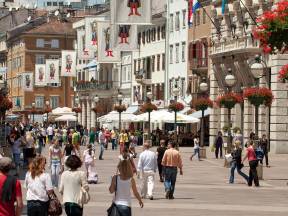
You are now on the most important city street and promenade of Rijeka, called Korzo. The name "Korzo" comes from the Italian "corso", which means main street or promenade, and the street began to take its final, recognizable form in the first half of the 19th century, after the demolition of the city walls and major works on filling the shore. Here, on the former seashore, representative palaces of various architectural styles grew up - from classicism, historicism, art nouveau to modernism - which still bear witness to Rijeka as one of the cultural and economic centers of the Mediterranean.
At one end of the Korzo rises the City Tower, the symbol of the city and the most popular orientation point, while the other end is completed by fountains and the tall "Rijeka skyscraper-house" on Jadranski trg. The streets are filled with pedestrians of all generations and nations every day - tourists, citizens and business people - whose bustle creates the urban mosaic of a city known for its interculturality and openness.
Korzo has always been the epicenter of city life – from morning coffees to evening walks, shops and famous cafes, but also a gathering place during the Rijeka Carnival, themed fairs, sports celebrations and cultural performances. Every corner hides a piece of history: from the city hall and department stores to legendary pastry shops and galleries.
Croatian National Theatre Ivan Pl. Zajc
Before you is the Croatian National Theatre of Ivan pl. Zajc, the central stage of theatrical life in Rijeka. The first theatre on this site was built back in 1765, but the current building opened on 3 October 1885 under the name Teatro Comunale. It was designed by the famous Viennese architects Ferdinand Fellner and Hermann Helmer, who designed more than 40 theatres across Europe, including the Vienna Volksoper and the Zagreb Croatian National Theatre.
The theatre was built in the neo-Baroque style, and the façade is adorned with statues by the Austrian sculptor Völkel. Of particular interest: the ceiling was painted by Gustav and Ernst Klimt, and Gustav Klimt later became one of the most famous painters of the Art Nouveau period. The first performances were Verdi’s “Aida” and Ponchielli’s “La Gioconda”, which immediately raised the bar for artistic quality.
Over the years, the theatre has changed names – from Teatro Comunale, to Teatro Verdi, to the National Theatre after World War II. It has had its current name since 1994, in honor of the composer Ivan pl. Zajc, whose opera “Nikola Šubić Zrinjski” became a symbol of Croatian musical heritage.
A major renovation was carried out between 1970 and 1981. At that time, all technical systems were modernized, but the exterior of the building remained almost unchanged, which is rare for such interventions.
Today, the Ivan pl. Zajc Croatian National Theatre has four artistic ensembles: Croatian Drama, Italian Drama, Opera and Ballet. Interestingly, the Rijeka theatre is one of the few in Europe to have a permanent Italian drama ensemble, which reflects the rich multicultural history of the city. The repertoire is diverse – from classics to contemporary works – and regularly attracts audiences from all over the region.
Modello Palace
You are now looking at the Modello Palace. This impressive building was built between 1883 and 1885, exactly on the site where the famous Adamić Theatre once stood. The project was designed by Fellner and Helmer, Viennese architects whose buildings have marked many European cities – including the Croatian National Theatre of Ivan pl. Zajc in Rijeka.
The Modello Palace immediately attracts attention with its neo-Baroque façade and rich combination of Renaissance and Baroque elements. This blend of styles was a rarity in Rijeka at the time, and the palace, interestingly, was built at a time when Rijeka wanted to rival Trieste, and even the name “Modello” was taken from Trieste, where there is a palace of the same name. The façade is adorned with sculptural reliefs by the Rijeka sculptor Ignazio Doneghani, while the wrought iron details are the work of Matija Dumčić. There is also a memorial plaque on the façade from 1897, which was placed by Adamić’s grandson, the then mayor Giovanni Ciotta.
The interior of the palace is equally interesting – the staircase and the ceremonial hall exude luxury, and in the past each booth of the café was decorated in a different oriental style, from Turkish to Persian. Originally, the palace was the headquarters of the Rijeka Savings Bank and the Casinò Patriottico society, which was a popular form of cultural gathering at the time. Many still remember the café on the ground floor, where Frano Supilo, a famous journalist and politician, also drank coffee.
Today, the palace houses the premises of the Italian Union and the Circolo italiano di cultura, and until recently, the Rijeka City Library operated here for more than half a century. Interestingly, the Modello Palace was built during a cholera epidemic, which did not prevent the city authorities at the time from investing significant funds in its construction and decoration.
The Modello Palace is not only an architectural gem, but also a symbol of Rijeka's competition with other Adriatic cities, especially Trieste.
Today, it is still open, the premises are available to visitors and everyone can enjoy this unique part of Rijeka's history.
Former Rikard Benčić factory
In front of you stands the former Rikard Benčić factory, which holds great importance in Croatia as a significant industrial complex. The factory is a symbol of Rijeka's transformation from a city of industry to a city of culture and creativity. Located in the very heart of the city, the factory testifies to the rich industrial past of the city of Rijeka, but also to its contemporary vision of development.
The complex itself was built in the 18th century as a sugar refinery, and is one of the first industrial factories in the Rijeka area. During the 19th century, as the city changed and developed, the complex also changed its function. The complex served as a tobacco factory, then as a military warehouse, and then as a ship and motor equipment factory. The factory gets its name in honor of Rikard Benčić, a prominent worker and national hero of World War II, which symbolically connected the long industrial tradition with the labor movement, and also the socialist period of Rijeka.
Sometime in the second half of the 20th century, the factory was one of the most important production bases in the Rijeka area, employing thousands of workers. However, as with all other industrial factories in Croatia, there comes a time when they cease to operate due to economic transitions during the 1990s and early 2000s.
After a long period of neglect, the Rikard Benčić complex has become one of the key projects for the cultural revitalization of Rijeka, especially in the context of preparations for the European Capital of Culture 2020. The complex is a valuable example of industrial architecture that ranges from Baroque to Modernism. The renovation was carefully carried out with the aim of preserving historical elements such as stone walls, iron structures and industrial details, while introducing modern technologies and functionalities. The project was co-financed by European funds, which enabled a high-quality and sustainable revitalization.
Museum of Modern and Contemporary Art
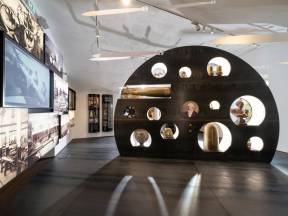
The Museum of Modern and Contemporary Art Rijeka (MMSU) lives in the renovated industrial space of the former Rikard Benčić factory. Founded in 1948 as the Gallery of Fine Arts, MMSU arrived at its current location only in 2017, after decades of “wandering” through several city spaces: the Governor’s Palace, the University Library building, and former city gallery spaces.
The museum’s current concept, designed by architect Dinko Peračić, is known for its “museum in the making”—the raw industrial floors, original columns, and concrete structure have been preserved, while the minimalist styling allows for a flexible gallery space recognized by domestic and international professionals (the project earned MMSU the Bernardo Bernardi Award).
The museum does not have a permanent exhibition: exhibitions are constantly on the move, bringing the audience selective retrospectives, thematic cycles, international and young artists, as well as project formats that comment on contemporary themes, the city, community, and society. MMSU systematically gathers and preserves collections of graphics, drawings, photography, posters and multimedia art, with a special emphasis on the works of key Rijeka and Croatian artists (e.g. Romolo Venucci, Božidar Rašica, Slavko Grčko).
In addition to the Rijeka Salon, the Biennale of Young Artists and a collection of international drawings, MMSU regularly encourages urban interventions, performances, guest workshops and involves people of all generations through educational programs and talks with artists. During the Rijeka 2020 – European Capital of Culture project, MMSU became an epicenter of domestic and European contemporary art, open to experiments, interdisciplinary dialogues and visual innovations.
Governor's Palace
You are now standing in front of the imposing Governor's Palace, one of the most important historical and architectural symbols of Rijeka. It was built between 1893 and 1896 according to a design by Alajos Hauszmann, on the orders of Governor Lajos Batthyány. The palace was built in a neo-Renaissance style inspired by the Italian Renaissance and is located on a hill overlooking the Rijeka harbor, making it one of the representative places in the city's panorama.
This building was not only the residence of the governor, but also the center of important political events until 1945. During its rich history, it often changed the flags of various countries, reflecting the turbulent past of Rijeka and the region.
Since 1948, the palace has been home to the Maritime and Historical Museum of the Croatian Littoral, whose collections present the development of maritime affairs and the historical heritage of the Primorje-Gorski Kotar County - from prehistoric times to the present day. Some of the original furniture, art objects and sumptuous salons, such as the Red, Green and Marble Halls, have been preserved and are available to visitors.
The museum exhibition “Through the Window of the Governor’s Palace” highlights the historical significance of this location, offering an interactive insight into political and cultural events from the late 18th to the mid-20th century. Here, visitors can learn more about the role of the governor, relations with the Habsburg Monarchy and turbulent changes of government, including the period of annexation to the Kingdom of Italy.
Natural History Museum
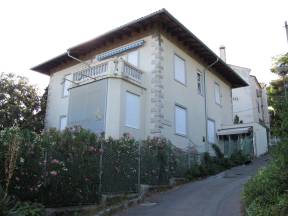
Now you are in front of the Rijeka Natural History Museum, one of the oldest and most important museums in Croatia, dedicated to the research, preservation and presentation of the natural heritage of the Rijeka area and the wider region. Located in the historic villa of Count Negroni, within the green Nikola Hosta Park in the very center of Rijeka, the museum is a meeting place for science, education and culture.
The museum itself was founded on May 16, 1876, at the initiative of Dr. Josef Roman Lorenz, who modeled its concept on the Vienna Naturhistorisches Museum. The museum has gone through numerous phases of development and expansion throughout its history, and has been operating as an independent institution since 1945. It was first opened to the public on May 1, 1946, and since then it has been continuously enriching its collections and programs.
The Rijeka Natural History Museum preserves around 90,000 exhibits arranged in 26 collections covering a wide range of natural history topics. Among them are minerals, sponges, algae, insects, birds, mammals, reptiles and amphibians characteristic of the Rijeka area and its surroundings. The museum has also modernized its exhibitions by introducing multimedia content and interactive educational workshops, such as the "Aquarium - Multimedia Center" on the ground floor, where children and adults can learn about the marine world through play.
In the immediate vicinity of the museum is a botanical garden, opened in 2005, which presents the natural flora of the Rijeka area. The garden is designed as a place for relaxation, but also as an educational space where visitors can learn about indigenous plant species and their role in the ecosystem. The Natural History Museum also manages the permanent exhibition "Wildlife with a View of the Sea" in the historic Zrinski Castle in Brod na Kupi. This exhibition was awarded the annual award of the Croatian Museum Association for the best permanent exhibition in Croatia. Through interactive exhibitions and the "Paths of Frankopan" interpretation center, visitors can explore the natural heritage of Gorski Kotar and learn about the history of this region.
Rijeka City Museum
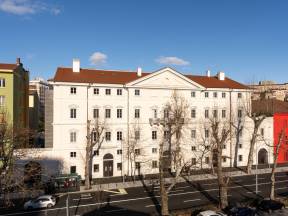
You are currently viewing the Rijeka City Museum, a general cultural and historical city museum founded in 1994 by renaming the former Museum of the People's Revolution Rijeka, which had been operating since 1961. Since 2020, the museum has been located in the historic Sugar Mill Palace, one of the important Baroque monuments in Rijeka, while other museum locations include a 1976 building in the courtyard of the Governor's Palace and the motor ship Galeb.
The museum collects, processes and restores materials related to the history, culture, economy, politics, science, education and sports of Rijeka from the 18th to the 21st centuries. By organizing exhibitions, research projects and publishing catalogues, the museum presents the rich history of the city and its notable citizens, such as architects, artists and scientists.
The museum building from 1976 was designed by architect Neven Šegvić, who received awards for the best architectural achievement in Croatia for this work. The museum itself is an important cultural center of Rijeka, preserving and presenting the city's documentary and material heritage, and actively participating in the cultural life of the community.
The Rijeka City Museum is a key institution for the preservation and promotion of Rijeka's history and culture, housed in historic and modern spaces, with a rich permanent collection and numerous exhibitions that depict the city's development through the centuries.
Rijeka Tunnel
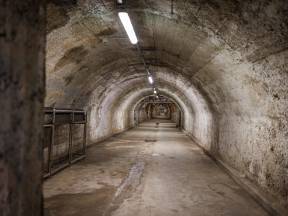
Now you are standing in front of the Rijeka Tunnel, also known as TunelRi. This is an underground pedestrian tunnel about 350 meters long, located under the historic center of Rijeka, from the Cathedral of St. Vitus to the courtyard of the Dolac Elementary School. It was built between 1939 and 1942, and was dug by the Italian army in the living rock with the aim of protecting the civilian population from Allied air bombing during World War II.
The tunnel is about 4 meters wide, and its average height is 2.5 meters, while in some places it descends to a depth of ten meters. It has two blind branches; one leads to the Rijeka Resolution Square and the building of the former city municipality, and the other to the Cathedral of St. Vitus. The original inscriptions from the war are still visible on the walls of the tunnel, such as "Riservato all U.N.P.A." ("Reserved for air defense").
During 1944 and 1945, when Rijeka was subjected to intense Allied bombing, the tunnel served as a shelter for the population. It also had a similar function during the Homeland War, when citizens took refuge in it on two occasions.
After being closed for almost 75 years, the tunnel was thoroughly cleaned, renovated and equipped with new lighting, and on May 5, 2017, it was reopened to the public as a tourist attraction and public passageway. The tunnel's internal temperature is stable at around 15°C, making it pleasant to visit throughout the year. As part of the renovation, a video installation "Tunel-RI" by Sandro Đukić was installed as part of the contemporary art content.
Today, the tunnel is a popular tourist destination that offers visitors a unique insight into Rijeka's history and military architecture, while also being an important reminder of the difficult wartime times the city went through.
Archaeological Park Principius
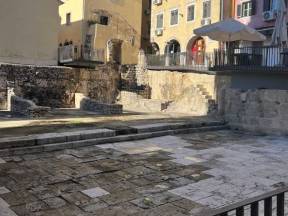
You are in the very heart of Rijeka's Old Town, home to the Principium Archaeological Park, an authentic place where history literally springs from the ground. Here, on Jurja Klović Square, around the Church of St. Vitus and along Pod Voltun Street, you can see the well-preserved remains of a Roman military-administrative complex, once crucial to the life of the Roman garrison on the edge of the empire.
Archaeological excavations conducted in 2007 under the supervision of the Croatian Conservation Institute revealed the complex layout of the Principium from the second half of the 3rd century. The center of the complex was an open paved courtyard, surrounded on three sides by rooms intended for storing weapons and equipment, while the fourth side was closed by a monumental building - a basilica, probably used for administrative and religious purposes. Remains of side rooms, staircases, paving and the facade of the central building were also found - all of which testify to the architectural ingenuity of the Romans of late antiquity.
Throughout history, medieval, Renaissance and Baroque houses were built on the foundations of Roman principles. The ancient walls – built using the advanced opus mixtum technique (alternation of layers of stone and brick) – are now preserved in places up to the height of the second floor of neighboring historic buildings, unobtrusively integrated into the fabric of the city.
The current appearance of the park is the result of a project by architect Nenad Fabijanić, who designed the space as a public archaeological ground-level park, functional for cultural events and everyday life at the same time. The contrast of the white lamellar structure and red concrete, which clearly marks the border between the ancient layers and the modern city, is particularly striking. The landscaping of the park was made possible by significant investments from the monument rent of the City of Rijeka and the Ministry of Culture, and the grand opening in 2014 was accompanied by cultural events, light projections and hologram exhibitions.
Dominican monastery and church
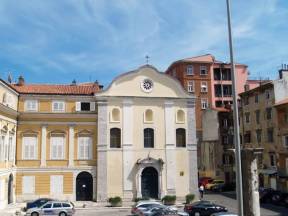
Right before you stands the Dominican Monastery and Church of St. Jerome, an important religious and cultural-historical complex in the city center. Located on the Rijeka Resolution Square, they bear witness to centuries of history and architectural changes and a spiritual tradition that has lasted for more than seven centuries.
The complex was originally founded in 1315 as an Augustinian monastery, under the patronage of Rijeka's feudal lords, the Dukes of Devin. Construction began during the reign of Ugon II and was completed in 1408 under the administration of his grandson Ugon VI. The Augustinian order operated here until the end of the 18th century, when the reforms of Emperor Joseph II abolished many monasteries, including this one. After almost two centuries, in 1951, the complex was taken over by the Dominicans, who renovated it and continued their long spiritual and cultural mission. Since then, the monastery and church have once again lived as an active religious center of Rijeka.
The Church of St. Jerome was originally built in the Gothic style, but after the devastating earthquake of 1750 it underwent significant Baroque alterations. It was expanded and raised, and the interior is richly decorated with Baroque elements. The main altar from 1744 is the work of the famous sculptor Antonio Michelazzi, while the altarpiece "The Virgin Mary with St. Jerome and St. Augustine" from the 17th century also depicts a panorama of Rijeka at that time, which is a rare historical document.
Within the monastery complex there are two important Gothic chapels, the Chapel of the Holy Trinity and the Chapel of the Immaculate Conception. The monastery cloister is today the site of a lapidary, where tombstones and monuments of the Augustinians and the Devin-Walsee family are exhibited, which further testifies to the historical significance of this place.
The Dominican Monastery and the Church of St. Jerome are still an active spiritual center of Rijeka today. Regular masses are held on Sundays and weekdays, and the monastery is also open to visitors interested in history, architecture, and art.
Dead channel
At this moment you are looking at the Dead Canal, which was once the natural old riverbed of the Riječina River, which in the 19th century became separated from the new riverbed and turned into a harbor for boats and smaller ships. Its name, "Dead Canal", originates from the 19th century, after the Riječina River was regulated and its flow redirected to a new, excavated riverbed that led the river directly to the sea. As a result, the old riverbed, or the Dead Canal, remained filled with sea water and lost its river course.
The original port of Rijeka was located precisely in the area of the Dead Canal, which stretched from today's Jelačić Square to Školjić. Due to frequent floods and problems with the swollen Rječina River, after a major flood in the mid-19th century, it was decided to regulate the river flow by excavating a new riverbed, which was carried out between 1854 and 1855 with a large investment and personal intervention by Emperor Franz Joseph. The new channel led the Rječina River straight into the sea, while the old channel became the Mrtvi kanal. Between the new and old channels, an area known as the Delta was created, due to its triangular shape similar to the Greek letter delta.
The Mrtvi kanal has historically played an important role as a border between parts of Rijeka, especially in the 20th century, when it divided the city into a part that belonged to the Kingdom of Italy and Sušak, which was part of the Kingdom of Serbs, Croats, Croats and Slovenes. The Mrtvi kanal was also a place where port and trade activities took place, and along its banks there were warehouses and markets.
Today, the Mrtvi kanal serves as a port for smaller ships and boats and is an important historical and urban area of Rijeka, which bears witness to the long and complex history of the regulation of the Rječina River and the development of the Rijeka port area.
Railway station
Right now, when you look at the Rijeka railway station, you are looking at one of the key places in Croatian transport, industrial and cultural history. The first station here was opened in 1873, which immediately placed Rijeka among the most important ports and traffic points in the region – it was the only point in Croatia at that time where two railway lines arrived at the same time: one from Karlovac and Budapest, the other from Ljubljana and Vienna. At that time, other Croatian cities were just getting their first railway lines, and Rijeka was already a significant European transport hub.
After the great fire of 1888, a larger and more representative building was erected on the same site in 1891 according to the designs of architect Ferenc Pfaff, who also designed the Zagreb railway station. The building is an example of classicist architecture: a massive central pavilion, two side wings connected by lower parts, and a spacious square in front further emphasizes the monumentality of the entire complex.
The Rijeka railway complex does not only consist of the station building – there are also historic locomotive sheds, turntables, warehouses and administrative buildings, many of which are now protected as cultural assets. The complex was crucial for the development of Rijeka's industry, and it still serves passengers and freight traffic every day.
It is also interesting that during the Austro-Hungarian era, Rijeka's railway station was an important crossroads for two state railway companies, which further accelerated the city's economic and transport boom. The station was electrified in 1936, and its history has been marked by a series of changes in management – from the Austro-Hungarian Empire, through the Italian government and the Yugoslav period, to today's Croatian Railways.
Today, the station is being renovated: the facade and interior spaces are being restored to their original splendor, and modernization such as air conditioning is being introduced. The building is listed in the Register of Immovable Cultural Monuments of the Republic of Croatia, which guarantees that this historical site will continue to be connected to the everyday life of Rijeka and its passengers.
Torpedo, launch pad
At this moment, you are near the launch pad. Rijeka is a city with a rich industrial and maritime tradition, but it is also home to one of the greatest innovations, the first modern self-propelled torpedo. This 19th-century technical invention not only changed the way warfare was fought at sea, but also earned Rijeka the status of a world center of military-technological industry.
The idea of a self-propelled vessel for coastal defense originated with the Rijeka officer Ivan Blaž Lupis, who in the early 1860s conceived the concept of an autonomous, remote-controlled ship, called a "self-propelled boat". However, the technical realization of this concept was made possible by the British engineer Robert Whitehead, who in 1866 developed the world's first functional torpedo at the Rijeka factory Stabilimento tecnico Fiumano. This collaboration resulted in a revolutionary weapon that could navigate independently underwater and destroy enemy ships, which completely changed naval strategy and defense.
In 1875, the first torpedo factory was founded in Rijeka, which soon became the world's leading manufacturer of this type of weapon. During the late 19th and early 20th centuries, Rijeka torpedoes were supplied to almost all the major navies of the world, including Austria-Hungary, Italy, Germany, Russia, Japan and the United States. Over time, the factory expanded its production to include other military and industrial products, but the torpedo remained its trademark and symbol of technical excellence.
In order to test torpedoes in real conditions, a launching ramp was built in the port of Rijeka, a specialized structure extending from land to sea. This metal and concrete structure was used to fire torpedoes and measure their performance, such as speed, stability and accuracy. Although it is now in a state of disrepair, the ramp is an extremely important monument of Rijeka's industrial and military heritage, unique on a global scale.
The Rijeka torpedo factory and launching ramp represent a global historical turning point in the development of naval weapons. Rijeka is the only city in the world that can claim to be the birthplace of the modern torpedo, which gives it a special status in the history of technology and military industry.
Trsat stairs
The Trsat Stairs, also known as the Petar Kružić Stairs, are a stone link between Rijeka and Trsat – a pilgrimage shrine dedicated to the Mother of God of Trsat. They were built as a vow by the Croatian military leader Petar Kružić in 1531, to facilitate the ascent for devout pilgrims, with about 128 steps initially being installed. Over the course of several centuries, the stairs were continuously extended, until in 1930 they reached their current length of 561 steps.
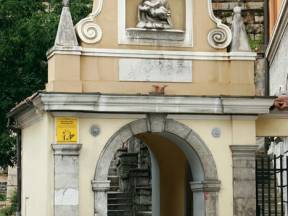
The stairs begin with an impressive Baroque portico – a small triumphal arch decorated with a relief of the Virgin Mary and the inscription “Consolatrix afflictorum”, from 1745, which symbolizes the beginning of the spiritual and physical ascent. Along the stairs themselves there are votive chapels dedicated to saints dating from the period between the 15th and 18th centuries. They were the stations of pilgrimage penance, often performed on their knees, before reaching the Sanctuary of Our Lady of Trsat – the Basilica next to the Trsat Castle.
This climb of over five hundred steps in a vertical of approximately 138 meters above sea level offers an attractive panoramic view of the city, the port and the Kvarner Bay. Like the pilgrimage, the stairs are not only a physical challenge but also a symbolic preparation – the scenery of a spiritual experience that leads to the church on the hilltop.
Legends have further enriched the meaning of the stairs – folk tradition says that the Franciscans vowed to the devil to build the stairs but were deceived when the first soul to climb was a goat. Allegedly, the devil was so angry that he mixed up the number of steps, which is why it is impossible to count them accurately today.
Today, the Trsat stairs form an indispensable visual and spiritual connection between the city and Trsat. They not only connect physical space, but embody layers of history, from the Renaissance to the Baroque to modern times.
Trsat Castle
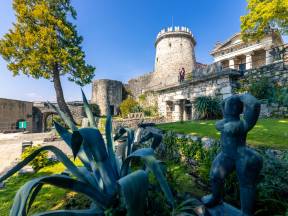
You are now on a 138-meter-high hill above Rijeka, a place that has been a strategic watchtower and city defense for centuries - Trsat Castle. Its roots go back to prehistoric times when a Liburnian watchtower existed there, and later the Venetians and Romans used this location to monitor an important road between the interior and the Adriatic as part of the Liburnian Limes.
The first written traces of the castle date back to 1288, when Trsat was mentioned as the seat of a parish. During the 13th century, the Frankopans took over the property, built a fortress and turned it into a key defense base. Later, the castle changed owners and functions several times, but none of these changes diminished its strategic importance.
After the earthquake of 1750, the castle fell into disrepair, until it was saved in the 19th century by the Irish military leader Laval Nugent, who reconstructed it in a romantic-classical, Biedermeier style and built a mausoleum inside the fortress. Today, the castle is an interactive cultural hotspot – the interior includes the “Paths of the Frankopan” interpretation center, multimedia panels about the Frankopan family, and the “Peace of Heroes” Mausoleum dedicated to Nugent.
From the rocky plateau, there is a panoramic view of the Trsat Steps, the old town of Rijeka, the Kvarner Gulf, and the remains of the luxurious fortifications of the Liburnian Limes on the nearby hills of Katarina and Kalvarija.
Today, the castle is a lively venue – art galleries, summer concerts, theater performances, fashion shows, and literary evenings make it the cultural epicenter of the city.
Sanctuary of Our Lady of Trsat
You are now looking at the Shrine of Our Lady of Trsat, which represents the heart of Marian devotion in Croatia and the oldest Marian shrine in the country. Its story begins on May 10, 1291, when, according to tradition, the Mother of God was miraculously transferred from the Nazareth cottage – called the Nazareth Cottage – to Trsat, where she remained until 1294, when she was transferred to Loreto; this event remained the foundation for the spiritual creation of the shrine.
As a sign of consolation for the loss of the cottage, Pope Urban V donated in 1367 the miraculous image of the Mother of Mercy (later called the Mother of God of Trsat), which became the central place of worship for pilgrims and a recognizable symbol of the shrine. In the 15th century, the church and Franciscan monastery were built by the Frankopan rulers, and in 1453, Prince Martin Frankopan, with the permission of Pope Nicholas V, allowed the arrival of the Franciscans from the Bosnian Vicariate to take over the pilgrimage complex.
Today's basilica is a combination of Gothic, Renaissance, Baroque and Biedermeier: it impresses with its Baroque main altar from 1692, rich altar paintings of saints and a pulpit and decorations that together create a space of exceptional aesthetic and spiritual value. The church still houses an icon of Our Lady, next to which believers leave numerous votive gifts - ship models and paintings that testify to the gratitude of sailors spared from storms, and even a miniature representation of the Titanic by a member of the Carpathia ship.
In addition to the holiness of the icons, the sanctuary houses the Treasury and archives with votive gifts from Croatian nobles, rulers and church dignitaries, and a walk through the Cloister and the Aula of Pope John Paul II testifies to its strong spiritual and cultural role in the life of Rijeka. Interestingly, in 1930, Pius XI awarded the church the title of **basilica minor**, and Pope John Paul II visited the shrine on June 8, 2003, preceded by a large procession and a statue of the “Tršat Pilgrim” placed in front of the entrance.
Pilgrims do not bypass the steps of Petar Kružić, pass through the Baroque chapel of the Votive Gifts and fall through sacred spaces that symbolize centuries of continuity of faith and the participation of the entire national identity in this spiritual place.
Astronomical Center Rijeka
You are on the Sveti Križ hill above Rijeka, where the Rijeka Astronomical Center is located, the only institution in Croatia that combines a digital planetarium and an observatory under the same roof. This modern point of science and education was established in 2009, but its story goes back to the beginning of this century, when the first Rijeka observatory with a powerful MEADE LX200 telescope was opened on the site of a former military fort from World War II. Today, the center stands as an example of the transformation of forgotten war infrastructure into an open public institution where science, education and recreation are equally represented.
The planetarium dome, eight meters in diameter and with a capacity of just over 50 visitors, allows for high-resolution projections of the universe, thanks to a sophisticated system of five projectors and advanced “fulldome” technologies. Visitors here can participate in interactive lectures, watch educational films or witness real footage of astronomical phenomena, such as eclipses or meteor showers, which are broadcast live from the observatory. In addition, it was from this observatory that amateurs discovered two variable stars, which further confirms its scientific significance and openness to the wider astronomical community.
The location itself is also special: the Sveti Križ hill is considered the oldest archaeological site in the city, and indigenous sub-Mediterranean vegetation grows around the center. The place is also a natural viewpoint, dotted with interesting historical, botanical and astronomical facts.
A stay here offers a unique experience: the combination of digital technology, scientific equipment and the spectacular panorama of Rijeka allows every visitor to have an equally exciting view of the starry sky – whether through a telescope, a digital simulation or simply from an open terrace, with the scents of sub-Mediterranean greenery.