Imotski is a quiet town located in the interior of Dalmatia, known primarily for its impressive natural attractions. The most famous are the Blue and Red Lakes – deep karst phenomena located near the town and often attracting visitors from the entire region. The town has around 10,000 inhabitants and a long history dating back to ancient times.
Audio guides available in:
中文, Español, 日本語, Italiano, Polski, Arabic, Dansk, Português, English (American), Czech, Hungarian, Slovakian, Français, English (British), Nederlands, 한글 , Deutsch , русский, Svenska, Hrvatski, Українськa, Suomalainen, Slovenian
To find more content and listen to free audio guides, download the Guide To Go app.
Imotski
Points of interest
Ricice (Green Lake)
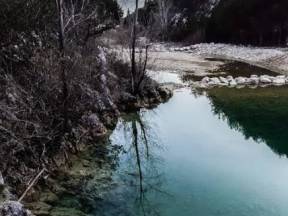
At this moment, you have a view of the Green Lake, officially called and more commonly known as the Ričice Reservoir, located in the village of Ričice in the northwest of the Imotska Krajina region. Unlike the more famous Blue and Red Lakes, the Green Lake is artificial and was created in 1985 by the construction of a dam on the Ričina River, as part of a project to irrigate the Imotsko-Bekijsko polje and to regulate flash floods that previously affected this area. The dam is 45 meters high and 206 meters long, and the lake can accumulate about 30 million cubic meters of water.
The construction of the lake submerged the fertile Donje Polje and four hamlets (Parlovi, Dujmovići, Gujići, Topalušići), completely changing the landscape of Ričice. The former hills and fields were replaced by a turquoise-green water surface, which today attracts visitors with its unusual beauty and specific environment, in places resembling the surface of the moon. The lake is fed by water from numerous springs and streams, especially from Vrbica and Ričina, which erupt abundantly in winter and early spring and flow into the reservoir. Like other karst lakes in the Imotska krajina region, the water level in Zeleni jezero can vary significantly depending on the season and the amount of precipitation. During winter and spring, due to melting snow and rain, the lake fills up and can reach depths of up to 50 meters, while in summer it often decreases.
Although originally conceived as an important infrastructure project, the irrigation system was never fully implemented, so Zeleni jezero is today primarily a recreational and excursion destination, ideal for walking, cycling, barbecuing and swimming in the summer months. The viewpoints along the road offer impressive views of the emerald water and the surrounding karst landscape, and the lake has also attracted foreign filmmakers due to its attractiveness.
Another interesting fact is that sports activities such as a 3.3 km swimming marathon are held at the Green Lake, which further contributes to its popularity and tourist importance.
The Green Lake thus represents a combination of natural and cultural transformation of the landscape, a place with a rich history, but also contemporary significance for the local community and visitors. In case you are interested in one of the most interesting natural phenomena of this area, visit the Badnjevice Canyon.
Badnjevica Canyon
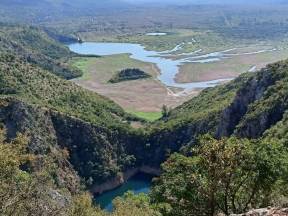
At this moment you are looking at the Badnjevica Canyon, one of the most beautiful and least known natural phenomena of the Imotska Krajina region. Located between Prološac and Ričice, it is about three kilometers long and represents a deep, narrow natural passage that was created by the millennial action of the Suvaja torrent. The canyon is characterized by its steep rocks, natural dams that once held water, and picturesque landscapes that delight every visitor.
In addition to its natural beauty, the Badnjevica Canyon also has significant cultural and historical value. On its western side, in the southern part of the canyon, there is the medieval Badnjevica fortress, most likely built in the 14th or 15th century. The fortress was in use until the end of Ottoman rule in this part of Dalmatia, and it stands out for its inaccessibility and multi-level construction on steep cliffs. Next to it is the Kokića glavica hillfort, with the remains of a prehistoric and late antique settlement. The fortress served as a strategic point for monitoring the canyon and the surrounding area, and it offers a wide view of the entire landscape.
Today, the Badnjevica canyon is popular among hikers and nature lovers, and hiking and hiking trails lead through it. However, due to difficult access terrain and rock erosion, movement through the canyon requires caution. Badnjevice is a real hidden pearl of the Imotski Krajina, a place where wild nature, history and silence intertwine, far from the usual tourist routes.
Lokvičić Lakes
Now you are looking at the Lokvičićka jezera, a hidden natural gem of the Imotski Krajina, located in the municipality of Lokvičići, not far from the famous Blue and Red lakes. It is a group of 3 karst lakes: Galipovac, Knezovića lake and Mamića lake. Although they are less known to the general public than the Blue and Red lakes, these lakes offer a breathtaking view and show specific karst characteristics.
The largest and most famous among them is Galipovac, which stands out for its steep rocks and clear water. The lake is about 170 meters long, 115 meters wide, and its depth reaches up to 80 meters, depending on the season and the inflow of water. The bottom is muddy, and the water is mostly clear, except during times of high inflow. Viewpoints and rest areas have been arranged around the lake, which makes it attractive for hikers and nature lovers.
Lake Knezovića and Lake Mamića are located southwest of Galipovec. Knezović Lake is a more inaccessible sinkhole with clear water and a depth of up to 40 meters, while Mamić Lake is the smallest, but also up to 35–40 meters deep. These two lakes resemble the Red Lake in appearance due to their steep cliffs and karst surroundings. The Lokvičić Lakes are unique in that they never dry out, and the water level in them fluctuates by up to ten meters, which indicates a constant inflow of water from underground watercourses. It is assumed that they are interconnected, as well as with the nearby Prološko Lake and Imotski Polje.
One interesting fact is that there is a story in the Lokvičići area about the noble and famous Roman soldier Arturius, after whom the legend of the English King Arthur was born, which is related to the discovery of a tombstone in Podstrana that says that Arturius was buried under it.
Although some lakes are not accessible by road and remain poorly known even among the local population, their natural beauty, peace and isolation make them a unique phenomenon of the Imotski Krajina region. In case you are interested in more about the lakes of this region, visit Zeleno jezero, better known as Ričice lake.
Prološko mud
At this moment you have a view of Prološko Blato, located in the northwestern part of the Imotski polje. It is an occasional, or seasonal, lake and wetland that forms every year during the winter months and early spring, when due to heavy rains and increased water inflow from numerous springs, especially from Studenci and Ričice, the water surface increases significantly. At that time, Prološko Blato covers an area of 3 to 4 km², and the water depth varies from 1 to 6 meters, while the depth of Prološko Lake, which is part of Blato, is about 35 meters. The southern edge of Prološko Lake has merged with Blato, so during periods of high water levels the entire area turns into a large lake.
Prološko Blato is an extremely important habitat for numerous plant and animal species, and it has a special value due to the abundance of water in the karst landscape of the Imotski krajina region. The Vrljika River, which springs nearby, abundantly waters the Imotski polje, making it one of the most fertile areas in this part of Dalmatia. Vrljika is also known for its endemic soft-mouth trout, and the source part of the river is rich in karst springs and lakes such as Dva Oko.
Historically and culturally, Prološko blato is also significant. On a hill that becomes an islet during floods, known as Manastir, the Franciscans hid from the Turks in 1493, and later built a monastery there. Today, Prološko blato is protected as a significant landscape under the Nature Protection Act, which further confirms its value and the need for preservation.
The ogre, an endangered animal, is also a symbol of the Imotska Krajina region, and inhabits karst underground lakes, rivers and caves in the Dinaric karst, and in the Imotska Krajina region it can be found in the groundwater of the Vrljika River and Lake Prološko blato. The ogre prefers cold, calm and oxygen-rich waters with a constant temperature of 6 to 12 °C, where it can burrow into the mud and lives mostly deep underground, but can also appear near the entrance to caves. It rarely surfaces, mainly during heavy rains, which usually means danger for it.
As part of the Biokovo-Imotska Lakes Geopark, Prološko blato attracts nature lovers, birdwatchers and all those who want to experience the unique combination of water, karst and rich biodiversity of this area. Another natural beauty of these areas are the hidden Lokvičićka lakes, which you can learn more about at the location of the same name.
Green Cathedral
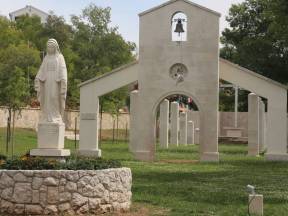
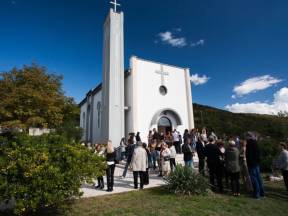
At this moment you are in the Green Cathedral, which is a unique open-air sacral place, along the Vrljika River in the village of Donji Proložac. The Green Cathedral is a church without walls and a roof, built in 1995 according to the design of architect Edo Šegvić and is completely integrated into the natural environment: centuries-old trees create natural shade, and the central place is occupied by a large stone altar. The appeal and uniqueness of the Green Cathedral is its harmony with the environment in which it is located, the boundaries of the space are determined by the Vrljika River, while the elements of nature and architecture merge into one.
The Green Cathedral is known for its large gathering of believers every year on August 15, on the feast of the Assumption, when a solemn holy mass is held there. This event is deeply rooted in local tradition and is considered one of the most important religious gatherings in the entire Imotska Krajina region. In addition to its religious significance, this place also attracts newlyweds who choose it for weddings and photo shoots, as well as numerous tourists who want to experience a combination of spirituality and natural beauty.
At the same time, it is often highlighted as a very special combination of nature and architecture, and its special atmosphere and peace make it an indispensable stop for anyone visiting the Imotska krajina region. In case you are interested in more natural attractions of Prološac, visit Prološko Blato.
Mills on Perinuša
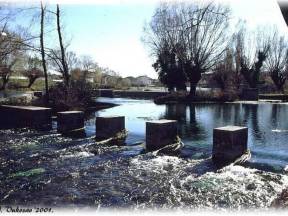
The mills on Perinuša serve to supply the inhabitants of this area. Located along the Vrljika River, these mills have been the central place for grinding grain for centuries, not only for the inhabitants of the surrounding villages, but also for the wider Imotski area. The history of the mills dates back to the Ottoman era, and the core of the complex also includes a Turkish tower from the 16th or 17th century, which was later expanded and adapted to the needs of the new owners.
In the past, the mills were a kind of social centers, similar to today's cafes, where people spent time waiting for the grain to be processed, which contributed to an intense social life and exchange of information. Many legends and mythological stories have been created on this occasion. One of the frequent themes in these traditions relates to mystical events and unusual sounds that the locals used to attribute to spirits or fairies guarding the mills. According to one legend, the mills were protected from evil forces thanks to the goodwill and honesty of the millers, and those who tried to abuse their power or deceive others were supposedly punished by unexplained accidents or strange events in the mill itself. Another story tells of a mysterious girl from the surrounding villages who, according to legend, would come to the mills at night and sing sad songs, her voice spreading through the valley, leaving a feeling of sadness and nostalgia among the locals. Such legends and stories are part of the rich oral tradition of the Imotski region and contribute to the mystical atmosphere of Perinuša, making the mills not only a technical facility but also a place filled with spiritual meaning and local myths.
A special role in the development and restoration of the mills was played by the Franceschi family, who, after the liberation of Imotski from the Ottomans in 1717, were granted the right to manage this property. Thanks to their initiative, in the second half of the 18th century, as many as fourteen millstones were built, making Perinuša the largest and most important milling complex in the region. The mills were also equipped with additional facilities such as a defensive tower, a two-story house and a stone bridge, and the entire complex was protected by high walls and semi-fortified gates.
The mills were in use until the end of the 20th century, and today they are a protected cultural asset and a valuable monument of traditional architecture. The Perinuša complex bears witness to the rich history, turbulent times and the importance of milling for the life and economy of the Imotska Krajina region. Today, work is underway to restore the old Franceschi house and the mills, so that this historical site can be preserved for future generations. In case you are interested in the combination of natural beauty and architecture, visit the Green Cathedral, which is also next to Vrljika.
Source Opacac
You are now in front of the Opačac spring, located next to a meadow in the Prološac area. Opačac is the main and largest source of the Vrljika River, which is of crucial importance for the entire area because it supplies the Imotska krajina region with drinking water. The water from Opačac has never completely dried up, except in exceptional cases of major earthquakes, which makes it an extremely reliable source in a karst landscape known for its water scarcity.
Historically, the area around the Opačac spring was also important for religious life. The monastery of St. Francis was built around the spring itself around 1300, on the site of an even older Benedictine abbey, which testifies to the long tradition of spirituality and gatherings of people in this place. Today, a votive church stands next to the spring, and every year on the Assumption of the Virgin Mary, mass celebrations are held there.
Before the arrival of the Turks, there was a small church of the Assumption of the Virgin Mary near this spring, where nuns lived. One of the more powerful Turks fell in love with the nun and wanted to take her by force as one of his wives, to which she refused. Her will was rejected, but when they started to take her away, she jumped into the spring and drowned. Since then, this spring has been called Opačac.
As for the influence of the Vrljika River itself, on its way to the Adriatic Sea, the Vrljika changes its name five times and passes through two countries (Croatia and Bosnia and Herzegovina). In addition to its natural values, the river also has great cultural and economic significance for the local population, who have always depended on its water for their livelihood and agriculture
The Opačac Spring and the Vrljika River are also known for their wealth of flora and fauna, including the endemic soft-mouthed trout and crayfish, which makes this area valuable from an ecological perspective. Opačac, along with other Vrljika springs, is key to the life, economy and identity of the Imotska Krajina region. Another trace of history along the Vrljika River are the Mills on Perinuša, which you can learn about at the location of the same name.
Red Lake
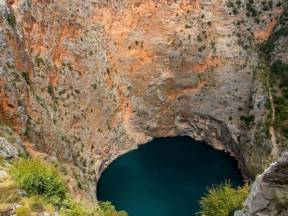
At this moment you are looking at one of the most impressive and deepest karst lakes in Europe, formed by the collapse of the vault above a large underground pit, the Red Lake. This lake got its name because of the reddish rocks that surround it, and its depth reaches about 250 meters, with a bottom that is even below sea level. The lake is also known for its mysticism and inaccessibility, steep cliffs prevent access to the water, and a special attraction is the attempt to throw a stone into the lake, which rarely succeeds due to strong air currents.
In addition to its natural beauty, the Red Lake, along with the Blue Lake, is also accompanied by the legendary story of Gavan's Palaces. According to legend, the site of today's lakes once stood the luxurious palaces of the rich man Gavan, known for his arrogance and callousness. When God, disguised as a beggar, asked for help: “Give me a crust of bread, I am hungry. If you help me, God will help you.”, Gavan’s wife replied: “I don’t need God while I have my Gavan.” The beggar turned and left, but after that the earth rumbled, opened up and swallowed the entire palace, Gavan, his family and wealth, and 2 lakes were created, Modro and Crveno. Gavan’s sons fled, but the earth swallowed them and two round lakes were created there, one next to the other, which the people called Dva Oka. The inhabitants of Imotski still say today that when the bora blows, the cries of Gavan and Gavanica can be heard from the depths of the lake.
Crveno jezero is not only a natural phenomenon, but also a symbol of the Imotski region, a place of legends, scientific research and admiration for the power and beauty of nature.
Blue Lake
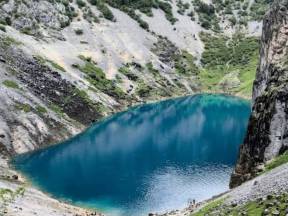
At this moment, you are in front of the Blue Lake, one of the most famous karst lakes in Croatia. It is located right on the edge of the city, in a deep sinkhole shaped like a kidney, with a length of about 800 meters and a width of between 250 and 400 meters. The lake was named after the characteristic blue color of the water, and its level and depth vary significantly throughout the year, for example, in spring the water reaches up to 90 meters deep, while in summer, during dry years, the lake can dry up completely.
The special feature of the Blue Lake is its accessibility, a well-maintained promenade leads to the water, so the lake is a favorite swimming and walking spot for the residents of Imotski and visitors. When it dries up, a football match is traditionally played at its bottom, which is a unique event in the world. The lake was formed by the collapse of underground cavities in the karst, and the water comes from underground springs and cracks, which causes constant changes in the water level.
The Blue Lake, like the Red Lake, is shrouded in many myths and stories. The most common stories are about fairies, who are mythical creatures that live in the lake area. The inhabitants named them “Fairy Cave” and “Fairy Rest” after Blue Lake, places believed to be the dwelling places of fairies in the stories. One of the stories says that the fairies of Imotski would call young men to the lake, and those who would spend the night with them would never sleep with the girls of Imotski again. However, the fairies were considered more positive beings, rather than classic cautionary tales. Another myth associated with matches on the dried-up bottom of the lake is that two teams, symbolically called “Werewolves” and “Elves”, play a football match every time the bottom dries up. They played their first match back in 1943, and the custom continues today. The rule is that the match always ends in a draw, so that peace reigns in the town.
The Blue Lake, together with the nearby Red Lake, is an unmissable natural attraction of the Imotska Krajina region and the whole of Dalmatia, and the landscape around the lake is part of the UNESCO Biokovo-Imotska Lakes Geopark. Stories and myths make the Blue Lake not only a natural phenomenon, but also a place of rich oral tradition, where legends about punishment for arrogance, fairy temptresses and common rituals of the local community intertwine. The Red Lake, which shares the title of symbol of the city with the Blue Lake, is also nearby, so if you want to learn more, visit it.
Vidikovac
You are now at the Blue Lake Lookout, which offers a panoramic view of the natural beauty of this area. On the south side of the lake, along the road, there are several lookouts, some of which are landscaped and some "wild", which can be reached through bushes. From these points, the view opens up to the impressive blue-blue surface of the lake, the steep cliffs that surround it, and the entire landscape of the Imotska Krajina region.
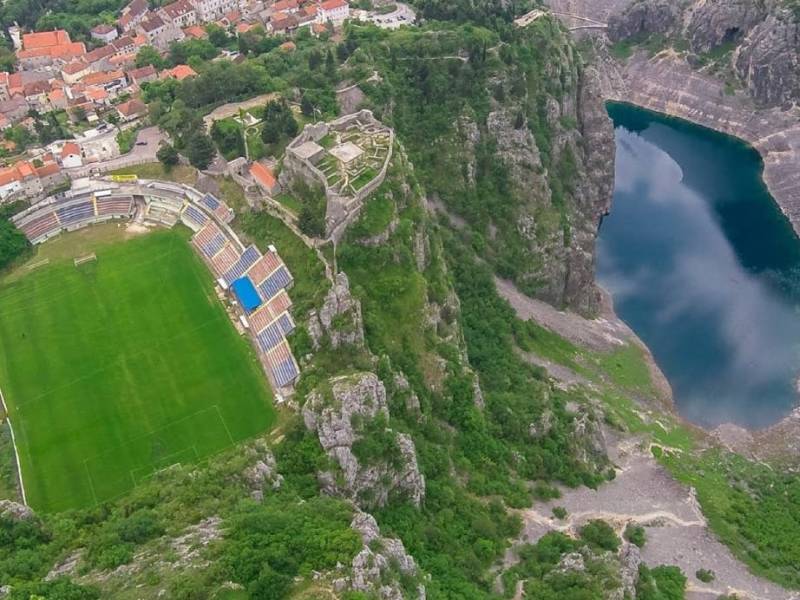
The lookout near the Topana fortress, where you are now, is particularly noteworthy, offering a panoramic view of the Blue Lake, and the path itself that takes you down to the Blue Lake. From here, you can see the iconic colors of the Blue Lake, and the changing color of the water throughout the seasons further adds to the impression. In spring, when the water level is highest, the scene is particularly dramatic, while in summer the water level drops and the lake sometimes dries up, which also allows for a walk along its bottom. In this area, as in many destinations in these regions, many stories were created when residents socialized. One prominent legend tells of ghosts and magical beings in the lake caves. According to this story, good and evil spells lived in the caves and influenced people: those who washed themselves with water from the lake on certain days would become good, while evil spells brought misfortune and tears. Because of them, unusual and terrible events occurred, about which every person would have a new story to tell.
Near this viewpoint and the lake itself, there is the stadium of the Imotski football club, where they consistently play matches, whose name is “Gospin Dolac”.
A leisurely walk to the lake itself is also recommended, during which the landscape is revealed in all its beauty. From the viewpoint of the Blue Lake, you can experience a unique blend of nature, history and everyday life of Imotski, as this place is a favorite gathering place for both residents and visitors. In case you want to experience first-hand the feeling of this enchanting lake, and learn a little more about it, go down the promenade to the Blue Lake.
Topana Fortress (Fortica)
You are currently at the Topani fortress, which is considered a symbol of the town of Imotski and its surroundings, located on a steep cliff above the Blue Lake. The first written traces of this fortress date back to the 10th century, when it was mentioned in a part of the Byzantine emperor Constantine Porphyrogenitus, but it is assumed that construction began earlier during the time of the Croatian princes. Throughout the Middle Ages, Topana served as the center of the Imotski County and had a strategic function for the defense of these parts of inner Dalmatia.
Topana gained its final form over the centuries, especially during the 13th and 14th centuries, when the highest and strongest parts of the fortress were built. During the Ottoman rule of these parts, Topana became the most important military fortress in the region, and up to 500 people could stay in it. The name of this fortress comes from that period, from the Turkish word "tophana", which translates to a place for cannons, because of the then newly built special tower with a cannon platform. It was liberated in 1717 after a siege that would have lasted until help arrived for the Topana garrison from Mostar if the liberators had not begun to undermine the ramparts in order to bring them down with gunpowder. When the Turks saw this, they agreed to surrender Topana with the promise of free departure for all those who wanted to leave Imotski, to which the liberators agreed.
Today, Topana is an unmissable destination for every visitor to Imotski. In addition to offering a spectacular view of the Blue Lake and the town, it is also a place for gatherings, cultural events and memories of the rich past of the Imotski region. Nearby is the church of Our Lady of the Angels, the patron saint of Imotski, which was built in 1718 and remains the spiritual center of this region to this day. The Topana fortress, with its walls and legends, remains a proud witness to the turbulent history and guardian of the identity of Imotski. In case you are interested in another view of the Blue Lake, as well as the entrance to the promenade, visit the Modrog Jezera Lookout.
Chapel of Our Lady of the Angels
In these moments, in front of you is the Chapel of Our Lady of the Angels, inside the Topana fortress. With its location on a gorge above the Blue Lake in Imotski, it has an extremely important place in the history and identity of the city and the entire Imotski region. It was built in 1717, immediately after the liberation of Imotski from the Ottomans, as a simple single-nave stone building, with a gable roof and modest dimensions. It was built by the Venetians as the headquarters of a military parish for their garrison at the fortress, but it was also used by civilians from the beginning. Inside the chapel is a valuable painting of Our Lady of the Angels, measuring 80 x 60 cm, which depicts Our Lady being taken into heavenly glory by angels. This painting is located in a niche above the altar and has a special meaning for the faithful.
Traditionally, the last three days of the novena to Our Lady of the Angels are held in this chapel, with processions and masses that gather many believers from the Imotski region. Our Lady of the Angels soon became the patron saint of Imotski and the entire Imotski region, and her feast day, August 2, is celebrated as the Day of the Town. On that day, believers from all over the area gather in and around the chapel, participating in a procession and a solemn mass. The chapel has been extended and renovated over the centuries, and there was once a town cemetery next to it at the foot of the walls.
It is interesting that the chapel was built on the site of a mosque, which symbolizes the end of one era and the beginning of a new one for Imotski. In addition to its spiritual role, the chapel and fortress are today an important tourist and cultural attraction, and the celebrations of the feast of Our Lady of the Angels are one of the most important events in the life of the town.
Parish Church of St. Joseph
You are standing in front of the parish church of St. Joseph, in Glavina Donja, which belongs to the parish of St. Francis in Imotski. Every year, the church gathers believers on the occasion of the feast of St. Joseph, the patron saint of the town, which is solemnly celebrated with a procession, mass and socializing in the church crypt. The believers prepare for this celebration with a three-day fast, and the parish priest, parish vicar and other priests from the area participate in the celebration.
The church has an interesting and special history that testifies to the unity and faith of the local people. The construction of the church began in the early nineties of the last century, during challenging times for all of Croatia due to the war. The locals decided to build a church dedicated to St. Joseph, the patron saint of families and workers, in order to have their own spiritual center and gathering place. The construction lasted two years, and the church was blessed in 1993. It is especially interesting that the locals themselves, with their contributions and work, made the construction of the church possible, which is today a rarity and a true example of unity.
The church of St. St. Joseph's Church is not just a building, but also a symbol of the spiritual life of Glavina Donja. Every year, on the feast of St. Joseph on March 19th, the church becomes the center of a large gathering of believers from all over the area.
Franciscan path
The Franciscan Path in Imotski marks the centuries-old activities and migrations of the Franciscans throughout the turbulent history of the Imotski Krajina. The first Franciscan monastery in this area was built around 1300 along the Vrljika River at the Opačac site, where the Franciscans remained until the arrival of the Ottomans. Due to Turkish conquests and insecurity, the Franciscans moved to an island in Prološki Blato around 1600. They did not stay there for long either, as the Turks expelled them in 1715, and they found refuge in Omiš, where they built a new monastery.
The turning point came in 1717, when Imotski was liberated from Turkish rule. The Franciscans were then allowed to return to Krajina and settle within the city itself. First, they built a church and a house at the foot of the Topana fortress, and then a residence, a hospice, and a new monastery. The construction of the present-day monastery began in 1740, and most of it was completed by 1775. The monastery and church of St. Francis of Assisi are today a protected cultural property and the center of spiritual, cultural and social life of the Imotski region.
The Franciscan Way symbolizes the persistence and dedication of the Franciscans in preserving the faith and identity of the people through centuries of persecution, migration and renewal, and their presence has left a deep mark on the history and culture of Imotski.
If you are interested in a collection of the overall culture and history of this homeland, visit the Imotski Local History Museum.
Church of St. Francis and Franciscan Monastery
At this moment, the Church of St. Francis is in front of you, and right next to it is the Franciscan monastery. This complex is considered an unmissable destination for all those who love the combination of history and spirituality of the Imotska krajina region, and with a history that stretches back to the first half of the 18th century, the monastery and the church are protected heritage sites.
The church is a monumental three-nave building in the neo-Romanesque style, while the monastery preserves a valuable cultural and historical collection and a rich library. In addition to being important historical monuments, they also play an active role in the community and are open to visitors of all ages. Occasionally, spiritual and cultural events are organized there that further enrich the experience of the visit.
The Parish of St. Francis is the spiritual center of this region, known for its rich religious life and activities that bring together people of all generations. The Franciscan Secular Order, Frama and charitable initiatives make this parish very lively and engaged.
The staging of the Imotski Passion is particularly famous, which attracts numerous visitors every year and because of which Imotski becomes a kind of "Jerusalem" during the duration of this event. The parish of St. Francis is an excellent example of how faith and tradition can be the basis of unity and cultural identity in this part of Croatia.
When the Turks arrived in the area of Imotski, which was also a parish, the Franciscans, in order to be protected from Turkish oppression, built a monastery on an island in Prološki Blato, which was nothing more than a hill in a field surrounded by several springs that the people of this area called Kljuke. In order to create water protection, the then guardian, Fr. Mijo Runović, and the parishioners had the abyss into which all these springs flowed filled up. The story goes that the abyss was filled up with beams and sheepskin, and that then a lake was formed around the hill and the hill became an island that people at that time called the Monastery. A large part of the people fled from that monastery to escape Turkish oppression, and the monastery was abandoned and demolished.
When the Turks were expelled from Imotski in 1717, the Franciscans and some of the people returned and built a monastery under the Topana fortress, in a town called Imotski.
One anecdote comes from the time when Emperor Francis Joseph came to Imotski in 1875 and stayed overnight with honors. After mass, the people of Imotski told him that a new church was being built, and when he asked them what it would be called, the people replied: “And how could it be called anything other than St. Francis”. When the emperor heard this, he promised to support the construction of this church.
The Franciscan monastery and the church of St. Francis in Imotski represent a vibrant center of faith, culture, and community. Their history testifies to perseverance and adaptability, and today they are open to anyone who wants to learn about the rich heritage and living tradition of the Imotski region. If you are interested in more about the collection that this monastery keeps, visit the monastery museum, which is also part of this complex.
Franciscan Monastery Museum
The museum in front of which you are standing is an integral part of the Franciscan monastery and occupies an important place in the preservation and presentation of the history and rich cultural heritage of Imotski and its surroundings. Its premises house a collection of valuable objects that testify to life in this area from ancient times to the present day. Of particular value is the collection of archaeological finds from the Illyrian and Roman periods, collected from the Imotski region, which makes this museum collection an indispensable source for understanding the oldest past of this region.
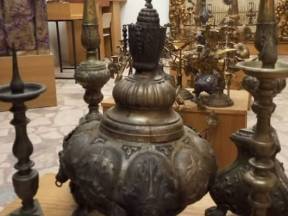
It was systematically shaped by the Franciscans, and among the most deserving are Fra Ivan Tonković and Fra Vjeko Vrčić, who, with the help of the faithful, dedicated years to collecting and preserving objects from spiritual and everyday life. In addition to preserving sacred art and valuable church utensils, it houses numerous paintings and prints by Croatian artists such as Iveković, Šimunović, Crnčić and Uzelac, as well as the legacies of significant spiritual and historical figures such as Bishop Fra Paškalo Vujčić and Archbishop Šimun Milinović. Also on display are objects depicting the bourgeois life of Imotski in the 19th century, old crafts, artistic crafts and photographs from that period, and of particular value is the ethnographic collection with traditional jewelry, village costumes and weapons, among which the 15th-century sword known as the “ščavon”, an iron chainmail shirt from the 17th century and a decorated pirate saber from the 18th century stand out.
The museum’s art gallery is enriched with works of art from the 17th century onwards, and in the atrium there is a lapidary with the remains of old churches in this area. In addition to the museum section, the monastery also keeps a rich library, the most valuable treasures of which are, among other things, a manuscript of Cicero’s speeches from 1422 and a transcript of Gundulić’s Osman. All this heritage is protected as a cultural asset of the Republic of Croatia and is a living reminder of the long-standing role of the Franciscans in preserving the identity and wealth of this region.
Monastery library
The monastery library of the Franciscan monastery in Imotski is one of the most important cultural institutions in this part of Croatia. Its oldest copies date back to the 15th century, and it was formally founded in 1774 when Fr. Šimun Gudelj donated several hundred books to the monastery. Today, the library contains around ten thousand books, with an emphasis on theological literature, old Croatian writers and works that have significant value for the history and development of the Imotski region. Over time, the collection has acquired extremely rare and valuable editions, among which the most famous are old manuscripts, Glagolitic missals, older printed Bibles and works by famous Croatian authors.
The library also keeps collections related to the work and creativity of prominent Imotski Franciscans and bishops, such as Fr. Paškval Vujčić and Fr. Vjeko Vrčić. Manuscripts and various publications from the fields of science, religious education, history and culture occupy a special place in the collection. The library also houses old geographical maps and postcards that testify to the social history of Imotski.
The library has been fully catalogued in the last few years, which greatly facilitates access to its contents for researchers and all interested users. The value of the library is not only reflected in the richness and rarity of its publications, but also in the long-standing role it has played in education and preserving the identity of the Imotska Krajina region. Today, it is available to anyone interested in the history, cultural heritage and work of the Franciscans in this region, and is often a starting point for researching the past of this part of Dalmatia.
Local collection
In front of you is the Imotski Heritage Museum, which contains a heritage collection of these regions and contains a rich and diverse collection of objects that testify to the history, culture and everyday life of the Imotski region. The museum is located in a building built in 1903, which was originally part of the industrial complex of the largest tobacco purchasing station in Dalmatia, which is still visible today through the museum exhibition dedicated to tobacco production and processing, an important economic activity of this region.
The permanent exhibition of the museum is divided into several sections. The archaeological collection includes objects from prehistoric, ancient and early medieval periods, including stone monuments, mosaics, jewelry, weapons and tools. Particularly valuable are the finds from the Roman era, since an important Roman road connecting Salona and Narona passed through the Imotski region. Late antiquity and the early Middle Ages are represented by finds from early Christian basilicas and plaited plastic, which testifies to the presence of Croats in this area since the 8th century. The cultural and historical collection traces the development of the city with an emphasis on the late 19th and early 20th centuries, a period of economic progress and the flourishing of civic life. The ethnographic exhibition is dedicated to life in the Imotski villages, with exhibits of objects from rural households, folk costumes and woven items. The story of growing silkworms and making silk thread, which was an important women's occupation in the past, is particularly interesting.
The museum also preserves a rich numismatic collection, as well as a collection of photographs, while exhibitions are occasionally held in the gallery space. The Imotski Native Collection thus preserves and presents the heritage of the region in a unique way, offering visitors an insight into all layers of the history and tradition of this region. In case you are interested in the church that was built during the war and difficult times for the people, visit the parish church of St. Joseph.