We now drive into the 377-meter-long tunnel, Hellesyltporten, as serves as a gateway to breathtaking fjords and natural wonders.
Hellesylt itself is known for its picturesque scenery, with quaint houses and lush landscapes.
One of the main attractions we will pass on the upper side of the tunell, is Hellesyltfossen, a powerful waterfall that cascades through the village, creating a stunning and dramatic view.
Amidst these infinitely beautiful surroundings around Hellesylt lurks an invisible threat - Åkerneset. This unstable mountainside, high above the fjord, is monitored around the clock. Should the entire slope collapse, a tsunami could reach Hellesylt in just five minutes - rising up to 85 meters above the fjord.
Such destructive power is hard to imagine in a landscape otherwise exuding peace and picture-postcard charm. Yet preparedness is high, with the village equipped with warning systems and evacuation plans.
The contrast between beauty and danger is palpable. How do you imagine it feels for those who live here year-round?
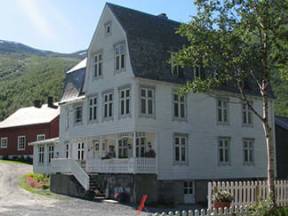
We are now passing Villa Norangdal, an elegant wooden villa that blends history, art and luxury amidst the wild nature of western Norway. Built in 1885 as a guesthouse, it accommodated mountain hikers and tourists seeking adventure in the Sunnmøre Alps. Among its guests were British mountaineering pioneer William Cecil Slingsby and even Queen Wilhelmina of the Netherlands.
During tourism's golden age in the 1920s-30s, thousands of cruise passengers stopped here for refreshments. The hotel closed in 1965 due to new fire safety and bathroom regulations, but was completely renovated and reopened as a boutique hotel between 2003-2007, with a focus on design history.
Each room is unique, inspired by eras like Art Nouveau and Functionalism, and filled with original furniture and artwork. Today, Villa Norangdal holds the "Olavsrosa" quality certification and is environmentally certified as a "Miljøfyrtårn" (Eco-Lighthouse). Staying here is like traveling through time – without sacrificing modern comfort.
The English upper class fell in love with the area from the mid-1800s onwards. Large yachts and luxury ships brought tourists to Øye, where they traveled by horse and carriage through Norangsdalen to Hellesylt, where the boats awaited them.
Amid this influx of Europe's elite, dairymaids worked. They went up to the mountain dairy farms in the evening to milk and stayed overnight for morning chores. The next morning, they tended the animals, took the milk down to Øye, and worked on the farms during the day before returning to the mountain dairy farms in the evening.
Do you enjoy climbing mountains? We are now approaching one of the starting points for those wishing to ascend the majestic mountain, Slogen. The trail from here leads to Patchellhytta, named after the British mountaineer Charles Watson Patchell.
This cabin serves as an ideal base for exploring the surrounding majestic peaks, especially the iconic Slogen, known for its spectacular views.
The hike up to Slogen is a challenging yet rewarding experience, with steep paths that reward you with panoramic views of fjords and mountains.
We're now driving through Øye, a small village that over a century ago was a bustling meeting place. The dramatic landscape attracted adventure tourists as early as the 1800s - English salmon anglers, German emperors and Norwegian artists arrived by tourist ships.
Soon hotels and guesthouses were built, with up to four accommodations operating at its peak. Tourism transformed the local community: farmers became transporters, dairymaids turned into waitresses, and many encountered foreign languages and customs for the first time.
This was a pivotal era - not just for Øye, but for all of Norway. This small village played a significant role in shaping modern Norwegian tourism.
You're not the only one captivated by these beautiful surroundings. Our own royal family, led by Queen Sonja, has a special connection to Norangsdalen.
She has visited the valley multiple times and refers to Mount Slogen as a personal favorite.
The Queen is known for her passion for mountains and outdoor life, and has often acted as the family's guide during hikes in the area. Both in 2024 and 2025, private visits were reported, with the royal family enjoying the tranquility and grandeur of the spectacular landscape.
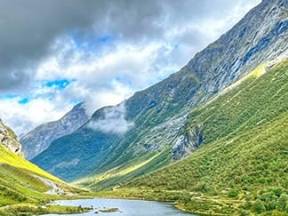
Lyngstølvannet, located here in Norangsdalen, is a captivating lake formed by a rockslide in 1908.
The submerged remains of a farm can still be seen underwater, creating an eerie yet beautiful sight.
This unique underwater forest, along with the stunning surrounding scenery, makes Lyngstølvannet a popular destination for visitors and photographers.
Before us stands Hotel Union Øye, one of Norway's most historic hotels. Opened in 1891, it quickly became a popular destination for European aristocracy and mountain enthusiasts. Among its famous guests were Emperor Wilhelm II and Karen Blixen.
Many rooms are named after historical figures, and the hotel is renowned for its mysterious atmosphere. You may have heard of the "Ghost Queen" in room number 7 - said to have died of a broken heart. Guests have reported doors opening by themselves and cold drafts outside the room, though there's surely a natural explanation.
The hotel features additional rooms in converted surrounding houses and an exquisite garden perfect for relaxation and contemplation. This is where those seeking quality, tranquility and beautiful nature come to stay.
Hellesylt, a small village
At the fjord's edge, valleys, rivers and fjord converge, and in the heart of this beautiful idyll lies Hellesylt - a small village with great appeal. Each summer, tourists flock here to experience the dramatic landscape, waterfalls, and not least, the ferry continuing into Geiranger.
Right in the center, the Hellesyltfossen waterfall plunges through the village - a spectacular sight and photo opportunity, especially during snowmelt. Simultaneously, Hellesylt serves as an important transportation hub with road connections to Stranda, Ørsta and Stryn.
The location is also known for the Hellesyltdagane cultural festival and as a popular starting point for mountain hikes in the area.
Norangsdalen has long been used for summer pasturing and mountain dairy farming.
We will soon pass Stavbergsetra, where the houses, or "sela" as they are called here in Norway, are placed against large rocks in a scree, to shelter them as much as possible from avalanches and wind.
The mountain dairies were built in the mid-1800s when dairy farming was at its most intensive in the country.
From the 1920s, dairy farming in Norangsdalen declined, and by the 1950s, it had almost completely ceased. Today, cattle and sheep graze in the valley.
Have you ever wondered about the forests in Norway?
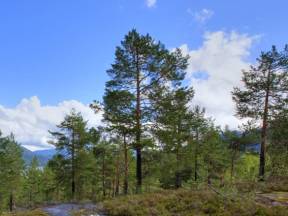
Norway is home to approximately 11 billion trees. The most common tree species include Norway spruce, Scots pine, and birch.
These trees dominate the vast Norwegian landscapes, contributing significantly to the country's biodiversity. Additionally,
Norway is renowned for its Christmas tree tradition, with the Norway spruce being the most popular choice for decorating homes during the festive season.