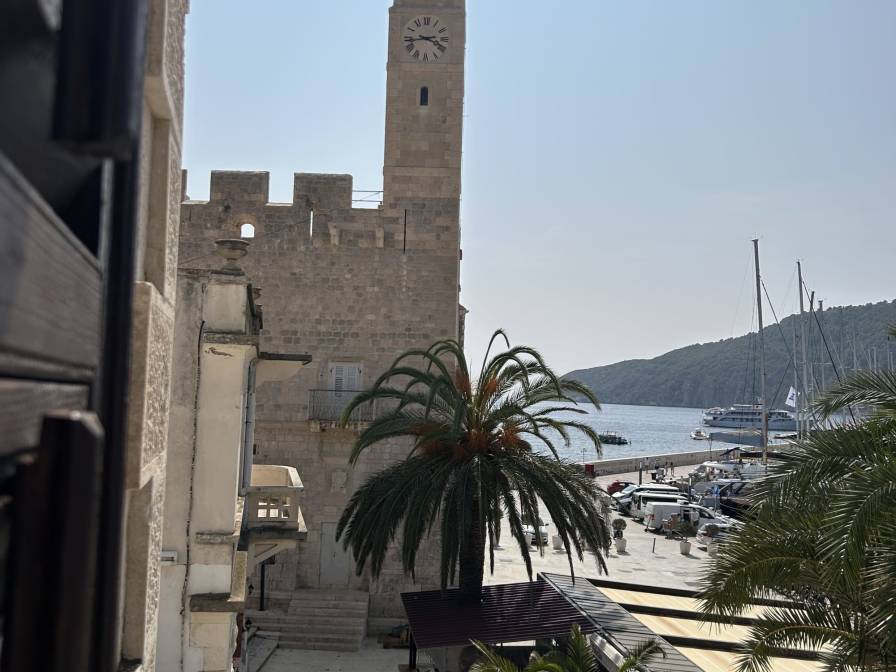
Fisherman's Museum (Commune)
0
Komuna, the castle in Komiža, was built in 1585 on a small cape of the Komiža harbor. It has a quadrangular shape with walls that widen diagonally at the bottom, and on the north and west walls there are stone rings for mooring ships. The walls end with a battlement with openings for defense. They contain cannon mouths, narrow loopholes and square openings. Above the entrance door there is an inscription and the coat of arms of the Venetian prince and governor Ivan Grimani, which states that the castle was built with his efforts. On the north wall it is also emphasized that the construction was financed by the income from fishing of Komiža near the island of Biševo, and not by Venetian state money. Next to the inscription there is a relief of a winged lion, the only remaining symbol of the Venetian Republic on the island. The interior of the castle is vaulted with solid vaults that rest on a central column. On the first floor there is a Gothic arch, and a staircase leads to the terrace. After the Austrian disarmament of the island of Vis in 1879, the Komiža municipality purchased the castle and housed its administrative offices. At that time, a clock tower was added to the facade. Today, the Commune houses the Fisherman's Museum. The museum houses a collection of objects related to fishing and shipbuilding, which made Komiža famous on the Adriatic. The exhibits include original pieces of fishing and ship equipment, as well as objects related to fish processing, which was once particularly developed in Komiža. The most valuable exhibit is a replica of the Komiža gajeta falkuša. A falkuša was a special fishing boat about nine meters long and slightly less than three meters wide. It could carry a crew of six fishermen and up to eight tons of fish. The mast was nine meters high, and the sailing speed reached up to ten nautical miles per hour. It was built exclusively from pine from the island of Svec. The last original falkuša, called Cicibela, was destroyed in a storm in 1986. The tradition of building these boats was later restored, and three new falkushas are used today for tourist and cultural purposes.