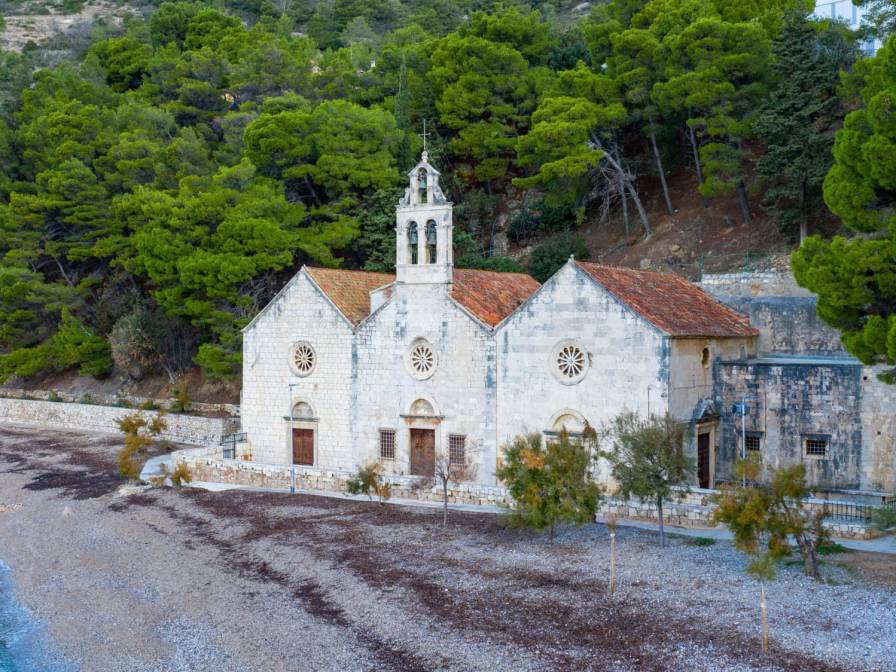
Church of St. Mary the Pirate
0
The Church of St. Mary the Pirate in Komiža is one of the most important cultural and religious landmarks of this place. It was built in the mid-16th century on the coast, on a pebble beach, in the Renaissance style. It is special for its unusual shape – it consists of three interconnected churches, so the facade appears as a series of three triangular ends. It is built of finely worked stone blocks, and the entrance door is decorated with Renaissance moldings and a simple lunette. The name “Pirate” is associated with the legend according to which pirates stole her painting, but after their shipwrecked, the sea returned it to the shore in front of the church. There is a record of this from the 18th century, and the legend is still part of the local heritage today. The interior of the church has a three-nave design – the naves are separated by arches on massive masonry columns, and each naves has a different vault. The central one has a Gothic vault with a pointed arch in the apse, the western one also has a Gothic vault, while the eastern one is covered with a semicircular vault with Baroque features. There are five altars in the church, and the main altar with gilded Baroque statues of the Annunciation is particularly noteworthy. The wooden choir is valuable and richly decorated - the middle part is Baroque gilded, and the side wings are closed with carved grilles. Next to the church is a small courtyard with an octagonal well in which spring water is kept. Each of the eight sides of the well is decorated with reliefs with figures of saints and biblical motifs: St. Nicholas, St. Andrew, St. Anthony, Archangel Michael, Adam and Eve, Our Lady with Child, the divine lamb and the symbol of a torch in the open door. The Church of St. Mary the Pirate, with its altars, sailors' vows and rich artistic equipment, not only bears witness to the piety and cultural creativity of the people of Komiža, but also has the status of a protected cultural asset of the Republic of Croatia - an immovable cultural asset of individual value.