We begin our journey in Svolvær, known as the capital of Lofoten. This dynamic town is picturesquely situated on the islands of Northern Norway and is renowned for being Lofoten's largest fishing village and a central hub for trade, administration, and communication.
Historically, Svolvær has been a vital fishing port, with the Lofoten fishery being an essential source of income for the locals throughout the centuries. Today, the town is a centre for a diverse fishing industry and workshop industry, making it a thriving nexus for business and trade.
Svolvær is also an important administrative centre, with both Lofoten District Court and Svolvær Police Station being part of the Nordland Police District. The town's architecture, an exciting mix of old fisherman's cabins and modern buildings, gives Svolvær a unique atmosphere.
On the cultural side, Svolvær is an active cultural hub, with several art galleries and annual festivals, including the Lofoten International Art Festival. Whether you're here to experience the vibrant business life, the rich culture, or to take in the overwhelming natural beauty, Svolvær has something to offer everyone.
To find more content and listen to free audio guides, download the Guide To Go app.
Points of interest
Vågan church
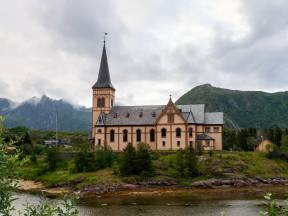
Let's take a moment to admire the historic landmark standing before us - Vågan Church in Kabelvåg. Often referred to as the 'Lofoten Cathedral', this impressive building was erected in 1898. With its neo-Gothic style and as one of Norway's largest wooden churches, it has the capacity to house around 1200 people.
As you approach, you will immediately notice the majestic church spire stretching high into the Nordic sky. The carved details in the woodwork complement its grand appearance, further enhancing its historical significance.
Step inside, and you will be met with a kaleidoscope of colours from the stunning stained glass windows. These works of art provide a sense of calm and contemplation, further complemented by the altarpiece, painted by the renowned Norwegian artist Eilif Petersen. These artistic details provide a unique insight into the religious art and culture in Norway at the end of the 19th century.
The church, surrounded by the rugged landscape of mountains and sea, creates a unique atmosphere. It is an excellent backdrop for reflecting on the area's natural beauty and the cultural significance of the church building.
If you have time, it is highly recommended to experience one of the many concerts held here. During the Lofoten International Chamber Music Festival and Lofoten International Piano Festival, Vågan Church becomes a vibrant heart of musical expression, where visitors have the opportunity to experience international artists perform in a truly unique setting. Every sound, every note, is amplified by the church's acoustics, providing an unforgettable musical experience.
Devil's Staircase and Devil's Gate
You are now standing at the 'Devil's Staircase', an exciting hiking trail in Svolvær that offers you stunning views of the town and the surrounding landscape.
The Devil's Staircase, which starts in the centre of Svolvær, is a moderately challenging hike that leads you up the steep, staircase-like terrain. The trail gets its name from the mountain formations that look like a giant stone staircase leading upwards. After a two-hour hike, you will reach the top and be rewarded with a fantastic view of Svolvær, the surrounding seascape, and the majestic Lofoten mountains.
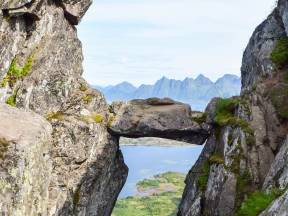
On your way up, you will pass the Devil's Gate, a large rock lodged in a crevice. This is an attraction in itself. If you continue upwards, you will reach Fløya, Svolvær's local mountain. From here, you get a fantastic view of the town.
Remember to bring a camera to capture the stunning sight. After enjoying the view, you can carefully make your way back down the same way you came up. Be aware that there are some parts of the hike that require climbing, so appropriate footwear and good physical condition are necessary. Enjoy your hike!
Svolværgeita
Ready for a truly unique experience? Get acquainted with Svolværgeita, or "The Goat" as it is often referred to.
This majestic mountain formation, towering over Svolvær harbour and Vestfjorden, is easily recognisable with its distinctive "two horns". The Goat is a living emblem of the wilderness of Lofoten.
Our adventure begins with a leisurely hike up to the foot of The Goat. The clearly marked trail provides you with the opportunity to enjoy the incredible panorama of Svolvær and the surrounding seascape.
For the adventurous and adrenaline seekers, The Goat offers an unparalleled challenge - "the goat jump". This daring leap between the mountain's two horns offers an unforgettable experience. But be aware, this is only for experienced climbers with appropriate equipment.
Svolværgeita was first climbed in 1910 by Carl Rubenson, Alf B. Bryn, and Ferdinand Schjelderup. Since then, climbers from all over the world have come to Lofoten with the goal of ascending one of the routes on The Goat.
Whether you decide to climb Svolværgeita, or if you choose to admire its majesty from a distance, the sight of this mountain will undoubtedly enrich your visit to Lofoten.