Welcome to this tour that takes you from Torghatten back to Brønnøysund.
Along the way, you’ll learn more about life on the islands, local tourism, and the importance of the sea—both as a travel route and as a source of food.
The journey takes about 25 minutes, depending on traffic.
So sit back, relax, and enjoy the ride!
Along the entire Brønnøysund area, the islands lie like small worlds in the sea, each with its own story. In fact, there are 10,045 islands, islets, and skerries here. Before bridges and roads connected the coast, the boat was the lifeline. People rowed to neighboring islands to trade goods, shop, attend church on Sundays, and to the mainland to sell fish, butter, and wool.
Life along the coast in earlier times was defined by a close connection to the sea. Most people relied on a combination of fishing and small-scale farming to secure their livelihood. Communities were often small and largely self-sufficient, with a strong focus on using local resources from the sea—such as fish and seabirds. Life was demanding, but this mix of occupations also provided a safety net, reducing the risk of food shortages if one resource failed.
Fishing provided both food and important trade goods. Many also farmed to produce butter, meat, and wool, and these two livelihoods were often combined to ensure survival in a challenging but resource-rich environment.
Along this coast, people live in close contact with the weather—and it shapes everything. Some days, storms whip in from the open sea; other days, the sea lies flat like a mirror, and the silence is so deep you can almost hear the oars slipping through the water.
This shifting weather shapes both the landscape and the people. No day is ever the same, and that is why locals say they “talk to the wind”—because here, weather is more than climate; it is a life companion.
When the storm settles, the coast reveals its softer side. To the west, the sunset spreads across the sky like a painting in gold and pink, and in summer the night never becomes truly dark—only deep blue. These light summer nights let sea and sky flow together, making everything feel endless.
And in winter, when the darkness returns, the Northern Lights dance over the Helgeland coast. Many people travel to Toft and the Norwegian Aquaculture Centre to experience the light waves shimmering above the fjord while the sea lies calm beneath. It is nature’s own performance—an unforgettable moment.
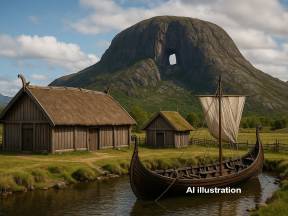
The island we are driving on now is called Torget, and it has a long and fascinating history. The island has been inhabited for thousands of years and was, in earlier times, a centre of power in Southern Helgeland. This is where the large estate Torgar once stood.
According to legend, this is where King Harald Fairhair came when he set out to unite Norway into a single kingdom in the 9th century. He is said to have stayed here with the local chieftain before the Battle of Hafrsfjord, where Norway was united under one crown. Archaeological findings show that Torget has had substantial settlement since the Iron Age, with traces of farming, trade, and seafaring.
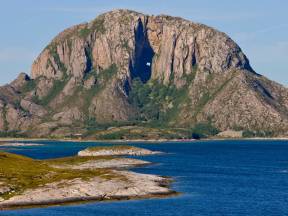
Torget and Torgar was a natural stopping point along the coastal route, where people could trade, exchange goods, and seek shelter. The island is protected by surrounding skerries and islets, with views toward both mountains and open sea. Today, Torget is best known as the gateway to the famous mountain Torghatten, and many come here to experience the nature and history up close.
Brønnøysund has always been a lively little community. Around the year 1900, only a little over 300 people lived here, and daily life was closely tied to the sea. The boats were small, and the weather and wind set the rhythm of everyday life. It was a place where everyone knew everyone, and whenever something important happened, the whole village gathered.
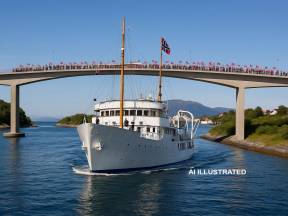
And nothing was more important than a royal visit. Whenever the kings travelled on coronation or blessing tours, people dressed in their finest clothes, scrubbed the piers, and decorated with flags and birch branches. The joy of welcoming royalty was genuine—an event that filled the sound with life.
In 1907, King Haakon and Queen Maud came here together with young Crown Prince Olav and Fridtjof Nansen, and visited Torghatten. Since then, every Norwegian king has stopped here. King Olav visited in both 1959 and 1963, and King Harald and Queen Sonja came in 1992, also on a blessing tour.
Between these royal occasions, the town continued to grow—getting its first dentist in 1916, its first car in 1919, and eventually its own airport. Today, the municipality has around 8,000 inhabitants, but the pride in these royal visits remains.
And when the royal ship Norge once again drops anchor in the sound, people will still gather along the quay—just as they always have—with flags, smiles, and the stories that bind generations together.
Not far from here lie Kvaløya and Kvaløyholmen, once among the most vibrant trading hubs in all of Helgeland. Here you can see the remains of piers, boathouses, and stone foundations from a trading post of great importance in the 1800s.
Along the stone walls by the shoreline once stood large warehouse buildings connected to the busy trade of the time. This was a central point for transport and communication, and it was here, in 1878, that the company D.S. Torghatten was founded—the beginning of what later became Torghatten Dampskipsselskap, a name that still shapes the region today. Kvaløya was also early in adopting new developments: the island received electricity in 1894, at the same time as Hammerfest and long before many other Norwegian communities.
Ships traveling north stopped here to stock up on supplies, trade goods, and seek shelter. It was a small, self-contained community with a bakery, storehouse, guesthouse, barns, warehouses, and living quarters—a key crossroads for trade, fishing, and maritime activity.
When the large pier in the center of Brønnøysund was completed in 1912, trade on Kvaløya gradually quieted down. But people still speak of the beautiful guest rooms from 1845 on “Kvaløen,” which were said to be the most elegantly furnished in all of northern Norway.
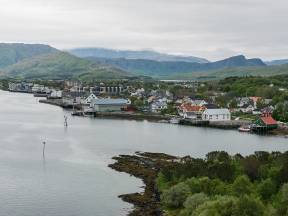
We will soon cross the bridge into Brønnøysund, where you can see the coastal route docked at the pier, take in the town center, and look out across the long, stretched-out coastal landscape. You won’t have time to count them all, but from the bridge you can actually see large parts of the Helgeland coast, with its more than 24,000 islands, islets, and skerries reaching out toward the open sea—nearly half of them, 10,045, located within Brønnøy municipality.
As evening approaches and the sun sinks below the horizon, everything changes. The sky and the sea blend into shades of gold and blue, and you may experience the atmosphere northerners call hildringstimen. It is that moment when distances fade, the mountains drift in the light, and you no longer know where the sea ends and the sky begins.
And then it becomes clear why both locals and visitors often describe this as one of the most beautiful places in the world.
Along this coast, people have always lived with tales and stories of trolls, hidden folk, and other mysterious beings.
But in our time, a completely new kind of story has emerged—the Oil Adventure—and Brønnøysund has become part of it, partly because of the helicopter base that serves the Aasta Hansteen and Norne oil fields in the Norwegian Sea.
Norway is one of the richest countries in the world per inhabitant, and according to many, this is thanks to the oil resources lying offshore.
What we now call the Norwegian Oil Adventure began in the 1960s, when oil was discovered in the North Sea. Norway quickly developed into one of the world’s leading producers of oil and gas, with major fields such as Ekofisk, Statfjord, and Troll. The income from these fields generated significant economic growth, and the surplus has been collected in a fund known as the Oil Fund (the Government Pension Fund Global). It is now one of the largest funds in the world and owns almost 1.5 percent of all listed companies globally.
The income from Norwegian oil has meant a great deal for our country, but one day the oil will run out. The purpose of the Oil Fund is to ensure that we use this wealth responsibly, think long-term, and safeguard the future of the Norwegian economy.
You might be wondering how much money is in the Oil Fund.
The answer is: a lot—over 20 trillion NOK in 2025. On the Oil Fund’s official website, nbim.no, you can check the exact value at any time
We are now approaching the town center, and this is a good moment to talk about Brønnøysund before and after the establishment of the Brønnøysund Register Centre. Before it was created, the town was a traditional coastal community shaped by fishing, trade, and small local businesses. When the Norwegian government decided in the 1970s to gather several national registers here, a completely new era began.
Suddenly, the town became a national hub for administration and IT. Everything from companies and accounting records to vehicles is registered here—and if you are married, that is registered as well. In total, there are around 20 different national registers, approximately 550 employees, and additional branch offices in Narvik and Oslo.
This means that almost everyone in Norway—companies, organisations, and private individuals—interacts with Brønnøysund without even noticing it, every time they register something, submit a form, file an application, or report information to the state.
The Brønnøysund Register Centre has become an important part of the town’s identity and a symbol of how a coastal community can combine long-standing maritime traditions with modern technology and future-oriented jobs.
All that remains now is to thank you for joining us on this journey. Today you have had a glimpse of Brønnøysund—from island landscapes and ancient legends to trading history, royal visits, dramatic weather, shifting light, and forward-looking technology. You’ve heard stories about Torghatten, old trading posts, UNESCO sites, and life as it once was—and as it is today.
We wish you a safe and pleasant onward journey.