Join a historical journey through Herøy and Havlandet. From findings of Viking ships to rock carvings, from several thousand years old burial mounds to exciting stories and experiences at Herøy Gard, Herøy old churchyard. The teller's voice will play automatically as you approach the red areas on the map.
Enjoy your stay!
To find more content and listen to free audio guides, download the Guide To Go app.
Coastal culture and stories from Havlandet
Points of interest
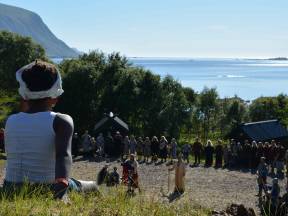
The Herøy play
«One of the best historic plays in the country», according to the famous Norwegian actress Agnes Kittelsen after she played the main role in the Herøy play ‘ The King’s Ring’. The play is both theatrical art and the world’s most beautiful Viking musical, but it is also so much more.
When 200 actors come together on the stage along with 100 other workers behind the scenes, they form a community that creates magic. The childrens’ sparkling eyes when they get to be a part of the performance, and join the community, is golden for the public and also for the future.
Snorre first told the story in his Royal Sagas. But since 1992 ‘ The King’s Ring’ has been performed here on the first weekend in July. An orchestra with 17 musicians and a large choir amplify the action with music. The actors, both adults and children, amateurs and professionals, bring to life the magic of the ‘play by the sea’.
And the audience are captivated year after year by the story of the Chief’s daughter Unna who is caught up in a choice between following her heart and choosing the charming Viking rebel Møre-Karl or following tradition and choosing the suitor that her parents had picked. Each of the men had their own entourage and there were battles and strife, then Saint Olav arrived to keep the peace in Havland.
The play is set on the island of Herøy with its powerful sea backdrop and where the Lord is the Master of the light. Before and after the play, people gather to eat and talk at the Herøy Coastal Museum just as the people of Herøy have done for hundreds of years. There is a Viking camp for the children, cultural walks, and outdoor church services.
Inner Herøy Church
Not many people know that the Norwegian Seaman’s Mission, or the Norwegian Church abroad, began its work in Tjørvåg in Herøy in Sunnmøre. Sevrine Klungsøyr visited Bergen in the summer of 1864 and discovered that there was a need for a Norwegian Seaman’s Mission. Sevrine was quick to act, and when she returned home, women gathered for the very first meeting of the Norwegian Seaman’s Mission, before the organisation was officially founded.
With her husband and five sons at sea, Sevrine knew all about what it meant to have her loved ones absent – and what it meant to lose them. Three of her sons died at sea.
Outside Inner Herøy Church is a memorial to Sevrine Klungsøyr. Another memorial has been erected to commemorate the sea as a hard master and the tragedy in the Arctic Ocean. 79 people from Troms and Sunnmøre died when seven fishing ships sunk in Vestisen in a violent hurricane in 1952. One of the ships was MS Pels from Tjørvåg. The ships went down, and the entire crew disappeared.
The church also has a monument dedicated to those who gave their lives for their country in World War II.
ROSKARRISTINGA CARVING
The people of Herøy and Havlandet have always been used to travelling by boat. The approximately two thousand-year-old Roskar Ship is proof of this.
In the middle of the dark grey stone lies a brown-orange rock and some archaeologists believe it could have been a mountain. This is because the rock has the only carvings we know of in Sunnmøre, and carvings were usually made on sacred mountains. Perhaps it was a holy place, where a ship transported the dead to the other side.
Or the place that the people of the sea are known to dream about.
A half-metre-long boat has been hammered into the rock. At one time or another in the centuries around the birth of Christ, a predecessor to the many skilled ship designers in Havlandet sat and carved a ship on this rock. It has beautiful lines, a split frame and a proud guide on board. We don't know what course the boat was going on, but we recognise the longing to embark.
VÅRFJØSEN
With grey wood walls and a wild grass roof, the spring stable is a natural creation. During the Second World War, it served as a set-off point for illegal traffic across the North Sea. Thanks to islanders whose hearts were in the right place, Skorpa was one of the few places along the coast that could be used during the entire war.
Many waited in the spring barn for a crossing to England. Intelligence people and fugitives received food and help from the people on Skorpa. During busy times, there could be twenty or so people in the small stable, and the waiting time could be several days or weeks. One of the most famous people who sought shelter here in Skorpesundet was Shetlands-Larsen and his crew. They arrived following bombings further north up the coast.
Eventually, those who were most active in the resistance work had to escape to England themselves. Two of them were declared dead and a death certificate was issued so that the Germans wouldn't keep looking for them.
The stable remains a commorative building to the courage and willingness to do the right thing.
Herøy Kystlag - Slippen
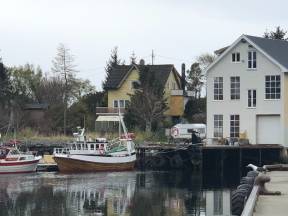
Those who appreciate engines and coastal history will enjoy exploring the former three-storey Brødrene Nerem Mek workshop in Fosnavåg harbour. Here you'll find boats, engines, photography - and coffee. Drinking coffee and exchanging stories, both real and fictional, is an important part of our efforts to preserve coastal culture.
Here you'll find desks and signs, lighting units, medicine chests and nuts and bolts. And you'll meet people with a heartfelt passion for coastal history.
If you’re lucky, you'll also get to see herring drying from the ceiling. Coastal life is preserved with the tradition of salt and dried herring. Sometimes the herring is sold in Fosnavåg's town centre, and is always popular. 'Bokna herring' is a popular traditional food here.
THE PREHISTORIC CEMETERY AT LØSETSTRANDA
Close to the magnificent and fiery sunset, with an uninterrupted view of the ocean and easily visible to all those who crossed the sea. Can you imagine a better final resting place?
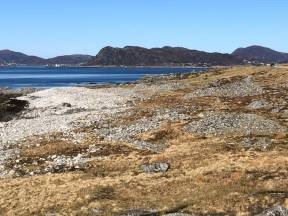
Large excavations by the sea are a special mark for this coastline, and one of the largest of these is Løsetstranda with 63 burial cairns. No excavation findings have been made in the graves.
The oldest graves at Løsetstranda date from the bronze age. The tradition of monumental graves came from Greece and returned in the Iron Age. Back then the burial cairns were lower and had more shape. The oldest burial cairns at Løsetstranda may be from the 1700s BC, with the most recent dating from 1050 AC.
This means that the burial cairns at Løsetstranda were built in a period of time stretching over 2000-3000 years.
The sea has always been an attraction.
KVALSUNDSKIPA
On a summer's day in 1920, a farmer in Kvalsund was working in his fields and discovered wood from a boat in a bog. He realised that there was something special about it and contacted the Bergen Museum.
There were excavations in the town and two ships were found. They had been broken up and laid in the ground in what was most likely a sacrifice to the pagan gods
The largest ship was 18 metres long, with room for ten pairs of oars. The smallest was almost ten metres long. A replica of each ship has been built, and they are located at the Sunnmøre Museum in Ålesund.
Whether these were Viking ships or not has been the subject of much debate. At first people thought that the find was so old that it dated from before the Viking era. Recent accounts indicate that the ship may have been built in the transition between the 700s and 800s,
so it is not clear whether those who sailed in the ship were Vikings or not. What is certain is that they were skilled seafarers in Havlandet. The ship is the oldest find with keels in all of Northern Europe. It reflects a time when ships didn't just have oars but also sails.
THE ISLAND FLÅVÆR - TORVHOLMEN
Flåvær is like a little Venice towards Stadhavet, with canals between homes and people, boathouses and houses. For anyone who only uses a car as a means of transport, this row of islets is a specific reminder of a time gone be. Tiny bridges linked some of the islets together, but otherwise transport was by boat.
Flåvær is also known as 'Pinebenken' (The Pining Bench). The name refers to a place where boaters would gather to wait impatiently for the good weather to pass over the infamous Stadhavet. And wherever people meet, there's always trade. Flåvær was one of the first settlements in Sunnmøre, and was a trading and hospitality town from the 1600s through to the end of the 1900s.
During the busier times, the harbour would be full of boats, and the small islets with their limited number of dwellings would sometimes have up to 1500 people milling around.
The largest islet is home to a guest house and a large store. The houses and the facility have been so well taken care of by the owners, that they have received the "Good protection award" from the Society for the Preservation of Ancient Norwegian Monuments.
On one of the other islands lies the school, which served the local community for 30 years in the early 20th century and then re-opened for a few years in the 1980s. There was only one student and the teacher went to Flåvær every day.
For those who want to experience Flåvær, accommodation is available at Torvholmen in the large main house, which stands as a testament to the island's past life. It is open for event hostings and is a great alternative venue for meetings, and a chance to rent your own island.
SVINØY LIGHTHOUSE
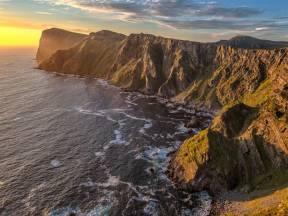
Svinøy Lighthouse is one of the most remote lighthouses along the coast.
The wind is particularly strong here, with recorded wind speeds of up to 120 knots, roughly double that of a hurricane.
There are no natural harbours or small coves to shelter in, only the cliffs and the endless ocean, which meants boats had to be hoisted ashore. The lighthouse stands 18 metres above sea level.
The extreme weather conditions explain why there was no lighthouse in this location before 1905. A lighthouse master and some lighthouse assistants arrived on the island, but they were seldom able to travel to and from the mainland, and had to live alongside the fish and seabirds. They had a couple of cows and goats who competed for the small patch of grass on the island, and otherwise it was seaweed and kelp for dinner. It was a tough life even for the animals, and there are many stories of goats blown out to sea.
The first lighthouse worker at Svinøy brought his wife and their seven children with him. A governess would visit to teach the children. It was an isolated life. Mail was delovered only once a fortnight. Apparently they would save the newspapers and keep one to read for each day, which meant they were always a couple of weeks behind the rest of the world.
They never knew when they would be able to go on land again. That was down to the weather and the waves to decide. Things got better with the introduction of helicopter traffic in 1970, but it was still the weather gods who had the final say in terms of when the crews could switch over on the island.
In 2005, the lighthouse keepers' 100-year service on Svinøya went down in history, and the lighthouse was then automated.
HERØY HISTORY
When the ice retreated after the last great ice age, the outermost islets in Havlandet were the first to emerge. Some people even claim that the ice never settled here. People clung to the narrow strip of land between the ice and the sea, and when the ice melted, it was still only a short distance to the fishing grounds, and a good place to live.
On the large beaches between the mountains and the shore you will find traces of people who lived here housands of years ago; bronze knives and stone axes, ships, burial cairns and rock carvings.
Farm names also reflect the settlements that stretch back thousands of years.
The name of the municipality, Hørei, comes from the small island of Herøy and may refer to the word "hær" (army) revealing that this was probably an army base or meeting point. It may also come from Hørn, a name for the female god Frøya, something that may indicate a cult city for god worship, and again a meeting place.
The find of the Kvalsund ship and the line of Viking kings who visited Herøy, indicate a central place along the main road; the shipping lane. And even though the people here ran farms, it was the sea and fishing that fed them and put money in their pockets. 18th century rofessor and naturalist Hans Strøm noted the Herøy people's unwillingness and inability to engage in agriculture.
For thousands of years, the people of Herøy hunted the 'blue fields' instead. And this is what life in Havlandet is all about.
HAVLANDET`S FISHING HISTORY
Open boats, oars and sails. That's how you fished the waters for hundreds of years. Then, towards the end of the 19th century, more and more deck boats arrived, and the beginning of the 20th century saw the arrival of the motor boat. And that changed everything. Fishermen could venture further out to sea, and the new boats were better equiped to withstand the bad weather.
The first Sunnmøre boat to take part in herring fishing off Shetland was from Herøy. The Faroe Islands and Iceland were next in line. There’s always fish to be found. During the abundant herring years of the 1950's, the fishing was literally on people's doorsteps. But when the herring disappeared, the fishermen had to go further out again, and it wasn't long before they found themselves off the coast of Canada fishing for shark.
Competition was fierce and triggered both a willingness to take risks and to adapt quickly. The boats were self-equipped, and life became about beating your neighbour to it.
More recently, the Herøy people have begun fishing north of Svalbard, west of Ireland and in the Southern Ocean - in addition to all the large sea areas off the Norwegian coast. Fishing is done in coastal boats, line boats, trawlers and 'ringnotsnurparar'. It is Herøy, along with the much larger cities of Ålesund and Tromsø, that has the most fishermen in Norway. And Herøy fishermen land seven percent of the total catch values in Norway, which amounts to almost NOK 1.5 million per year.
Value creation in fisheries has a ripple effect on land, because the fish needs to be delivered and processed. The boats need rebuilding and repairing, and they need equipment on board, from high-tech kit to food and bedding. A workplace on board a 'ringnotsnurpar' provides two workplaces on land.
The sea is the livelihood of the people who live in Havlandet.
The Marble Church on Herøy
Legend tells of three sisters who drifted out to sea, helplessly lost after a shipwreck. They promised that if they made it to land alive, they would build a chuch in the place that they came ashore. One of the sisters made it to Kinn, another to Giske and one to Herøy. These are three places along the coast with churches dating from the early Middle Ages.
The building of the marble church on Herøy could have begun as early as the 11th century. The church was devoted to Mary and was built in the same style as churches in England and Ireland. In the middle of the 19th century there was an order from the state that churches should have a designated number
of seats according to the population. Therefore, the old church was too small and had to be demolished. The stone was used in the foundation wall of the new church, which was built just a few metres away. It was later moved, and now only the walls remain. Within the walls you can see finely carved marble stones from the church that was built there nearly a thousand years ago.
On the site of the old church, the outline of the marble church is marked in slate. The altar is there too with a large stone slab from the marble church as an altarboard. In the middle of the stone there is a depression. That is where the relics were placed.
The residents of Herøy have been gathering for church services on the island of Herøy for almost 1000 years. And it was possibly a religious gathering point prior to that also. It was usual to build churches at the ancient Pagan places of worship, and many believe the Goddess Frøya was worshipped here on Herøy before the church was built.
Today, Herøy is a key point on the stretch of the coastal pilgrim path that runs from Stavanger from Nidaros and pilgrims can get their pilgrim passport stamped in Havlandet.
Stegleholmen near Herøy
It is almost too strange to be true, but on the small islet next to the island of Herøy, people were beheaded and their heads set high on stakes, to both warn and scare people.
The name ‘Stegleholmen’ tells about their barbaric methods. Stegle is another name for a pole, and these poles were used to attach heads to, or to fasten the victims to cartwheels, which they were strapped on to as a form of torture.
In Norway public beheadings were the usual method of execution for many hundreds of years.
One execution that we know about in Havlandet, took place in the middle of the 17th century. At that time there was a war between Norway-Denmark and Sweden. The Swedish forces withdrew from Sunmøre, but 5 swedish scouts were captured. They were beheaded and their heads set on stakes, most likely at Steglehomen.
The last beheading in Herøy took place in 1700. The condemned was a Herøy man who had killed his neighbour’s wife. Again it is most likely that the beheading took place on Stegholmen.
Herøy Coastal Museum
The island of Herøy has been a gathering point in Havlandet for over a thousand years. And this is how the municipality gained its name.
Viking Kings arrived here on the small island with their ships. And the Arch-Bishop came here in the 15th century when Herøy was a great church power in Sunmøre. At that time there was a Court House, and people gathered to attend church and to trade here.
Then cars arrived and people moved from the coastal roads inland. Herøy Farm was forgotten, and eventually fell into disrepair. The Borgstova which may have been built in the 14th century, was demolished right after the war. Everything was falling down. Just in the nick of time, the historical society in the municipality took hold of the buildings.
Now the yard at the old trading centre of Herøy farm is the centre of the Herøy Coastal Museum. The stately farmhouse, the house by the sea, boathouses and stores, kitchen and potato cellars, tell us about the lively trading centre and the households that lived here. The house and interior were taken care of, but as always in Havlandet the boats always held a special place in the heart and were high on the priority list.
A Museum boat team both restore and build traditional open wooden boats. These beautiful creations lie moored like jewels at the Coastal Museum. Together with the Sunmøre Sailing boat ‘Anna Olava.’
The island of Herøy invites you on a walk through a thousand years of history. It is well signposted but feel free to take a tour and become better acquainted with the history and people that have lived on Herøy.
In addition to the historical walk there are also good opportunities for nature walks both on the tarmacked path that goes over the island and on the adopted nature trail around the island.
RUNDE`S GOLD TREASURE
A raging storm rips at the sails. Captain Nicolaas de Roy is unable to rescue the Dutch ship. She was thrown into the mountain wall in Goksøyra on the night between 7 and 8 March 1725. All 200 people on board drowned. Crew, officers – and their wives. Two tons of gold and silver stored in nineteen chests were swallowed up by the sea.
Almost 250 years later, someone knocked on the reception desk of the Sunnmøre Police Station in Ålesund. It was a diver with 75 kilos of coins. The kelp forest and stretches of white sand were once the location of one of the biggest treasure finds in Europe. 57,000 coins were picked up along with canons, bronze vats and embroidery scissors, pipes, silver forks and belt buckles.
Many of the coins were sold, and the treasures were stored at the Bergen Maritime Museum, before rather symbolically being once again transported by boat back to Runde and the Runde Environment Centre. Here, people can see the gold coins, weapons and tools, decorations and splendour from the Akerendam trading ship .
Many people long to find more wrecks on the seabed in Havlandet. There's a story of a ship, “The Invincible Castle” from the Spanish Armada, which is supposed to have sunk near Goksøyra at the end of the 1500s. It is believed that this vessel was also carrying great wealth. Even if you don't find any treasure, diving in this area of clear water and exploring the kelp forest is still an incredible experience.
THE FISKARKONA STATUE IN FOSNAVÅG TOWN CENTRE
The statue of the Fiskarkona is located on the furthest point towards the sea in Forsnavåg town centre. The statue is a well-known photographic point and meeting place for local residents.
The sea gives and the sea takes. Living conditions for people along the coast were tough.
The men fought with the forces of nature out at sea, while the women had their battles at home. They ran the family, garden and the local community, while worrying about their men at sea.
In the 1990s, Fiskarkvinnelaget in Herøy wanted to honour the fishwives and a statue was raised at the quayside in Fosnavåg. It commemorates all the fishwives and coastal woman who stood by the sea waiting for their loved ones with a baby in her arms and a second child tugging at their skirt.
The people of Herøy have also experienced tragedies at sea more recently and that's when this statue became place to light candles and come together in the footsteps of those who had experienced similar tragedies
GERHARD VOLDNES
When the potent smell of herring oil settled over Fosnavåg, people said that "it smelt of money". People had to protect their laundry from the smell, but when the herring oil lubricated the entire economy, suddenly the smell didn't matter so much. It was the smell of money afterall.
Fosnavåg was Gerhard Voldnes' home town, and he established a herring oil factory, a herring saltery and a shipyard here. The shipyard delivered the very first Norwegian-built supply boat to a Norwegian shipyard, which made part of the Norwegian oil adventure.
During the abundant herring years of the 1950s, up to 1,000 employees were employed at Voldnesanlegga in Fosnavåg. The large houses at the very heart of Fosnavåg are still standing. The brick office building is an architectural gem, where the Gerhard Voldnes office is as it was during his heyday, with all the furniture and fittings still intact. The safe is so big that you can actually enter it.