
Borgund Market Place
0
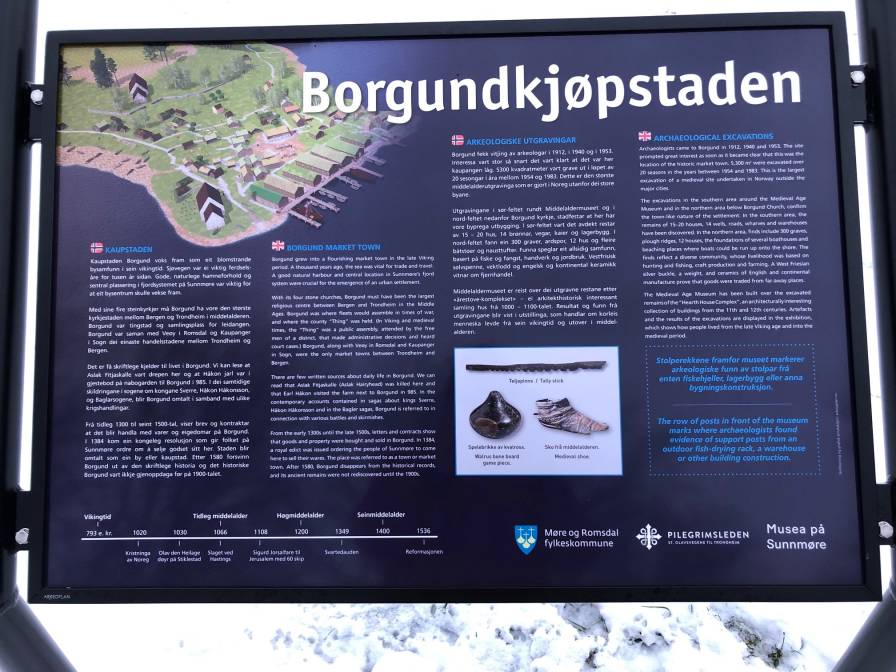
Borgund was a main trading and religious centre in the early Middle Ages. And it is mentioned many times in Saga literature. The town or market place grew from Viking times and was probably at its largest around the year 1300. At that time the place had a definate town like feeling. It was easy to arrive here by boat from all directions and goods that were to be transported further to Bergen were loaded up here. Craftsmen sold their wares here, and we can assume that that it was bustling both in the harbour and in the market place. Borgund was also known as a large Parish, consisting of four churches. All the churches were built in stone. This shows that the town was relatively prosperous. Pilgrims hiking towards Nidaros would quite likely have stopped here for a few days before they continued on their way. In modern times Borgund has become a key point on the Coastal Pilgrim Path. In the later Middle Ages, Borgund lost some of its status as a central trading place. The black death, a change in climate and a downturn in fishing could be some of the reasons for this. After 1570 there is no mention of the town in written sources. It was forgotten about and after some years the town of Borgund also disappeared from people’s memories. The first excavation here, was of Margareta Church in 1912, but excavations only speeded up after 1953 when the graveyard at Borgund church was expanded. Over the next 40 years there were several periods of excavations and all together over 45 000 objects have been discovered here.