Listen WHENEVER and FROM WHEREVER you want.
This audioguide is available in:
Norwegian 🇳🇴
English 🇬🇧
German 🇩🇪
Or take the walk on site; the map in the app shows you where to go. 30 minutes.
To find more content and listen to free audio guides, download the Guide To Go app.
Listen to the Story of Tromsø (Audioguide)
Points of interest
WELCOME
A very warm welcome to Tromsøya, an island placed in magnificent surroundings in what mariners call ‘Northern Europe’s most beautiful harbour approach’.
When the great Norwegian poet Bjørnstjerne Bjørnson visited the area 150 years ago, he recommended a visit to anyone with the need to ‘put their nerves in order’.
So let the sea air work wonders for your nervous system while I explain how this guided walk works:
The map on your mobile tells you where to go and I’ll start talking automatically when you get to the next red circle. Or you can choose to press it yourself. You can scroll down on the routes’ startpage to find all the points of interest with their audiotrack and photos. You’re the roving blue dot on the map, which means you can move around at your own pace. Just make sure to listen to the end of each recording before you move on. Enjoy the walk!
Look across the other side of the sound and you can see the famous Arctic Cathedral and the Fjellheisen Cable Car. The airport is over on the other side of the island, but don’t waste any time looking for a railway station – for thousands of years, the way to reach the city has been by sea.
The island is about 10 km long and is situated about 69 degrees north, that’s to say within the Arctic Circle, which means that the sun dips below the horizon in November and its light is not to be seen again until the 21st of January. This is celebrated with ‘Sun Buns’ and hot chocolate. In the summer, the sun is visible 24 hours a day as it journeys around the sky.
Tromsø has very strong links to the history of polar exploration: Welcome to ‘The Gateway to the Arctic Ocean’.
THE COASTAL EXPRESS
Northern lights, Pole Star, Polar light.
No, not the names of celestial phenomena, but of the ships in one of northern Norway’s oldest institutions: the Hurtigruta or Coastal Express. This famous ferry service was inaugurated in 1893 and for many decades was the fastest way to get from one part of the country to another.
They still come into town twice a day – one on its way south, the other bound north-eastwards. Perhaps one of the service’s many ships is berthed before you as we speak?
As early as the 1930s, the Hurtigruta was transporting 300,000 passengers a year, equivalent to 10% of the entire country’s population at the time. During the Second World War, opposing forces attacked ship after ship to prevent the transportation of supplies. 14 coastal steamers fell foul of mines or torpedos with the loss of 700 lives.
Recovery after the war saw the ship owners order new, modern ships, and the service experienced its heyday in the 1950s and 60s.
If you arrived here on board a cruise ship, then you are part of a long tradition: The Hurtigruta has always wished tourists welcome and actually had brochures in both German and English from the very start in the 1800s.
Bjørnson – our famous poet again – warmly recommended that travellers ‘take an invigorating voyage rather than a nauseating bathing holiday. One lives as on the drawing-room floor at home,’ he enthusiastically explained.
Are you a little worried about being sea-sick perhaps? Well, don’t be, because according to Bjørnson seasickness was ‘a healthy affliction’.
ROALD AMUNDSENS PLASS
We’ve come to Roald Amundsens plass, named in honour of our great polar explorer. But the statue, unveiled in 1937, was meant as a monument to all heroes who risked their lives to expand humanity’s field of knowledge.
The park is triangular and arches down towards the sea, echoing the ‘cake segments’ formed by our system of coordinates at the poles. To your right you can see the Northern Norwegian Art Museum.
On the 14th of December 1911, Amundsen was the first person to set foot on the South Pole following the most daring dog-sled expedition in polar history. Amundsen was also the first – alongside Italian Umberto Nobile – to fly over the North Pole in the airship Norge in 1926.
Amundsen learned “snowhow” – how to survive the inhospitable Arctic conditions – from both Norway’s indigenous people – the Sami – and Canada’s Inuit: members of the expedition wore sealskin coats and slept in Sami-inspired reindeer-skin sleeping bags as the thermometer dipped below minus 40 degrees Celsius and the liquor in their compasses froze to ice.
Amundsen recruited a crew with Arctic Ocean experience from Tromsø and found the polar ship Gjøa at the Tromsø Shipyard.
The people of Tromsø were also the last to see their hero alive. When Umberto Nobile went missing during a later polar flight, Amundsen set out from Tromsø in a flying boat to find him. Both he and his crew disappeared without trace. They were never found.
The legacy of the polar heroes, however, lives on: Tromsø is host city to the Arctic Council for the promotion of sustainable development in the Arctic, a forum where indigenous peoples’ organisations participate on equal footing with Canada, Russia, the US, all the Nordic and a number of other countries. The Arctic University of Norway alone has the equivalent of 130 full-time positions with a focus on polar research.
As you might have guessed, ours is the northernmost university in the world.
A TRADING CITY
On your right hand side now you can see Tromsø Cathedral and the main street, Storgata, behind it. We’ll be coming back to both later.
People have been living in Tromsø for over 11,000 years, but it wasn’t until 1794 that that King Christian VII granted the city ‘market town privileges’: Finnally we could trade with whomever we wanted. Today 1 in every 5 jobs is within commerce and hospitality. Here in Kirkegata, for example, you can buy traditional Sami handicraft such as silver jewellery or a large sami knife – or maybe a Norwegian cheese slicer with a reindeer-antler shaft?
Or perhaps you’re dreaming of that Arctic selfie? Here you’ve got the chance to pose with a full size polar bear – luckily, he’s been to the taxidermist first! As you can see from the old postcard on your screen, polar bears have been a popular draw for the city’s fur specialists at least as far back as the 1930s.
Animal lovers can rest assure: Live polar bears have been protected by the dedicated ‘polar bear law’ since 1957.
One of the architectural characteristics of the city is that central Tromsø boasts the largest collection of historical wooden buildings north of Trondheim. It also has Norway’s most important concentrations of early 19th century Empire-style [] manor houses – the yellow corner house right in front of you, for example. Walking down Strandgata, make sure you don’t miss the classic Empire doors with pilasters on either side, each crowned with splendid capitals and supporting the elegant architrave [] which stretches between them.
Would you like to know something very special about the Tromsø Empire-style? Unlike the designs of Emperor Napoleon’s Paris, which give the style its name, here they are rendered in wood, not stone.
PARTY TOWN
Tromsø has long been known as a party town, and as far back as 1838, when there were only 2,000 inhabitants, there were 28 licensed merchants selling spirits. We are now approaching Strandtorget where many of the city’s bars and restaurants today can be found.
We were never a large industrial city but we do have Mack beer brewery founded in 1877. Fancy an Arctic Beer? Not only does Mack brew a beer of that name, in 1981 it also became the first beer to be drunk at the North Pole.
Despite only having 68,000 inhabitants, Tromsø is very much a university town, and our more than 12,000 students from 92 countries are keen to be ‘out on the town’ as we say.
The university offers a whole range of subjects, including Sami language studies. Did you know that Sami has 300 words for snow? If atmospheric research is more up your street, then maybe the 100 year-old Tromsø Geophysical Observatory should be the place for your studies?
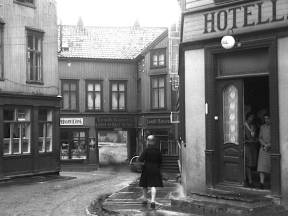
If, on the other hand, you want to know more about Tromsø café life back in the day, then settle down with the novel Kranes Konditori, by one of the city’s most important writers, Cora Sandel, and published in 1945. At your phone you’ll find an interior photograph of the original Tromsø café with its lead glass windows and a canary in its own little niche in the wall.
The Geophysical Observatory is a world leader in a much larger niche, namely space weather. Did you know that forces at work in the solar system affect the Earth’s navigation systems, radio communication and power supplies?
THE CHEMIST’S HOUSE
When Roald Amundsen was in Tromsø, he habitually stayed with his good friend Zapffe in the chemist’s house across the street, which accommodates the Hard Rock Café today.
The chemist’s son, Peter Wessel Zapffe, is one of Norway’s most famous philosophers. An existentialist of the highest order, whose doctoral thesis, On the Tragic, excited a great deal of attention. Zapffe believed that the meaning of life was to find an outlet for one’s abilities and talents. The tragic arises on account of mankind’s being over-equipped for the task.
When Amundsen disappeared with his flying boat in 1926, Zapffe wrote sceptically about the modern machine:
“The spark-plug from Hell leads him triumphantly, pistons singing, over the Earth’s icy shell. Mephisto, however, stands in its light. (...) No strength of spirit, no physical training, no lifetime of experience can clear a carburettor in four seconds in a stormy sea (...) A few bitter escapades out on the wing, the boat turns over and the waves roll on as before.”
Following that, perhaps we need a glass of Mack beer? Well, 200 metres south along Storgata here takes you to the brewery’s famous watering hole and beloved tourist attraction, the Beer Hall, established in 1928. But we’re going the other way.
Zapffe was an eager photographer: On your mobile you can see a picture he took of the view from the top floor. He was also a keen mountaineer and convinced of the importance of untouched nature – indeed, he was one of Norway’s first environmentalists. He formed the Keep It Quiet club, whose number one premise upon discovering a formerly unknown natural wonder was not to make it public. That way, every individual had the opportunity of discovering it for themselves.
One of Zapffe’s boldest climbing feats took place no more than a few metres away. Can you guess what he managed to climb?
PARIS OF THE NORTH
Tromsø people were often traders or seafarers and therefore travelled a good deal. Impulses they got from outside the country left their mark on Tromsø’s architecture, culture and dress.
A German tourist’s travelogue from 1882 proclaims: ‘Stockholm is considered the Paris of the North. Should the settled areas of the high north have such a thing, then it can only be Tromsø.’ Indeed, Tromsø is still known as ‘The Paris of the North’.
The city merchants dealing in gentlemen’s attire and ladies’ couture imported the latest fashions directly from Paris, so the young women here were often dressed as ‘Parisian seamstresses’ as the saying goes. A scent of the past may be experienced right here: Randi Parfymeri with its blue wooden shopfront remains famous for its ladies’ millinery, as you can see from the display.
Tromsø’s more affluent homes were decorated in what became known as ‘klunke-style’. The wealthy had upholstered furniture featuring fringes and tassels – known as ‘klunker’ – these also being used to edge their elaborate curtain draperies and opulent portières as well as ornately decorated table edges and shelves. Life was wall-to-wall carpets and textiles, the non-symmetrical style complemented by delicate palms from southern lands. The visual arts were in the ascendant and people would set up framed paintings on easels in their drawing rooms, often with exotic subject matters – preferably lightly veiled women of the harem. Here was a beautiful ‘mix ‘n’ match’ of rococo, baroque and gothic styles. ‘Less is more’ was definitely not an aspect of ‘klunke-style’; on the contrary, Tromsø 150 years ago was the capital city of ‘more is more’.
Talking of more, there’s more to come: in the next chapter we’ll be ascending to the heavenly heights!
TROMSØ CATHEDRAL
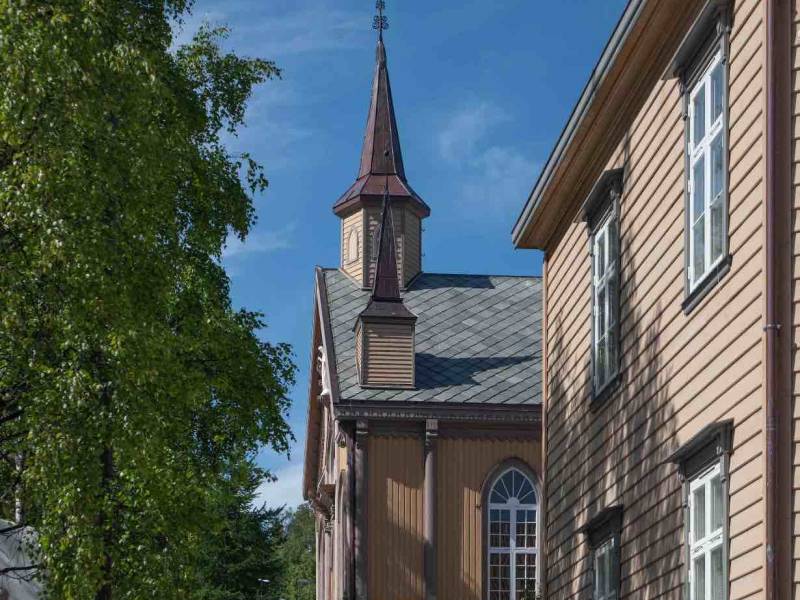
Tromsø Cathedral is the only Protestant cathedral in Norway built of wood. From 1861, it employs typical log construction, a building style from the Middle Ages. There are the pictures in the link at the bottom of your screen.
The cathedral is a neo-gothic single-nave church featuring decorative rosettes and clover leaves both inside and out. It also boasts one of the country’s most valuable 19th century organs.
The first church in Tromsø was constructed around the year 1250 as the northernmost church in the world. Pope Clemens refers to the church in a letter from 1308 as ‘Ecclesia Sanctae Mariae de Trums juxta paganos’ – The Church of Saint Mary in Troms, close to the heathens.
Tromsø philosopher Zapffe was a heathen too – or at least never found ‘the faith’. Perhaps he was trying to reach God when, one day in the 1930s, he ran up the steps of the church tower, scrambled through an aperture and climbed to the top of the spire to the great consternation of the city’s inhabitants.
It is not easy to determine if the climb gave him any new existential perspectives, but the photographs he took and the description he gave of his attraction to climbing speak for themselves:
‘Have you ever thrashed like the Midgard serpent in your bed, while nightmares tore at your nerves like predators in living flesh, and anxiety crawled like a centipede through your guts? You haven’t? Then neither do you know the obsession that mountaineering alone can bestow on its initiates.’
And what kind of safety precautions did he take for his breath-taking ascent I hear you ask. It goes without saying: none whatsoever.
https://snl.no/lafting
AUTHOR CORA SANDEL
In the corner of the park is one of the city’s first brick buildings: the infamous Bankgata 13, from 1880. This eclectic building features elements from both the Italian Renaissance – note the horizontal decorative borders – and Medieval Germany, as can be seen in the stepped gables.
The building has served as a mondain gentlemen’s club, a school for mariners and the Gestapo headquarters during the Second World War. People then feared this brick fortress and its cellar dungeon. Today the building serves duty as bank offices.
When the author, Cora Sandel, arrived in Tromsø as a child in the 1890s, the beautiful building became her family’s home.
Cora Sandel is one of Norway’s greatest literary stylists, but dreamed of becoming a pictorial artist. She studied painting several years in Paris, and said: ‘I loved painting; I never became a painter’.
Rather she wrote in an extraordinarily painterly fashion, able to create outstanding literary portraits at a single stroke, albeit with the pen instead of a brush. She created one of the greatest female portraits in Norwegian literature: the trilogy about the artistic soul, Alberte, who travels to Paris from a little North Norwegian town to attend art school.
Sandel was a literary pioneer, one of the first to make extensive use of the present tense, and her works have been translated into many languages. She expressed the discomfort of being human, in her words ‘a painful consciousness of one’s own person’. Her stories form an episodic mosaic in which the core domain of the novel is the protagonist’s mind.
Later on, our walk will take us past a museum where you have the opportunity of visiting exhibitions concerning her life and work.
THE MACK PASSAGE
The old wooden houses make the centre of Tromsø particularly distinctive, but the risk of fire meant that building in brick gradually became mandatory. And right in front of us now we have one of the few Art Nouveau buildings in the city centre, known as Mackgården.
Organic forms inspired by nature are typical of Art Nouveau architecture. Take, for example, the oval window high up in the bowed gable, all placed centrally in the mansard roof – which is another characteristic feature. Also note the bay window that extends over two floors in the middle of the facade.
The passage alongside the building accommodates a number of restaurants as well as the old Prelaten Kro or Prelate Inn, whose role as a concert venue and cultural arena – not least for radical students – dates back to the 1970s.
Walking through the passage takes you to Sjøgata, replete with a number of Empire-style houses and catering establishments. But we’re going to continue along the pedestrian street past Cora Sandelsgate up on the left. At the top, you’ll see Tromsø’s City Library and Archive, with its wholly distinctive roof construction – a so-called Candela shell balanced on four points of support.
If you’re looking for more information about things to see and places to eat, this might be a good time to pop into the Visit Tromsø office down here on the right, on the lower side of the street.
EXOTIC PEOPLE & BUILDINGS
From 1740 on, Tromsø was coloured by the famous Pomor Trade, with Russian ships selling grain in exchange for fish and leather goods. The Pomor Trade continued right up until the Russian Revolution in 1917.
Tromsø was as ‘busy as an anthill’, and the town’s trade in fish and cod liver oil really took off from 1820 when sailing ships set off for the Arctic Ocean for the first time. In the marketplace there were Russians with long beards and fur-trimmed overalls and Sami’s in white embroidered jackets; there were Hamburg skippers eagerly dealing with local traders, and fishermen unloading their catch at the quayside.
In quayside huts and warehouses, in shops and market stalls you could buy Sami handicrafts, the work of goldsmiths and clockmakers, fur and leather products and carved walrus teeth – even seal or whale oil from the city’s floating rendering plant aboard a ship.
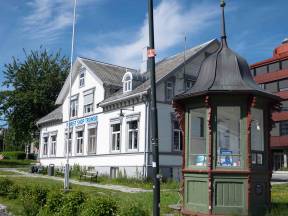
At the top of the square, you can see one of the many oriental-inspired booths which the city gradually acquired. The townspeople simply call it the ‘rocket kiosk’, although today it’s actually a bar. Behind it you can see the world’s northernmost Catholic cathedral, this too built of wood and consecrated in 1861. Pope John Paul II stayed over at the Catholic bishop’s house below when he visited Tromsø in 1989.
You and I, however, are off to the movies.
WORLD'S THEATRE
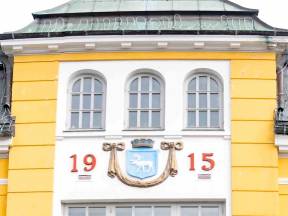
‘The most beautiful cinema in the country” the media said when Tromsø’s public cinema opened in 1916 in this neoclassical building with its art nouveau-towered middle section – today Norway’s oldest cinema still in use.
The Tromsø locals were already enthusiastic movie goers. In 1909, the Tromsø Post announced the filmic presentation of a lion hunt in Africa, life in China and the Great Balloon Ascent in Berlin.
No wonder then, that the new cinema was given the name ‘Verdensteatret’, the world’s theatre. Norway had once again become an independent nation after the union with Sweden was dissolved in 1905, and film was part of a modern, national-romantic educational programme in which film adaptations of national literature was a key theme, such as Henrik Ibsen's famous poem about Terje Vigen.
The interior decoration of the cinema also bore the stamp of nation-building: the walls sport 13 murals from 1921 with Norwegian folkloric subjects.
Silent films were the original fare and the house musicians played twenty to thirty compositions while they sat shivering in their outdoor clothes in the icy orchestra pit. For many people, this was their first meeting with musical high-brow culture.
Today the old cinema has evolved into a ‘cinématèque’, with the purpose of stimulating people’s interest in the history and art of cinema – not least during the annual Tromsø International Film Festival.
The elegant Empire-style building alongside was home to Cora Sandel’s family a little over 100 years ago. Today, the building houses the Perspective Museum, where you can visit exhibitions about her life and work.
And with that, dear listener, our walk comes to an end. All that remains is to wish you Bon Voyage, wherever your journey takes you.