To find more content and listen to free audio guides, download the Guide To Go app.
THE NORTHERN LIGHTS (AudioGuide)
Points of interest
LIGHT
Throughout human history, man has studied light. There is still a lot we don't know. Ever since man gained dominion over fire, light has been our best friend and our rallying point, and not least our defense against darkness, cold and natural enemies.
Cosmologists claim that the universe itself will die one day, and believe that then the light will most likely be the very last thing to disappear.
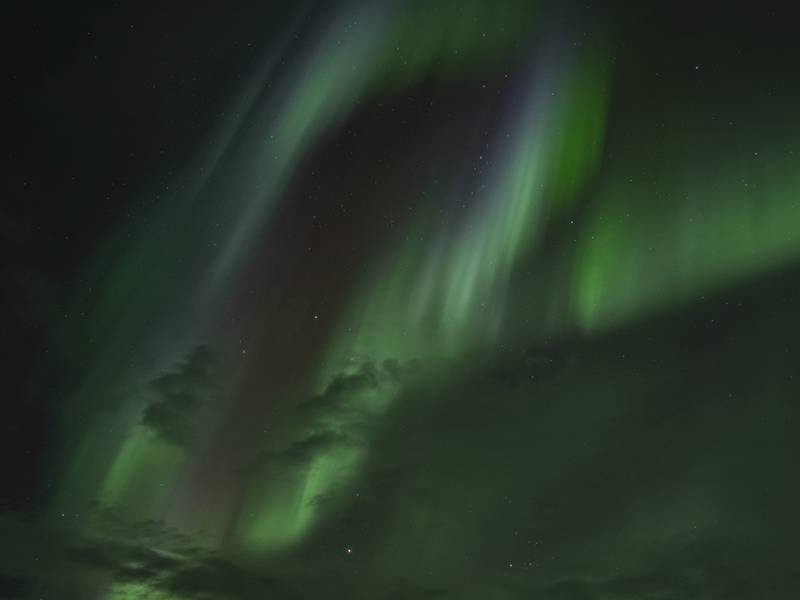
The Northern Lights are one of many light phenomena that humans have long been fascinated by, and which they have spent many a night or dark winter's day studying. Actually the Northern Lights could just as easily be studied in the middle of the brightest summer day – but then they are outcompeted by the sun's much stronger shine, so that the Northern Lights are not visible to the naked eye. It is only in the dark winter that this magnificent heavenly spectacle comes into its own.
According to the Christian Bible, the prophet Ezekiel told about the Northern Lights as early as two and a half thousand years ago: "I had a vision. Behold, a storm came from the north. There was a big cloud of blazing fire. And a brightness was about it, and inside the fire it flashed as if of shining metal."
In this audioguide, you will hear what science has to say about the Northern Lights, but first: What did people around the world in the past think when it comes to what the Northern Lights really are?
FOLKLORE AROUND THE WORLD
In Chinese annals from the centuries after Christ, the Northern Lights are mentioned several times, while the Japanese in their old writings called the Northern Lights “the dogs of heaven”.
In the Faroe Islands, parents used to fear the Northern Lights; they never sent their children outside without a hat when the Northern Lights were on, because then the light could hit them and burn their hair off.
In Sweden, they had a similar fear, and thus the Swedes never cut their hair when the Northern Lights were shining.
Here in Northern Norway, people were also afraid of the power high up in the skies: Parents feared that the Northern Lights could paralyze people, could come down and take their children or even worse: take their lives.
Even in modern times, we learned that one should never wave a white handkerchief, because this would irritate the Northern Lights and then they could “create themselves wrong” as old people said; it could be dangerous. In any case, you should never whistle, because then the dead – who were believed to live in the Northern Lights – could come out.
The Inuits in Greenland also believed that the dead reside in the Northern Lights, but they meant this in a positive sense: When the Northern Lights shimmered, one could make contact with loved ones who had died.
What about the Sami population here in Norway, were they just as hopeful about what the Northern Lights could bring?
SAMI FOLKLORE
In Sami folklore, there is a myth about the boy who teased the northern lights.
Once upon a time, two brothers were out one winter night to herd reindeer. They were wearing ‘pesks’ – a Sami outer garment made of reindeer skin – and each drove a sled; a sled with skis underneath that people can sit on while their reindeer pull them across the snow.
The youngest brother started to ‘joik’. ‘Joik’ is the traditional Sami folk music, and when you ‘joik’, you perform a unique form of song – it is not uncommon to improvise the lyrics on the spot. The youngest boy ‘joiked’ in such a way that he teased the forces of nature, and the older brother strongly advised against teasing God’s creatures.
But the youngest brother did not heed his elder brother’s warnings; he teased the sun, so it disappeared behind a cloud and they were stuck in the snow for several days. When the moon shone, he joiked the moon in the same teasing way. Then they were suddenly surrounded by a veil of darkness, and could not get anywhere for another three days.
As soon as they could see the stars again, the youngest brother joiked them too, only to have a ball of fire shot down from the sky. It hit one of the reindeer, causing the animal to fall dead to the ground. The eldest brother again begged him to stop, but to no avail.
Then they saw a fierce northern light, and the youngest brother starting joiking it:
The northern light ran, lip, lip, lip,
Flesh in the mouth, lip, lip, lip.
Hammer in the skull, lip, lip, lip,
Axe on the back, lip, lip, lip.
The northern light started waving feroiciously. The eldest brother overturned his sled and crawled under it. But the northern light beat the youngest to death and burned up his sled. No one ever found his body afterwards.
Since then, the Sami people have known that it is dangerous to tease the northern lights.
What about the Vikings, who are said to have been so hardy: Did they also fear the northern lights?
NORSE FOLKLORE
In poems from the Norse society a thousand years ago there are descriptions of the northern lights. We know this from the collection of poems, named“Edda”, which was written down in the 13th century, but which contained poems that were several centuries older, going back to the Viking Age. The Edda collection of poems is the most important source of Norse mythology and heroic legends.
The northern lights are reflections from the shields of the Valkyries according to the religious beliefs of our Norwegian ancestors. Valkyries were women in war gear, mythological beings whose task was to rescue men who had fallen in war on the battlefield, and bring them home to the gods.
The Valkyries brought half of the dead heroes to Valhalla, the seat of the male chief god, Odin – the god of war, sorcery and wisdom. The other half of the fallen war heroes were brought by the Valkyries to the female chief goddess, Freya, who controlled magic and was the god with the greatest knowledge of life and death. When the northern lights crossed the sky, the Vikings believed that their fallen heroes were finally brought safely home to the gods.
In the 13th century, the most important literary work from the Norwegian Middle Ages was also written down, namely “Kongespeilet”. It is an educational-philosophical writing that depicts a dialogue in which a father teaches his son practical questions and morality that kings should know.
In the Kongespeilet, the northern lights are described as follows: There are Fire around the sea and all the waters that flow around the globe on the outside, and the northern light shines from that fire”.
Gradually, scientists began to take a serious interest in the northern lights. So, what kind of theories did more modern, Western scientists have about what the northern lights actually are?
THE FIRST THEORIES
"The Northern Lights are rays!", claimed early scientists, “rays from the sun that form reflections in the layers of air above the globe!”
“Not at all”, said others, “the Northern Lights are gas, a very special Northern Lights gas that dances in the gusts of the atmosphere!”
“No-ho-ho!”, said a third, “we are dealing with dust! Cosmic dust particles that cosmic meteors have thrown off on their journey through space, and then this dust descends onto our mountains.”
“Hahahaaaaaa!” – the fourth bellowed – we can at least imagine that the scientist Edmond Halley, you know the one who predicted Halley's Comet, laughed heartily at these silly theories when he presented his solution around the year 1700: “The Northern Lights are about magnetic fluid! It trickles up from the ground, leaks out into the polar regions, follows the Earth's magnetic field up, up, up, up into the atmosphere and makes the sky itself!! – light up!”
All these clever minds! All their brilliant theories! All of them fascinating – all of them completely wrong.
No, we must go to Oslo, or rather old Christiania, as Norway's capital was called at the time, to Inkognito street, to find the real answer to what the northern lights are. Because that's where the Norwegian inventor and physicist Kristian Birkeland lived.
He was so young when he got his physics professorship at the University of Oslo in 1898, only 31 years old, that do you know what they called him? You'll find the answer in the next chapter.
BIRKELAND'S EXPERIMENT
Kristian Birkeland is considered the world's first space scientist. At the end of the 19th century, he was a physicist at the University of Oslo, which was then called Christiania, and he was so young when he became a professor that his colleagues called him "The Boy Professor".
Birkeland was convinced that the northern lights were created by particles from the sun. He was also a brilliant inventor, and at home in his apartment on Inkognitogaten he even constructed a model of the Earth-in-space. He called this the "terella experiment"; terella means "a small model of the Earth" in Latin.
He set up a glass box – picture an empty fish tank – where a metal ball hung from the ceiling, representing the Earth. Then he pumped out all the air, so that the aquarium would be empty – just like in space – and finally he sent electrons through the glass box from a powerful electromagnet.
Each experiment took several days; it was time-consuming to pump all the air out. The electromagnet could be turned on and off, and the voltage Birkeland used was a whopping 25,000 volts, 100 times stronger than the electricity you use at home.
The air was therefore electric – with both power and exitment – when he started his experiment; what would happen when he shot the electrons towards the Earth?
BIRKELAND'S DISCOVERY
Norway's unofficial national physicist, Kristian Birkeland, had a theory that the sun not only emits light, but also a constant stream of charged particles, and that the northern lights occur when these particles collide with the Earth's atmosphere. This is what he wanted to test in his ‘terella experiment’, in which an electromagnet would send particles towards the small globe inside the glass box.
As mentioned, the excitement was great when Kristian Birkeland turned on the electromagnet: Sure enough, a kind of mini-northern lights appeared, both at the model's north pole and south pole! He now understood that the northern lights occur in a very thin gas at the very edge of the Earth's atmosphere.
Today we know that the gases in the atmosphere are made of atoms. But when the energy from the solar particles is transferred to these atoms as they collide, the atoms of the gas are unable to hold on to the energy: Instead, they emit the energy back out in the form of light.
And if you are lucky on your visit with us, you can enjoy the sight of this light in all its wonderful colors and shapes. By the way, do you know which color is the most common?
SPACE WEATHER TODAY
In the past, people looked up at the northern lights and believed that from this celestial, usually greenish-yellow, spectacle they could predict upcoming naval battles and warring armies fighting each other – or upcoming disasters on Earth. Some are said to have used the northern lights to predict the great fire that ravaged the Norwegian coastal city of Bergen in 1582.
Others saw it as a sign of good fishing; it was believed that large schools of herring swam close to the ocean surface so that their shells cast a light shine onto the celestial canvas.
When knowledgeable people today witness the beautiful nuclear crash of the solar wind, many are concerned about how this strange phenomenon affects our daily earthly life: The particles interfere with terrestrial radio signals, specifically the type that goes between satellites and your mobile phone when you use GPS services. Solar storms can also cause overloading in our power lines. Such aspects of space weather are carefully studied at various Norwegian scientific institutions, such as the famous Northern Lights Observatory in Tromsø.
What thoughts and feelings are triggered in you, I wonder? Do you daydream about the inherent forces of the solar wind and celestial color play? Or are you one of those who feel that the magic is diminishing now that science has revealed the invisible physics of space?
Instead, one could ask: What is light, really? And why are we able to perceive this divine fire that flickers across the Arctic night sky? Could someone really have orchestrated the whole thing in such a way that the people who live with the breathtaking sight think it speaks to them, and people from far away feel called to travel halfway around the globe to experience it?
Some of us who have grown up in a Christian culture are reminded of the Bible verse that says “I am the light of the world. Whoever follows me will not walk in darkness, but will have the light of life.”
Whatever your exact thoughts, it is perhaps timely to ask whether the mystery of the northern lights has not – after the revelations of science – actually only become even greater?
And with that, dear listener, our journey comes to an end. Would you like to hear more, perhaps about the history of the city of Tromsø, or about how life is in the small Senja village Fjordgård, under Norway’s world-famous mountain, Segla? You can find our other audioguides by clicking on the Johnsen&Johnsen link at the bottom of the page.
All that remains is to wish you the very best in your onward journey – wherever it may take you.