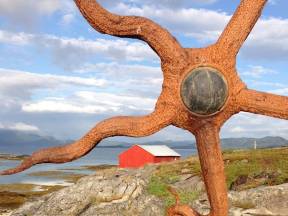
You are now standing before a creature of myth – a giant, crab-like figure that has washed ashore here at Tranøy Lighthouse.
This is the Kraken, a mysterious being from ancient legends, reimagined by the artist Alvin Jensvold.
Stories of the Kraken echo along the entire coast, and some even claim to have seen it in Mefjorden on Senja – described as having three pillar-like legs, looking like a giant fish or monstrous squid.
But the Kraken here at Tranøy bears the marks of our own time: it is made of plastic and waste – a stark reminder of the pollution filling our oceans.
Still, it's not only a frightening figure. Children have been fascinated by it, climbed on it, and learned its story.
If you’d like to know more, you can read the thrilling tale of the Kraken in a small booklet available at Tranøy Lighthouse.
Will you also be swept up by the mystery?
Was is los/ Hva skjer? (2020)
In front of you stands a sculpture that resembles a flat screen – but this is far more than just an ordinary display.
Was ist los? / What’s going on?, created by Bjørn Tore Stavang in 2018, plays on a familiar phrase from the German TV series Derrick. Here, it functions both as a wordplay and as an invitation to reflect on how we perceive the world.
From a distance, you might notice how the artwork mirrors the surrounding landscape – almost like a form of “surveillance” of its own environment. Stavang has used digital image processing to create an optical illusion: the screen repeats itself inwardly, forming a tunnel-like vision.
At the very center, barely noticeable at first glance, is a small lighthouse – reproduced at stamp size, yet rich in symbolic meaning.
What do you really see when you look at this work?
And how is your gaze shaped by the way the image is presented?
Perhaps Was ist los? is a question directed at you – about how we understand the world through what we see.
It can inspire, delight – or even evoke fear.
The bronze microphone before you is solid and timeless.
This is Talent Scout, created by Trygve Luktvasslimo and Fredrik Strid in 2016. The sculpture resembles a classic stage performance – but it’s also something more: a warm tribute to freedom of expression and the power of the individual voice.
The microphone is inspired by the iconic Shure Unidyne 55, a 75-year-old model known from historic speeches and legendary musical performances.
It looks like a moment frozen in time – yet it is active, inviting you to come closer, to let your voice fill the space and echo into eternity.
This is your invitation.
The artists want the microphone to be touched – polished over time by human hands.
Right now, it's just you, the microphone… and the world.
Take hold of it – and imagine the whole world listening.
Have you ever seen a jellyfish drift through the water – almost weightless, translucent, and hypnotic in its movements?
In front of you stands Aurelia, a sculpture created by Harald Bodøgaard in 2015.
Its name comes from the Latin word for the moon jellyfish – a creature that has fascinated the artist for years. But unlike the fragile jellyfish of the sea, Aurelia is carved from solid Lødingen granite.
The sculpture was donated to the Art Park by Kirsti Kalstad when she concluded her time as a gallery owner and sold Tranøy Gallery.
It is placed near the driveway of her childhood home, directly across from the gallery – a vital artistic meeting point in the area. Tranøy Gallery, which will celebrate its 30th anniversary in 2025, has been key in shaping Tranøy as a village of art.
If you stand here long enough, can you imagine Aurelia drifting through the wild sea beyond the Art Park?
Did you know that the word “window” comes from the Old Norse words vind, wind, and auga, eyes, – literally meaning “the eye of the wind”?
The sculpture Wind-Eye was created by Calina Pandele Yttredal in 2014. Yttredal is a multidisciplinary artist with an academic background from both Norway and abroad. Her work often blends traditional techniques with modern technology – frequently using iridescent light.
This sculpture was made especially for Tranøy and is inspired by nature, Indigenous culture, and the history of lighthouses and maritime pilots.
It was unveiled on August 28, 2014, as part of the 150th anniversary of Tranøy Lighthouse.
What do you see through the eye of the wind?
Perhaps it opens a new perspective – like a window to the sea, to history, and to the wind that has always shaped this place.
"Landskabshammeren" (2013)
Can a hammer be a symbol of preservation rather than destruction?
Before you stands Landskabshammeren – The Landscape Hammer – a sculpture by the Norwegian-Danish sculptor Øivind Nygård.
Cast in white concrete, it carries a clear message: Protect the untouched – protect nature.
Inspired by the literature of Knut Hamsun, the work explores the relationship between humans and the landscape – between intervention and preservation.
The sculpture was first exhibited at Bærum Verk during one of Nygård’s final exhibitions, and was later acquired by the artist’s family in 2013. Like many of his works, Landskabshammeren plays with ambiguity – balancing between the figurative and the abstract, between a powerful tool and a poetic reflection.
In 2019, it was illuminated, further enhancing its visual presence.
What thoughts does this hammer awaken in you?
Is it a tool for change – or a reminder to let nature remain untouched?
In front of you stands Thoughts for Two, a sculpture created by the Sámi artist Annelise Josefsen in 2011.
The work was commissioned for the 10th anniversary of the Art Park, following a careful selection process. Josefsen, originally from Kokelv in Finnmark, is known for her powerful stone sculptures.
Granite is her material of choice – heavy, solid, and timeless.
In Thoughts for Two, she invites you to reflect on the silence between people – how a thought can be shared without words, simply through presence.
Josefsen has created several large-scale public artworks and is recognized far beyond Norway’s borders.
Perhaps this piece is more than just a sculpture – perhaps it is an invitation.
To sit. To listen. To think… together.
What do you feel when you look at these sculptures? Longing, strength – or perhaps a silent conversation between them?
Coastal Women by Ingun Dahlin was created in 2010 and is one of the most photographed and visited artworks in the Art Park.
The figures, formed in rustic stoneware clay, express something timeless – a blend of wonder, care, and closeness.
Dahlin, who studied at the National College of Art and Design in Oslo, says:
“All art is about creating life – for me, it’s about trying to bring life out of clay.”
And maybe that’s exactly what happens here. As you stand before these women, an invisible communication begins – a connection between the sculpture and the viewer.
In 2017, the piece was illuminated, making it accessible even during the dark winter months. It also marked a new chapter in the development of the Art Park.
Perhaps it’s this very light that continues to draw people here – to see, reflect, and maybe even find their own reflection in these women?
Have you ever noticed how nature transforms with the light – how colors can shift and shapes come to life in new ways?
You’ve now arrived at the sculpture Nattarv, created by Harald Bodøgaard in 2009.
Carved from various types of granite, the piece symbolizes the sun, vitality, and the joy of life – but also the end of winter and triumph over death.
The flowers within the sculpture carry powerful symbolism:
Yellow stands for the sun, joy, and warmth.
Red represents blood, life force, and desire.
Black symbolizes death, darkness, and sorrow.
Placed within the tidal zone, the sculpture is constantly changing.
When the sea recedes and the stone dries, the colors brighten. When the waves wash over it, the expression becomes darker, deeper – almost alive.
Nattarv was inspired by Knut Hamsun’s novel Victoria and was unveiled in the same year as the opening of the Hamsun Centre.
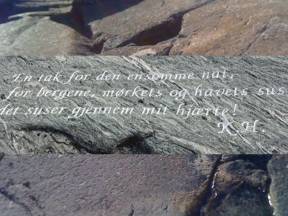
“A thanks for the lonely night,
For the mountains, the darkness, and the murmur of the sea.
It murmurs through my heart!”
These lines from Knut Hamsun’s novel Pan are carved into the rock in front of you by stonemason Knut Hansen from Møre og Romsdal.
They stand as a lasting tribute to the author who once lived and worked here.
Pan has been called the gospel of neo-romanticism, the world’s most beautiful nature poetry, and a poetic gem in novel form.
Hamsun himself described it as “a little book with few people and much soul – a quiet and glowing love story.”
In his youth, Hamsun worked as a shop assistant at the Tranøy trading post. It was here that he found inspiration for many of his later novels set in Northern Norway.
Today, the Hamsun Gallery is located in the old general store buildings – a place where you can explore the author’s life and literature.
What happens when words are carved in stone?
Do they become more alive and
You’ve now arrived at Grenseland. or Borderland, a sculpture by Linn Kalseth, installed in 2007.
Made of glass – an unusual material for a sculpture – it creates a fascinating contrast: heavy and solid, yet fragile and translucent.
The light constantly changes its expression. Depending on how the sun or clouds reflect on the surface, you may notice new details each time you look.
Kalseth studied art in Denmark and Scotland, and has made her mark on the Norwegian art scene – including exhibitions at the Festspillene in Harstad. Her works are displayed in galleries across the country.
Borderland is placed just below Saint Dorothea’s Chapel, which was consecrated by Bishop Øystein I. Larsen. The chapel is dedicated to weddings, young children, and ceremonial gatherings – moments in life when we stand at the threshold between past and future, between something old and something new.
In front of you lies Stor fisk, or Big Fish, a work by Mindaugas Navakas – one of Lithuania’s most acclaimed artists.
The sculpture was not only made for Tranøy – it was also created here. In the summer of 2006, Navakas spent his time in Tranøy carving the piece from Lødingen granite.
Navakas is best known for his monumental works, but he has also worked with installations, photography, and video – often in connection with opera and ballet productions. He has received numerous national and international awards for his art.
Big Fish rests in Heimerhavna, a location where it almost merges with the natural surroundings.
Here, where sea meets land, the fish seems to be at peace – as if it has found its final resting place.
But what do you think?
Is it stranded here on the shore – or slowly making its way back to the sea?
Plass til fler – Tid til mer (2005)
Did you know that the title of this sculpture has become a slogan for the entire area?
"Plass til fler - Tid til mer", or Room for More – Time for More, created by the artist duo Elmgreen & Dragset in 2005, is more than just a piece of art – it’s a reflection on Tranøy as a place.
The sculpture was part of Nordland County’s project Artistic Interruptions, which aimed to create works that challenge and explore contrasts.
Elmgreen & Dragset consists of Danish artist Michael Elmgreen and Norwegian artist Ingar Dragset. Since 1995, they’ve collaborated on art projects exhibited in some of the world’s most prestigious venues – including Tate Modern in London, the Venice Biennale, and The New Museum in New York.
In Tranøy, this sculpture has taken on a special meaning. It has become not only a visual landmark but also an expression of the spirit of the place.
"Room for More – Time for More" is now used as a slogan for Tranøy – an open invitation to come, breathe, and take in the art, nature, and stillness.
The Royal Cormorant – Kongeskarven – standing before you now, is more than just a sculpture.
It’s a symbol of Northern Norway, the sea, and the rich history connected to the Sund Fisheries Museum in Lofoten.
The original cormorant figure was forged in wrought iron by master blacksmith Hans Gjertsen, and it gradually became the signature symbol of the forge at Sund.
Today, Tor-Vegard Mørkved continues that tradition – as both the museum’s owner and the creator of this sculpture.
The name Kongeskarven – The Royal Cormorant – stems from a special event in 1963, when King Olav V officially opened European Route 10, now known as King Olav’s Road.
As a gift, he received a hand-forged cormorant from the Sund Blacksmith, and a photograph of the moment sparked widespread attention. Suddenly, everyone wanted a Kongeskarv of their own.
Now the sculpture stands here in Tranøy – the cormorant, or the Royal Cormorant – watching over the sea.
Perhaps it's gazing into eternity… or perhaps it's simply waiting to take flight once more?
Disse altfor mange ting jeg ville (2003)
Have you ever felt the urge to do too much – to reach for everything, yet still fall short?
The sculpture All Those Too Many Things I Wanted was created by Anne Berit Nedland in 2003.
Cast in bronze, the work carries the artist’s characteristic style – a mix of humor and seriousness, where the everyday meets the thought-provoking.
The title is taken from Inger Hagerup’s poem Verse with the Wind, a text that captures the restlessness and longing to do all the things one dreams of – even when life doesn’t always allow room for them.
Nedland was educated at both the National Academy of Fine Arts and the National College of Art and Design in Oslo, and she often works in a figurative style.
The sculpture invites reflection:
What do these words mean to you?
Are they a reminder to seize the moment – or an acceptance that we can't always achieve all we dream of?
Stjerner som fisker i himmelen (2022)
This sculpture, Stars Fishing in the Sky, by Harald Bodøgaard, was installed in 2002.
Here, the artist plays with both materials and symbolism.
Made from welded steel with elements of polished granite, the work contrasts hardness with softness – the industrial with the natural.
Material exploration is a hallmark of Bodøgaard’s art. He often combines raw materials to create pieces that balance between the abstract and the concrete.
Educated at the National Academy of Fine Arts in Oslo, he has enjoyed a long career with exhibitions and study trips that have shaped his artistic expression.
This sculpture invites interpretation.
Are the stars fishing for us – or are we casting our dreams into the night sky, hoping to catch something greater?
In front of you stands Ørnekvinnen, or The Eagle Woman, a sculpture by Elin Bergstø Rossing from 2022.
Rossing works across various art forms, but in her sculptures she seeks to capture the organic, the musical, and the unspoken – the elements that awaken a sense of wonder in the viewer.
The sculpture was first exhibited on the rocky shoreline of Tranøy during Rossing’s summer 2022 exhibition at the Hamsun Gallery. It was later purchased by the association Protect the Vestfjord for the Future and donated to the Tranøy Art Park.
Its powerful presence reflects the association’s mission: to protect the rich biodiversity of the Vestfjord, its vulnerable coral reefs, and the delicate balance of nature.
Rossing sees humanity as part of nature – a connection where everything affects everything.
Perhaps The Eagle Woman is a reminder of that?
An invitation to see, to listen, and to understand how deeply we are tied to the world around us.