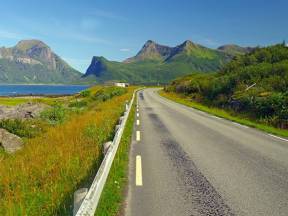
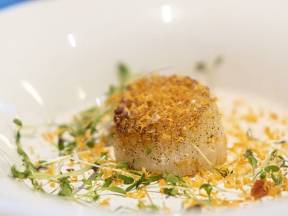
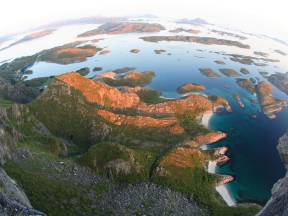
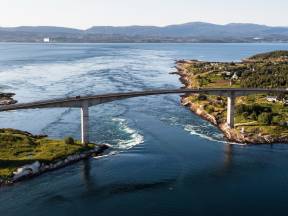
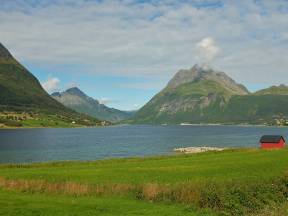
This journey takes you from Nesna to Bodø and Kjerringøy, through a land where towering mountains plunge into the sea, remote island communities thrive, and powerful tidal currents shape the coast.
Along the way, you’ll pass:
Myken, Lovund, and Rødøy – tiny island societies where life dances to the rhythm of the waves.
Svartisen, Norway’s second-largest glacier, a shimmering giant watching over the coast.
Saltstraumen, the world’s strongest maelstrom, where the sea boils with raw power.
Quaint fishing villages like Glomfjord and Tonnes, where history and modern life meet.
As you travel, we’ll share tales of daring fishermen, Arctic explorers, and the forces of nature that forged this unforgettable landscape.
So slow down, breathe in the salty air, and let the stories of the coast carry you all the way to Bodø – and beyond.
You can listen to the guide before your journey for inspiration and planning—or revisit the stories later, to relive the magic from home.
Audio guides available in:
English (British), 中文, Deutsch , Français, Español, 日本語, Italiano, Nederlands, 한글 , Svenska, Dansk, Polski, русский, Українськa, Arabic, Português, Suomalainen, Norsk bokmål
To find more content and listen to free audio guides, download the Guide To Go app.
The Coastal Highway, North
Points of interest
Mørkved
We are now passing Mørkved, a vibrant district just 8 kilometers from Bodø city center. Mørkved is an important hub for education and sports. It is home to one of Nord University’s main campuses, as well as the Police University College, Bodø division, which trains future law enforcement officers.
In Mørkvedlia, you’ll find one of the region’s most comprehensive sports facilities. It includes a football field with artificial turf, a gymnastics hall, two multi-purpose halls, a running track, and the impressive Mørkvedhallen climbing center, boasting over 2,500 m² of climbing surface. This makes it a popular destination for professional athletes and recreational enthusiasts alike.
With its rich offerings in sports, education, and outdoor activities, Mørkved is a dynamic place that attracts both residents and students.
Nesna ferry terminal
The next stop is Nesna ferry terminal, a key hub along the Helgeland coast. From here, ferries depart to Levang, with a crossing time of approximately 25 minutes, as well as to the Nesna islands – Tomma, Handnesøya, and Vikholmen.
The Nesna ferry terminal connects the mainland to these beautiful islands, making it easy to explore the unique nature and culture of the area.
Hunstadmoen
We are now passing Hunstadmoen, Bodø’s largest district, located just east of the city center. This area is known for its rich activity offerings and proximity to nature. Hunstadmoen features several sports facilities, including Hunstad Arena, a modern multi-purpose hall used for everything from handball to concerts. Nearby, you’ll find excellent hiking opportunities in Bodømarka, with trails and lit paths for outdoor enthusiasts.
Hunstadmoen also boasts a central location with Hunstadsenteret, offering a variety of shops and services. For families, the district is highly appealing with its schools, kindergartens, and quiet residential areas.
Combining modern amenities and an active local community with easy access to both urban life and nature, Hunstadmoen is a popular place for residents and visitors alike.
Bodø tunnell
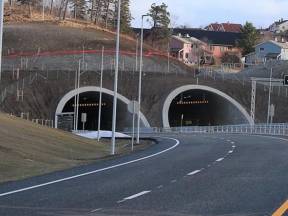
We are now entering the Bodø Tunnel, a 2.8-kilometer-long road tunnel on Route 80 connecting the districts of Hunstadmoen and Bodøelv. Opened on April 28, 2019, the tunnel was built as part of the “Bodø Urban Package” to ensure smoother traffic flow and more efficient connections between the city's eastern and western areas. With two lanes in each direction, it is a vital part of Bodø’s modern infrastructure.
Bodø is also home to Bodø/Glimt, the city's pride on the football field. Known for their attacking playstyle, dedicated fans, and international success, the club has secured several league titles and become a symbol of Bodø’s ambitions and unity. Just as the tunnel connects districts, Bodø/Glimt brings people together and puts Bodø on the map far beyond Norway’s borders. This is a city of passion, community, and progress.
intersection Road 80 and 17
We are now arriving at the intersection of National Road 80 and County Road 17, the Coastal Highway.
National Road 80 leads west to Bodø, 16 kilometers away, with the spectacular Lofoten islands beckoning on the horizon. Eastward, the road takes you to Fauske and the E6, Norway's main highway.
To the south, County Road 17, the Coastal Highway, stretches all the way to Steinkjer. This scenic route offers breathtaking coastal landscapes with fjords, islands, and charming local communities. It’s a journey where the experience along the way is just as rewarding as the destination.
Bodø 2024
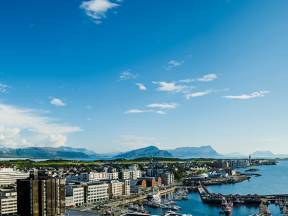
In 2024, Bodø was the European Capital of Culture – the first city north of the Arctic Circle to receive this honor. Throughout the year, Bodø and the region hosted over 600 events, including concerts, theater performances, exhibitions, and festivals.
The theme "Arcticulation" highlighted the connection between culture, nature, and society in the Arctic region. Bodø showcased its vibrant cultural scene, from its dynamic music environment to its art and local culinary traditions.
The city became a creative hub, blending tradition and innovation. With natural wonders like Saltstraumen and breathtaking northern lights as a backdrop, the year was an unforgettable celebration of Northern Norway’s culture and identity. Bodø truly left its mark on Europe and remains a symbol of Arctic creativity and community.
Expressboat terminal Bodø
Welcome to Sentrumsterminalen here in Bodø, a bustling hub for both bus and boat travel, connecting you to exciting destinations along the coast and throughout the region. From here, express boats head to islands like Rødøy, Myken, and Sandnessjøen, while ferries offer routes to the Lofoten Islands and the Helgeland coast.
Check below for departure and arrival information for the express boat to Sandnessjøen, which stops at several islands in Rødøy along the way.
Buses from the terminal serve Bodø city and nearby attractions like Saltstraumen, Kjerringøy, and Fauske. Regional routes take you south along the Coastal Highway or north to Narvik and Tromsø, with options to combine your journey with ferries and boats. Centrally located, the terminal offers waiting areas, ticket sales, and information screens to make your trip easy and convenient. Your adventure begins here, by sea or by road!
A Young City in Development
The idea of establishing a city on this headland was proposed 300 years ago, but it wasn’t until 1816 that Bodø was founded as a market town to reduce Northern Norway's reliance on Bergen. Early growth was slow, with just 228 residents by 1855. The city expanded in the 1860s due to abundant herring stocks.
On May 27, 1940, Bodø was bombed by German aircraft, destroying 420 of its 760 buildings and claiming 15 lives. The city was swiftly rebuilt with new architecture from the 1940s to the 1960s. Today, Bodø is celebrated for its modern design, having been named Norway’s most beautiful city multiple times and the European Capital of Culture in 2024.
Jektvik Ferry Terminal
Welcome to Jektvik Ferry Terminal, an essential stop along the scenic Coastal Highway. From here, ferries connect you to Kilboghamn and Ågskardet, as well as Nordnesøy, with stops at Rødøy, Gjerøy, Selsøyvik, Tonnes, and Storselsøy. These ferries accommodate both cars and passengers, making it convenient to explore the stunning Helgeland coast.
The terminal is equipped with waiting facilities and information boards to assist travelers. For express boat services, head slightly north to Jektvik Express Boat Terminal. Don’t forget to check the link below for updated schedules and departure information.
Kilboghamn Ferry and Express Boat Terminal
You are now at Kilboghamn, a key transport hub on the Helgeland coast. From here, ferries connect you to Jektvik, with occasional stops at Sørfjorden upon request. This scenic ferry route is a vital link along the Coastal Highway.
The express boat from Kilboghamn takes you to Melfjordbotn, stopping at Telnes and Sørfjorden along the way, offering stunning views of the fjords and surrounding landscapes.
At Jektvik, ferries continue to several islands in Rødøy, making it easy to explore this beautiful region. Be sure to check the link below for updated schedules and departure information.
Seng og Suppe
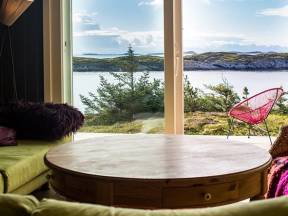
Myken Bed & Soup welcomes visitors to its cozy guesthouse, located in the old Myken school, which opened in 1973. After the school closed 40 years later, it was transformed into a charming place to stay. Many features of the school remain, preserving its history. The guesthouse is just a stone's throw from the Whisky Cathedral, the warehouse for Myken Distillery, which hosts whisky tastings and art exhibitions.
Run by the same team as Fiskebruket restaurant, Bed & Soup serves exceptional food made with local ingredients, including lunch and dinner, with breakfast included for all guests. In the evenings, enjoy Myken’s own whisky or gin and mingle with locals. Some rooms share bathrooms, converted from the old school toilets, while others have private facilities.
Myken Distillery
You are now standing in front of Myken Distillery, the world’s first Arctic whisky distillery, established in 2014. Located on the small island of Myken, it produces high-quality whisky that has earned international recognition. The distillery uses the island’s soft, pure water and specializes in single malt whisky, shaped by the fresh sea air and Arctic climate.
Powered by renewable energy, sustainability is central to its production. Join a guided tour to experience the entire process, from malted barley to finished whisky, and enjoy tastings of their exclusive products. Myken Distillery is where tradition, creativity, and international quality come together – a unique experience not to be missed.
Sentrumsterminalen
You are now at the Sentrumsterminalen in Bodø, a hub for both bus and boat travel, connecting you to exciting destinations along the coast and in the region. Express boats depart from here to islands like Rødøy, Myken, and Sandnessjøen, while ferries take you to the Lofoten Islands and the Helgeland coast.
Buses from the terminal serve Bodø city and nearby attractions such as Saltstraumen, Kjerringøy, and Fauske. Regional routes take you south along the Coastal Highway or north to Narvik and Tromsø, with options to combine your journey with ferries and boats. The terminal is centrally located and equipped with waiting areas, ticket sales, and information screens to make your trip seamless. Your adventure begins here, by sea or road!
Salten
We are now driving through the region of Salten, renowned for its spectacular nature, with towering mountains, deep fjords, and idyllic coastal communities. Salten encompasses the municipalities of Bodø, Fauske, Sørfold, Steigen, Hamarøy, Gildeskål, Beiarn, Saltdal, and Røst.
This diverse region offers everything from the urban life of Bodø to peaceful villages and stunning national parks. Here, you’ll find the Saltfjellet-Svartisen National Park, home to Norway’s second-largest glacier. Along the coast, you can explore islands, beaches, and rich wildlife, while the inland areas provide exciting hiking trails and fishing opportunities.
Salten is also known for its rich cultural history, including Sami heritage and traces of the Viking Age. It’s the perfect destination for both adventurers and those seeking tranquility in nature.
Whisky Cathedral
Here, on Myken, you’ll find the unique Whisky Cathedral, a former fish processing plant now repurposed as a storage facility for Myken Distillery. This impressive space is a tribute to whisky production, filled with oak barrels where the whisky matures in the distinctive Arctic climate.
The cathedral’s open, airy architecture and historical charm make it a special experience for visitors. Here, you can learn about the aging process and how the climate influences the whisky’s flavor. The Whisky Cathedral has become a symbol of Myken’s transformation from a traditional fishing village to a destination for innovation and quality.
A visit here is not just for whisky enthusiasts, but for anyone looking to experience a unique blend of history, culture, and taste.
Ferry Kilboghamn - Jektvik
We are now arriving at the Kilboghamn ferry terminal, where the ferry departs for Jektvik, a one-hour crossing that takes you across the Arctic Circle, marked by a globe on the mountain Vikingen.
From Jektvik, you can access the beautiful islands in the Rødøy Basin, each offering unique coastal culture and natural experiences.
For those interested, it is also possible to take the ferry to Sørfjorden.
Foto: Av TorbjørnS
Glomfjord
If you wish, you can now turn off to Glomfjord center, a little gem just a minute away. Here, you’ll find local hospitality, fascinating history, and breathtaking views that will leave you in awe.
Fiskebruket
Hungry? Welcome to Fiskebruket, a unique restaurant where community and culinary experiences take center stage. Here, we serve only a four-course menu, crafted from world-class ingredients sourced from the sea, the island's fauna, and local farmers. The menu changes frequently, and dinner begins each evening at 7:00 PM with a single seating.
Fiskebruket was created by Stian Floer, a renowned chef, bestselling cookbook author, and founder of the culinary collective Lava Oslo. Lava Oslo has established several well-known restaurants in Norway's capital, including Smalhans, Sentralen, Hitchhiker, and Katla. With this expertise, Fiskebruket combines local ingredients and culinary innovation to offer a truly unique dining experience.
Handnesøya
Across the fjord, you can see Handnesøya, one of Helgeland’s many beautiful islands. The island spans 34 square kilometers and is home to a small but active community. Agriculture remains an important livelihood here, and the island is known for its lush meadows and striking mountain formations.
From your car window, you can admire the island’s varied landscape – rolling green hills, forested areas, and steep cliffs that plunge into the fjord. Handnesøya is also a popular starting point for outdoor adventures, with hiking trails offering panoramic views of the Helgeland Coast.
Life here moves at a peaceful pace, and it’s easy to see why the island has preserved its authentic coastal culture.
Foto: Av Finnrind – Eige arbeid, Offentleg eigedom, https://commons.wikimedia.org/w/index.php?curid=2643684
Svartistunellen
You are now driving into the Svartistunnel, which opened in 1986 and was, at that time, Norway's longest tunnel at 7,624 meters. As the name suggests, it runs beneath an arm of the famous Svartisen glacier.
The Svartistunnel was the first in Norway to be constructed using a full-profile machine, which made it narrower than standard tunnels and lacked a central line. This can make driving challenging, and the tunnel is also known for condensation issues, which can reduce visibility.
Pedestrians and cyclists are prohibited from using the tunnel due to the risk of gas. An alternative route for cyclists is the ferry between Vassdalsvik and Ørnes.
Fykanvatnet
We are now entering the Fykantunnel, one of three long tunnels leading to Glomfjord from the south. This tunnel, 1,946 meters long, cuts through the Reben mountain, connecting the Glomfjord Tunnel to the Svartis Tunnel. Opened in 1938, it showcases impressive engineering and historical significance.
Between the Fykantunnel and the Svartis Tunnel, you can stop by Fykanvatnet, where you’ll also encounter the story of Fykantrappa. Built in 1919, this staircase of 1,129 steps was used to transport equipment up to the power plant.
The stairs were constructed by "rallarer," or navvies, who were laborers specializing in building railways, roads, and industrial facilities. These workers endured harsh conditions, carrying heavy equipment and taking on dangerous tasks. Their efforts laid the foundation for Norway’s early industrial development and remain a symbol of resilience and determination.
Bilde: Svein Erik Dahl
Rødøy municipality
You are now driving through Rødøy municipality, an area spanning hundreds of islands and islets along the Helgeland coast. With its dramatic landscape, where towering mountains meet the sea, the municipality is renowned for its rich natural beauty and cultural history.
The iconic Rødøyløva mountain rises as a symbol of the area. This lion-shaped peak is a must-see and offers stunning views for those who hike to its summit. The municipality is also home to Svartisen, Norway's second-largest glacier, which attracts nature enthusiasts from far and wide.
Rødøy combines coastal culture with breathtaking scenery – a place inviting both tranquility and adventure.
Holandsfjorden
You are now driving along Holandsfjorden, one of Helgeland's most spectacular fjords. With its deep, emerald-green waters and dramatic mountain walls, this fjord is a natural attraction. The most famous sight here is Svartisen, Norway's second-largest glacier, which stretches down toward the fjord.
Svartisen can be admired from several viewpoints along the road, and the surrounding area offers excellent opportunities for hiking and boat trips. The fjord is also home to rich wildlife – you might even spot sea eagles soaring above the water.
This is a place where nature truly takes your breath away, offering a glimpse into Norway’s untouched wilderness.
Foto: Aurora Revå Olsen
Saltstraumen bridge
We are soon crossing the Saltstraumen Bridge, with one of the world’s strongest tidal currents flowing beneath you. Saltstraumen is a natural phenomenon where massive volumes of water are forced through the narrow strait between the Saltfjord and Skjerstadfjord. The current can reach speeds of up to 20 knots, and the swirling whirlpools are a breathtaking sight.
The bridge offers stunning views of the fjord and surrounding landscape. The area is also a haven for anglers, with opportunities to catch large fish in the powerful current. Saltstraumen has been an attractive site for thousands of years, as evidenced by ancient rock carvings nearby that date back to the Stone Age.
This is a place where the forces of nature truly take center stage.
Stokkvågen
You are now arriving at Stokkvågen, a key hub for travelers along the Helgeland Coast. This small village serves as the gateway for boat routes to the islands of Træna, Lovund, and Onøy. With its strategic location, Stokkvågen has become a natural stop for both locals and tourists exploring the coastline.
The area around Stokkvågen offers stunning scenery, with fjords, green valleys, and views of the open sea. Here, you can enjoy a moment of calm while waiting for the ferry. On clear days, you might catch a glimpse of the distinctive peaks of Lovund and Træna on the horizon.
Stokkvågen is your gateway to some of Norway’s most iconic islands and a perfect starting point for adventures along the Helgeland Coast.
Træna
Out on the edge of the Helgeland coast, 33 nautical miles out to sea, lies Træna, on the brink of the open ocean. This is Norway's oldest fishing village and one of the smallest municipalities in the country. Every summer, the internationally renowned Træna Music Festival brings the island to life, multiplying its population tenfold and offering unforgettable musical experiences in the middle of the ocean.
This vibrant community welcomes visitors with open arms year-round. As Norway’s oldest fishing village, it boasts two active fish processing plants and nearly 30 fishing boats. The island also has shops, a school, a café, a pub, accommodations, dining options, and a museum.
Did you know Træna has its own "Hawaii," with white sandy beaches, and even a historical connection to the real Hawaii?
Though Træna is far out in the open sea, it is easily accessible by express boat from mainland Bodø, Sandnessjøen, Nesna, Lovund or Stokkvågen, or by ferry from Stokkvågen.
Lovund and the puffins
Out in the open sea, yet not far from here, lies Lovund – one of Helgeland's most iconic islands. The steep Lovundfjellet mountain, rising 625 meters above the sea, has been a landmark for sailors for centuries. The island blends a rich coastal culture with modern aquaculture and has been inhabited for thousands of years.
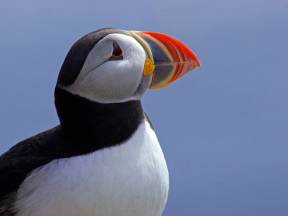
Lovund is best known for its puffins. Every year, around April 14th, thousands of these seabirds return to the island’s mountainsides to nest after spending the winter at sea. Their arrival marks the beginning of spring on Lovund, and watching them in flight is an unforgettable experience.
Lovund offers breathtaking views, excellent hiking opportunities, and local cuisine that captures the essence of the coast. You can reach Lovund by ferry from Stokkvågen.
Tomma og Hugla
Out in the open sea, just a short ferry ride from Nesna, you’ll find the islands of Tomma and Hugla – two gems along the Helgeland coast. Tomma rises majestically with its towering peaks, including Tomskjevelen at 922 meters, offering spectacular views for those who make the climb. The island is famous for its pristine white beaches, crystal-clear waters, and unique experiences like sea eagle safaris, where you can watch these magnificent birds soaring over the fjord.
Tomma is also home to the famous "Kjærlighetssuppe," a delicious seafood dish made with local ingredients – a true taste of coastal culture.
Nearby lies Hugla, a lush and peaceful island with forests, meadows, and charming walking trails. Here, you can enjoy the tranquility and admire views of Tomma’s dramatic mountains and the mainland.
Together, Tomma and Hugla offer the perfect blend of nature, culture, and history. Take the ferry from Nesna, just a few minutes from here, to explore this stunning island paradise, where sea and sky meet.
Nesna
What do you think of the beautiful surroundings?
Next place, or maybe next stop, is Nesna, a picturesque village along the Helgeland Coast. This is one of the oldest settlements in the area, and Nesna has historically been an important location for trade and seafaring. Today, it is a popular stop for travelers exploring the Coastal Highway.
Nesna is home to a university center that attracts students from across the country, as well as a modern marina that serves as a gateway for island hopping to nearby islands. Just offshore, you’ll find Tomma, Hugla, and Handnesøya, all offering exceptional outdoor experiences.Here you will also find the famous attractions as, Handelshuset Zahl and Klokkergården in Nesna.
With views of the surrounding fjords and mountains, Nesna makes you feel as if you’re at the heart of nature’s rhythm.
Foto: Av E rik, CC BY-SA 3.0, https://commons.wikimedia.org/w/index.php?curid=2350237
Ørnes
You are now arriving in Ørnes, the largest settlement in Meløy municipality and an important hub along the Coastal Highway. Beautifully situated by the fjord and surrounded by mountains and sea, Ørnes has a long history of trade and maritime activity. Today, it is a natural stop for both locals and travelers.
Ørnes serves as the gateway to the stunning islands around Meløy, offering opportunities for boat trips, sea fishing, and hikes through the diverse coastal landscape. In summer, you can experience the midnight sun casting its magical glow over the fjords and mountains.
From Ørnes, you can also enjoy views of nearby glaciers, including Svartisen – Norway’s second-largest glacier. This is a place where nature and history intertwine, with the sea as a lifeline throughout the ages.
Foto: Av Janter – Eget verk, CC BY-SA 3.0, https://commons.wikimedia.org/w/index.php?curid=2095267
Hellåga
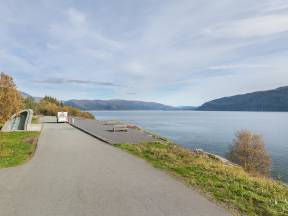
We are soon passing Hellåga Rest Area, a great spot for a break along Sjona in Rana. Here, you can stretch your legs, try your luck fishing in the fjord, or simply enjoy the stunning fjord scenery.
The rest area features a unique wave-shaped toilet building made of black concrete with a tempered glass facade. Stairs lead all the way down to the water’s edge, with benches placed throughout the area for relaxation.
You are driving along Kystriksveien, County Road 17, which is also part of the Helgelandskysten National Scenic Route – the longest of Norway’s 18 National Scenic Routes.
Junction FV17/ FV810
We are now approaching the intersection of the Coastal Highway (County Road 17) and Nesnaveien (County Road 810), an important junction along the Helgeland coast.
To the south, County Road 17 leads to Sandnessjøen, 64 kilometers away, and further to Steinkjer, 400 kilometers to the south. Heading north, the road takes you to Bodø, 600 kilometers away.
Turning onto Nesnaveien (County Road 810), you’ll reach Skarpteigen after just a few hundred meters. This picturesque area offers stunning views of the Ranfjord and the surrounding landscape. Continuing east for 35 kilometers, you’ll arrive in Mo i Rana and connect with the E6, a central highway in Norway.
This intersection is not just a crossroads but a gateway to experiencing some of Nordland’s most diverse and beautiful scenery.
Grønsvik kystfort
We are approaching Grønsvik Coastal Fort, part of the Helgeland Museum here in Lurøy. This historic coastal fort is a part of the Atlantic Wall, built during World War II, and serves as a reminder of a dark yet important chapter in Norwegian history.
The museum offers engaging exhibitions during the summer season, focusing on topics such as radicalization, historical artifacts, and wartime documents. The bunker complex and surrounding area are open for free exploration year-round, making it an ideal spot for self-guided tours.
Photo: Av Ingeeiliv – Helgeland Museum
Tonnes
You will soon have the opportunity to turn toward Tonnes, a charming village along the Helgeland coast offering stunning nature and exciting experiences. Tonnes is well-known as a starting point for island hopping, with boat routes to idyllic destinations such as Træna, Lovund, and Myken.
Here, you can visit OscarBrygga, a popular spot for local cuisine, renowned for its fresh fish and seafood. Don’t miss Tonnesgrotten, a fascinating cave nearby, perfect for adventurous explorers.
A highlight of the area is the Arctic Circle Globe on the island of Vikingen in Rødøy municipality, just a five-minute boat ride from Tonnes. This iconic landmark marks the geographical Arctic Circle.
With its blend of history, culture, and natural beauty, Tonnes is a must-visit stop along the Helgeland coast.
Photo: Av Petter Hansen
Aldersundet
You are now passing through Aldersundet, an area of deep fjords, lush farms, and fascinating history. Did you know that this is the largest district in the municipality, both in size and importance? Over 40% of Lurøy’s active farms are located here, surrounded by mountains and rivers.
Across the fjord, you can see the island of Aldra, known for its significant limestone deposits in the bedrock. On the mountain peaks, you may spot remnants of Norway’s only Omega station, once part of a global navigation system.
Along the fjord, the fish processing facility in Aldersundet has been sending live crabs southward for generations. This area highlights how natural resources and innovation have shaped coastal life.
Aldersundet is also the starting point for some of Norway's most beautiful hikes, Åstuva and Klubben.
Photo_ Av Frankemann
Vågaholmen og Rødøy museum
Curious about where you can experience authentic coastal history? Then you’ll soon have the opportunity to turn toward Vågaholmen and Rødøy Museum, located in the historic Falch Trading Post. This cultural landmark tells the story of fishing, farming, and trade that have sustained life along the Helgeland coast for generations. The museum is open during the summer season, offering visitors a glimpse into the region’s rich coastal heritage.
In Vågaholmen, you’ll also find Kystens Varehus ("The Coast’s Warehouse"), a modern service hub that continues the tradition of being a vital center for the local community. Here, you can shop for local products and experience a taste of contemporary coastal life. From there, you can also go island hopping to several islands, such as the beautiful Rødøya and the legendary Myken, far out in the open sea.
The area boasts stunning natural beauty, with fjords and mountains framing a landscape steeped in history and tradition. This is a stop that truly blends the charm of the past with the conveniences of today.
Myken
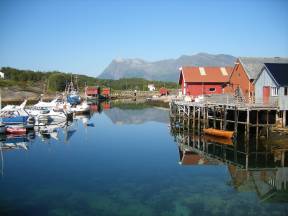
Have you heard of the small fishing village of Myken, far out in the open sea? With its iconic red houses, windswept landscapes, and endless ocean views, Myken is a place that combines tranquility and adventure. The archipelago is famous for its unique micro-distillery, producing whisky from desalinated seawater, the first of its kind in the world. Myken Distillery also houses a restaurant, Fiskebruket, where you can enjoy delicious food based on local ingredients and focuses on seafood.
For the adventurous, The island offers excellent hiking opportunities and spectacular sunsets. In winter, you can experience the northern lights dancing over the open ocean.
You can reach Myken by express boat a couple of times a day from Tonnes to the south or Vågasundet to the north. . You can also reach Myken by express boat from Sandnessjøen and Bodø during the summer season.
Ferry Jektvik - Kilboghamn
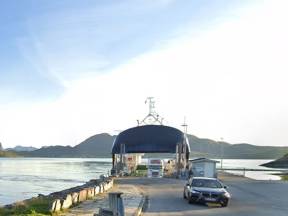
You are approaching the ferry terminal at Jektvik, a coastal village and an important transportation hub in Rødøy municipality. From here, you can take the ferry along the Coastal Highway to Kilboghamn, a one-hour crossing during which you pass the Arctic Circle, marked by a globe on the mountain Vikingen. Jektvik is also the gateway to the beautiful islands in the Rødøy Basin, each offering unique coastal culture and natural experiences.
On Nordnesøy, you’ll find a beach with limestone formations shaped by nature over thousands of years. You can also visit Selsøyvik Old Trading Post, a cultural heritage site from the 1770s that is still in operation.
Jektvik is surrounded by spectacular nature, with views of Rødøyløva, rising majestically above the sea, and nearby attractions such as Storsanden beach on Rødøya and the sculpture Indre, part of the Arctic Sculpture Landscape project.
The waiting room at the ferry dock is clad in translucent fiberglass that glows like a large Chinese lantern in the dark.
Storvika rasteplass
You’ll soon have the chance to stretch your legs and enjoy nature, architecture, and a beautiful sandy beach at Storvika rest area. Here, the elegant stone arch bridge connects the rest area to a kilometer-long sandy beach, perfect for a peaceful walk or simply soaking in the view.
The rest area is beautifully situated between the sea and mountains, offering facilities such as a motorhome waste disposal station and restrooms that are open year-round. The area is also wheelchair accessible.
From the rest area, you can take a detour to Finnes and explore more of the Helgeland coast’s stunning nature and culture.
Ureddplassen
We are soon arriving at Ureddplassen, one of the most iconic rest areas along the Helgeland coast. Here, you’ll find a nine-meter-wide terrace with panoramic views of the fjord, the open ocean, Fugløya, the Lofoten Wall, and the endless horizon. As you walk down to the beach and sit on one of the steps, the sound of passing cars fades away, leaving you with serene silence. In May, the area comes alive with intense birdsong from the mountainside.
Ureddplassen is ideal for a quick break, a meal, or long evenings under the midnight sun or northern lights.
This site is also a memorial for the submarine Uredd, which struck a mine in Fugløyfjorden during World War II. Onboard were agents from Kompani Linge, a resistance group known for their courage and high-risk sabotage missions. The monument honors their memory.
Sandhornøya
In a couple of minutes, you can turn toward what may be one of Norway’s most beautiful islands, Sandhornøya. This gem along the Helgeland coast offers spectacular landscapes with majestic mountains, pristine white beaches, and lush nature.
The island is also the birthplace of Elias Blix, one of Norway’s most famous hymn writers. Here, you can visit Elias Blix Cafe, where local food is served in charming surroundings, and the Elias Blix Museum, which showcases his life and works.
Sandhornøya is best known for its iconic mountain, Sandhornet, towering 993 meters above sea level. For those seeking tranquility, Langsanden, a two-kilometer-long sandy beach, is perfect for relaxation or a leisurely stroll.
Sandhornøya combines natural beauty, culture, and history – a destination you won’t want to miss.
Inndyr
You can soon turn toward Inndyr, a charming village and administrative center in Gildeskål municipality. Inndyr is beautifully situated along the coast, surrounded by fjords and mountains. Here, you’ll find Gildeskål Church Site, a historic location with over 1,000 years of history, featuring the medieval Gildeskål Old Stone Church and the newer wooden church.
Inndyr is also home to the Salmon Center, a visitor center dedicated to salmon farming, one of Norway’s most important industries. Visitors can learn about modern aquaculture and how it combines technology and sustainability.
Inndyr is a place where history, culture, and industry meet – perfect for a stop along the Helgeland coast.
Ertenvåg og Nygårdsjøen
You can now take a short detour between Ertenvåg and Nygårdsjøen along the old County Road 474 if you wish. This scenic route winds through a stunning coastal landscape, featuring fjords, mountains, and small farms that create a peaceful atmosphere.
Along the way, you can visit Saura Church, a charming wooden church built in 1884 that stands as a symbol of the region's cultural heritage. The area also offers beautiful views of the surrounding fjords and islands.
Further along, you’ll come to Skålsvikleira/Ystleira Nature Reserve, a protected area known for its rich birdlife and unique tidal flats. It’s a perfect spot for birdwatching or simply enjoying the natural beauty.
Take some time to pause, soak in the views, and experience the tranquility of this hidden gem along the Helgeland coast.
Braset rest area
Have you ever seen Svartisen with your own eyes? Now’s your chance. We are approaching the Braset rest area, offering a magnificent view of Engenbreen, a powerful glacier arm of Svartisen.
Engenbreen is Europe’s lowest-lying glacier, with its base just 100 meters above sea level. The glacier’s name comes from the old term "Svartis," describing the deep blue hue of the ice.
Norway is home to over 1,500 glaciers, ranging from small ones to giants like Jostedalsbreen. These glaciers are vital to the ecosystem and a fascinating reminder of how the climate has shaped the landscape over thousands of years.
Ågskardet ferry terminal
The next stop is Ågskardet ferry terminal in Meløy, connecting County Road 17 to Forøy ferry terminal toward Halsa. The crossing takes about 15 minutes.
Ågskardet is a charming village with a community hall, chapel, and private businesses. Råkk Huset, located in the old school building, is a vibrant gathering place. It houses Råkk Cafe, a 1950s-style diner, a pub, the yarn shop Ullkurven, a thrift store with a radio museum, and a music shop. Råkk Huset hosts concerts, quiz nights, and a monthly village cinema.
Near the ferry terminal is Åg Free Church, a community hub with over 100 years of history. On the first Sunday of Advent, the Christmas tree is lit here before a torchlight procession to Råkk Huset.
For hikers, Teppfjellet offers a marked trail to its 364-meter summit with stunning views of Ågskardet and the surrounding area.
Forøy ferry terminal
The next stop is Forøy ferry terminal, connecting County Road 17 to Ågskardet ferry terminal. The crossing takes about 15 minutes.
Forøy is part of the village of Halsa on the island of Esøya in Meløy municipality. Not far from the ferry terminal, you’ll find Furøy Camping and Kvitbrygga Basecamp, perfect spots to relax and explore the surrounding area.
Glomfjord tunnel
We are now entering the Glomfjord Tunnel, the northernmost of three tunnels leading to Glomfjord from the south. This tunnel is 2,238 meters long, cutting through the mountain before emerging near the village of Glomfjord, just north of the tunnel’s exit.
Glomfjord is perhaps best known for Operation Muskedunder, a daring sabotage mission carried out by British and Norwegian commandos in 1942 in the mountains above the tunnel. The objective was to destroy pipelines supplying water to Glomfjord Power Plant, which provided electricity for German aluminum production. The mission was perilous but successful, delaying the German war industry.
Following the mission, the occupation forces abandoned plans to expand the aluminum plant. Of the twelve saboteurs, eight were captured shortly after the operation. Four managed to escape over the mountains to Sweden, while seven of those captured were sent to Germany and executed in Sachsenhausen on October 23, 1942.
Take a moment to honor the courage of those who risked everything for the freedom we enjoy today.
Hjallis
We are now rounding Reppen, located at the innermost part of Tjongfjorden, where you’ll find the Helgeland Smolt facility. This is where smolt – young salmon, trout, and Arctic char – are raised, preparing them for life in the ocean. These young fish undergo an adaptation process that enables them to grow and thrive in saltwater.
At the outermost point of the village of Kvalheim, near the mouth of Tjongfjorden, one of the world’s greatest speed skaters, Hjalmar Andersen, known as Hjallis, was born. The family moved to Trondheim shortly after his birth, but his roots remain here. Hjallis won three Olympic gold medals in 1952, setting new standards in the sport.
Like the smolt in the fjord, Hjallis ventured out into the world and grew into a legend, but his roots are firmly tied to the stunning coastal nature of Tjongfjorden.