This stretch takes you from Steinkjer to Vennesund (Brønnøysund), where rugged islands, historic fishing villages, and untamed nature unfold along the way. You’ll pass through charming coastal towns like Namsos, with its lively harbor and timber heritage, Rørvik, home to the fascinating Norwegian Coastal Museum, and the hidden gems of Kolvereid and Leka, an island steeped in Viking legends and dramatic geology.
As you drive, we’ll share stories of the people, landscapes, and traditions that shaped this coastline. From ancient seafaring history to the forces of nature that carved these islands, every mile has a tale to tell.
So settle in, let the ocean views guide you, and enjoy the journey, one story at a time.
You can listen to the guide before your journey for inspiration and planning—or revisit the stories later, to relive the magic from home.
Audio guides available in:
English (British), Español, Deutsch , Français, 中文, 日本語, Italiano, Polski, Arabic, Dansk, Português, Suomalainen, Nederlands, русский, Українськa, 한글 , Svenska, Norsk bokmål
To find more content and listen to free audio guides, download the Guide To Go app.
The Coastal highway, south
Points of interest
Smines, heritage trail.
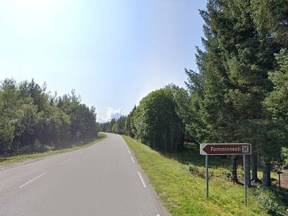
This area has been inhabited for thousands of years. We are approaching Smines, where you’ll find the Fornminnestien heritage trail.
This short walking route is suitable for most visitors. Along the trail, signs in Norwegian, English, and German provide information about important historical and cultural sites, with a main information board located near the parking area.
Archaeologists believe Smines has been continuously inhabited for the past 6,000 years. Its strategic location ensured access to food and a clear view of the fjord, useful for spotting potential threats.
Further inland, remains of an Iron Age hillfort (500–800 CE) and a paved pathway connecting the sea to the inland can be found. Near the path, remnants of a boat from around 1,000 CE were also discovered, offering a glimpse into the area's fascinating history.
Egge museum
Here, in these lush surroundings, you’ll find Egge Museum. With fascinating exhibitions, a cozy café, and a charming museum shop, this is the perfect place for both learning and relaxation. Enjoy the town's best waffles or a warm apple cake while soaking in the atmosphere.
Explore history through the exhibition "Old Steinkjer" or delve into Viking times with "The Gold Foils of Mærin." Kids can enjoy play corners across three floors, from running a store to riding pedal tractors.
Outside, the open-air museum features traditional animals and beautiful grounds, ideal for a family day out. With elevator access, everyone can explore the museum's three rich floors.
Egge Museum offers a timeless experience for all ages!
Check links and additional information below for further details.
Salsnes
Here, in these beautiful surroundings, lies the village of Salsnes, located on a narrow strip of land between Foldafjord to the west and Salvatnet to the east. Moselva flows through the village, connecting Salvatnet to the sea.
Salvatnet, also known as Salsvatnet, is Norway's and Europe's second deepest lake, reaching an impressive depth of up to 482 meters. The lake is situated 9 meters above sea level and is surrounded by stunning nature, perfect for recreation.
By the coast, you’ll find Salsnes Boat Association, offering access to Foldafjord and the sea. Salen Chapel, a charming church, and the scenic Moselva make Salsnes an ideal stop to experience the culture and breathtaking landscapes of Trøndelag from the road.
Elvalandet and Jøa
In front of us, County Road 769 intersects with County Road 777, which leads to the islands of Elvalandet and Jøa. These islands are connected by the Seierstad–Ølhammeren ferry, which takes you across the scenic Seierstad Fjord.
Elvalandet, known for its lush landscapes and peaceful atmosphere, is a perfect place for hiking and enjoying nature. Continuing further, you’ll reach Jøa, the birthplace of renowned Norwegian author Olav Duun. Jøa is celebrated for its cultural heritage and stunning coastal scenery, offering opportunities for outdoor adventures and exploring local history.
The journey to these islands combines the charm of rural Norway with spectacular views, making it a memorable experience for travelers.
Horvereid
We are now passing the village of Horvereid and the two lakes Rotvikvatnet and Mulstadvatnet, with the latter located closest to Kolvereid.
Horvereid is a typical agricultural village surrounded by beautiful nature. Rotvikvatnet, also known as Naklingvatnet, is renowned for its excellent fishing opportunities. The lake is home to a large population of trout, with an average weight of 300–600 grams, though fish weighing up to 2 kilograms are caught annually.
Rotvikvatnet flows through a short river into Horvereidvatnet, which eventually empties into the sea. This connection allows sea trout and some salmon to enter the lake, making it a popular spot for fishing enthusiasts. The area also offers scenic surroundings, perfect for outdoor activities and relaxation.
Kolvereid
Do you know what Norway's smallest town is? It’s the town just ahead of us now, Kolvereid.
With fewer than 2,000 residents, Kolvereid is a small yet vibrant community. It was granted town status in 2002 and has since been a charming hub in the region. Here, you’ll find cozy shops, cafes, and local businesses, as well as a cultural center hosting concerts, theater performances, and exhibitions.
Surrounded by stunning nature, Kolvereid offers excellent opportunities for hiking and outdoor activities. The town is also known for local events like Kolvereiddagene, which bring together residents and visitors for festive celebrations.
This little town proves that even small places can offer great experiences, with its warm atmosphere and proximity to both nature and culture.
Olav Duun
Here in this area, specifically on the island of Jøa, the renowned Norwegian author Olav Duun was born. Jøa, with its tranquil landscapes and rich cultural history, played a significant role in shaping Duun’s literary voice.
Duun’s birthplace has become a point of interest for literary enthusiasts and visitors alike, offering insight into the roots of one of Norway’s most celebrated authors.
His works often reflected the lives, struggles, and moral dilemmas of ordinary people, drawing inspiration from the island’s close-knit community and rugged surroundings.
Through works like Juvikfolket (The People of Juvik) and Medmenneske (Fellow Man), his voice remains as relevant today as ever, addressing questions that resonate in our modern context.
What can we learn from Duun today? Perhaps to see the world through others’ eyes, reflect on choices and responsibilities, and find strength in everyday life. Take a moment to consider how his words can continue to inspire us.
Junction 771 and 770
Soon, you can take a short detour to experience some truly fantastic destinations in the area.
Måneset, just 20 minutes away, is a charming coastal spot perfect for exploring nature. A hike to Væremsnubben is highly recommended, offering a breathtaking viewpoint. On clear days, you can see Vikna to the south, the open sea to the west, the unique island of Leka to the north, the Helgeland mountains to the northeast, and the Namdal mountains on the mainland. A stunning 360-degree panorama that will leave you speechless.
Naustbukta, also 20 minutes away, is another picturesque spot along the coast. From here, you can travel further north to Leka, one of Norway’s most intriguing islands, renowned for its reddish terrain and unique geology. These destinations offer unforgettable experiences for nature lovers.
Krekling
We are now driving along Innerfolda and passing the small village of Krekling, a picturesque spot by the fjord.
Innerfolda is part of the Folda Fjord, known for its rich wildlife and stunning surroundings. Here at Krekling, you’ll notice several fish pens operated by Mowi, one of the world’s largest producers of farmed salmon. These pens are large, circular enclosures in the sea where salmon grow under close supervision.
The aquaculture facilities here play a vital role in the local economy and contribute to Norway’s position as a global leader in salmon export. Innerfolda is also a favorite area for fishing and outdoor activities, offering fantastic opportunities for kayaking and boating. The nature around Krekling provides peace and recreation for both residents and visitors alike.
Otterøya
We are now driving along Otterøya, Trøndelag’s third-largest island, where County Roads 769 and 767 intersect. The island is connected to the mainland by the picturesque Lokkar Bridge. Traveling 35 kilometers to the far end of the island, you’ll find Om Aglen Camp, RV parking, and the enchanting Ravnholet Cave.
Otterøya is vibrant with music, hosting its own school choir, band, and several rock and blues groups. The biennial Fjøslarm Music Festival celebrates this passion. The island is also home to the world’s northernmost deer population, and hunting is both a tradition and an economic activity.
In addition, Otterøya thrives on kilnot fishing, with wild salmon as a key part of its culinary heritage. The island supports several large farms, aquaculture, shrimp fishing, honey production, and even music studio production. Its mix of nature, culture, and industry makes Otterøya truly unique.
Rørvik
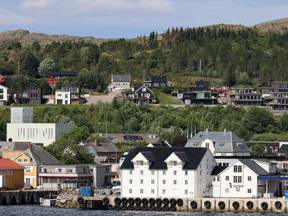
We are now arriving in Rørvik, a charming coastal community and an important hub in the region.
Rørvik is known for its rich coastal culture and its picturesque location by the Nærøysundet, surrounded by islands and islets perfect for exploration. Here, you’ll find the Norveg Coastal Museum, an architectural gem that tells the story of life along the Norwegian coast from the Viking Age to the present day.
The town boasts a bustling harbor, serving as a stop for the Hurtigruten coastal voyage, and offers activities such as fishing trips, boat tours, and guided experiences in the Vikna archipelago. Local shops and cafes provide a taste of the region’s culinary traditions and hospitality.
Rørvik is where history meets modern coastal life, a place that beckons visitors to return again and again.
County Road 769
We are now driving along County Road 769, which connects Namsos and Nærøysund Municipality toward Rørvik. The road and municipality are divided by the Folda fjord and strait, crossed via ferry between Lund and Hoffles. From Lund, it’s approximately 50 minutes to Namsos, while from Hoffles, it’s about 30 minutes to Rørvik.
Rørvik, a bustling coastal town, is a hub for maritime industries and cultural experiences. It features the Norwegian Coastal Museum, showcasing the region’s history and ties to the sea.
This stretch has become a popular alternative route on the Kystriksveien Coastal Route, offering travelers stunning coastal landscapes in both municipalities, along with Rørvik’s unique blend of modern industry and cultural heritage.
Røyklibotnet Nature Reserve
To the mainland, you can glimpse parts of the Røyklibotnet Nature Reserve, a boreal rainforest blending bogs, lakes, natural forests, and managed woodlands. Dominated by spruce and pine, the forest also hosts a variety of deciduous trees such as birch, rowan, willow, aspen, alder, hazel, and elm.
Some spruce trees in the area are over 250 years old. Rare species like gold-flecked lichen, and beard moss, have been recorded at several locations.
The reserve’s purpose is to preserve the natural flora, fauna, and ecological processes. Driving here, it’s humbling to reflect on how ancient trees and delicate ecosystems remind us of nature’s resilience and our responsibility to protect it for future generations.
Lund ferry terminal
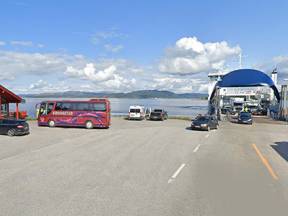
We are now arriving at Lund Ferry Terminal, which connects County Road 769 with Hoffles Ferry Terminal across the fjord. From Hoffles, you can drive west toward Rørvik or east toward Kolvereid and the Kystriksvegen Coastal Route, County Road 17. The ferry crossing takes approximately 25 minutes. Heading south, County Road 769 continues for about 50 kilometers to Namsos.
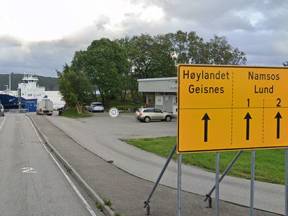
It is also possible to take a ferry from Hoffles to Geisnes, where County Road 776 leads to Salsbruket and Høylandet, rejoining County Road 17 along the Kystriksvegen route.
Visit the link below the text for details on ferry times.
Hoffles ferry terminal
We are now arriving at Hoffles Ferry Terminal, which connects County Road 769 with Lund Ferry Terminal across the fjord. From Lund, you can drive south toward Namsos, a stretch of approximately 50 kilometers. The ferry crossing between Hoffles and Lund takes about 25 minutes.
From Hoffles, you can drive west toward Rørvik or east toward Kolvereid, continuing on to the Kystriksvegen Coastal Route.
Hoffles Ferry Terminal also provides a connection to Geisnes, where County Road 776 leads to Salsbruket and Høylandet, rejoining County Road 17, the Kystriksvegen route. This opens up several exciting options for exploring both coastal and inland areas.
Intersection 769
At the intersection ahead, you have three options.
You can continue west on County Road 769 toward Abelvær and Rørvik.
You can head toward Hoffles Ferry Terminal to take the ferry to Lund Ferry Terminal and onward to Namsos, or to Geisnes Ferry Terminal, continuing to Salsbruket and Høylandet.
If you drive east, you’ll reach County Road 770, leading to Kolvereid and further to the Kystriksvegen Coastal Route.
Abelvær
Soon, you can turn off to the beautiful fishing village and trading post, Abelvær, that is steeped in history. All you need to do is follow County Road 768 to the end, which takes about fifteen minutes.
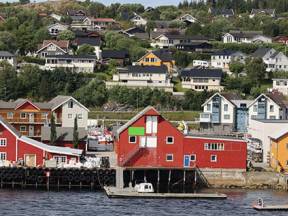
Abelvær, idyllically situated by the coast, is renowned for its charming wooden houses and rich fishing traditions. Here, you can experience history through the old buildings, which tell stories of trade and coastal culture over the years.
The small harbor is a popular spot for both local fishermen and tourists who want to enjoy the fresh sea air. Near Abelvær are two of the finest beaches in Namdalen, Kjeksvika and Hesthagan. Take your time to explore Abelvær’s charming streets and soak in the atmosphere,
The Namsen River
We’re now traveling alongside the famous Namsen River, often called "The Queen of Rivers" due to its reputation as one of Norway’s best salmon rivers.
Stretching over 228 kilometers, Namsen is a lifeline for local wildlife and communities. During the summer months, anglers from all over the world come here to try their luck, hoping to reel in one of the river’s prized salmon. The river’s steady, powerful flow through lush forests and wide valleys creates a scenic backdrop that has inspired many stories and legends. Can you imagine the thrill of catching a salmon in these clear waters? For centuries,
Namsen has provided both food and recreation for locals, making it a cherished natural resource in the region.
Overhalla - Ranemsletta
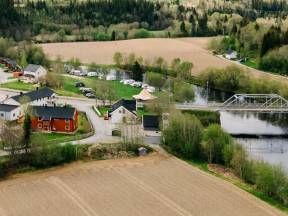
We are now passing Ranemsletta, a village in Overhalla municipality and the administrative center for the area of Ranem. Locally known as “Sletta,” this is the second largest village in the municipality after Hunn. At the heart of Ranemsletta stands Ranem Church, one of only two stone churches in Namdalen, built in 1187.
With its thick stone walls and historical significance, Ranem Church has been a central gathering place for over 800 years, serving as a link between generations.
The village’s administrative buildings and community facilities make Ranemsletta an important hub for locals and visitors alike, reflecting both history and modern community life in Overhalla.
Junction road 769/770
At the triangular junction ahead, where County Road 769 meets County Road 770, you have three great route options.
Following 769 will take you to Abelvær, Hoffles, and onwards toward Namsos. Heading west on 770 leads to Rørvik and further out to the open sea. Heading east brings you to Kolvereid and onward to the Coastal Highway, County Road 17.
Nærøysund Bridge
We are now on Marøya, located between the Nærøysund and Marøysund bridges, two of Norway's most scenic bridges.
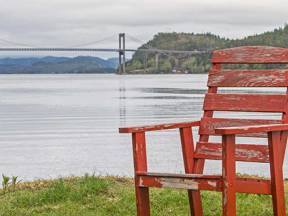
To the west, the Nærøysund Bridge is a stunning 701-meter-long suspension bridge rising more than 40 meters above the sea. From here, you can enjoy breathtaking views of Rørvik to the north and Nærøysundet to the south. The bridge includes a walkway and cycle path, perfect for admiring the views at your own pace.
The Marøysund Bridge, 590 meters long, spans the beautiful Marøysundet and offers views of Nærøya, named after Njord, the Norse sea god. Nærøya has been an important hub for trade and maritime activity throughout history, reflecting the region’s rich cultural heritage.
Flosand and Arnøya
If you wish, you can soon take a short detour to Flosand or Arnøya, both just a few kilometers away.
Flosand is an idyllic spot by the fjord, known for its stunning natural surroundings and tranquil atmosphere. It’s a perfect place to enjoy the coastal landscape, with opportunities for relaxation and picturesque views.
Arnøya is a gem in the area, surrounded by sea and mountains, ideal for short hikes and nature experiences. The island is also popular among birdwatchers seeking to explore its rich birdlife.
On your way there, you’ll pass Lundring Church, a beautiful wooden church dating back to the 1600s. The church stands as a significant landmark, reflecting the region’s deep historical and cultural ties to the coast.
Terråk gjestegård
Terråk Gjestegård, located in the heart of Terråk, is a cozy Bed & Breakfast offering stunning views of the fjord. The guesthouse features 11 spacious, newly renovated rooms, including single, double, and suite options, all equipped with private bathrooms. Additionally, two timber cabins on the property can accommodate up to six people each, complete with modern bathrooms and kitchens.
The on-site restaurant, Færingen Spiseri, named after Bindal's famous færing boats, offers a unique menu blending local ingredients, Norwegian traditions, and African-inspired dishes. Paired with exquisite wines, it promises a memorable dining experience.
The guesthouse boasts modern facilities for meetings and conferences, WiFi throughout, and rental options for bikes and boats. Cyclists and motorcyclists are welcome, with secure parking and tailored services available.
Discover nearby attractions like Heilhornet, Leka, or enjoy the tranquility of Bindal's scenic coastline.
Learn more and book your stay via the link below!
Borders Nordland and Trøndelag
At this moment, we are crossing the border between Nordland and Trøndelag.
Nordland stretches along the coast with majestic mountains, fjords, and thousands of islands. The region is renowned for its fisheries, aquaculture, and tourist attractions like the Lofoten Islands and Saltstraumen.
Trøndelag, Norway's breadbasket, boasts a diverse landscape of forests, mountains, and fertile farmland. It blends historic treasures like Nidaros Cathedral with modern innovation centered around NTNU in Trondheim.
Can you spot any differences between the two counties?
Terråk
If you wish, you can soon take a short detour to the charming village of Terråk, located just 10 minutes from the Coastal Highway.
Terråk is beautifully situated by the fjord and is a picturesque village in Bindal Municipality. Here, you’ll find Terråk Gjestegård, renowned for its warm hospitality and delicious homemade food. The guesthouse offers comfortable accommodations and a restaurant serving dishes crafted from local ingredients, often featuring fish and seafood.
Terråk boasts a scenic harbor, excellent hiking opportunities, and a vibrant local community. It’s a perfect stop for those looking to experience tranquility, local culture, and stunning natural surroundings.
Namsen Hotel
We are now arriving at Namsen Motor Hotel, where parking is free and convenient.
Located just 3 kilometers from Namsos city center, the hotel offers modern and spacious family rooms equipped with flat-screen TVs and free WiFi. Some rooms also feature kitchens for added convenience.
Relax in the hotel’s garden or enjoy a moment on the cozy terrace. Airport transfer to Namsos Airport, only 4 kilometers away, can be arranged for a small fee.
With its ideal location close to both city life and nature, Namsen Motor Hotel is the perfect base for exploring the area. Book your stay now and experience warm hospitality!
Scandic Rock city hotel
Dreaming of becoming a rock star?
Whatever your dreams may be, you’ll sleep well at Scandic Rock City Hotel. This unique hotel features 96 guest rooms, a restaurant, and modern conference facilities with a capacity of up to 400 people.
The interior pays tribute to Trønder rock, showcasing the genre’s history in the rooms, restaurant, and communal spaces. Wake up to a delicious breakfast buffet with stunning views of the Namsenfjord.
Fancy a bike ride? In partnership with Namsos Sykkelsenter, the hotel offers affordable bike rentals. Enjoy tailored routes, special family and couples' prices, and even picnic baskets to enhance your adventure in the Namsos area.
Book your rockin’ stay today via the link below!
BRAA BAR & BARMAT
Hungry?
Here at the historic Braaholmen, you’ll find BRAA BAR & BARMAT, located right where the city of Namsos was founded in 1845. According to old theories, the islet was where boats were tarred and dried, and the name "Braa" comes from the Old Norse word "broðr," meaning warmth or fire.
Today, BRAA continues the tradition of hospitality and quality. Enjoy a delicious meal or a refreshing drink in cozy, welcoming surroundings. Pair your dining experience with activities that create joy and lasting memories with friends.
Order now and find out more at the link below!
Spillum Sawmill and Planing Mill
Have you ever seen how timber processing was done over 100 years ago? Now you’ve arrived at Spillum Sawmill and Planing Mill, a unique part of the Norwegian Sawmill Museum. It is the only remaining steam-powered sawmill in Norway that still has its original machinery intact.
The sawmill was established in 1884 and operated until 1986. Here, you can experience how saws and planing machines were used to process timber and learn about the sawmill’s vital role in Norway’s industrial history.
The museum offers both interactive exhibitions and live demonstrations, providing a glimpse into the lives and work of those who shaped this important industry. Spillum is not just a historic site but a living story of how timber processing laid the foundation for many communities in Norway.
Photo: Anja Heie
Hunn og Skage
We’re now passing through Hunn, the village center for the Skage area in Overhalla municipality. With almost 1000 residents, Hunn is the largest village in the municipality and a vital community hub.
This area is steeped in history, known especially for its ancient burial grounds from the Iron Age, where you can still see burial mounds rising in the landscape. Imagine the many generations that have called this place home, from the early chieftains to today’s villagers. Hunn’s church,
Skage Church, stands as a cultural and spiritual anchor for the community, where people have gathered for over a century.
Asp
We are soon arriving at the small village of Asp, with long historical roots tied to agriculture, fishing, and known for its rich birdlife.
Here, County Road 17 and the E6 meet just north of the village. County Road 17, also known as the Kystriksveien, or the coastal national road, stretches from Asp, just outside Steinkjer, all the way to Bodø and Lødingen, and is often referred to as one of the world’s most beautiful travel routes.
Nærøysund municipality
You are now driving the furthest east of Nærøysund municipality, a region stretching across an impressive coastal landscape of islands, straits, and fjords. Established in 2020 through the merger of Vikna and Nærøy, it is now one of the largest municipalities in Trøndelag.
Nærøysund is a powerhouse for aquaculture and fishing in Norway, home to one of the country’s most vital seafood industries. The many fish farms and fishing villages along the coast highlight the region’s importance for food production. The Nærøysund Bridge, connecting the island of Marøya to the mainland, stands as a symbol of modernization and development.
History is also alive here. The municipality boasts ancient fishing villages and trading posts, with evidence of settlements in the surrounding waters dating back to the Stone Age. The natural surroundings offer mountains, open seascapes, and diverse wildlife, making this a perfect destination for exploration and relaxation.
Rødhammerberga rest stop
We are now driving along the innermost part of Namsenfjorden, Løgnin, and will soon pass Rødhammerberga rest stop. Here, you can stretch your legs, use the restroom, or simply relax and enjoy the beautiful surroundings.
Høylandet
As we continue, you’ll soon reach Høylandet, a charming village known for its strong sense of community and rich cultural heritage. Høylandet is especially famous for hosting the Norwegian Revy Festival, an event that brings together comedians and performers from all over Norway every other year, making it a hub for laughter and creativity.
Surrounded by lush farmland and rolling hills, Høylandet offers a peaceful landscape that is both picturesque and inviting. Can you imagine the lively atmosphere here during the festival? Outside of festival season, Høylandet maintains a quiet charm, with its agricultural roots and scenic beauty offering a true taste of rural Norway.
Norwegian farms
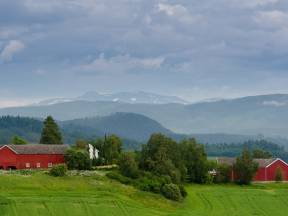
You can see them everywhere; smaller or larger farms with white farmhouses and red barns.
Norway is a nation of people who harvested the resources where they lived. Farmers and fishermen laid the foundation for the cultural landscape you see on this trip.
A traditional farm usually consists of a farmhouse and at least one or more outbuildings in the form of a barn, livestock shed or storehouse.
In 1950, there were over 200,000 active farms in Norway, most of them very small. Today, this number has been drastically reduced, and there are now just over 38,000 farms. Farms today are considerably larger. The closure of many small farms has, especially in recent years, led to significant areas of cultural landscape being lost as forests and scrub take over previously cultivated cropland.
And you might be wondering why all the barns are red?
This is because red paint was the cheapest paint available in olden days, so farmers could save money by painting their large farm buildings red. In their vanity, though, they used expensive white paint on their homes. What was once necessity, has today become a tradition.
County road 776
You now have the option to turn onto County Road 776, a scenic route that stretches for about 60 kilometers and ends at the Hoffles–Geisnes ferry crossing. This road winds through lush forests, farmland, and small villages, offering a journey through some of Trøndelag’s hidden gems.
Along the way, you’ll pass the powerful Skrøyvstadfossen waterfall, a striking natural sight, as well as the village of Salsbruket, known for its rich industrial history in forestry and milling. For those looking to explore rural Norway, this detour is a chance to experience quiet fishing spots, hiking trails, and picturesque viewpoints.
County Road 776 provides a taste of Trøndelag’s peaceful countryside, leading you all the way to the shores of the fjord at the ferry crossing.
Bangsund
You are now passing Bangsund, a village with deep historical roots and a unique place in Norwegian history. The Bangsund farm was likely cleared during the Early Iron Age, around 400 AD, and two burial finds from that era testify to early settlements here.
Bangsund also thrived as a hub for the sawmill industry, which shaped the area for many years. However, what truly sets Bangsund apart are its UFO sightings. In 1972, strange triangular imprints were discovered on the beach at Kjølsøya in Lyngenfjorden, drawing significant attention.
Another notable event was when Bangsund native Mette Veiseth Skogstrand won Miss Norway in 1987 and represented the country in Miss World. Bangsund offers a captivating mix of history, industry, and mystery.
Foto: Av User Gretekh Offentlig eiendom, https://commons.wikimedia.org/w/index.php?curid=1164815
Namdalseid
You are soon passing the small village of Namdalseid, known for its beautiful nature and rich agricultural traditions. The area has deep roots in farming, forestry, cross-country skiing, and Nordic combined. As you can see, the village is surrounded by stunning mountains, lakes, and forests, offering great opportunities for outdoor activities and fishing.
Trond Einar Elden and Hallstein Bøgseth and other in their families, hailing from this area, achieved numerous victories in Nordic combined and cross-country skiing World Cup events. These families produced top athletes, contributing significantly to Norway’s strong tradition in winter sports competition on the global stage.
Namsos
Ahead of us is Namsos, known as an important industrial town with strong roots in timber processing and sawmills, shaping the town’s development over the years.
The town also has a rich musical heritage and is the birthplace of several famous Norwegian musicians, including Terje Tysland and Åge Aleksandersen, who have left their mark on Norwegian rock.
Today, you can visit cultural attractions like Rock City, a center for Norwegian pop music. Namsos was bombed during World War II in 1940, leading to significant destruction, but the town was rebuilt after the war. Located by the scenic Namsenfjord,
Namsos is popular for fishing, outdoor activities, and boating, especially known for its salmon in the Namsen River, one of Norway’s best salmon rivers.
You will find a separate route for Namsos in the app or in the link below.
Eidsvatnet and Grungstadvatnet
You’re now near Eidsvatnet and Grungstadvatnet, two beautiful lakes that lie side by side in a serene natural setting.
These lakes are popular spots for fishing, with a variety of fish species, including trout and char, attracting anglers from near and far. The clear waters and tranquil surroundings make these lakes perfect for those seeking a peaceful retreat in nature. In summer, the lakes are ideal for fishing and picnicking, while in winter, the frozen surfaces create opportunities for ice fishing. Imagine casting a line into the still waters, surrounded by forests and distant mountains—an ideal spot for relaxation and a taste of Norway’s natural beauty.
Grungstadfossen
If you want to see a spectacular waterfall, you can soon turn off towards Grungstadfossen.
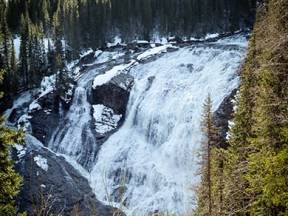
This natural gem is known for its powerful cascade, especially in spring when the snowmelt increases the river’s flow. Grungstadfossen is not only a beautiful sight but also an important part of the local ecosystem, supporting diverse plant and animal life along its banks. The waterfall has long been a popular spot for both locals and visitors looking to experience nature up close.
Imagine standing by the falls, feeling the cool mist and hearing the roar of the water—an invigorating experience just a short detour a few minutes away.
Lensmanngården
Soon, one of Central Norway's most exciting and charming guesthouses will appear – Lensmannsgården here in Namdalseid.
Lensmannsgården Guesthouse offers a unique experience where history and modern comfort come together. Once the home of the local sheriff, the house has been lovingly restored to provide a warm and authentic atmosphere. Guests can enjoy cozy rooms, homemade meals crafted from local ingredients, and the opportunity to explore beautiful surroundings.
Namdalseid is an excellent base for activities like fishing, hiking, or simply enjoying the tranquility of nature. This is a stay you'll treasure.
Round bales
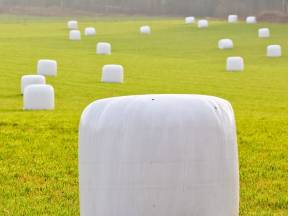
You see them everywhere—those white balls scattered across the fields like giant marshmallows.
They are called round bales, or hay bales, and contain grass or hay that farmers use to feed their animals. The round bale is kept fresh because it is wrapped in plastic, which prevents air from getting in. When the air is sealed out, the grass begins to ferment in a controlled process called ensiling. This preserves the grass and keeps it nutritious for a long time. The process prevents the grass from rotting or drying out, so it can be used as animal feed during the winter. The plastic wrap also protects against rain and pests, ensuring the round bale stays in good condition.
Before round bales became common, farmers dried grass to make hay. They would cut the grass, spread it across the field, and let it dry completely. This was a time-consuming process and required good weather, as the grass had to be dry for storage without rotting. Dry hay was often stored in haystacks or barns to be used as winter feed for the animals. If it rained a lot, the grass could be ruined, making the process more uncertain than today’s round bale method.
Beitstad
Do you like the beautiful scenery?
We are now passing Beitstadsundet, as is the innermost arm of the Beitstadfjorden, an arm of the Trondheim Fjord, stretching approximately 28 kilometers and known for its rich marine life and fertile shores. It’s a key area for local fisheries and farming.
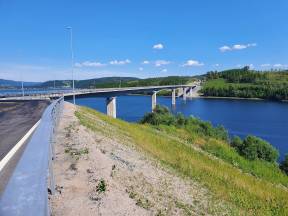
Beitstad Bridge, was completed in 2019 and spans 580 meters and connects communities across the fjord, improving transportation.
Roundabout County Roads 17 and 769
Ahead is the roundabout where County Roads 17 and 769 meet, a central junction for travelers along the Coastal Highway.
To the northeast, County Road 17 leads to Brønnøysund, 203 kilometers away, and onward to Sandnessjøen and Bodø. This route also takes you to Grong and the E6, just 50 kilometers away.
Heading north on County Road 769, it’s only 4 kilometers to Namsos, with further connections to Rørvik and Kolvereid.
To the south, County Road 17 leads to Steinkjer, 70 kilometers away, providing access to southern destinations along the E6.
At west you can reach the Norwegian Sawmill Museum and Spillumvika.
Skogmo
We are approaching Skogmo. Here, you can turn onto the E6 and reach Grong, just a short drive away.
Skogmo is also home to Bjøra Camping, beautifully located by the Bjøra River. Renowned as one of Norway's best salmon rivers, Bjøra is a paradise for fishing enthusiasts. The campsite offers peaceful surroundings, accommodation, and an excellent base for exploring Trøndelag's stunning landscapes and natural beauty.
Norwegian Sawmill Museum
Out by the fjord, you can now see the Norwegian Sawmill Museum and Spillum Steam Sawmill & Planing Mill, a national cultural heritage site showcasing the history of sawmills that shaped Norwegian industry from the mid-1800s.
Spillum Steam Sawmill & Planing Mill was established in 1884 and operated until 1986. It is the only remaining steam-powered sawmill in Norway with its original machinery intact. Here, you can witness demonstrations of historic saw and planing machines and learn about how sawmills played a vital role in the development of Norwegian industry and export.
The museum features interactive exhibits suitable for both children and adults, along with a cozy café for a relaxing break. The surrounding area offers stunning views of the fjord, making it a perfect stop for anyone interested in history and Norwegian cultural heritage.
Photo: Norsk Sagbruksmuseum
Høyknes bridge
We are now driving over the Høyknes Bridge and the Namsen River, which flows into the Namsen Fjord – and that explains how Namsos got its name.
In the old days, timber was floated down the Namsen River from the forests of Trøndelag. Logs were tied into rafts and carried by the current to the sawmills near the fjord. It required skill and strength from the log drivers, who often worked under challenging conditions to ensure the timber reached its destination.
Jutulsteinen
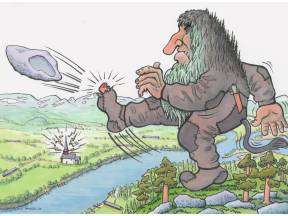
Have you heard of the Jutulsteinen, or the Jutul rock? It’s not just any rock – it’s a rock with a story straight out of a fantasy film, spiced with a dash of troll humor!
About 900 years ago, when Ranem Church was being built, a grumpy troll lived in Grandeåsen. Annoyed by the noise, church bells, and people’s joy, he decided to take matters into his own hands.
He found a massive boulder, carefully aimed, and kicked it with all his trollish might. The result? The boulder flew like a cannonball – but completely missed and landed in Blæsteren. And the troll? Well, we never heard from him again; maybe he burst with rage.
The rock, however, remained, and some say it moves whenever the church bells ring. If you visit, you can still see the troll’s footprint. Maybe he kicked it a bit too hard?
Illustration: Knut Høihjelle
Hunting and fishing
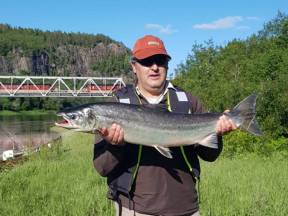
We are now driving along the Bjøra River, one of Norway's best salmon rivers and a symbol of Overhalla’s long tradition of hunting and fishing. These activities have been the foundation of settlement here for centuries and have evolved into a thriving tourism industry, attracting visitors from both Norway and abroad.
Salmon fishing has played a particularly important role. Rivers like Namsen were initially vital for transport, agriculture, and food. In the late 1800s, English salmon lords popularized sport fishing, and many farms began renting out fishing spots.
Today, salmon fishing tourism continues to thrive, with landmarks such as the Salmon Hotel at Bertnem Bridge and stately homes like Engelskhuset at Stor-Skogmo and the Grande farm. Salmon fishing remains a popular activity and a cherished part of Overhalla’s local culture.
Moose hunting
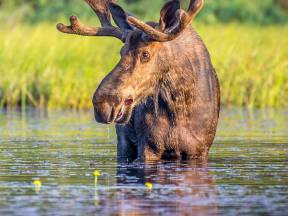
Moose hunting has long traditions in Norway and remains an important part of our cultural heritage. Nationally, around 30,000 moose are harvested annually, and in Høylandet municipality, the number typically ranges between 200 and 300 each year. With its vast forested areas, Høylandet is an ideal location for moose hunting.
Historically, moose were a vital resource for food and materials. Today, hunting also serves an ecological purpose, maintaining a balanced population and reducing damage to forests and farmland.
In this region, moose roam freely through expansive woodlands, and Høylandet is renowned for its excellent hunting conditions. Moose hunting is not only a valuable resource here but also a cherished social tradition, bringing people together for collaboration and memorable outdoor experiences.
Flakkan naturreservat
We are now passing Flakkan Nature Reserve, a unique wetland area in Høylandet municipality. This protected site is renowned for its rich birdlife and pristine wetland environment, which is increasingly rare today.
Flakkan serves as an important stopover for migratory birds and is home to species such as curlew, redshank, and various types of ducks. The reserve plays a crucial role in preserving biodiversity and attracts nature enthusiasts from near and far.
With its tranquil landscapes and natural beauty, Flakkan is an excellent spot for birdwatching or simply enjoying the peaceful atmosphere. The area offers a unique opportunity to experience wetland ecosystems up close, surrounded by Høylandet’s stunning natural scenery.
Forests
Forests, forests, and more forests. A full 25% of Høylandet municipality is covered in trees. Forestry has always been a vital industry in Norway, and Høylandet is no exception. For generations, the forests have provided both work and resources for the local community.
In Høylandet, working in the forest was tough but valuable. From felling trees to floating timber down the many rivers, it required skill and teamwork. The timber was transported to sawmills, which were a cornerstone of Norwegian industrial history. The sawmills in Høylandet supplied wood for everything from house construction to exports.
Today, forestry is a modern and sustainable industry. Timber from Høylandet’s forests is used for building materials, paper, and bioenergy. The forest remains a crucial resource, and forestry contributes both economically and environmentally to the municipality.
Lonelva river
Is there anything more soothing than the sound of a rushing river, fresh air, and the wonderful scent of nature? Further ahead, you can stretch your legs and experience the beauty of the Lonelva River, which we are now driving alongside. This picturesque river flows through Høylandet municipality, originating from Lonsjøen.
The Lonelva winds its way through the landscape and is known for its rich wildlife and plant diversity. It is also part of local cultural history, once used for fishing and as a resource for forestry in earlier times. Along the river, you’ll find several beautiful spots to take a break, perfect for soaking in the tranquility of nature. The Lonelva serves as a reminder of the importance of preserving such unique areas for future generations.
The coastal lifeline
The Coastal Highway (Kystriksveien) is more than just a road; it’s a lifeline that has connected towns, villages, hamlets, and islands along the coast for generations. The road is brought to life by the people who live along it, and in return, it provides them with life – a true symbiosis between humans and the journey itself.
This coastal route isn’t about traveling as quickly as possible from A to B. It’s about all the sights, experiences, and adventures you can have along the way, as well as the incredible, creative people who make it all possible.
At Kystriksveien Reiseliv, we aim to inspire you with places to visit, activities to try, and people to meet along this breathtaking coastal stretch. We tell the stories of the locations, the people, and even the wildlife that make Kystriksveien so unique. Safe travels!
Tired?
Need a place to stay? Along the Coastal Highway, you’ll find a wide range of accommodations to suit all preferences.
Cabins and fishermen’s cottages are the most popular options, often with self-catering facilities. Most have running water, a kitchen, and shower/WC. Prices range from 800–1600 NOK per night, while simpler cabins cost 400–600 NOK. Some places include bed linen and final cleaning, while others offer these as additional services. Many campgrounds also have rooms for rent.
Hotels and motels are located in towns like Steinkjer, Namsos, Rørvik, Brønnøysund, Sandnessjøen, and Bodø. Smaller, charming hotels like Abelvær Gård, Dønnes Gård, and Handelsstedet Forvik offer a historical touch. On the islands of Vega and Lovund, Vega Havhotell and Lovund Rorbuhotell provide unique stays with personal service and exceptional dining.
For more information and booking, visit kystriksveien.no.
Nordelva
We are now driving along Nordelva, also known as Reinbjørelva. The river originates in Urddalen, 520 meters above sea level near Vetterhushatten, and stretches 25.6 kilometers before joining Norddalselva to form Meosen, which flows into the Namsen River. In its final kilometers toward Namsos, Nordelva runs parallel to Namsen.
In one of Nordelva's tributaries, Kvernelva, lies Vannebo Power Plant, which harnesses a 107-meter drop to produce 3.6 million kilowatt-hours of electricity annually—enough to supply a little over 200 households.
Norway boasts around 4,000 major rivers and waterways, along with countless smaller streams and tributaries. These rivers play a vital role in shaping the landscape and ecosystems, providing essential resources for hydropower, recreation, fishing, and tourism. Each river has its own unique story and significance, enriching both nature and the lives of those who live nearby.