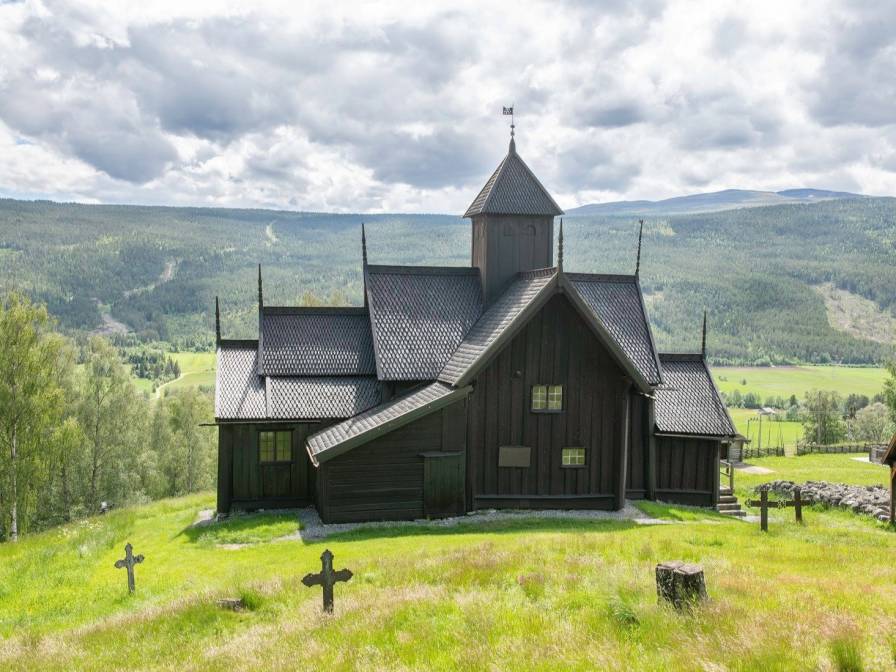
Uvdal Stave Church
0
Uvdal Stave Church was built around the year 1168. It was set up at a time when Norway had consolidated its position as an independent European kingdom, with its own church government. It was built as a central pillar construction, complete with nave, apse, aisle and roof tower, but what we see today is the result of various expansions and conversions. Before 1537, the church consisted of a single church room, an almost square nave where the roof tower was supported by a central pillar. The choir was quite small and ended with a semicircular apse. After the Reformation, the nave was extended to the west, the apse was torn down and the choir expanded. The church was probably not decorated until after the Reformation. Possibly the profiles on arches and other construction parts had been highlighted with brown-black tar, but otherwise there was no decoration. In 1656 the church was decorated. The colours used were ochre, red, grey, and white. At the same time, the pulpit was added. In 1620 came the first windows, then rows of benches for the congregation (previously these had been reserved for the sick and elderly). In 1720, the church was rebuilt as a cruciform church, and at the same time a corridor was demolished and the porch erected. One unusual artefact, a Limoges crucifix, was discovered hung up beneath the ceiling in the choir of Uvdal Stave Church, and is now stored at the Antiquities Collection in Oslo.