Introvideo Aurlands skofabrikk
Bruk kode 1874 for å se introvideoen etter du har trykt på lenken nedenfor.
The creator of the iconic Aurland shoe was Nils Tveranger, who in his early twenties travelled to America, where he learnt the trade of shoe making. Whilst there, it is claimed he found inspiration from the Indian moccasin shoes of the Iroquois people, he was also inspired by the Tese shoes of the "indigenous people of Norway". Tveranger used both these sources of inspiration in his shoemaking in Aurland in the development of the Aurland shoe.
After several years in America, Tveranger returned to Norway and settled in Aurland, where he met Hansine Torlandsdotter Ohnstad who later became his wife. The two of them married and had four children. Tveranger firstly designed an Aurland shoe which was known as the "National Shoe". The shoe which had a heel and laces won first prize at the National Exhibition in Bergen in 1910.
From 1930 to 1935, Gustav Nesbø and Kristin Ohnstad took over production of The National Shoe. In the interim, Tveranger designed a new shoe, which became the Aurland shoe as you know it today. This shoe takes a lot of its inspiration from the local tese shoe, which brothers Vedbjørn S. Vangen and Andreas O. Vangen designed and exhibited in the Norwegian Pavilion during the World Exhibition in Chicago in 1893. Tveranger's new model was a huge success both at home and abroad, and in Denmark it was known as the "Norwegian cabin shoe".
The History of the Factory
The art of shoemaking has a long tradition in Aurland, and the story behind the iconic Aurland shoe goes back in time. The shoemaking profession here has roots that date back to the 1880s. At that time, farmers sewed their own shoes, which were known as ‘loda shoes’. A loda shoe was simple to make and was a common shoe type amongst the Norwegian farming community.
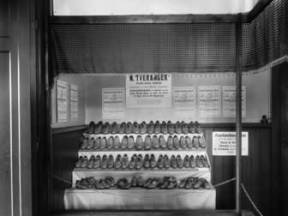
At its peak, during the period between 1930 and 1970 there were 19 factories employing around 100 workers making Aurland shoes. The 100 employees were only the men, whilst the ladies cleaned, accepted orders, and kept accounts.
Although the 1930s were marked by economic downturns, there was optimism in Aurland with a new shoe on the market. However, the end of the 1960s – saw a tougher time for the shoe industry in Norway and increased competition led to the closure of shoe factories across the whole country. This also had a knock-on effect on shoe production in Aurland.
In a short time those 19 factories were reduced to just a few.
Despite many leaving the shoe making industry, there was one person who tried to keep the shoe making profession alive with the Aurland shoe.
Ansgar Wangen, his wife Eldbjørg and their son Svein Odar, have been the only producers of the Aurland shoe since 1989.
In 2008 the business was transferred to other local owners and was registered in the Economusèe in 2009, as the only business of its kind in Northern Europe. Today Aurlandsskoen is 100% owned by Norway’s best, previously known as Flåm AS.
Two Models of Aurlands Shoe
Aurlands shoe has two models, Wangen and Buxton.
Wangen is our oldest model and is the one that most people recognise. It came out in 1934, and is seen as the factory’s «everyday shoe».
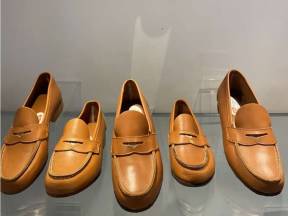
Our other model, Buxton, was launched in 2019 and is a more elegant version of the original Aurlands shoe.
It is claimed that the British ‘Salmon Lords’ who came to Aurland in the 1880s, came asking for help to repair their shoes, and this was one of the reasons that the shoe making trade in Aurland prospered.
One of the ‘Salmon Lords’ Lord Buxton, apparently came to the shoemakers in Aurland asking for a shoe that was both comfortable to wear, but at the same time elegant enough to be worn in the hotel that he was staying in.
Hence the reason for our choice of name for the new model; Buxton.
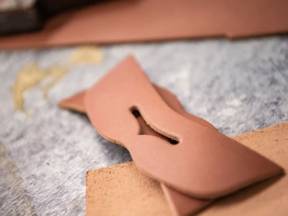
The cross strap is the hallmark of the Aurland shoe and is the last part to be sewn onto the shoe. When there were many producers of the Aurland shoe, it was the design of the opening in the cross strap where the 10-øre is placed, which distinguished the different producers from each other, as each factory had its own design on the cross strap.
The 10-øre in the shoe has many different meanings. Many wore the 10-øre as jewellery on their shoes, with others using the 10 øre to show unity during The Second World War, in the same way as many wore a paperclip on their lapel to show solidarity.
There are also some fun stories about the coin in the shoe. Some people used a 10 øre in their shoe to show if they were in a relationship or not. If you had a 10 øre in your shoe, you were single, but if you were taken, then you would put 2 coins in your shoe.
Several customers from the Bergen area also told us that they used the 10 øre if they were single, but if they were in a relationship, they would have a 25 øre coin in their shoe.
Leather and Punching Machine
The two machines that you are now standing next to, punch out large pieces of leather which the shoemakers later sew together. Punching out leather is not as easy as it might look, the shoemakers here in the factory have a good knowledge of how to punch out and which parts of the cow hide are the best to punch out. The leather on the back is stiffer and finer than that on the stomach.
Lower on the stomach the skin is often softer and not well suited for shoe production. The surplus leather is often used to make other products, for example make up bags, card holders, belts and bracelets.
We use cow leather for our products. Previously, we bought the leather from Borge tannery on Osterøy, but it went bankrupt in 2011. Today, we use high quality genuine leather from Turkey.
To make the Wangen Model of the Aurland shoe, we punch out 7 different pieces which are put together in other departments.
These parts are:
1. Heel
2. Cross Strap
3. Edge
4. Side
5. Toe cap
6. Top side
7. Insole
Do you know what ‘to shive’ means?
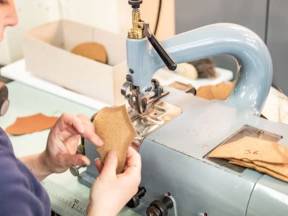
This is a machine that thins out the leather.
Before we start to sew the shoes together, we need to shive the parts. To shive means to thin out the leather so that it becomes easier to sew the different parts together.
When sewing together 2 or 3 different parts, the leather soon becomes too thick to sew through. The skiving machine solves this, by scraping a bit of the leather off so that it is easier to sew through, it also makes the shoes nicer and more comfortble to wear.
The skiving machine is also used to thin down other pieces of leather that will be used in other products such as belts and the edging on hand bags. The red and blue machines do the same thing.
So now you know what it means to shive!
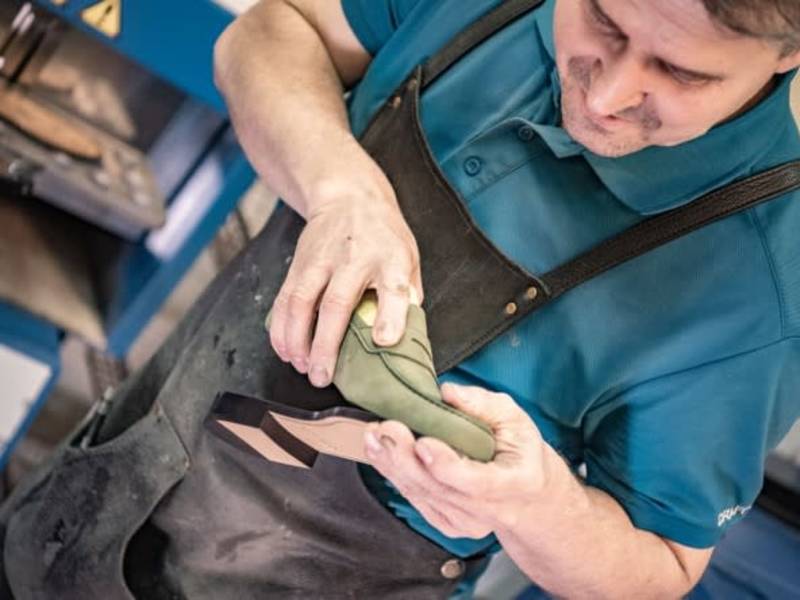
Today the production of the Aurland shoe is more modernised, but a large amount of the work that goes in to making the Aurland shoe is still done by hand.
For the most part, sewing machines are used to sew the shoes. Using a machine is a more effective and less tiring way of sewing than doing it by hand as was done before. Previously, when the shoes were hand stitched, they used linen thread from Ireland, and in place of a needle they used Russian pig bristles.
The shoe makers fastened the pig bristle to a linen thread and started to sew the pieces of the shoe together. They punched a hole with an awl, and the pig bristles were threaded into the hole from each side.
Today there are several different sewing machines used to sew different pieces of the Aurland shoes.
Once all the pieces are sewn together, we are left with what is known as a ‘nåtling’.
A nåtling is a shoe which is sewn together, but which has not been shaped and does not yet have a sole.
You have now arrived at the pinning room. The shoes are shaped and get their inner soles here.
Machine Number 1 is used to insert the heel into the shoe. When the nåtling is sewn together, it is sewn so that there is a small space at the back of the heel where the heel cap can be inserted. Once the shoemaker has inserted the heel cap, they use the machine to warm it up and shape the heel on the shoe.
Today, steam is used to form the shoe. The shoemaker uses machine number 3 to steam the nåtling so that they can be formed into shoes. Once the shoe has been steamed, the shoemaker places it on a shoe last, the last is in the shape of a foot and helps the leather to shape itself. Once the nåtling is on the last, the shoe maker places it on machine number 4. This machine helps to create the shape of the shoe. The machine uses warm glue to glue the shoe to the sole, and now the shoe has taken shape.
The shoe lasts that were previously used were made out of wood. After the nåtling were dipped in warm water, the shoemaker would stretch and form the nåtling on the last, and afterwards nail the leather together on the last to form the shape of the shoe. Today it is more effective to use steam and a machine to stretch and glue the shoes together.
Here in the gluing room, the shoemaker glues the soles on the shoes. They use a special type of glue in this process, so that the sole is well attached. Before the shoe maker can glue the sole on, they must first sand the shoe with a sanding machine, which is in the next room.
Machine number 1 is a sanding machine. The reason that the shoe maker sands the shoe is to make it smooth under the inner sole, so that it is not lumpy and uncomfortable under the shoe. If the shoe is not sanded underneath there will be a lot of texture under the sole that will make it lumpy and uncomfortable to use, and at the same time the sole will not attach properly.
Machine number 2, is used to sew the sole onto the Buxton shoe, that model can only have a sole which is sewn on.
The last stage here in the gluing room is to press the sole on. The shoe maker uses machine number 3 to warm up the glue again. Once it is warmed, the shoe maker attaches the shoe and the sole together and places them in machine number 4. The machine has air cushions inside that press the soles onto the shoes using air pressure. This means that the sole is attached evenly across the whole sole.
The Evolution of the Aurland Shoe
The first shoe that you see in the exhibition is a Tese shoe. This is one of the shoes that inspired Nils Tveranger to make the Aurland shoe.
The other shoe you can see is a moccasin shoe from the Iroquois people, which Nils Tveranger learnt to make whilst he was in the USA.
The other shoe that you can see on display is the National Shoe, the National Shoe was the first shoe that Nils Tveranger produced. It was with this shoe that he won first place at the national exhibition in Bergan in 1910.
Shoe number four in the exhibition are two shoes produced by two different factories here in Aurland. At its peak there were 19 factories in Aurland and Flåm collectively, 17 in Aurland and 2 in Flåm. As mentioned previously, you could see which factory the shoe had been produced in by looking at the cross strap, where the coin sits.
Shoe number 5 is a pair of old bunad shoes, these are shoes that are worn with a bunad which is the Norwegian national costume. Locals have used Aurland shoes as bunad shoes for many years. They would use a regular black Aurland shoe and sew a silver buckle onto them.
Shoe number six is a shoe from Angstar Wangen’s factory, the factory that you are in now. This is how he made Aurland shoes.
The last shoe that you can see in the exhibition is how the shoe looks today. As of today, we have two different styles, the Wangen, which is named after the factory and its former owner, and the Buxton which is a new more elegant version of the Aurland shoe.