Welcome to the Flåm Railway Museum
Press the red download button, then tap on the interest points below, as you follow the route around the museum.
With a pleasant narration, you will hear about the construction of the Flåm Railway and the history of Flåm.
At your own pace, on your own mobile, you will get to know the authentic exhibition at the museum.
LANGUAGES:
-Du kan endre språk ved å trykke på den lille knappen oppe til høyre.
-You can change to your preferred language by pressing the small button up to the right.
-Sie können Ihre bevorzugte Sprache ändern, indem Sie auf den kleinen Button oben rechts drücken.
-Vous pouvez changer pour votre langue préférée en appuyant sur le petit bouton en haut à droite.
-您可以通过按右上方的小按钮来切换到您喜欢的语言。
-Puede cambiar a su idioma preferido presionando el pequeño botón ubicado arriba a la derecha.
-右上の小さなボタンを押すことで、お好みの言語に変更することができます。
-Puoi cambiare alla tua lingua preferita premendo il piccolo pulsante in alto a destra.
-우측 상단에 있는 작은 버튼을 눌러 원하는 언어로 변경할 수 있습니다.
Audio guides available in:
English (British), Español, 日本語, Italiano, 한글 , 中文, Deutsch , Norsk bokmål, Français, Nynorsk
To find more content and listen to free audio guides, download the Guide To Go app.
Flåm Railway Museum
Points of interest
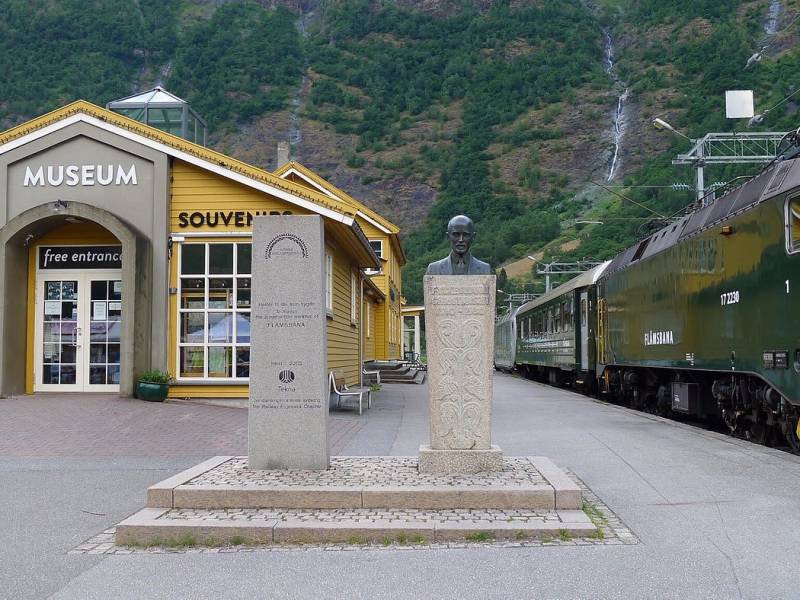
The Flåm Railway Museum.
Welcome to The Flåm Railway Museum.
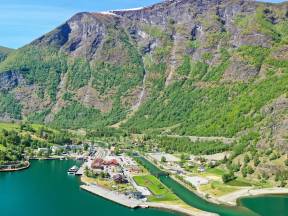
The Flåm Valley and the little village of Flåm has a history that stretches back thousands of years, and during your visit we want to take you on a journey through this history – with extra focus on the development of the Flåm Railway and why it is so important for our local culture and history.
The Flåm Valley and Sognefjord was shaped by several ice ages over two million years and by rivers and weathering in interglacial times. The highest mountain tops became visible from the icecap 15-16 000 years ago and the last side valleys melted away 11 000 years ago.
There are written records of farming in Flåm as early as the 1300s, but there were most likely permanent settlements in the Flåm Valley for at least 2000 years. The oldest settlements, from late Iron Age, seems to have been farms at Fretheim and Flåm, and they are still in operation.
Several of the farms were deserted for a long time, after the Black Plague in the mid-1300s, but tax records from the 1500s refers to 6 farms, a population of about 80 and tough living conditions.
Census from the mid-1800s refer to 634 residents in the Flåm Valley, whereupon 1/3 of the population of Aurland emigrated to the United States, as all land was in use and the valley could not feed more people.
The decision
Until the decision to build the Bergen Railway, the Flåm Valley was a secluded area, where only winding and steep cattle trails connected the farms to the outside world.
In 1871 the first known initiative to establishing a railway between Oslo and Bergen was proposed, and the idea also implied sidetracks to Sognefjord and Hardanger fjord. Parliament decided in 1908 the construction of The Flåm Railway, but first granted funds in 1923, after numerous years of discussing different technical solutions. Norwegian State Railway had the idea of Voss-Stalheim-Gudvangen as an alternative sidetrack.
Myrdal to Flåm was luckily drafted as a better and cheaper solution, with a shorter alignment and the same good connections to places along Sognefjord and onwards to Bergen.
The construction of the Flåm Railway was based on locomotives with a cogwheel up the steepest section to Myrdal, with the rack rail halfway between the running rails, mounted on the same sleepers as the running rails. Track facilities in the Alps were studied, but it was concluded that a pure standard gauge track was best.
The Flåm Railway wasn’t originally built for tourists. It was supposed to be a connection to the rest of the country. They envisioned transportation of goods, some passenger traffic and gladly some tourists. This is today turned upside down and transportation of goods are mostly done on trucks.
Myrdal Station
“All aboard”
Myrdal station has been a junction on The Bergen Railway for over 100 years. There is no road connection to Myrdal, and the old navvies road, which was mostly used during the construction of The Bergen- and Flåm Railway, is only accessible by hiking and biking today.
Many are surprised to learn that Myrdal was more than just a train station when The Bergen- and Flåm Railway was built. After WW II a tightly woven community of 142 people lived here, a number that declined through the years, to no residents after 2017.
Stationmaster Stenberg started the first private school in his own home, with a teaching governess. The first public school was established on the second floor of the locomotive stable, and later moved to the house of assembly after the locomotive stable burnt down.
In 1921 a separate school was built at Myrdal and had, a swimming pool in the basement, as the first school in the old county of Sogn og Fjordane. The school offered summer tuition only, for the first few years, but early offered complete schooling and was in full operation until 1982.
Myrdal fostered several good winter sport athletes, among other track keeper Gunnar Hjeltnes, who was national downhill champion in 1951 and finished 7th. in the Oslo Olympics, the year after.
The construction of Flåm Railway
"How are you going to build a railroad here?"
- A foreign railway engineer, who looked out over the Flåm Valley.
If the Bergen Railway was a challenge, the Flåm Railway was no less challenging.
The risk of landslides and the difficult terrain means that the Flåm Railway has 20 tunnels on a total stretch of 20.2 kilometres and with 5.7 kilometres being tunnels. This was one of the reasons why the work on the track took so long, since 18 of the tunnels were drilled by hand. They embarked on the longest tunnel, and it took almost 11 years to build. The rock rubble was transported out of the tunnels by horse-drawn rails, and from there transported on by horse and carriage.
Machine drilling was used in only two of the tunnels, without the progress being much faster. From the start, the workforce was just over 120 men and quickly rose to 280. In addition to the permanent employees, there were 400-500 workers in total during the summer seasons, but the number was reduced year by year, to 60-70 in the great depression years.
The Flåm Railway, in rough surroundings, with major topographical and geological challenges, and all the demanding technical and physical work, was an outstanding engineering achievement.
The construction of Flåm Railway II
The Flåm Railway is considered one of Norway's major engineering works, due to the height difference and the unique turning tunnel, which runs in an eight-figure loop over several levels. These are necessary so that the climb does not become too intense for ordinary train traffic.
From the Myrdal plateau down to the bottom of the Flåm Valley, the height difference is 865.5 metres. It is stated that 80% of the section has an incline of 55 ‰. and makes the railway the second steepest in Europe.
Rail laying began in the autumn of 1936, and four years later the Flåm Railway was opened for steam operation.
In 1944, the line was electrified with electricity from Kjosfossen power plant. It was almost 20 years before the Bergen Railway itself was electrified.
Despite dangerous work, a fast pace, poor security and unimaginable toil, there were only two fatal accidents at the Flåm Railway's facilities.
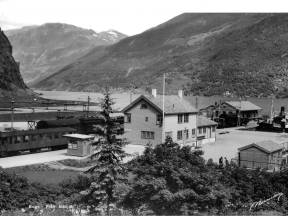
Flåm village was historically located about 3 kilometres further up in the Flåm Valley. However, with the Flåm Railway as the name of the railway, Fretheim was over time renamed Flåm.
The Flåm Railway is the country's most visited and well-known tourist attraction both because of the dramatic nature and the railway's special alignment to overcome the large height differences.
By many named the world's most scenic train journey.
History of Flåm Valley
Through two thousand years, farming has been the most important and virtually the only livelihood in Flåm Valley. Cattle was mainly the only livestock, but a shift towards more sheep and goats came at the end of 1800s.
There’s been mountain summer farms from the early ages, as there weren’t enough pastures for the animals down in Flåm Valley. Livestock was herded up to spring pastures and further on to mountain pastures and farms. There were long days on the mountain farms, hard work and a lot of responsibility. These weeks accounted for the main income of the farms, with the production of butter and cheese.
1/3 of Aurland's inhabitants emigrated to America and the loss of manpower, had major consequences for those who remained. Ways of agriculture had to be restructured and new machinery and tools were put into use.
Hunting and fishing in the mountains and on the fjord, were extra income for the farms, as well as food for their own household. For the farms bordering the Flåm River, fishing for salmon and sea trout was also food on the table. When foreign anglers arrived in the summer months in the mid to late 1800s, this fishing gained a greater economic value for the river owners.
This was the basis for today's tourism and the history of Flåm and Fretheim Hotel has had up to the present day.
Locomotives
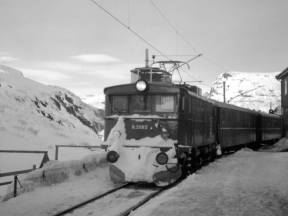
In 1944, the Flåm Railway received its first three electric locomotives of type EL 9 and this locomotive is the last of these three. The EL9 was built specifically for the Flåm Railway and had four braking systems to cope with the descent from Myrdal.
In the early 80s, the original locomotives were replaced by three converted locomotives of type EL 11. These were modified for use on the Flåm Railway, with changes to the electrical equipment, better brakes and more searchlights. After 1998, the service is provided by push–pull trains consisting of an EL 17 at each end, to be followed by EL 18 locomotives at each end in 2014. Pulling 6 passenger carriages and a capacity of 500 passengers per departure in high season.
Until 1977, the Flåm Railway was central to the postal service's distribution system in Sogn. Agricultural products and livestock were also shipped with the track. When the aluminum plant in Årdal was developed during World War 2, large quantities of goods were transported on the Flåm Railway and loaded into boats. The hydropower development in Aurland in the 1960s also led to heavy freight traffic on the Flåm Railway.
Today, the line has minimal significance as a railway in the "traffic sense". It is the tourist traffic during the summer months that gives the railway the greatest revenues. The Flåm Railway is among Norway's five most visited tourist attractions.
Dresinene
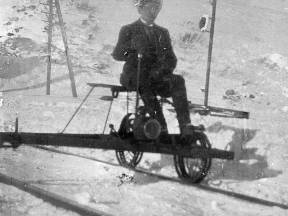
Here you’ll see several railbike-draisine models, used on both the Flåm- and Bergen Railway line, to inspect rail tracks and means of transportation between keeper housing. They were transported on the Flåm Railway train and placed on a chosen track. They were then used to get to the day’s place of work and back home at the end of the day.
The first draisine’s were based on the bike fundament, with pedaling and manual brakes. Eventually there were motorized models. The draisins could easily reach a speed of 50 km/h, on the way down the valley.
The bicycle trolley became the most common type of draisin on the Norwegian railways, because several Norwegian workshops produced their own railbikes. The slat wheel was developed, based on a steel disc bolted on four rings - the innermost ring held the draisin on the track, while the others made up the actual wheel path towards the rails.
Motorized draisines arose in response to a demand for inspection and assistance vehicles, for use in larger areas far beyond station areas, as railroad routes grew longer.
After several deaths and accidents, draisines were banned on Norway’s active railtracks in 1993. Today they have been replaced with rail work wagons, with all the necessary work equipment on board.
Huldrer
Have you heard of Huldra?
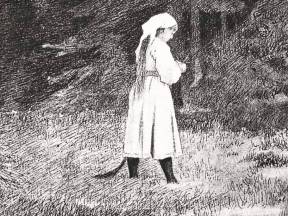
The Hulder people are in Norwegian folklore, supernatural beings who live underground and in mountains. Huldra is a beautiful woman with long hair and a cow’s tail. She is known for luring young men, into the mountain, with her beautiful singing.
The Hulder people belong especially to the mountain farming tradition, and many people believed that they lived on the farm, when they themselves did not use it. When the farmers came to the mountain farm in early summer, they often asked nicely to move in and sang loudly, to give the Huldre people time to leave the farm.
The Hulder people are rich, have strong horses, milk-rich cows and sheep with good wool. The sagas indicated that inside the mountain, there was more than enough food, drink and valuables.
Several saga stories about the Hulder people have been circulating on the farms in the Flåm Valley. For example, a farmer got hold of a hulder cow, by throwing a piece of steel over it. It was a great cow, and the farmer had several fine calves bred.
Many people claim to have seen the Hulder people in the valley and the fairy tale of our own huldra Nora, is inspired by local sagas and such claims.
Fretheim
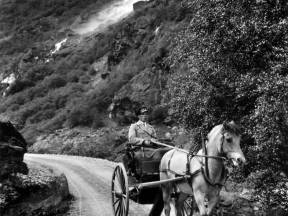
Horse-drawn carriages like these were used to transport people and goods, on earlier cattle trails, upgraded to construction roads, in connection with the building of the Bergen-Oslo railway. The 21 hairpin turns up Myrdalskleiva, were tough on people and horses, and travelers were encouraged to spare the horses and walk up the steep mountain.
Around the mid-1800s English lords and anglers started to visit Flåm, for salmon fishing in the Flåm River and hiking the surrounding mountains. Many lodged at Christen Fretheim’s farm, and towards the end of the 1800s, it was considered more of a hotel. There were two lodgings on the farm, one called the “The English Villa”. These were connected right after the turn of the century and marked the start of today’s Fretheim Hotel.
In the same period, tourism through the Flåm Valley increased and Fretheim started early with horse-drawn carriages. Prior to the opening of The Bergen Railway in 1909, scheduled traffic was initiated on the railway between Voss and Myrdal. Travelers came by boat to Flåm and needed rides up to Myrdal or vice versa, maybe with an overnight stay at Fretheim Hotel.
The Myrdal-turns were an adventure, with 30 to 40 carriages in a line up or down the steep turns.
Before the 1900s, Christen Fretheim had established a steamship quay, a general store and a post office in Flåm.
Destination Flåm
In the fifties and sixties, the Flåm Railway was included on the list of threatened side railways, and closure could become a fact. But gradually, travel numbers began to rise in the years that followed.
The Flåm Railway was again threatened with closure in the eighties. In winter, there were few travelers on the Flåm Railway. The rail tracks were worn and large funds for maintenance and upgrades was needed. This took a toll on the economy, and the Norwegian State Railway only wanted to keep the line open during the summer months.
At the same time, local forces started fighting for the Flåm Railway's future as a year-round railway, both to increase the number of passengers and to ensure much needed maintenance.
The current station building was completed in 1992 with its own post office. Tourist guiding on board the Flåm Railway was introduced in 1996 to provide a better overall experience of the journey.
A new era for the Flåm Railway started in 1998 when Flåm Utvikling took over operational and marketing responsibility, and product development of the Flåm Railway. The Norwegian State Railway (Vy) and Jernbaneverket (BaneNor) were still responsible for safety, train operation and maintenance of the section, as well as staffing of the trains.
Now plans were made for a tourist destination in Flåm, with opportunities to accommodate more cruise traffic and more hotel guests. The cruise quay was completed in 1999 and the expansion of Fretheim Hotel the following year.