Outside the Romsdalsgondolen Fjord Station
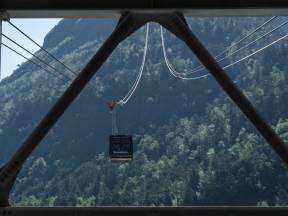
Well, hello there! What brings you to little old Åndalsnes? Whatever the reason – welcome! You’re now standing in front of Norway’s longest aerial tramway – the Romsdal Gondola.
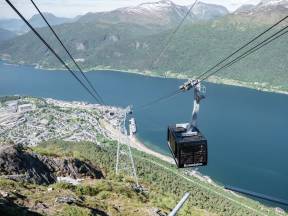
This cable car was built in 2021 and takes you on a breathtaking ride to the top of our city mountain, Nesaksla – 708 meters above sea level. From up there, you're treated to majestic views of the Romsdal Alps and Romsdalsfjord. You’ll even spot the peaks of Trollveggen and Trollstigen in the distance.
There’s a whole bunch of smart, forward-thinking solutions behind this project – from how it was built to the materials chosen, and not least, the logistics. Why? Because there’s no road up to the mountain station.
Everything had to be flown in by helicopter! And on top of that, they mounted a 30-meter-high crane up there to piece everything together – that way, they cut down on the number of helicopter flights.
So yes, the Romsdal Gondola can proudly call itself one of Europe’s – if not the world’s – most innovative and sustainable aerial tramways.
On the way up, I’ll tell you more about the unique engineering behind this place. And once you reach the top and follow the green trail, you’ll hear some exciting local stories as well.
Inside the Romsdalsgondolen Fjord Station
You’re now standing inside the fjord station of the Romsdal Gondola. Just beneath your feet is the engine room – and believe it or not, it actually sits below sea level.
Down there, powerful pumps stand ready to act in case seawater ever finds its way in.
What’s a bit unusual is that the machinery is placed down here at the bottom station, and not at the top. But there’s a good reason for that. First of all, it reduces noise significantly – but more importantly, it means the gondola cabins come all the way down to street level.
That makes boarding super easy for everyone – whether you’ve got a pram, a wheelchair, or just don’t fancy climbing stairs.
If you look up, you’ll see a window into the control room above.
That’s where our experienced and steady-handed gondola operators sit, keeping a close eye on the wind and weather – and making sure everyone gets in and out of the cabins safely.
On the way up, I’ll tell you more about the incredible construction process and the mountain-top restaurant – Eggen.
Inside the Cabin on the Way Up
There’s some real innovation behind this gondola. From the design and materials to the actual building process – everything had to be rethought. Since there’s no road up to the mountain station, every single bit of material was flown in by helicopter.
To make it more efficient, they even built a 30-metre-high crane up on the mountain, so they didn’t have to rely solely on helicopters for assembling the station and buildings.
Oh – and did you know the Romsdal Gondola holds a world record?
Instead of laying pipes and cables on the mountainside, they drilled a so-called pilot hole from the fjord station all the way up through the mountain. It’s a unique engineering feat – both in terms of length and altitude – and it means there are no visible scars in the terrain.
The tunnel is about 697 metres vertically, and around 1345 metres long in total. No one’s ever done it quite like this – so yes, that makes it a world record.
Nearing the Eggen Restaurant
As we get closer to the top of Nesaksla, you’ll see the Eggen Restaurant stretching out over the edge of the cliff. It opened just a month after the gondola, and it’s an architectural gem – offering unbeatable views over the Romsdal valley.
The restaurant was designed to blend seamlessly with the landscape and offers visitors a one-of-a-kind dining experience with locally sourced ingredients.
Now – you may have guessed it – there’s no road up there either. That was a conscious choice, made to preserve the wild mountain feel and avoid damaging the natural surroundings.
So how did they build it? The entire restaurant was made from large, prefabricated wooden modules that were flown up by helicopter and assembled with a crane.
The whole installation is reversible – it stands on pillars drilled into the rock, with no blasting, no concrete foundations. That means: if someone one day decides to take it down, there’ll be no scars left on the mountain.
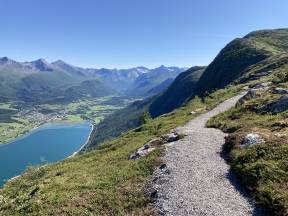
From the restaurant’s outdoor area, you can follow well-marked trails with views in every direction. If you take the green trail, I’ll tell you some wild stories – about mountain climbing, salmon fishing in the Rauma River, and the building of what might just be Europe’s most beautiful railway: the Rauma Line.
The Panorama Signs on the Viewing Ramp
Welcome to the top of Nesaksla – 708 metres above sea level – with a jaw-dropping view that’s made this place one of the most iconic landmarks in the Romsdal region.
From here, you can gaze out across a dramatic landscape of steep mountains, deep valleys and the 94-kilometre-long Romsdalsfjord.
A major turning point for Åndalsnes came in 1924, when the Rauma Railway opened.
That railway connected the town to the rest of Norway and made it much easier for visitors to get here. It also helped turn Åndalsnes into a base for those eager to explore the Romsdal Alps and surrounding nature.
Over the years, Åndalsnes became a popular destination for hikers, climbers, and anyone longing for the great outdoors. After the Second World War, tourism in Norway really took off – and Åndalsnes became a must-see stop along the scenic Rauma Line.
Even today, the town continues to draw thousands of visitors each year. It’s a hotspot for outdoor activities like climbing and hiking, yet it’s also managed to keep its old-world charm and close connection to the wild landscape around it.
And up ahead – you’ll soon reach a landmark that perfectly symbolises this region’s deep love for the mountains.
You’re now standing by Ottarbu – a small stone hut built in 1987.
You’ll find several of these shelters scattered across the Romsdal Alps. They were built for one important reason – to give hikers a place to take cover. Up here in the mountains, the weather can turn on a dime.
Feel free to pop inside and take a look – you’ll see it’s a very basic shelter, with nothing but a bench and a table. But in a storm, that’s all you need.
If you find the guestbook – go ahead and sign your name. It’s a simple way to mark your visit. And do remember to close the door when you leave – the next hiker will thank you for it.
Viewpoint towards Isfjorden
Ahead of you lies Isfjorden – a small village that’s seen a real boom in newcomers over the last few years.
Nature-loving freelancers and adventurers from across Norway and abroad have moved here to live closer to the mountains.
Whether it’s summer or winter, they’re out skiing, hiking, or just enjoying the wilderness.
One of the best-known peaks out there is called Kirketaket – which literally means ‘the church roof’. And as you can probably see, that name fits it quite well.
So, why is the village called Isfjorden – ‘Ice Fjord’?
Well, visit in winter and you’ll see why. Isfjorden is one of the coldest spots in the entire region. In fact, there can be as much as a 20-degree temperature difference between Åndalsnes and Isfjorden – and they’re only 8 kilometres apart!
It gets so cold that even the salty seawater at the end of the fjord freezes to ice.
In the middle of Nesaksla
Åndalsnes remains one of the most sought-after destinations for those in search of adventure, awe-inspiring landscapes, and proper outdoor living.
Whether you’re a climber, hiker, or simply here to take in the view – this place offers nature at its wildest and most beautiful.
Thousands of visitors come here each year, drawn by a town that has somehow struck the perfect balance between modern adventure hub and timeless mountain village.
It’s a place rooted deeply in the stunning surroundings that made it famous in the first place.
So take a deep breath – and enjoy the power, the beauty, and the calm that only Romsdalen can offer.
Thanks for joining me on this tour. Now it’s your turn to explore at your own pace. And if you're feeling peckish, why not drop by Eggen Restaurant for lunch or dinner with what we like to call the world’s most scenic backdrop?