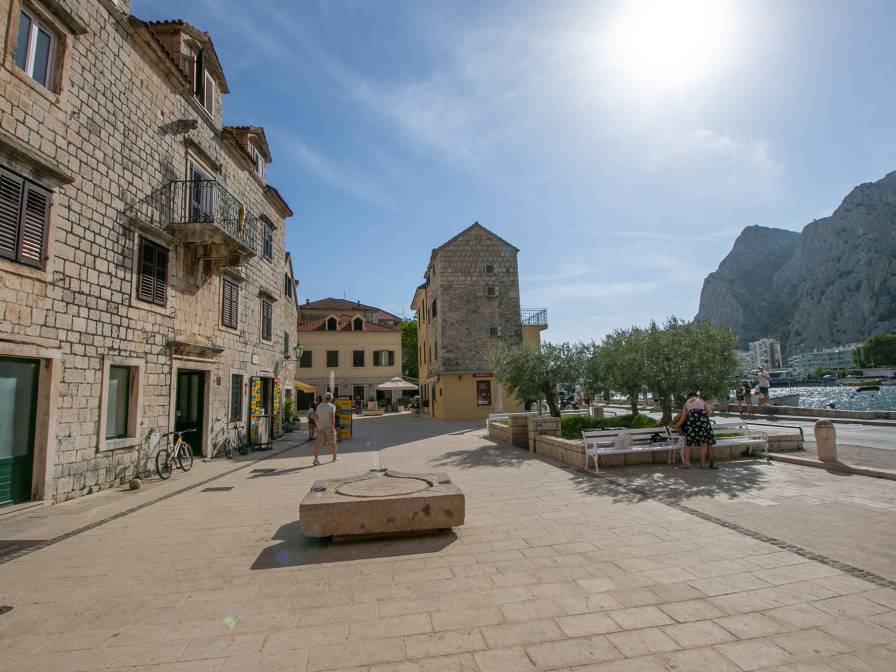
Poljica Square
0
You are in Poljica Square, a place that Omiš acquired in the early 17th century, when the city first emerged from its medieval walls and began to expand. The square immediately became the center of trade and social life, and was named after the Poljica Republic, an independent principality that existed from the 12th to the 19th centuries and had its own laws, known as the Poljica Statute, which regulated daily life and relations in the region. The square was once the site of grain fairs, public assemblies, and religious ceremonies, and was also the main meeting point between the inhabitants of the Poljica hinterland and coastal Omiš. It is surrounded by Baroque houses from the 17th and 18th centuries, and the most recognizable is the two-story 17th-century house with stone portals and Baroque facades, today protected as a cultural heritage site. Interestingly, the inscription on the stone slab from 1625 above the entrance to this house confirms its age and provides insight into the lifestyle of the time. The square itself is home to the Caralipeo House and the famous Pillar of Shame, which in the past was used to publicly punish and shame offenders, which was a common way of maintaining order in Dalmatian towns. Nearby is the Parish Church of St. Michael, and the square is located between it and the eastern city gate, making it the true heart of the old town core. Today, Poljica Square is a place where history and everyday life intertwine – there are cafes, occasional events and a lively atmosphere. In the city museum, located not far from the square, you can see the original Poljica flag and the Poljica Statute, one of the most important legal documents in Croatian history. Another interesting fact: the Poljica Republic was known for its exceptionally democratic system – the prince was elected every year, and decisions were made publicly, which was rare in Europe at that time.