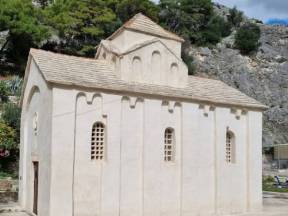
Pillar of Shame (Pranger)
Before you is the Pillar of Shame – a historical monument that was part of the everyday life of Dalmatian towns in the Middle Ages and early modern period. Those who committed offenses such as theft, slander or blasphemy ended up here, as well as those who did not have the money to pay the fine. It did not matter if you were poor or a foreigner, it was enough for the town prince to decide so and you were already tied to the pillar, exposed to the gaze and mockery of passers-by, and sometimes to being pelted with rotten fruit or garbage.
The Pillar of Shame in Dalmatia was often placed on the main or side square, and in some towns there were even more – for example, in Zadar there were two, one for the nobles and one for the commoners. This pillar probably dates back to the 17th century, from the time of Venetian rule, which is confirmed by the coat of arms of the providores carved on the pedestal. The providores were Venetian administrators and their coats of arms still testify to their power in Dalmatia today.
The convicts were tied to the pillar for several hours, and according to the Šibenik statute, “one day” on the pillar meant standing from sunrise to sunset. The punishment often included additional measures – for example, in Perugia, a notary who forged wills was not only tied, but also mutilated before being exposed to the public. Some pillars, such as Orlando’s in Dubrovnik, had other functions: they were used to fly flags or as a yardstick for merchants.
Today, the Pillar of Shame is a reminder of old legal customs and Venetian influence, although exact information about its construction has not been preserved. If you are interested in learning more about the history of this region, be sure to visit the church of St. Roch, which was important in the 17th century and preserves interesting traces of the past.
One interesting fact: the punishment of the pillar of shame in Croatia was only abolished at the end of the 18th century, by the decision of Emperor Joseph II.
Church of the Holy Spirit
You are standing in front of the Church of the Holy Spirit, just below the Mirabella Castle, in a place where the history of Omiš literally comes to life. This church, built in 1585 on the remains of an older Gothic building, is not just another stone in a row – its renovation was the result of the vision of the headman Marko Drešković, and the work was led by the Dubrovnik master Marin Martinović and the Venetian engineer Giovanni Battista Camozzini, who also designed the bell tower.
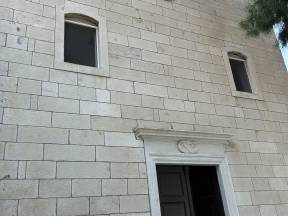
At first glance, the facade of the church attracts attention with a stone portal from the workshop of the famous Omiš Bokanjić family, decorated with reliefs and a rosette divided by columns. The central opening in the shape of a quatrefoil is surrounded by Gothic dentils, a detail rarely seen in Dalmatian churches from that period. The bell tower is made of finely worked stone and combines Renaissance and Baroque elements, while the interior of the church hides a ribbed vault with a stone cornice and side windows with arched ends.
Of particular value is the main altar with Jacopo Palma the Younger's work, "The Descent of the Holy Spirit", which is one of the most important works of art in the church. On the wall above the side entrance are the coats of arms of Venetian governors, and the main portal bears an inscription about the renovation in 1585. Right next to the church there used to be a hospital for the poor and sick, which shows how important the Brotherhood of the Holy Spirit was to the entire community.
The Church of the Holy Spirit is today a nationally protected cultural asset and an essential point on any tour of the old town. Here, in a small space, Gothic roots, Renaissance innovations and a strong Venetian influence intertwine. It is interesting that this very complex was the administrative center of Omiš, so important decisions were made here and the city elite gathered. Another interesting fact: the bell tower of the Church of the Holy Spirit is one of the few in Dalmatia whose designer is known by name, which further emphasizes its uniqueness.
Mirabela Fortress (Peovica)
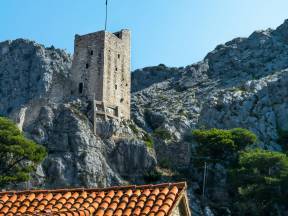
You are standing beneath Mirabela, the fortress that has watched over Omiš for centuries from a height of 200 meters. Also known as Peovica, this stronghold was more than just a pile of stone on a hill—it was the main stronghold of the Omiš pirates, who used it to monitor every ship passing through the Brač Channel and decide who could pass and who would become their next target.
Built in the 13th century, its age was confirmed by a Byzantine coin deliberately hidden in its foundations—a pirate move meant for future generations.
Mirabela has four levels and a trapezoidal layout, with thick stone walls that have withstood numerous attacks and storms. On the ground floor, there's a secret walled-up door—an escape route in case of danger—showing just how cautious and prepared the pirates were. From the top, there’s a panoramic view of the entire town of Omiš, the Brač Channel, and the surrounding areas—once a matter of life or death, and today, one of the most breathtaking viewpoints in Dalmatia.
One of the most interesting stories is related to the Turkish attack in the 16th century. The defenders then used the echo from the fortress to create the impression that they were much more numerous than they actually were, which forced the enemy to retreat.
Mirabela has been damaged several times throughout history, but the worst was in 1988 when it was almost destroyed by lightning. Although its story seemed to be over at the time, the fortress has been completely restored and today it is a protected cultural property and an unmissable attraction for anyone who wants to experience the authentic pirate history of Omiš.
Interesting fact that you may not have known: In the 13th century, the people of Omiš ruled the sea between Split and Dubrovnik so much that even Pope Honorius III launched a crusade against them – and lost. Mirabela has thus become a symbol of the time when pirates set the rules in the Adriatic.
You are in front of the Church of St. Roch, in the heart of the old town, right next to the former western gate of Omiš. It was first mentioned in 1579, which means that it had been here before. It belonged to the Brotherhood of St. Roch, an association of citizens that played an important role in the life of the city in the 16th and 17th centuries. At that time, the brotherhoods, in addition to gathering believers, often took care of public order, organized events, and sometimes even had the right to propose pardons for convicts. It is interesting that the members of the brotherhood elected their leadership every year by secret ballot and held joint lunches, which was an important form of gathering and decision-making for the society of that time.
St. Roch and St. Sebastian were protectors against the plague, a disease that repeatedly threatened Omiš. During epidemics, residents prayed to them in particular, hoping for protection.
In the 18th century, while the Church of St. Peter on Priku, the Baroque altar from that church was moved to the church of St. Roch. That altar, together with the painting of St. Roch, was thoroughly renovated in 1998 under the leadership of the parish priest, Don Ljubo Bodrožić. This preserved the valuable cultural heritage and history of this place.
Another interesting fact: for the altar with the coat of arms of the Kačić princes, the famous painter Francesco Negri painted the altarpiece "The Virgin Mary with Child, St. Roch and Sebastian". This painting further connects the church with the most important Omiš nobility and artistic heritage.
Today, the church of St. Roch is not among the largest in Omiš, but its history and connection with the local community make it an indispensable part of the city's identity.
You are looking at the House of the Happy Man, one of the symbols of the Renaissance in Omiš. Above the entrance is an inscription in Latin: "Gratias ago tibi Dne quia fui in hoc mundo" – a simple but powerful thanks for life that translates to “I thank you, Lord, that I was in this world.” The house was built in the 16th century, while the city was under Venetian rule. It is believed to have belonged to Ivan Primojević, a famous lawyer and ambassador of the Omiš commune to Venice, but very little is known about his life.
This house is a typical example of Dalmatian architecture from the Venetian era: it has three floors. The ground floor housed a workshop and living room, the bedrooms were on the first floor, and the kitchen – quite unusually – on the top. Historians have long tried to explain this arrangement, but the reason is actually very practical: having the kitchen on the top floor reduced the risk of fire, which was a common problem in medieval cities.
Today, this house is a protected cultural heritage site and a symbol of optimism, preserved thanks to traditional building techniques. The white stone facade is decorated with Renaissance details, while the interior shows how practical and adapted to everyday life in old Omiš was.
Interestingly, the inscription above the door has become an inspiration for numerous visitors, and the house is now an indispensable part of the city's cultural offer. Lesser known fact: near the house there is also the Pillar of Shame, another historical symbol of Omiš, which testifies to the past customs and justice in the city.
Piazza (St. Michael's Square)
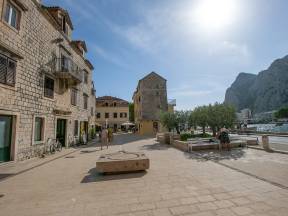
You are on St. Michael's Square, also known as "Pjaca", in the very heart of old Omiš. Everything is connected here - from the 17th-century Church of St. Michael, built on the foundations of an even older Gothic church, to the stone houses that have witnessed the life of the city for centuries. The square was the main place of gathering, trade and exchange of news, and today it is the lifeblood of the old town, connecting the land gates with the Cetina River.
The medieval history of the square connects it to the main city street, today's Knezova Kačića, which once connected the defensive walls built due to the constant threat from the Ottomans and the Venetians. In the 17th and 18th centuries, the square takes on a Baroque appearance - a stone rosette stands out on the facade of the church, and the bell tower with a pyramidal roof was designed by the famous Venetian engineer G. B. Camozzini in 1719. Next to the square are the 16th-century Bishop's Palace with a Renaissance monophor and the coat of arms of the Tomadelli family, and the Caralipeo-Despotović house preserves a coat of arms with an inscription from the same period.
Until the mid-20th century, all public life took place here, until it was replaced by Fošal, a new promenade built on the site of the former defensive ditch. Today, St. Michael's Square is the venue for the final concerts of the Dalmatian Klapa Festival, surrounded by cafes and shops that preserve the Dalmatian spirit.
Interesting fact that you may not have known: Omiš was famous for its pirates in the past, and the Cetina River, which runs right next to the square, served as a safe haven and hidden port for them. The Church of St. Michael combines Gothic, Renaissance and Baroque elements, making it the most interesting building in Omiš. The interior of the church hides valuable works of art, and the narrow streets around the square are often so narrow that it is almost impossible to capture the entire church in a photograph.
The Church of St. Michael was first mentioned in 1282, but there is evidence that it existed earlier. The current building was built between 1604 and 1627, and the bell tower was added in 1724 according to the designs of the Venetian engineer G. B. Camozzini. The bell tower is made of white Brač stone and has a distinctive pyramidal roof.
The church combines Gothic, Renaissance and Baroque styles. The portal was made in the Bokanjić workshop and is decorated with reliefs. On the facade there is a stone rosette with a wreath of leaves, angel heads and the coat of arms of Omiš. The interior is single-nave, with broken Gothic vaults. The church contains two Gothic crucifixes from the 15th century and altar paintings by the sculptor Ivan Rendić from 1897. The organ in the choir was made by Gaetano Moscatelli in 1792 and is still in use, and in 1996 it was restored and protected as a cultural monument.
In the sacristy are the remains of a medieval presbytery from the 13th century. Right next to the church are the Bishop's Palace from the 16th century with Renaissance windows and coats of arms of Venetian nobles.
The Church of St. Michael is a nationally protected cultural property and an important gathering place in Omiš. It is interesting that Pope Pius II. in 1461 mentioned this church as the main church in Omiš to which all other Omiš churches belonged. Another interesting fact: Omiš has as many as ten churches within the old town core, which is rare for a town of this size
You are in the old town market, right next to Poljički trg, which became one of the main places of trade in Omiš in the 17th century. Although today's market and fish market are not exactly in the same place where they once were, they are still the heart of local trade, just like a few centuries ago.
In the Middle Ages, trade took place along the main city streets and in front of churches, and Poljički trg then became the first organized place where local products and fresh fish were sold. People didn't just shop here - the market was and remains a place for meetings, conversations and everyday "chat", which is still typical of the Mediterranean way of life today.
Interestingly, the famous Pillar of Shame was also located near the market, where violators of city rules were punished, which shows how important this space was for the life of the entire community. Although the market has changed location, its role has not changed - it still brings people together, preserves tradition and reminds us of Omiš's rich past.
You are on Fošal, the main promenade of Omiš, but few people know that this place was once a key part of the city's defenses. The former moat, after which Fošal got its name (Italian fossa), was dug along the southern walls and filled with water - a real obstacle for any attacker from the sea. This moat was part of a complex Venetian defense system, and was additionally protected by towers and bastions, such as the famous Turjun tower on the southeast corner, which was expanded into a large five-sided bastion in 1659.
Interestingly, Fošal inherited its name from the Foša river, which once flowed through this area, before the canal was turned into a defensive moat. During the 19th century, when the city began to expand southward and the road to Split was being built, the moat was filled in, and Omiš took on its present appearance. Although the moat has disappeared, traces of the southern walls can still be seen under the first rows of houses north of Fošal, and the line of the former rampart can be seen in the paving.
Today, Fošal is bustling with life – it is surrounded by cafes and historic houses, and their courtyards hide the walled-in remains of former battlements and loopholes. Recent archaeological research has discovered underground fragments of the walls, which are a constant reminder of the warlike past of this area, which has gone from being a defensive barrier to becoming a symbol of the city's everyday life and tourism.
Another interesting fact: Omiš was famous for its pirates in the Middle Ages, and their skill in defending the city was so renowned that even after the Ottoman conquests, they managed to keep the city under Venetian rule, while the surrounding fortresses fell one after another. The pirates used their special ships with shallow drafts and hidden passages, and even built an underwater wall at the mouth of the Cetina River, which was invisible and deadly to enemies.
You are in Poljica Square, a place that Omiš acquired in the early 17th century, when the city first emerged from its medieval walls and began to expand. The square immediately became the center of trade and social life, and was named after the Poljica Republic, an independent principality that existed from the 12th to the 19th centuries and had its own laws, known as the Poljica Statute, which regulated daily life and relations in the region.
The square was once the site of grain fairs, public assemblies, and religious ceremonies, and was also the main meeting point between the inhabitants of the Poljica hinterland and coastal Omiš. It is surrounded by Baroque houses from the 17th and 18th centuries, and the most recognizable is the two-story 17th-century house with stone portals and Baroque facades, today protected as a cultural heritage site. Interestingly, the inscription on the stone slab from 1625 above the entrance to this house confirms its age and provides insight into the lifestyle of the time.
The square itself is home to the Caralipeo House and the famous Pillar of Shame, which in the past was used to publicly punish and shame offenders, which was a common way of maintaining order in Dalmatian towns. Nearby is the Parish Church of St. Michael, and the square is located between it and the eastern city gate, making it the true heart of the old town core.
Today, Poljica Square is a place where history and everyday life intertwine – there are cafes, occasional events and a lively atmosphere. In the city museum, located not far from the square, you can see the original Poljica flag and the Poljica Statute, one of the most important legal documents in Croatian history. Another interesting fact: the Poljica Republic was known for its exceptionally democratic system – the prince was elected every year, and decisions were made publicly, which was rare in Europe at that time.
You are in front of the Omiš City Museum, right next to the eastern gate of the old town – a place that is almost impossible to miss. Here you can see ancient stone carvings, inscriptions dedicated to Roman emperors and the marble head of Emperor Tiberius, which clearly shows how important Omiš was even in Roman times.
In the medieval part of the museum, the tombstone of Prince Miroslav Kačić from the 13th century stands out, as well as the Poljica Statutes – the rules by which people used to live in the Poljica Republic. If you are interested in how the inhabitants of Omiš used to write and what they considered important, workshops on the Glagolitic script and early Christian monuments provide an excellent introduction. The museum regularly organizes thematic exhibitions and participates in the popular Museum Night, so you can always experience something new here – it is not just silence and display cases, but a lively place of events.
The museum is located right next to the Church of the Holy Spirit and the city gate, which makes it an ideal starting point for exploring the rich history of Omiš – from Roman foundations to the special self-governing tradition of Poljica. Interestingly, the Republic of Poljica had its own laws and elected its own prince every year, which was a real rarity in this part of Europe.
Another interesting fact: the museum building itself is an example of neoclassical architecture, so it is worth paying attention to its details when entering. If you like museums where history is not just written on tiles, but can be experienced through interactive programs and workshops, the Omiš City Museum is a place where you will want to stay longer than you planned.
You are looking at the Eastern City Gate of Omiš, located right in the heart of the old town, at the entrance that was the main checkpoint for anyone coming from the mainland in the Middle Ages. The gate was built in the 12th or 13th century and was a key part of the defensive walls that protected Omiš from attacks from the interior, especially from the Poljica area.
Today, only parts of these walls remain, built into newer buildings, and are located right next to the Omiš City Museum, where you can see exhibitions about the history of the city and the region. This gate was not only used for defense – it was also the main passage for trade, as it connected coastal Omiš with the Poljica hinterland, enabling the exchange of goods and new ideas.
Near the gate is Poljica Square, once the main gathering place, and the Church of St. Michael, which still attracts the attention of visitors today. Although this gate is less conspicuous than the famous Mirabela and Fortica fortresses, it shows how Omiš had a dual defense strategy: protecting itself from attacks from the sea and land.
One interesting fact you may not have known: in the Middle Ages, the princes of Poljica passed through this gate when they came to negotiate with the Omiš authorities, and important public debates were held nearby. Today, the gate is part of a historic promenade that connects the most important cultural monuments of Omiš and is a reminder of the time when the city was independent and well-organized.
Remains of the city walls
Throughout history, Omiš has been a true example of a city that knew how to defend itself. Its defense system was not just a set of walls and towers, but a carefully designed network of obstacles that gave the enemy headaches from all sides. Although the city walls were mostly demolished in the 19th century, their remains are still clearly visible in the urban fabric of the city today. Three sides of the city (west, south and east) were protected by walls, while the northern side was guarded by the inaccessible Omiš mountain Dinara, a natural barrier that was almost impossible to cross.
During the Venetian rule, from the 15th century, Omiš was given a square defensive perimeter with bastions and towers at the corners. The western side was additionally protected by the Cetina River, and the southern rampart had a defensive ditch, today's Fošal, which was then filled with water and made passage even more difficult. Today, the only preserved entrance to the old city is the Land Gate on the eastern rampart, through which residents and visitors still pass. The eastern rampart, up to 6 meters high, is the best preserved, and next to it is the Turjun Tower in the southeastern corner of the old town.
It is particularly interesting that during the 20th century, thanks to the enthusiasm of local volunteers, parts of the Starigrad fortress were renovated - the cistern, chapel and triangular bastions. This preserved the authentic structure with loopholes and battlements, and today these remains form the core of the popular Pirate's Trail, which connects the key defensive points of Omiš.
What makes the Omiš walls special is their layering: ancient foundations, Romanesque towers, Venetian bastions and pirate defensive tricks are intertwined in a small space. For example, the Peovica (Mirabela) Tower from the 13th century, which still dominates the town today, had two floors connected by wooden stairs and a terrace on top from which the entire Cetina estuary was monitored. Interestingly, a coin of the Byzantine Emperor Basil I was found in that tower, which shows that Omiš was an important strategic point as early as the 9th century, on the border of the Frankish and Byzantine Empires.
Another interesting fact: the Fortica fortress (Starigrad) was not only used for defense, but also as a shelter for the population in case of danger. When pirates or enemies approached, the people of Omiš would leave their houses along the coast and retreat to the fortress on the hill, from where they could monitor every movement down in the valley.
If you are interested in how Omiš protected its sea, take a walk to Fošal – a former defensive ditch, and today the main promenade, where you can still feel the spirit of old times and imagine what the city looked like when the walls were intact. The walls of Omiš are a real mosaic of history, and every stone has its own story.
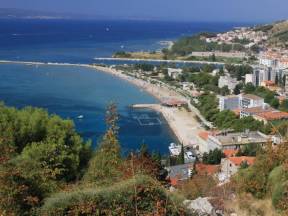
You are on the Omiš coast, in the heart of central Dalmatia, where the Dinarides mountains drop sharply towards the Adriatic Sea. Here, the rugged terrain and Mediterranean climate meet in a place known for its steep cliffs, numerous coves and beaches, all surrounded by mountain ranges that create the distinctive appearance of the coast.
Omiš is located right at the mouth of the Cetina River, which shapes the coast and creates natural canyons and harbors. This makes this area ideal for activities such as rafting on the Cetina, climbing the surrounding rocks and hiking, but also for swimming on the pebble beaches.
A new Omiš bypass has been built along the coast itself, with a bridge almost 225 meters long, which rises 70 meters above the Cetina River. This bridge has significantly relieved traffic through the city center, especially in summer, and has enabled faster connections with the surrounding area.
The waters of this area are home to numerous protected species, and it is interesting that in the Cetina River you can find an endemic species of trout – the Cetina trout, which lives nowhere else in the world.
The Omiš coast is rich in historical monuments: the old city walls, fortresses and towers testify to the turbulent past and the importance of this region in the conflicts between the Venetian Republic and the Ottoman Empire. Of particular interest is the Mirabela fortress, which offers a view of the entire city and the Cetina estuary, and once served as an observation post for the pirates for whom Omiš is famous.
You are in the area of the Franciscan Monastery of Our Lady of Mount Carmel in Omiš, a place that preserves more than three hundred years of interesting history. The monastery was founded by the Franciscans in 1715, after they had to flee from Prološki Blato near Imotski due to Turkish incursions. The journey to Omiš was not easy: the friars first stayed temporarily in Rogoznica, and only then reached Omiš, where the citizens and authorities welcomed them. They spent the first two years outside the city walls, and in 1716 they began building a monastery in Skalice, on land generously given to them by local owners. Interestingly, one of them, Jakov Mariani, made the donation of the land conditional on the Franciscans holding two masses for his deceased every year in perpetuity.
The Church of Our Lady of Mount Carmel, built according to the designs of the Split master Petar Bilinić, was completed in 1770. Over the centuries, it has undergone numerous alterations, including the renovation of the interior and the installation of new altars in the early 20th century. The church also houses a small Gothic statue of Our Lady from the 15th century, which was venerated even before the arrival of the Franciscans. The organ was installed in 1792, and the bell tower was renovated in 2014.
The monastery preserves a rich archive book bound in lambskin, written in Bosnian script, which describes the dramatic escape of the friars from Prološki Blato on 416 pages. Among the most valuable documents are 11 Venetian dukes and 46 Turkish documents, the oldest of which is from 1574. One Turkish document in particular stands out: it measures 58 x 42.5 cm, is decorated with gold frames and contains 20 signatures of the caliphs of the time, and experts believe that it also contains a prayer by Muhammad himself.
The library has more than 10,000 volumes, including rare incunabula and a valuable donation from Frank Radman in 1985. The Pinacoteca, opened in 1986, exhibits Baroque paintings and objects brought by the Franciscans from Prološki Blato, including liturgical textiles from the 17th and 18th centuries and paintings of Christ, Saint Jerome and other saints from the 18th century.
A special feature of this monastery are the caves dedicated to Our Lady of Lourdes and Our Lady of Fatima, which attract numerous pilgrims. Throughout history, the monastery was also known for its inn, where travelers and the poor received accommodation and food, and today it is a home for elderly and sick friars. Regular masses are held according to the summer and winter schedule, and although the official name is "Franciscan Monastery and Church in Skalice", in everyday speech the name Our Lady of Mount Carmel prevails.
One interesting fact: although the monastery was initially named after Saint Francis, and then after Saint Caius, the name Our Lady of Mount Carmel became established among the people in 1757 and has remained so to this day.
Church of Our Lady of Carmel
You are standing in front of the Church of Our Lady of Mount Carmel, which has been a silent witness to the turbulent history of Omiš for more than two centuries. This church, part of the Franciscan monastery in Skalice, was built in the 18th century, after the Franciscans from Prološac had to abandon their monastery due to the Ottoman threat. The first, smaller church on this site was built in 1618, and was expanded by the Omiš parish priest Jeronim Dešković ten years later.
The church owes its current appearance to the Split master Petar Bilinić and Petar Licini from Bol, according to whose designs the Baroque building was built. The main presbytery was completed in 1762, the Gothic ribbed vault was installed in 1766, and the entire construction was completed in 1770. What makes this church special is the organ by the Venetian master Gaetano Moscatelli from 1792, which was restored in 1996 and protected as a cultural monument. In front of the altar is a marble railing, the work of the sculptor Zefferino Grassi, and inside there are paintings from the 18th century: Christ, Our Lady of the Rosary, the Assumption of Mary, St. Jerome and others.
During the 20th century, the church underwent several renovations. At the beginning of the century, it was decorated by Fioravante Ravalico, and it is interesting that in 1978 the ceiling that he painted fell, after which the interior was returned to its original Gothic form. The church's collection contains Baroque works of art, old manuscripts and liturgical objects, and the monastery library also contains publications from the 16th and 17th centuries. The church was an important center of the Croatian national revival, where the Franciscans preserved the language and culture.
Situated in a panoramic position above the Cetina River and the Omiš Gate, the church is still a recognizable place of religious and cultural life in the city. Renovations in 2013 and 2014 restored the splendor of key parts, such as the triumphal arch and the bell tower, thus preserving its role as a living monument.
You may not have known: the monastery once housed an inn where the Franciscans received travelers and the poor, providing them with accommodation and food, and throughout history it was also a refuge for sick and infirm brothers. Today, in addition to the Franciscans, the monastery is also assisted by the Franciscan School Sisters from Split, which further testifies to the enduring humanitarian and spiritual role of this place.
If you are interested in more, the monastery keeps lists of relics, old books and Turkish documents, and books have been published that describe in detail the history and everyday life of the Franciscans in Skalice.
The Illyrian Seminary in Omiš was founded by the Archbishop of Split, Pacifik Bizza, in 1750 with a clear goal: to educate future Glagolitic priests who would celebrate mass in the Old Church Slavonic language. The building is located on Prik, directly opposite the pre-Romanesque Church of St. Peter, and it is interesting that it was built on the foundations of even older Benedictine and Franciscan monasteries.
The seminary operated until 1879 and was one of the few places where the Glagolitic tradition was systematically preserved and transmitted. At the entrance you will find a plaque from 1761, which marks the completion of the complex's decoration. The building itself bears recognizable late Baroque elements – the porch and facade immediately catch the eye, and such architecture was a rarity in Dalmatia at the time.
Today, part of the seminary has been converted into a chamber theater, while the rest is used for various cultural events, including performances at the famous Dalmatian Klapa Festival. The building is protected as an immovable cultural property, which further confirms its importance for the history and architecture of Omiš.
One interesting fact that many people do not know: it was precisely thanks to this seminary that Omiš was one of the key places in Dalmatia where the Glagolitic script and the Old Church Slavonic liturgy were preserved, despite the strong Turkish and Orthodox influences in the region. The seminary thus became a symbol of the Catholic Church's persistence in preserving national identity.
Starigrad Fortress (Fortica)
You are at the Starigrad Fortress, also known as Fortica, at the very top of the Omiš Dinara. From here, you can enjoy a view of the city of Omiš, the mouth of the Cetina River and the entire Brač Channel – it is clear why pirates and defenders chose it as their main fortress. The fortress was built in the late 14th or early 15th century, on the remains of even older settlements: the Illyrians lived here, and the Romans had their military stronghold. The first written record of Fortica dates back to 1443, and its history is marked by constant adaptations to new war threats, especially Ottoman attacks.
In the center of the fortress is a square tower with an observation terrace, and triangular bastions were added in the 16th century to house artillery. Inside is a courtyard with a cistern, the remains of the crew's quarters and a small chapel – everything that was needed to survive during sieges. The walls were built of local stone, about a meter thick, and still bear witness to the skill of medieval builders.
One of the most interesting details is the “stone avalanche plan”: large boulders were kept at the top of the fortress, ready to fall on enemies if they breached the defenses. Fortunately, this plan was never implemented, so the houses in Omiš have been preserved to this day. In case of danger, the people of Omiš fled the city and took refuge here, where they could track every movement of the enemy and warn others in time.
The fortress was repaired several times during the Candian War due to damage from storms and battles. In the 19th century, it was briefly under Napoleon's administration, and in the 20th century, it was rebuilt thanks to local volunteers and enthusiasts, without modern machinery - a real construction feat considering the inaccessibility of the cliff.
Today, Fortica is a protected cultural monument and a popular picnic spot. It offers one of the most beautiful views in Dalmatia: you can see Brač, Hvar, Šolta, the Cetina Canyon and the entire Poljica. If you are a history buff, it is interesting to know that part of the coat of arms of the Venetian Doge Nicola Marcello from 1474 was found, which confirms its importance in the Venetian-Turkish conflicts.
Another interesting fact: the fortress was the key reason why Omiš never fell under Ottoman rule, despite numerous attempts and attacks. If you are planning a visit, there is a well-marked trail leading to the Fortica, and the climb takes about an hour.
House of poet Jure Kaštelan
You are standing right in front of the house of Jure Kaštelan, one of the most important Croatian poets of the 20th century. Born in 1919 in Zakučac near Omiš, Kaštelan showed extraordinary curiosity as a young man – he first studied at the Split Classical Gymnasium, and then studied languages and literature in Zagreb. At the age of 21, he published a collection of poems called "Crveni konj", which immediately attracted attention due to its symbolism and existential themes, but also because it was soon banned by the authorities at the time.
When World War II began, Kaštelan joined the Partisans. His war experiences strongly shaped his poetry – the poem "Oj Mosore, Mosore" became a recognizable anthem of the Partisan movement. However, Kaštelan was not only a war poet; he managed to combine folk ballads and Mediterranean motifs with modern European styles, especially under the influence of Federico García Lorca, thus opening a completely new path for Croatian poetry.
His poem "Tifusari" is considered the pinnacle of Croatian war poetry – in it, in addition to the image of disease and war, the theme of freedom and love is also strongly present, which was new and brave at the time. It is interesting that Kaštelan was also an excellent translator.
After the war, Kaštelan did not remain only in literature – he taught at the Faculty of Philosophy in Zagreb, and for a time he was also a lector at the famous Sorbonne in Paris. He also participated in editing the Croatian edition of the Bible in 1968, which is a rare case for a poet of his rank to embark on such a large project.
Perhaps most interesting: Kaštelan was one of the signatories of the Novi Sad Agreement on a Common Language in 1954, which later caused numerous discussions and criticisms, especially in the context of language policy.
Today, a high school in Omiš bears his name, and memorial plaques have been erected in Zakučac and Omiš. His poems still live on, especially among those who seek images of the Cetina, Mosor and the Omiš region in his verses. Kaštelan remained a symbol of Mediterranean literature and a man whose verses are forever connected to the landscape and history of Dalmatia.
One interesting fact for the end: Kaštelan, in addition to poetry, occasionally wrote prose and essays, and was also known for always giving support and advice to young poets, believing that literature is alive only if it is constantly changing and opening up to new voices.
Church of St. Peter on Priko
You are standing in front of the Church of St. Peter on Priko, one of the most important ancient Croatian buildings in Omiš, built in the 9th or 10th century. This church stands on the right bank of the Cetina River, and was first officially mentioned in 1074, in a document of King Slavac. Interestingly, the church was built on the site of an even older early Christian building, which means that this place is a witness to a thousand years of history.
Over the centuries, the church has undergone numerous changes. In the 16th century, a Franciscan monastery was built next to it, but it was soon abandoned. In the 18th century, the interior was renovated in the Baroque style, with a new altar. From 1750 to 1879, a Glagolitic seminary operated here, where priests were educated in the Old Church Slavonic language, which is a rarity even for Croatian churches.
The architecture of the church shows typical pre-Romanesque elements: it is single-nave, with a semicircular apse and a dome on pendentives. The outer walls are divided by shallow lesenes, and the windows are decorated with stone lattices called transenes. It is particularly interesting that parts of an even older church from the 6th century were used in the construction, such as stone pilasters decorated with acanthus leaf motifs.
The church also contains a stone sarcophagus from the 11th century, which is now used as an altar table. It is assumed that it is associated with Peter the Black, which gives this place additional historical weight. During the 20th century, the church was often affected by floods, because the construction of surrounding buildings prevented the natural drainage of water towards the Cetina River, so worship had to be moved to another location.
In 1999, the church of St. Peter's Church became the center of the newly formed parish, but due to constant problems with moisture, a prefabricated metal church, known as the "tin church", was built in 2000, which served as a temporary solution. Only recently was a modern church with a pastoral center completed, designed by Dinko Brkljačić, and the new building covers 450 m² and has multifunctional spaces for various parish activities.
One interesting fact: on fragments of the altar railing, a record was found that the church was built by the Cetina prefect Gastika in honor of his mother and sons, which is a rare example of a personal dedicatory inscription from that time.
You are six kilometers from Omiš, at the site of Radman's mills, hidden in the canyon of the Cetina River, where water has powered mill wheels for centuries. The first mill was built here in the 18th century, and everything took on a new look in the mid-19th century, when the Radman family – who had fled Bosnia due to the conflict with the Ottomans – transformed the property into a country estate. It was then that this place became an important economic and cultural center, with gardens and country houses that attracted people from the surrounding area.
Today, Radman's mills offers much more than history. The 12,000 m² complex consists of authentic stone buildings, mill canals and bridges, all surrounded by Mediterranean greenery and the clear flow of the Cetina River. The restaurant within the mill is famous for its traditional Dalmatian dishes – homemade bread under a baking oven, Poljica soparnik and scampi on buzara are just some of the specialties you can try here. It is especially interesting that numerous outdoor activities are organized here - from rafting and boat rides to hiking and zip-lining. If you are a nature lover or looking for a bit of adrenaline, this is the right place for you.
In addition, Radman's mills is also a gathering place - picnics, cultural events and the famous Dalmatian Klapa Festival are held here. Interestingly, in the 1960s, the old mills were converted into a catering business, and at the end of the 20th century they became one of the most popular excursion destinations in Dalmatia. Many do not know that between 1962 and 1969, Radman's mills was a film set for the filming of the series about the famous Indian Winnetou, which makes this place even more special.
Another interesting fact: the Radman family, after whom the mills are named, comes from Bosnian nobility, and their art collection is now part of private and public collections. The road leading to the mills was built in 1925 and was part of the former route of the "Emperor Franz Joseph's Road".
Although Radman's Mills are not officially protected cultural property, they are a symbol of the combination of natural beauty and historical heritage of Omiš.
The Diocletian's Trail in Omiš is a real treat for anyone who loves history and nature. Although it is named after the Roman emperor Diocletian, famous for his magnificent palace in Split, this trail is not only related to Split - it takes you through picturesque areas near Omiš, where history and nature intertwine at every turn. It is part of the Perun circular trail, with a total length of about 14.5 kilometers, which connects Split, Žrnovnica and Srinjine, and also covers parts of the Omiš hinterland.
As you walk along this trail, you will be greeted by views of the mighty Omiš Dinara and the Adriatic Sea, as well as historical sites that hide traces of pirates and the medieval defense systems of Omiš. Interestingly, this is the area where the Omiš pirates once operated, known for their fortresses and cunning defense solutions, and some of these fortresses can still be seen along the trail today.
In addition to natural beauty, the Diocletian's Trail offers the opportunity to experience a rich cultural heritage, outdoor recreation and historical stories that have shaped this region in one place. If you like exploring old fortifications and observing the remains of times gone by, this trail is ideal - along the way you can also discover lesser-known churches and the remains of medieval walls that are not always on tourist maps, but hide numerous interesting things for curious walkers.
Another interesting fact: on parts of the trail you can find old Roman roads, which confirms how important this area was throughout history.
Roman bridge on the Cetina River
You are on the bridge near Han on the Cetina, where an important trade route from Salona to the interior of Dalmatia ran in Roman times. Here, the Cetina River was an obstacle, and the bridge allowed safe passage for people and goods, making this area a key traffic point in the ancient world. Only about two hundred meters away is the current stone bridge from the 19th century, but it is at this location, known as Mostine, that the remains of the Roman bridge are still visible.
Traces of Roman residential and farm buildings have been found nearby, as well as a workshop for making tiles and bricks, which shows how economically vibrant this place was in Roman times. The bridge has survived the centuries – it was also used in the Middle Ages, and the Turks probably renovated or expanded it on the Roman foundations. Interestingly, a han, or inn with an inn, was also built next to the bridge during the Ottoman period, which is why the place was named Han. The travel writer Evliya Çelebi wrote in 1660 that the bridge had seven shafts and two towers with iron gates.
The bridge near Han was part of the Roman limes, a defensive system that protected settlements and controlled traffic along the Cetina. Its location and function testify to how important the Cetina was as a traffic and economic artery throughout history. Another interesting fact: a stone hand wedge from the Paleolithic era was found in this area, which means that people were here as early as 35,000 years ago.
You are in the sanctuary of Saint Leopold Bogdan Mandić in Zakučac, a small town near Omiš. It was built on the site of the family of Saint Leopold, whose ancestors bore the surname Mandić and lived in this area before moving to Herceg Novi, where the saint was born in 1866. The initiative to build the sanctuary was launched by Archbishop Antun Jurić in the late 1990s, and it was officially opened in 2000, on the eve of the Great Jubilee of the Catholic Church.
You are also at the foot of Mount Mosor, in the immediate vicinity of the source of the Cetina River and the Ilinac waterfalls. The central part of the sanctuary consists of a stone chapel carved into the rock, which houses the relics of Saint Leopold. The interior of the chapel is adorned with a bronze statue of the saint and a relief made of silver, the work of academic sculptor Kažimir Hrast. In the immediate vicinity of the sanctuary, a stone cross more than eight meters high, the work of architect Ivo Buljević, has been erected.
The place is regularly visited by pilgrims from various parts of Croatia, especially on the feast of Saint Leopold on May 12. The sanctuary is also known for the Stations of the Cross for young people, which is traditionally held on Palm Sunday. Spiritual activities and liturgical celebrations are managed by the Parish of St. Peter the Apostle from Omiš. There is also an educational hiking trail near the sanctuary and a culturally significant point – the statue of Mile Gojsalić, a work of Ivan Meštrović.
The sanctuary in Zakučec combines religious and cultural heritage with the natural environment and represents an important point of the spiritual and historical identity of this part of Dalmatia.
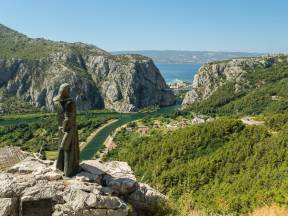
While you enjoy the most beautiful view of Omiš, we will tell you the story of Mila Gojsalić, who was a legendary heroine from the 16th century, known for her heroic act in the fight against the Ottoman invaders. According to folk legend, she came from the village of Kostanje in Poljica, and during one of the Ottoman attacks on the Poljica Republic, she managed to sneak into a Turkish camp and plant explosives there, sacrificing her own life. Her act caused confusion and the withdrawal of the Turkish army, and has since been celebrated as a symbol of courage and patriotism.
In honor of her sacrifice, the Croatian sculptor Ivan Meštrović created a monumental statue of Mila Gojsalić, which is placed above Zakučac, on a cliff overlooking the Cetina River canyon and the city of Omiš. The statue depicts Mila in a moment of determination and sacrifice, facing the area where the Turkish camp once stood. It is considered one of Meštrović's most impressive outdoor works and a powerful symbol of female strength, freedom and resistance.