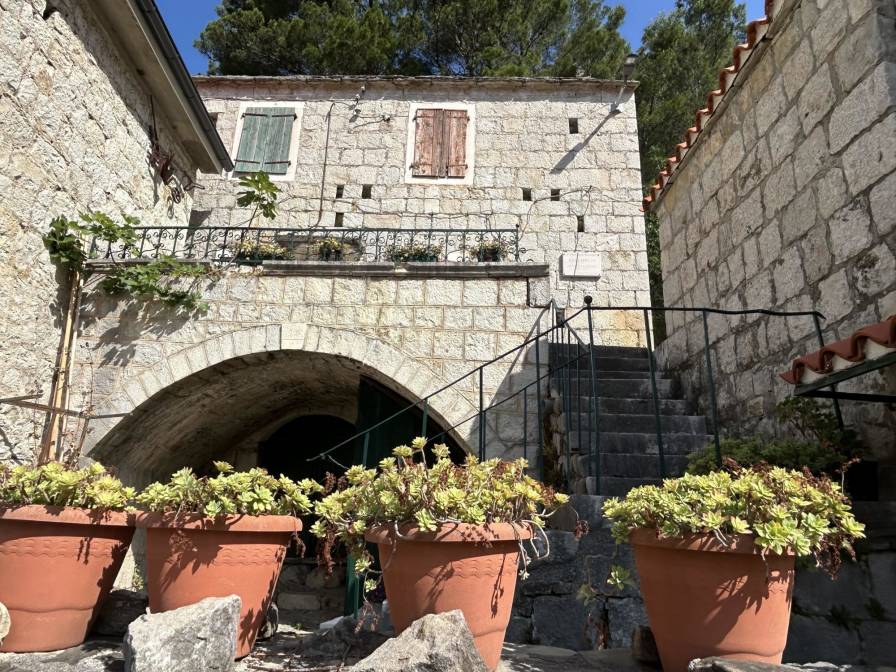
House of poet Jure Kaštelan
You are standing right in front of the house of Jure Kaštelan, one of the most important Croatian poets of the 20th century. Born in 1919 in Zakučac near Omiš, Kaštelan showed extraordinary curiosity as a young man – he first studied at the Split Classical Gymnasium, and then studied languages and literature in Zagreb. At the age of 21, he published a collection of poems called "Crveni konj", which immediately attracted attention due to its symbolism and existential themes, but also because it was soon banned by the authorities at the time. When World War II began, Kaštelan joined the Partisans. His war experiences strongly shaped his poetry – the poem "Oj Mosore, Mosore" became a recognizable anthem of the Partisan movement. However, Kaštelan was not only a war poet; he managed to combine folk ballads and Mediterranean motifs with modern European styles, especially under the influence of Federico García Lorca, thus opening a completely new path for Croatian poetry. His poem "Tifusari" is considered the pinnacle of Croatian war poetry – in it, in addition to the image of disease and war, the theme of freedom and love is also strongly present, which was new and brave at the time. It is interesting that Kaštelan was also an excellent translator. After the war, Kaštelan did not remain only in literature – he taught at the Faculty of Philosophy in Zagreb, and for a time he was also a lector at the famous Sorbonne in Paris. He also participated in editing the Croatian edition of the Bible in 1968, which is a rare case for a poet of his rank to embark on such a large project. Perhaps most interesting: Kaštelan was one of the signatories of the Novi Sad Agreement on a Common Language in 1954, which later caused numerous discussions and criticisms, especially in the context of language policy. Today, a high school in Omiš bears his name, and memorial plaques have been erected in Zakučac and Omiš. His poems still live on, especially among those who seek images of the Cetina, Mosor and the Omiš region in his verses. Kaštelan remained a symbol of Mediterranean literature and a man whose verses are forever connected to the landscape and history of Dalmatia. One interesting fact for the end: Kaštelan, in addition to poetry, occasionally wrote prose and essays, and was also known for always giving support and advice to young poets, believing that literature is alive only if it is constantly changing and opening up to new voices.