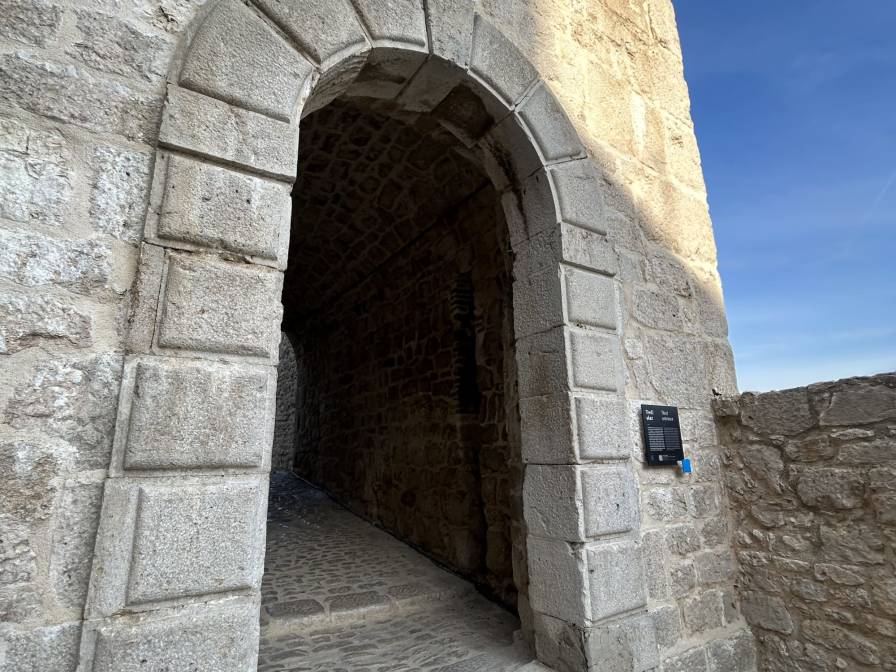
Third entrance
0
Entering through the third entrance, you will step into its most elevated and most important defensive part – the central complex that rises high above all other defensive lines. This area represents the final point of defense, the last line of resistance that has never, at any historical moment, fallen under enemy rule. Its dominant position provided complete control over the entire fortress, approaches from the hinterland and a view of the coast, making it a key point in any military defense strategy for Klis. The historical importance of this part of the fortress goes deep. Before the medieval walls shaped the landscape, there was an Illyrian hillfort here, evidence of the early settlement and strategic importance of this location. During the Roman Empire, a castrum – a military camp that served to control the gorge-like passage between the coast and the interior – was built on the same site. On its foundations, in the early Middle Ages, one of the first ancient Croatian fortresses rose – the seat of the Primorje County and an important stronghold of Croatian national rulers, including rulers from the Trpimirović dynasty. Before entering the inner defensive circle, visitors are greeted by a smaller defensive vestibule, the walls of which hide narrow loopholes – silent witnesses to the sieges and battles that were fought here. This space was the first point of resistance in the event of an enemy breakthrough, and it provided a defensive advantage in decisive moments of the conflict. During the Uskok era, during the 16th century, retreating to this part of the fortress meant that the fight had reached its most critical phase. But for the Uskok, surrender was not an option. Driven from their homes after the Ottoman conquests, the Uskok vowed to resist. They focused their fight on returning to their own homes and defending their faith, people and land. They gathered here, in Klis, and in Senj – another major Uskok center – under the command of the tireless captain Petar Kružić. The Uskoks were warriors of a special kind. Their devotion to the Christian faith and the Pope, but also their deep attachment to the Croatian people, gave them fearless strength. Skilled in battle, persistent, resourceful and often guerrilla-like, they attacked the Ottomans at moments when they least expected it – under cover of night, in a storm, suddenly and precisely. Their fighting ability and unwavering determination posed a serious threat to the expansion of the Ottoman Empire towards Western Europe.