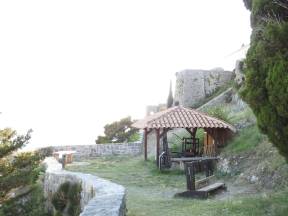
You are standing in front of the statue of Petar Kružić, one of the most prominent Croatian military leaders of the 16th century. This statue, located inside the Klis Fortress, is the work of sculptor Duje Matetić, a student at the Academy of Arts in Split. It was discovered in 2016 as a plaster model, and is planned to be cast in bronze.
Petar Kružić was a brave military leader and captain of the Klis Fortress who defended the city from the Ottoman Empire for almost 25 years. He is famous for having managed to break through the Ottoman siege in 1524 and save the fortress, gathering help from Senj and other regions. Despite the difficulties, the lack of help from the king, and constant attacks, Kružić tirelessly defended Klis and the surrounding areas, becoming a symbol of resistance. His death in 1537 marked the end of the long-term defense, but his courage is still celebrated today as a key part of the history of Klis and Croatia. After his death, his body was buried in the Chapel of St. Peter on Trsat, while his head was later purchased and placed next to his body.
Superiore/ Oprah Tower location
You are standing near Oprah Tower - where the HBO series Game of Thrones filmed scenes depicting Meereen, a key location in the story of Daenerys Targaryen. Oprah Tower is round in shape and was the main defensive stronghold of the western part. It was first mentioned in the report of Paul III Šubić in 1355 under the name Oprack. During the Ottoman period, the tower was known as Pasha's Tower. In the mid-17th century, the Venetians gave it the fortification name Torretta, which was later used by the Austrians. However, the tower has retained its original Croatian name Oprah throughout, which is still used today. In the series Game of Thrones, Oprah Tower served as the setting for the city of Meereen.
The scene in which Daenerys Targaryen confronts the rebels in Meereen (and makes decisions about how she will govern the city) uses Oprah Tower as a backdrop to show the exterior of the city. It is a moment when Daenerys, in order to maintain order and authority, must decide how to deal with those who rebelled against her rule.
Therefore, today visitors can tour the fortress and walk the path that Tyrion and Varys took, experience the atmosphere that has delighted millions of viewers around the world and feel a connection to one of the most famous moments of Game of Thrones.
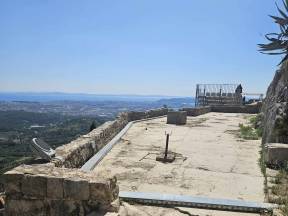
As you stand on this stone plateau within the walls of Klis Fortress, you are looking out over what HBO has transformed into a famous location called Dragon’s Landing – the backdrop for the city of Meereen from the world-famous series *Game of Thrones*. After the series was filmed, this historic site was no longer just a medieval fortress above Split. It became the home of Daenerys Targaryen, the Mother of Dragons, and the scene of her attempt to free the slaves in the eastern lands of Westeros.
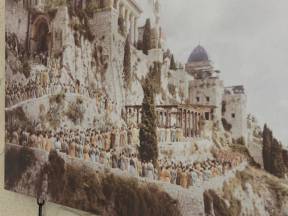
The production of the series arrived in Klis in 2013, during the preparations for the fourth season. The directors and set designers were looking for a location that exuded an oriental atmosphere, with rustic architecture, stone walls and dramatic views – and they found it right here. This part of the fortress was transformed into the main square of Meereen, where the famous scene of the crucifixion of the slave owners was filmed as a warning, when Daenerys takes over the city and begins her reign.
The film crew transformed this area into a set without any major structural interventions – they used the existing walls, courtyards and passages. Only details were added: flags, sculptures and props that gave Klis Fortress the appearance of an exotic capital. The cast, led by Emilia Clarke, filmed some of the key shots right here, while dragons – with the help of CGI effects – flew above these walls.
Today, when you step onto these stone slabs, you may not see dragons in the sky, but you will feel the same breath of drama.
The cisterns in the Klis Fortress were not just ordinary stone pits – they were the heart of the soldiers’ daily life and defense. Without them, the fortress would quickly be without its most important resource: water. The rainwater that collected in these underground tanks was the only way to survive, as there were no springs or opportunities to dig wells nearby. For this reason, the cisterns were strategically placed in places where they would be most needed during a siege, and their construction began in the Middle Ages and continued through the Ottoman and Venetian periods, when they were further improved and expanded.
It is particularly interesting that there were as many as seven cisterns in the fortress, each adapted to the terrain and architecture of the fortress. Some were dug deep underground to keep the water cool and protected, while others had special channels to direct rainwater from all parts of the fortress. In the eastern part of the fortress there is a cistern from the early Venetian period, which was crucial for the introduction of the water supply system.
During sieges, when attackers tried to cut off all external water sources, the cisterns literally became a matter of life and death. The canal systems were so well designed that they channeled rainwater from the entire area straight into the tanks, preserving every precious drop. If the water ran out, the defenders would be forced to surrender – which is why the cisterns were often the first thing attackers would try to destroy.
One of the interesting features is the Turkish fountain, now known as the “Three Kings”, located at the foot of the fortress. It is still in use, and its construction is connected to Islamic customs and daily religious rituals, where water had a special importance. This fountain, like the cisterns, is a testament to how precious water was and how engineering solutions from the past enabled Klis Fortress to withstand numerous sieges and remain a symbol of resilience throughout the centuries.
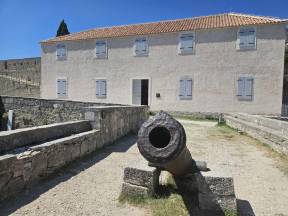
You are standing at Šperun position, the easternmost part of the third defensive wall of this fortress. Here once stretched a narrow bow with a strategic view of the surrounding areas, including the Ozrna hill on Mosor and the road leading north through the gorge at the foot of the cliff. This position had a key function, as it enabled surveillance and defense from the eastern side of the fortress.
Before the Venetian siege, a tall square-shaped tower stood on this site, which was of essential importance for the defense. Unfortunately, during the Venetian siege of the fortress, the tower was severely damaged and later demolished. However, in the 18th century, when the defenses were re-established, a plateau was built on this site. On its eastern side, a wall with a gate was built that allowed the cannon to be taken out, placing it on top of the bow of the position. Thus, the cannon could be used to defend the eastern part of the fortress, which was crucial in ensuring its security during sieges.
Today, although the high battlements and other defensive features, such as the northern parapet, have almost completely disappeared, the low parapets and loopholes that remain are evidence of the function of this position. The keep was a protective position, and the view you can enjoy today clearly shows how important this position was to all those who guarded the fortress.
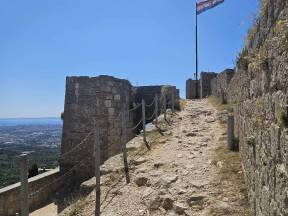
One last interesting fact - for fans of the series "Game of Thrones", the keep was the backdrop for the scene of the entrance to the city of Meereen. Although most of the city walls in the series were created with computer graphics, the real walls and stone paths of the keep served as an authentic backdrop for these scenes.
You are standing right in the place that was the brain and heart of the defense of Dalmatia – the Maggiore position on the Klis fortress. The name Maggiore comes from the Italian word for “chief”, and it is no coincidence – from this place the entire fortress was commanded and every movement of the enemy was monitored.
The Maggiore position was much more than an ordinary guardhouse. Equipped with cannons and thick stone walls, it had special rooms for commanders and soldiers. From this point, the view opens onto the Klis plain, the mountains and the coast, allowing the enemy to be spotted in time and the defense to be organized quickly. At a time when sieges could last for months, the Maggiore was crucial for the survival of the defenders.
In the 16th century, during the fiercest battles with the Ottomans, it was here that Petar Kružić and his Uskoks led a defense that withstood a superior enemy for decades. Every cannon fired from the Maggiore could change the course of the battle. After Kružić's death and the fall of the fortress in 1537, the Uskoks took the keys of the fortress with them to Senj, where they are still preserved as a historical memory.
The architecture of Maggiore is adapted to the irregular shape of the rock on which the fortress stands. The walls are thick, and the ramparts reach a height of nine meters. An arched passage passes under the position that leads to the eastern part of the fortress, which allowed for safe communication even under siege. In the northwest corner there is a large gunpowder storehouse, built by the Austrians in the 19th century - another proof of how important this place was in later periods.
One interesting fact that you may not have known: Klis Fortress was not only a military center, but also a place where quarantine facilities were located during epidemics in the past, which protected Split from diseases coming from the interior.
The New Powder Room at Klis Fortress was built in the 19th century during the Austrian, or Habsburg, rule, on the site of the former Venetian military quarters. For centuries, it served as a powder storage facility, which was one of the most important military functions within the fortress, as gunpowder was essential for artillery and defense. Its solid and secure construction allowed for the safe storage of explosives, protecting it from enemy attacks and accidents.
Interestingly, during World War II, this powder room took on a completely different role – it was converted into an Italian prison. At that time, Klis Fortress was under Italian occupation, and the powder room was used to detain prisoners of war and political opponents. This dark part of history is reminiscent of the turbulent events that gripped this area during the 20th century.
In addition to being a military warehouse and prison, the New Powder Room is part of the fortress’s complex fortification system, supported by the parapets of the Maggiore position and the Malpiero bastion. Its function and architecture are a typical example of military construction of that era, with a clearly defined purpose and strategic position within the defense complex.
You are in the central part of the fortress, which is connected to the Bembo bastion and the Maggiore position. It was built during the Venetian renovation of the fortress in the 17th century, when the Venetians adapted the fortress to new military technologies and artillery, transforming it into a modern bastion fortress.
This pentagonal bastion is surrounded by high parapets with narrow openings for cannons, which allowed for strong defense and effective shooting of the enemy from the approaches to the fortress. Below the bastion is an arched passage leading to the eastern Maggiore position, which allowed for quick communication and movement of defenders within the fortress.
This was an important artillery position from which the defenders could monitor the approaches from the south and southeast, the directions from which enemy forces most often approached. Its solid construction and strategic position made it one of the most important defensive elements of the fortress during the Venetian rule.
It is interesting to know that the Malipiero bastion was part of a complex defense system that allowed the Croats to effectively defend themselves and coordinate attacks, using artillery and well-designed passages. Its architecture testifies to changes in military technology and the fortress's adaptation to new threats during the 17th century.
The place where you are is known as the largest artillery position in the entire fortress complex. It was named after Marco Bembo, the first governor of Klis, and the current form of the bastion dates back to the mid-17th century, when it was built on the site of the former Kružić Tower.
Bembo Bastion represents the pinnacle of the fortification architecture of Klis Fortress, whose development was conditioned by complex historical circumstances and the need to defend against increasingly powerful enemies, especially the Ottoman Empire. While Klis Fortress went through numerous phases of construction and renovation over the centuries, Bembo is a symbol of technical and strategic progress in the design of defensive structures of that era.
Architecturally, Bembo is a polygonal bastion, with massive stone walls that are up to several meters thick in some parts. Its construction was adapted to accommodate a large number of cannons, which allowed for powerful fire at the enemy from different directions. High parapets protected the defenders from enemy missiles, while wide corridors and rooms within the bastion served to accommodate soldiers, store ammunition and weapons, and coordinate defense.
The position of the Bembo bastion on the western side of the fortress was strategically extremely important because it controlled access to the Klis Plain and the main roads leading to the interior of Dalmatia. From this location, the defenders could effectively monitor and defend the approaches to the fortress, preventing the enemy from penetrating deeper into the territory. During centuries of conflict, especially in the 16th and 17th centuries, Bembo was a key position in the defense of the fortress from Ottoman and other attacks.
Historically, the Bembo bastion was created as a result of the need to modernize the fortress at a time when firearms and artillery were becoming dominant in warfare. The construction of the bastion in the middle of the 17th century was part of a wider project for the fortification of the Klis fortress in accordance with the principles of bastion fortification, which enabled better coverage by fire and the reduction of dead zones in defense.
Inside the bastion were rooms for the accommodation of soldiers, storage for gunpowder and ammunition, as well as work rooms for the maintenance of weapons. This complex infrastructure enabled the long-term defense of the fortress even during months-long sieges, which was of crucial importance in the turbulent times of the Ottoman-Venetian conflicts.
Before you is the Church of St. Vitus – modest in size, but great in historical significance. This building, located between the Bembo and Malipiero bastions, has gone through a journey – from an ancient Croatian church, through an Ottoman mosque, and all the way to the present-day Catholic church.
In the 9th century, the Croats built a pre-Romanesque church on this site, probably already during the time of Prince Trpimir. Its remains are still clearly visible today in the floor of the southern part of the present-day church. However, with the arrival of the Ottomans in 1537, the church was demolished and the foundations buried. The Turks built a mosque here, as an endowment of Murat-beg Tardić – the commander who captured Klis. It was a simple but solid building, with a dome and a minaret, one of the rare Islamic buildings in Dalmatia.
When the Venetians captured Klis in 1648, the mosque was transformed into a church. The first mass was celebrated on captured Turkish banners, and General Foscolo was present – kneeling, as a sign of gratitude. A bell tower was added to the facade, and new furnishings were brought inside. A Baroque washbasin, brought from the Provindur's apartment, still stands inside today, alongside an elegant shell-shaped sprinkling bowl.
The interior of the church is rich in historical details. Parts of the altar partition from the old Croatian church have been preserved, including a marble fragment with the inscription "rex Croatorum filius" and "mea Domaslava regina". The phrase "rex Croatorum filius" means "King of the Croats, son (of the king)" and indicates that the man speaking in the inscription is the King of the Croats, the son of the previous king, which confirms his legitimacy and belonging to the ruling line. The phrase "mea Domaslava regina" means "my Queen Domaslava" and refers to the king's wife, a woman with the title of regina (queen). The name Domaslava was reconstructed based on the preserved parts of the inscription and is believed to be an unknown Croatian queen from the first half of the 10th century.
Also, a relief depicting Christ in glory from the 11th or 12th century was found. The interior of the church is characterized by a dome with trumpets, an octagonal drum and a tufa vault. The remains of the minaret, which was destroyed during the Venetian siege, have also been preserved.
The church later served as a military warehouse, but despite everything, it survived wars, decay and reconstruction. In the 20th century, its roof collapsed, but its splendor was restored with a renovation in 2005. Above the altar today stands a copy of the icon of the Mother of God, which the Uskoks took with them to Split, fleeing from the Turks. The original is kept in the Church of Our Lady of Dobrić, but this copy returns the spirit of past times to its original place.
The chaplain's apartment in the Klis fortress was much more than just a room; it was a place where the fate of the defenders, as well as their faith, was decided every day. Imagine a room modestly furnished, but always filled with quiet conversations, prayers and confidential confessions. Here, the Uskoks, tired of fighting, sought a moment of respite and gained strength for new challenges.
The chaplain was not just a priest – he was a support, a psychologist and a friend. Every morning, he gathered the soldiers and their families, held mass and prayers, and often it was his word that was crucial for maintaining morale during long sieges. Few people know that important documents and sometimes valuables of the fortress were also hidden in his apartment, because it was believed to be the safest place.
The apartment was located near the center of the fortress, close enough for the chaplain to respond quickly to any call for help, but also secluded enough to provide peace for reflection and prayer. This balance between the noise of battle and the silence of prayer was crucial – it was the chaplain’s presence that connected military courage and spiritual strength, creating an invisible shield around Klis.
One interesting fact: the chaplain was often the first to hear news from outside the fortress, as he was entrusted with messages and reports, knowing that he would guard them with special care. Thus, his apartment also became a silent link to the outside world, which was of great importance to the defenders of Klis.
The triple rampart was strategically important given the terrain and geographical position of Klis, this system was crucial for successfully repelling attacks. The ramparts were built to be oriented towards the most vulnerable parts, while being strong enough to withstand attacks from cannons, swords and other weapons of war. The triple rampart also had its own specific tasks. This defense system consists of three consecutive walls or ramparts, which are arranged in three different lines or phases of defense. The first rampart was the primary line of defense, while the second and third ramparts served as support in case the enemy broke through the first. Interestingly, the second and third ramparts were often lower and of lesser height, but they served as additional protective layers for the soldiers inside the fortress.
The greatest attack, which highlighted the importance of the triple rampart, was the siege of 1537, when the Ottomans tried to capture the fortress. During this siege, Klis was under extensive attacks, and the triple rampart provided protection. Although the Ottoman guns inflicted significant damage on the first lines of the ramparts, the second and third ramparts provided time for the organization and delivery of military aid.
At that moment, Klis was saved thanks to the tactics of retreating towards the higher lines of defense. The triple rampart allowed the defenders to retreat inside the fortress, and later the Venetians (who ruled the territory at the time) sent military aid and saved the fortress from Ottoman capture.
From the position of the Uskok Armory itself, a high staircase leads up to the upper, spacious part of the fortress. The entrance to this space had a simple arched shape, which was a common architectural detail of the time. Initially, this space served as the apartment of the weapons manager, the person responsible for the storage and distribution of weapons within the fortress. Later, this part of the fortress was renovated and used as accommodation for officers and soldiers, who stayed there during longer periods of combat readiness.
This upper space played an important role in the military organization of the fortress because it enabled surveillance, rapid coordination and readiness for defense, which further ensured the security of the entire complex.
The building in front of you was once a gunpowder storehouse, a key defense facility for the Klis Fortress. It was built by the Venetians in the early 18th century and renovated several times to keep it safe and functional. Interestingly, its vaulted structure with saddle arches was particularly strong, and the roof protected the interior from rain and wind.
The gunpowder stored here was the first explosive used by man in war. It was not only used to fire cannons and rifles, but the noise of the explosions also had a strong psychological effect on the enemy, creating panic and a sense of insecurity. Such tactics further increased the fortress's defensive power.
The gunpowder storehouse was carefully built and located in a safe place within the fortress, to avoid accidents and ensure a quick supply of weapons during battles.
The side tower of the Klis fortress once played a key defensive role as a guard for the entrance to the third part of the fortress. The entrance to this part led through the vestibule in front of the third gate, and the attacker was forced to cross a wooden bridge that connected the path to the side tower. This tower, located at the southeast corner of the entrance, was built in the mid-18th century and completed in 1763, as evidenced by the several phases of construction visible on its sloping walls.
In the event of an attack, the bridge would be raised, thus interrupting any attempt by the enemy to penetrate the fortress, leaving them exposed to the defenses of the tower. Thus, the side tower served as a strong defensive point, protecting the access to the third entrance and part of the Varoš settlement.
The third entrance, which was created in the Middle Ages, was part of the complex defense system of the Klis fortress, which consists of three fenced sections with separate entrances. The Venetians rebuilt it several times until the middle of the 18th century, and the last addition was made in 1763, at the same time as the side tower that guards it.
Thus, the side tower was not just an architectural addition, but a key element of the defense of the third part of the fortress, which, with the help of a movable bridge, enabled controlled access and efficient defense against enemy attacks.
The Uskok Armory in the Klis Fortress was a warehouse for weapons and ammunition, and today it is a space where replicas of Uskok uniforms, various weapons and depictions of the fortress through different historical periods are exhibited. This armory is a reminder of the long and turbulent history of the defense of Klis, a strategic fortress that was the key to the defense of Dalmatia for centuries.
The central figure of this defense was Petar Kružić, the Klis captain and prince, who led the Uskok for more than twenty years in the fight against the superior Ottoman army. Kružić was known for his perseverance and military skill, but also for the fact that he often had to seek help from European courts on his own, because there was little real support. He received most of his support from the Pope, who appreciated the courage of the Uskok and occasionally sent them aid.
In 1532, while Kružić was away seeking help in Rome, the Venetians seized the opportunity and, in agreement with the Ottomans, tried to take over Klis. Some of the defenders let them into the fortress, believing them to be allies, but they soon realized that the Venetians were collaborating with the enemy. The inhabitants of Klis expelled them, and Kružić returned with an army from Senj and, together with the defenders, managed to break the siege and defeat the Ottomans.
After the fall of Klis in 1537, the remaining Uskoks moved to Senj, where they continued the fight against the Ottomans and the Venetians, becoming known as the Senj Uskoks. Today, the historical unit "Kliški Uskoki" cherishes this tradition and organizes educational programs for visitors to the fortress.
Entering through the third entrance, you will step into its most elevated and most important defensive part – the central complex that rises high above all other defensive lines. This area represents the final point of defense, the last line of resistance that has never, at any historical moment, fallen under enemy rule. Its dominant position provided complete control over the entire fortress, approaches from the hinterland and a view of the coast, making it a key point in any military defense strategy for Klis.
The historical importance of this part of the fortress goes deep. Before the medieval walls shaped the landscape, there was an Illyrian hillfort here, evidence of the early settlement and strategic importance of this location. During the Roman Empire, a castrum – a military camp that served to control the gorge-like passage between the coast and the interior – was built on the same site. On its foundations, in the early Middle Ages, one of the first ancient Croatian fortresses rose – the seat of the Primorje County and an important stronghold of Croatian national rulers, including rulers from the Trpimirović dynasty.
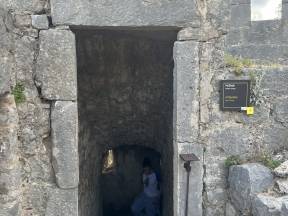
Before entering the inner defensive circle, visitors are greeted by a smaller defensive vestibule, the walls of which hide narrow loopholes – silent witnesses to the sieges and battles that were fought here. This space was the first point of resistance in the event of an enemy breakthrough, and it provided a defensive advantage in decisive moments of the conflict.
During the Uskok era, during the 16th century, retreating to this part of the fortress meant that the fight had reached its most critical phase. But for the Uskok, surrender was not an option. Driven from their homes after the Ottoman conquests, the Uskok vowed to resist. They focused their fight on returning to their own homes and defending their faith, people and land. They gathered here, in Klis, and in Senj – another major Uskok center – under the command of the tireless captain Petar Kružić.
The Uskoks were warriors of a special kind. Their devotion to the Christian faith and the Pope, but also their deep attachment to the Croatian people, gave them fearless strength. Skilled in battle, persistent, resourceful and often guerrilla-like, they attacked the Ottomans at moments when they least expected it – under cover of night, in a storm, suddenly and precisely. Their fighting ability and unwavering determination posed a serious threat to the expansion of the Ottoman Empire towards Western Europe.
Nearby is the Duke's House, also known as the Providur's Apartment. We are located on a rocky hill on the northern side of the weapons depot. Here, where this building now stands, in the past, rulers, captains, Turkish commanders, and later Venetian providurs settled.
This irregularly shaped building dates back to the Roman period, although its current appearance dates back to the Middle Ages. Over the years, the building has undergone several significant transformations. During Venetian rule, it was renovated in the mid-17th century, when it became the Providur's Apartment. At that time, it had an elongated shape, with a ground floor and an upper floor, and the roof was covered with tiles. The observation tower on the west side of the building served to monitor the surrounding area.
In the 18th century, the building was renovated again, and Venetian engineers removed the elevated western part of the facade. Although changes occurred over time, the building retained its importance as an administrative and military-historical center. On the west facade, you can still see the rectangular entrance, above which there were four symmetrically arranged windows.
Throughout history, the Governor's Apartment served various functions, and during the French rule it was also an administrative center. Later, under the rule of the Austrians, the building was thoroughly renovated. The conceived architectural plans included a semicircular arched entrance, and on its facade there is a plaque with an inscription from 1919.
Unfortunately, during and after World War II, the Governor's Apartment deteriorated significantly, and the roof and structure collapsed. However, at the beginning of the 21st century, the building underwent a complete renovation. Today, the ground floor houses an exhibition depicting the history of Klis, and above the new west facade rises a tower with an external staircase leading to the terrace.
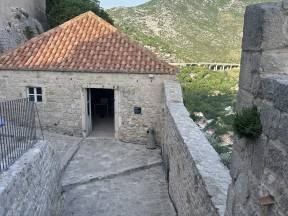
You are in the Mezzo position, better known as the middle position, which is located on the south side in front of the artillery barracks. During the Venetian rule, the guard building, two smaller residential buildings and a fortified entrance were located in this position. This entrance served for communication between the eastern and southern parts of the fortress and was of key importance for internal traffic and defense. However, at the beginning of the 18th century, this entrance was removed. The position of Mezzo was strategically important, as it enabled better access control and provided security to key parts of the fortress.
In the context of Game of Thrones, the concept of Mezzo Position has similarities to the strategic positions that power players occupy in the world of Westeros. Fortresses like Casterly Rock, Winterfell or The Red Keep often had these specific points from which the entrance to the fortress could be monitored or from which attacks and defense strategies were conducted. Like the Mezzo position, they allowed leaders to maintain the balance of power and ensure the defense of their territories.
Today, the Mezzo Position or Middle Position still holds significant historical value, although its function in the fortress's defensive system has disappeared. Part of the position also bears traces of Venetian buildings. Although no longer used in a military context, this area remains popular with visitors for its historical importance and insight into military architecture.
Scala Position was built in the 17th century, at a time when the Venetian Republic fortified Klis as a key point of defense against the Ottomans. It was not just an observation post – quick decisions were made here, messages were transmitted and control over the entire surrounding area was maintained. In the 19th century, during the Austro-Hungarian Empire, the position was further strengthened and used militarily until the end of World War I.
Interestingly, Klis has been an unavoidable military and trade crossroads since ancient times. The Illyrians built their first fortress on this site, then the Romans built their castrum, and the Croats had their kings' seat here in the Middle Ages. Klis was so important that it was called the "key to Dalmatia" and the "heart of the Croatian kingdom". Throughout history, the fortress has changed masters – from the Illyrians, Romans, Croats, Ottomans, Venetians, Austrians, and all the way to present-day Croatia.
At the heart of the fortress, this forge was a vital center for military production and maintenance of weapons. This workshop was where, under the tireless blows of hammers and with the help of fire, key parts of weapons and equipment were shaped, without which the fortress could not withstand long-term sieges and frequent military conflicts.
The forge was equipped with furnaces for heating metal, anvils, hammers and other tools necessary for processing iron and steel. Blacksmiths made and repaired a wide range of weapons there – from cold weapons such as swords, spears and axes to parts of firearms, including cannons, rifles and other mechanisms for shooting enemies. In addition to weapons, blacksmiths made and maintained door fittings, chains, catapult frames and other parts of the fortress’s defense systems.
Work in the forge was extremely demanding and technically complex. Blacksmiths had to have knowledge of metallurgy and the skill of shaping metal, but also speed and precision, because during sieges every moment was precious. Maintaining weapons and equipment was crucial to the survival of the defenders, and the forge allowed damaged parts to be quickly repaired or replaced with new ones without the need for external supplies, which was often impossible due to enemy blockades.
The forge's location within the fortress allowed for the efficient distribution of finished products to soldiers on the front lines of defense. During the most intense conflicts, such as the sieges led by Captain Petar Kružić in the 16th century, the forge operated almost continuously, ensuring that the defenders had functional weapons and equipment needed to defend the fortress.
Today, although the forge as a working space no longer exists in its original form, its role in the history of Klis Fortress is recognized as an important part of the military and technical heritage of the area.
You are standing in front of the second entrance to the Klis fortress, which, although today is called the "second entrance", was the main and first access to the fortress in the Middle Ages. This entrance, located on the western side of the fortress, led to the heart of the then Croatian state - the political and military center of the Trpimirović dynasty. For centuries, princes, kings, soldiers, diplomats and pilgrims entered through it, and the area in front of the gate witnessed many key moments in Croatian history.
The first historical record in which Klis is directly mentioned is in the Donation of Prince Trpimir from 852, where the fortress is referred to as "curte nostra que Clissa dicitur" - "our court called Klis". This confirms that this was the place where Prince Trpimir, after whom his dynasty - the Trpimirovićs - was named, lived. This historical document not only marks the importance of Klis in the early medieval Croatian state, but also confirms its role as a central place of royal power and political stability in the early Middle Ages.
The entrance itself, as we know it today, changed its appearance over time. During the Ottoman siege of 1648, when Venetian and Ottoman forces fought for supremacy over Dalmatia, this entrance was severely damaged. Due to the powerful artillery attack of the battles of that time, a significant part of the walls and defensive structures was destroyed. However, after the Venetians took control of the fortress the same year, they quickly began to restore the medieval parts, aware of its key strategic and symbolic value.
The second entrance, in addition to the restoration of the walls, also received a new terrace at the top – a kind of observation post and defensive plateau from which it was possible to monitor the arrival from the interior to the coast. This space allowed the guard to notice the danger in time, but also served for the daily management of traffic towards the fortress. The terrace above the entrance dominates the surrounding landscape, and offers a wide view of the mountains, Klis and Split, making this a key point for defense.
The second entrance is reached by a steep, paved path that was built in the 1930s. Although the current configuration of the access is not identical to that of the medieval period, its steepness and position faithfully reflect the logic of defensive architecture. The difficult and controlled approach slowed down the movement of enemy forces, while allowing the defenders a superior position.
Welcome to Megdan, a settlement located to the northwest of the Klis Fortress. Today, it is a peaceful part of Klis, but its name and the legends that accompany it remind us of the turbulent past of this region.
The name Megdan comes from the Turkish language, and means battlefield or place of duel. The name is no coincidence – this area has been the scene of conflicts between Uskoks and Ottoman soldiers for centuries, especially in the 16th century, when the Klis Fortress was an important defensive center.
According to local tradition, individual duels were also fought here, the most famous of which is the one from 1527. Legend has it that the Uskok Miloš Parižević, after making a vow to the Mother of God on Trsat, defeated the Turkish warrior Bakota. As a sign of gratitude, he donated to the church a candlestick as tall as his opponent, so large that it supposedly had to be carried by four men. Although historical sources about this event do not exist, the story still lives on among the locals today.
In the Middle Ages, the area below the fortress was an important part of the settlement. The oldest parts of Megdan are located on the slopes below the fortress, where it gradually developed along the old center of Klis – Varoš. After the liberation of Klis from the Ottomans in 1648, many buildings from the Turkish era were destroyed, but examples of old folk architecture can still be seen today.
At the beginning of the 20th century, the narrow-gauge railway Split–Sinj passed through Klis (1903), and a railway station known as Štacija was built next to it. Today, this stone building has been converted into a residential building, while the stone viaduct, which once carried trains, has been converted for road traffic.
Megdan was also the place where the first elementary school in Klis began operating in 1832. Classes were initially held in private houses in Megdan and Varoš, which testifies to the importance of this part of the settlement for the cultural and social life of Klis.
Welcome to the Walk of Punishment, one of the most striking locations from the Game of Thrones series. Although it is a fictional location in the city of Astapor on the continent of Essos, this place carries strong symbolism - it shows how power can be expressed not only through weapons, but also through control, silence and humiliation.
In the story, the Walk of Punishment is the street through which slaves who have been punished or sentenced to death pass. Their suffering is exposed to everyone - as a warning and a tool of fear. There are no swords or armies; just a cold display of power through public humiliation. It is a place where destinies are not shaped by battles, but by looks and orders, where every gesture carries the weight of a political message.
Interestingly, the episode titled “Walk of Punishment” (Season 3, Episode 3) refers not only to that place, but also symbolically to the entire episode – to the quiet forms of power and the consequences of humility experienced by various characters throughout Westeros and Essos.
One of the most striking displays of “quiet power” in the episode occurs far from Astapor, in King’s Landing, when Tywin Lannister convenes the Kings Council. There is no blood or harsh words in this scene – just the shifting of chairs. Whoever sits closer to Tywin has more power; whoever sits further away loses influence. This simple gesture becomes a perfect metaphor for politics in Westeros – where battles are often won without the sword, but with deliberate moves.
The scenes from Astapor, including the Walk of Punishment, were filmed on authentic locations in Croatia, primarily in Split (Diocletian’s Palace) and Dubrovnik, whose historic architecture served as an ideal backdrop for the world of power, slavery and intrigue. The stone and streets of these cities evoke the weight and dignity that Game of Thrones successfully conveys on screen.
Through this space, Game of Thrones perfectly demonstrates that power is not always loud. Often it is quiet, subtle, but equally powerful. Walk of Punishment shows how politics can be shaped not only by words, but also by gestures, by placing people in certain places and simply by changing their seats.
The vast area inside the fortress, where the summer stage is now located, was once home to an infantry barracks. This is where most of the soldiers stayed, while smaller contingents were stationed in other parts of the fortress or in houses outside. During the Middle Ages, the fortress was ruled by powerful noble families from southern Croatia, such as the Nelipićs, Svačićs and Šubićs, who exercised power and maintained order in this strategically important area on behalf of the king.
During the 13th, 14th and 15th centuries, Klis was the scene of numerous struggles for supremacy between different noble families, which further increased its military importance. At that time, the fortress was a key point of defense against Ottoman incursions, and its military garrison was constantly on standby.
Today, on the site of the former barracks, there is a summer stage, which becomes the center of cultural events every summer. This stage hosts numerous plays, concerts and events, including the "Uskok Battle for Klis". This international event, which takes place every year on the last weekend of July, brings together over 300 participants from Croatia and Europe. Through a historical and theatrical spectacle, visitors have the opportunity to experience the defense of Klis from the Ottomans, returning to the Middle Ages and the era of the Uskok resistance. The event not only promotes Croatian history, but also contributes to the preservation of cultural heritage and the development of tourism in the region.
It is precisely at this place, where soldiers and leaders once stayed, that visitors of all generations gather today, enjoying cultural events that connect the past and the present.
You are at Posto Avanzato, the easternmost and most exposed part of the Klis Fortress – a place that, with its name, “advanced guard”, clearly revealed its military purpose. Here, on the windswept edge of the fortress, the guards had to be quick, alert and ready, because this very position was the first line of defense against enemies coming from the mainland, from the east.
Unlike the representative towers and gates, Posto Avanzato was not built to impress – its architecture is simple and strictly functional. In its current form, it dates back to the 18th century, when the Venetians modernized the fortress and adapted it to the development of artillery and firearms. Due to its L-shape, this position was also known as “Tenaglie” – “pincers”, because it literally encompassed and protected the first and second entrances to the fortress.
From this place, the view encompasses the entire eastern approach to Klis, and in the distance Solin and Split are clearly visible. It is no coincidence that Klis was called the “key to Dalmatia” – whoever held this fortress controlled the entire coastline and the main roads to the interior. Throughout history, three great powers met and clashed here: the Ottoman Empire, the Venetian Republic and the Habsburg Monarchy.
Centuries later, Posto Avanzato took on a new role – it became the backdrop for the world-famous series Game of Thrones. Its stone walls and dramatic location served as the perfect backdrop for the city of Meereen.
The Klis watchtower was like the eye of the fortress – perched on the very edge of the cliff between Kozjak and Mosor, with a view that could catch any movement in the distance. Its basic task was simple, but crucial: to spot the enemy in time and raise the alarm, especially at a time when the Ottomans and other enemies constantly threatened this part of Dalmatia during the 15th and 16th centuries.
The terrain of the Klis fortress was so elongated and inaccessible that the watchtowers became key points for monitoring all approaches. They were built of massive stone, with narrow openings, which allowed the defenders to keep the entire area under control with a small force. Just imagine – in the dark, while the wind carried rumors of the enemy’s arrival, a guard in one of these watchtowers would be the first to see the glimmer of torches or the outlines of an army on the move, and would have the task of lighting a signal or sending a messenger to the heart of the fortress.
The watchtowers were not just observation posts – in case of attack, they were transformed into small fortresses, ready to offer resistance until help arrived. They were part of the complex defense system of Klis, which included the main fortress and several smaller fortresses in the surrounding area. During centuries of conflict, especially during the Klis Uskoks and Ottoman sieges, the watchtowers were a guarantee that the enemy would never surprise the defenders.
The watchtowers on Klis were part of a complex defense system that protected the passage between the coast and the interior for centuries.
Although only their remains have been preserved today, they testify to the ingenuity and endurance of the builders and soldiers who guarded the approaches to the fortress.
Due to its strategic position, Klis was called the “key to Dalmatia”, and whoever ruled it had control over the routes to the sea and the interior.
Main entrance / Mereen entrance
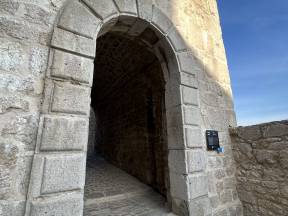
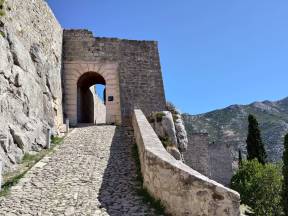
The main entrance to the Klis fortress is recognizable by its massive stone portal, built of large blocks of limestone without any binding material. Such construction ensured strength during sieges and attacks, and the slightly pointed arch above the gate further strengthened the structure. For centuries, armies from Roman legionaries to Uskoks and Ottomans entered through this passage.
In 1537, after a long siege, Ottoman soldiers entered through this gate for the first time, bringing Klis under their rule. Over the centuries, the entrance has been renovated several times, but it has never changed its original appearance.
More recently, this portal served as the main entrance to the city of Meereen in the fourth season of the series Game of Thrones. The scenes of Daenerys Targaryen and her army arriving at the city walls and the duel of the Meereen champion in front of the entrance were filmed here. During the image processing, the production digitally expanded the walls and added monumental statues, but the basic structure of the gate, staircase, and stone ramparts remained authentic – the recognizable entrance to Klis Fortress.