

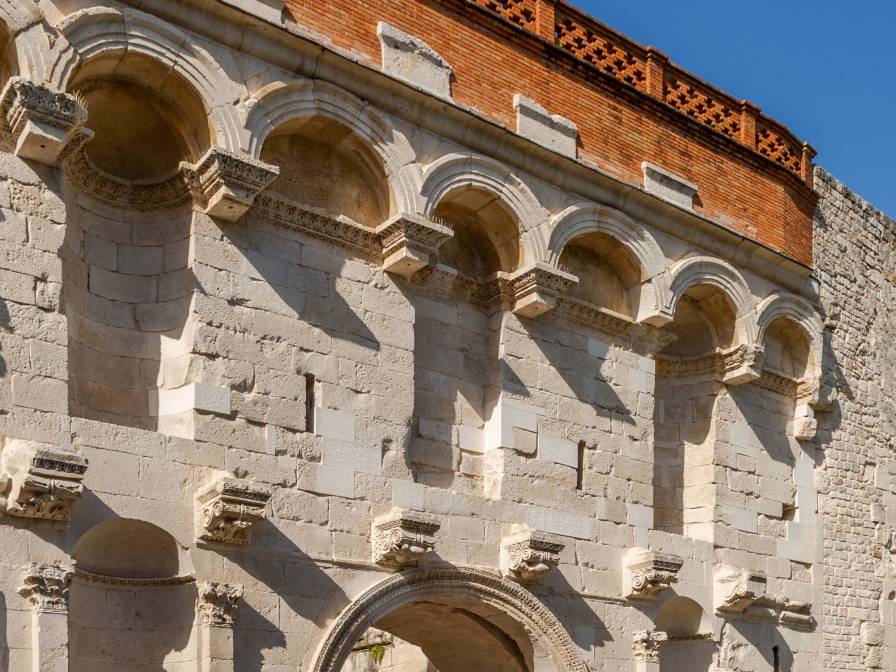

Golden Gate
0
You are standing in front of the Golden Gate, the most important entrance to Diocletian's Palace. Through it, Emperor Diocletian personally entered his luxurious home, and access was granted only to him and his most important guests. The gate is not golden in color, but in significance – it was reserved exclusively for the most privileged. Today, the gate is about 4.5 meters high, although it originally reached 6.5 meters. Over the centuries, layers of earth have raised the ground, so the gate has lost its height. It impresses with its reliefs, columns and niches. The niches once housed statues of the four tetrarchs: Diocletian, Maximian, Galerius and Constantius Chlorus, as a clear message of power and protection. Each huge stone block from which the gate is built comes from the island of Brač. Each block weighs several hundred kilograms. The palace and this gate were built between 295 and 305 AD, with the help of local and foreign craftsmen. In 614, when the Avars and Slavs besieged Salona, the surviving inhabitants found safety by passing through this entrance and taking refuge in the palace. From an entrance for emperors, it became a door of salvation for ordinary people. In the Middle Ages, the gate was walled up. The entrance to the city was moved further east, so the Golden Gate remained hidden until the 19th century, when it was rediscovered. As you walk past the gate, you are actually passing by apartments and spaces that ordinary Split residents had remodeled over the centuries. The imperial halls became a part of everyday life. One of the more interesting legends tells of the "imperial dream" - Diocletian allegedly dreamed, before his death, of a procession of Christians entering this gate carrying a cross. In that dream, the palace was transformed into a Christian city. This later came true - the mausoleum became the Split Cathedral. Another interesting feature is the Golden Gate, on the outer walls, where there is a statue of Gregory of Nin by Ivan Meštrović. Touching his thumb is a local ritual for good luck, and the gate remains the center of the city's customs and interesting stories.