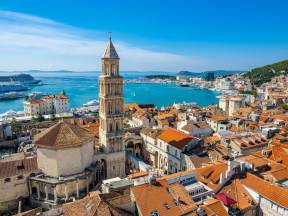
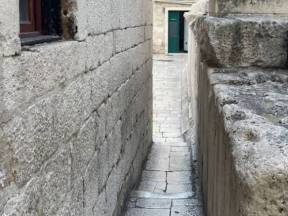
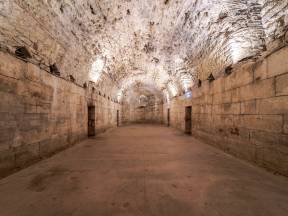
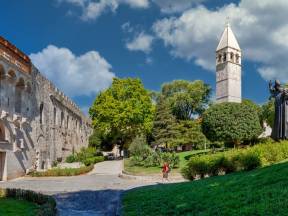
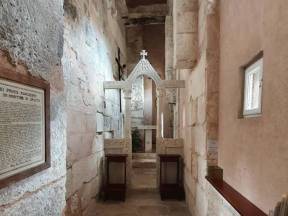
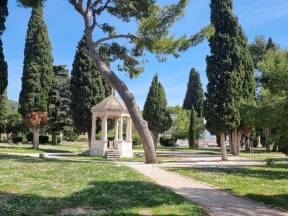
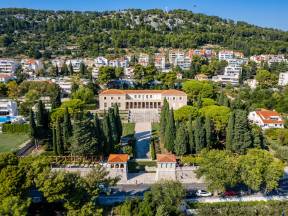
You are in a palace that represents one of the best-preserved buildings of the Roman Empire. It was built in the early 4th century, between 295 and 305 AD, by order of the Roman Emperor Diocletian, who had it built as a place where he would spend the rest of his life after his abdication. Located by the sea, the palace was strategically planned to have direct access to the port and maritime protection. It was built as a combination of a luxurious villa and a military fortress, with thick walls, defensive towers and monumental entrances on the four sides of the world – the Golden, Silver, Iron and Bronze Gates. Within the walls were the emperor’s apartment, the Peristyle as a central square, the temple dedicated to Jupiter, the mausoleum (today’s Split Cathedral) and numerous other buildings that served for housing, administration and defence. The southern part of the palace housed the emperor’s luxurious chambers and corridors overlooking the sea, while the northern part was occupied by soldiers, servants and warehouses. The palace's basements, which served as support for the upper rooms and storage areas in Roman times, are now preserved and open to visitors.
Diocletian, a native of Salona, then the capital of the Roman province of Dalmatia, was known for his determination and organization of the empire. He is especially famous for being the first Roman emperor to voluntarily abdicate, retiring from political life and dedicating himself to gardening in his palace.
Over the centuries, the palace underwent numerous modifications, and eventually became the core of medieval Split. Residents settled within its walls, adapting the Roman buildings to their daily needs. Today, Diocletian's Palace is a lively urban area with shops, restaurants, apartments and cultural attractions, and is inscribed on the UNESCO World Heritage List. In addition to being one of the most important historical sites in Croatia, the palace is also an attractive film location - scenes from the popular series "Game of Thrones" were filmed in its basements, where the underground spaces served as halls where Daenerys Targaryen kept her dragons.
The Peristyle is the central square of Diocletian's Palace in Split, built around 300 AD by order of the Roman emperor Diocletian. The square was designed as an imperial ceremonial stage surrounded by a double row of Corinthian-style columns. It was here that the emperor would address the people on a loggia (the so-called protyron), while his subjects would kneel and obey the "living son of Jupiter" - Diocletian, who wanted to further emphasize his divine status with a monument the likes of which had never been seen in this region before.
The Peristyle was located at the intersection of the main Roman streets of the palace (cardo and decumanus), and from it one can access the most important parts of the palace: the imperial mausoleum (today's Cathedral of St. Domnius), the Temple of Jupiter, and the spacious basements that could be used to logistically manage life in the palace. The most interesting details of the Peristyle are related to the ancient Egyptian sphinxes. Diocletian brought as many as 12 sphinxes from Egypt, and one, carved from black granite during the reign of Pharaoh Thutmose III, still stands proudly preserved in the square today. This sphinx, about 3,500 years old, is unusual because it ends in human hands, not lion paws, and holds a bowl for offerings, which is a very rare motif. Moreover, the ancient people of Split nicknamed it “Gorgon” from the legends, and over time it became a mystical symbol of the city. Much later, a wealthy American industrialist tried to buy it, but the people of Split proudly refused the offer. Today, the monument is under protection and a valuable archaeological gem.
The peristyle is framed on three sides by 24 granite columns, while construction materials, such as Egyptian granite, marble and Brač stone, were brought from various parts of the Empire, symbolizing the power of Rome. Above the main square were three statues: Diocletian, Jupiter and an unknown figure, while on the sides there were sphinxes, and the portico directly connected the imperial chambers and the public part of the palace.
The Protiron on the south side played a key role – it represented the imperial elevation and separated the private from the public part of the palace. The Temple of Jupiter was accessed from the west, and the Mausoleum of Diocletian from the east.
As Roman rule weakened over time and Christianity became dominant, the Peristyle lost its original imperial significance and slowly became the center of religious and city life. It was a square where trade, gatherings, social and religious ceremonies took place. It was surrounded by the noble palaces of the Split families Grisogono, Cipci and Skočibušić, which directly leaned against the antique columns and arches.
In the Middle Ages and the Renaissance, with decoration in new styles, the Peristyle gradually evolved into the city core. Another interesting fact – in 1929, a monument to Gregory of Nin was erected on the square, which was later removed by the occupying authorities and is now located at the Golden Gate of the palace.
Despite all the modifications over almost 1700 years, the Peristil has preserved its original features and remained an authentic stage of life. Today, it is a favorite place to gather, drink coffee and enjoy the unique ancient atmosphere. Thanks to its exceptional acoustics, opera performances and concerts are held here – such as the famous performance of Verdi’s “Aida” as part of the Split Summer Festival.
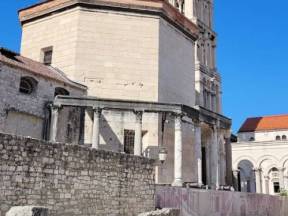
You are in front of the Cathedral of St. Duje, which was originally the imperial mausoleum of Emperor Diocletian, and in the 7th century was converted into a cathedral and dedicated to St. Duje, the bishop of Solin and a Christian martyr. It is a unique example of where a pagan tomb became a Christian church, without demolishing the original Roman building. The cathedral retains the shape of an ancient mausoleum – octagonal on the outside and circular on the inside, with a high barrel vault and a cornice of Corinthian columns made of marble. The interior is richly decorated and contains numerous artistic and historical elements.
The most important elements of the cathedral include the wooden doors from 1214, which were carved by the master Andrija Buvina. The doors are carved with scenes from the life of Jesus Christ, divided into 28 panels. The cathedral also contains stone choir stalls from the 13th century, Gothic-Renaissance altars, marble reliquaries and a richly decorated main altar with the relics of St. Dujma. Behind the altar are the tombs of some of Split's archbishops, including the tomb of St. Arnirius.
The cathedral also houses a sacristy, treasury and baptistery. The treasury houses valuable liturgical inventory, manuscripts, reliquaries, chasubles and goldsmith's works. The baptistery is located in the former Temple of Jupiter, a few meters from the cathedral itself.
The bell tower of the Split Cathedral is one of the most recognizable symbols of the city. Its construction began in the 13th century, but lasted for centuries. The styles of construction changed over time - from Romanesque foundations to Gothic and Renaissance additions. The bell tower is about 57 meters high and is accessible to visitors for climbing. A staircase leads to the top, from which there is a panoramic view of the whole of Split, Diocletian's Palace, the sea and the surrounding islands.
The Cathedral of St. Dujma is not only a religious building but also a museum and historical complex that testifies to the continuity of life in Split from Roman times to the present day. Visitors can tour the main church, bell tower, baptistery, treasury and underground spaces, and it is especially worth visiting in May, when the feast of St. Domnius, the patron saint of the city, is celebrated.
The Vestibule of Diocletian's Palace was the entrance to the imperial, or residential, part of the complex, which housed the private chambers of Emperor Diocletian. It was built together with the palace at the turn of the 3rd and 4th centuries, between 298 and 305 AD, at the time when Diocletian was planning his retirement from public life. The Vestibule was conceived as an imposing transition between the public square (the Peristyle) and the imperial private space, with a clear separation and strict access control – only the emperor and the closest circle of court guests were allowed to enter this part of the palace.
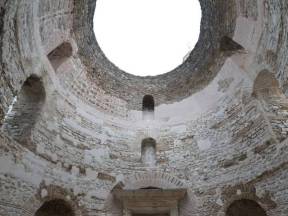
Architecturally, the Vestibule has a circular floor plan, approximately 13 meters in diameter, with four monumental niches that transform the shape of the space into a square from the inside. The walls reach a height of 17 meters, and the original monumental dome was completely closed and probably richly decorated with mosaics and stucco. Today, the central part of the dome is open due to collapse during later centuries, which gives the space a special light and sound effect.
The exceptionally richly decorated interior included a mosaic floor, walls covered with high-quality marble and modeled stucco, and the niches most likely housed statues of Roman deities or symbols of power and cult. The entrance door from the Peristyle was especially decorated with reliefs and monumental - its height was almost four meters, which further emphasized the importance of the entrance.
Today, the Vestibule is an attraction of the historic core of Split and one of the most recognizable places in the city. It is known for its exceptional acoustics and is often used for musical performances, mostly by traditional Dalmatian klapa groups. The entire Diocletian's Palace, including the Vestibule, has been protected as a UNESCO World Heritage Site since 1979.
The name "vestibule" comes from the Latin language and denotes the entrance area of a house or palace, which accurately describes its original purpose - to be a monumental lobby of the private part of one of the most important imperial palaces of late antiquity.
The Temple of Jupiter was built between 295 and 305 AD, as part of Diocletian's Palace. Located in its western part, not far from the Peristyle, it was erected as a sanctuary dedicated to the Roman god Jupiter, the highest deity of the Roman pantheon. Emperor Diocletian, who considered himself a divine descendant of Jupiter, had the temple built not only as a place of religious ritual, but also as a confirmation of his political and spiritual power. The temple was built on a raised podium, with a rectangular floor plan and a portico in front of the entrance adorned with six columns. The entrance portal is richly decorated with reliefs, including figures of gorgons - mythical creatures believed to protect against evil. Special attention is also drawn to the Egyptian sphinx placed in front of the entrance, one of the twelve that Diocletian brought from Egypt.
The interior of the temple is dominated by a barrel vault, richly decorated with coffers, which is exceptionally well preserved. This architectural element later had a significant influence on the development of Renaissance architecture on the Dalmatian coast, especially in Trogir. During the 6th century, during the spread of Christianity, the temple was converted into a baptistery, which did not destroy the original architecture, but rather carefully adapted it to new symbols and functions. In the crypt below the baptistery, a space dedicated to Saint Thomas was arranged, while above, in the baptistery itself, in the 13th century, a baptismal font was installed made of stone elements from the 11th century, originally from the Split Cathedral.
One of the more interesting historical features of this space is located on one segment of the marble slab of the well – a relief depiction of the Croatian king, probably Petar Krešimir IV. or Zvonimir, which is also the oldest known depiction of a European ruler in stone. Next to the well, inside the space are two sarcophagi with the mortal remains of Archbishops Ivan II. and Lawrence, which further confirms the role of this baptistery as an important spiritual point of the Split church community.
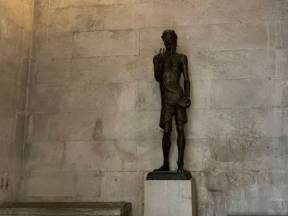
Today, the space is dominated by a bronze statue of Saint John the Baptist, a work by Ivan Meštrović from the 20th century, which in modern times rounds off the church function of the building. Above, on the coffered vault, there used to be an early Romanesque bell tower in the Middle Ages, but it was removed in the 19th century during the restoration of the building in order to return the temple to its original antique appearance. It is precisely this long-term use of the space, which has never lost its sacred function, that makes the Temple of Jupiter a unique example of architectural and cultural adaptation.
As part of Diocletian's Palace, the Temple of Jupiter has been on the UNESCO World Heritage List since 1979. It is here that different historical layers meet: the Roman imperial cult, early Christian symbolism and contemporary Croatian art.
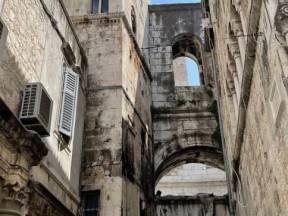
"Let me pass" street is one of the narrowest and most interesting streets inside Diocletian's Palace in Split, located in the immediate vicinity of the Iron Gates. It was named after its unusually narrow width, which makes it difficult for two people to pass each other, and the local expression "Let me pass" became its official name. Although the street is only a few meters long, its special charm and authenticity represent an important part of the atmosphere of the old city center of Split. It is popular among tourists who come because of its unusual name and picturesque appearance, while for the local population it is a symbol of the characteristic Split spirit and humor. Narrow streets like "Let me pass" are part of the ancient architecture of the city, where such passages served as protection from adverse weather conditions and enemies, and as a means of preserving privacy in densely populated parts of the city. Over time, this street has also become part of local folklore, which further contributes to the liveliness and unique atmosphere of the old city of Split.
The cellars of Diocletian's Palace are an impressive example of Roman engineering ingenuity. They were built at the turn of the 3rd and 4th centuries as a massive supporting structure for the residence of the Roman emperor Diocletian. The layout of the cellars precisely follows the layout of the upper halls, thanks to which the cellar spaces enabled the preservation of the palace through the centuries even after the upper parts of the urban core began to take on the shape of medieval Split.
The cellars served primarily as storage spaces for food, wine, oil and other necessities necessary for the daily life of the palace. Archaeological research has confirmed the discovery of ancient wine and oil presses and a water drainage system, which clearly testifies to the logistical and organizational role of the cellars. Imperial treasures were also kept in this very place, which speaks of the wealth and power of Diocletian in his time.
It is interesting to note that throughout history the cellars were often neglected or turned into landfills, and systematic archaeological research only began in the 20th century. Numerous valuable finds have been found, such as Roman coins, sculptures and ancient installations. At one point in the recent past, local residents even used the cellars as wine cellars.
The cellars gained particular popularity in the early 21st century when they were used as an impressive backdrop in the popular series Game of Thrones. It was in these spaces that scenes from the slave-owning city of Meereen were filmed, making Diocletian's Palace an even more globally recognizable symbol of history and popular culture. Walking through these corridors means literally stepping into the world of ancient Rome, but also into the fantastic world of Westeros.
You are standing in front of the Golden Gate, the most important entrance to Diocletian's Palace. Through it, Emperor Diocletian personally entered his luxurious home, and access was granted only to him and his most important guests. The gate is not golden in color, but in significance – it was reserved exclusively for the most privileged.
Today, the gate is about 4.5 meters high, although it originally reached 6.5 meters. Over the centuries, layers of earth have raised the ground, so the gate has lost its height. It impresses with its reliefs, columns and niches. The niches once housed statues of the four tetrarchs: Diocletian, Maximian, Galerius and Constantius Chlorus, as a clear message of power and protection.
Each huge stone block from which the gate is built comes from the island of Brač. Each block weighs several hundred kilograms. The palace and this gate were built between 295 and 305 AD, with the help of local and foreign craftsmen.
In 614, when the Avars and Slavs besieged Salona, the surviving inhabitants found safety by passing through this entrance and taking refuge in the palace. From an entrance for emperors, it became a door of salvation for ordinary people.
In the Middle Ages, the gate was walled up. The entrance to the city was moved further east, so the Golden Gate remained hidden until the 19th century, when it was rediscovered.
As you walk past the gate, you are actually passing by apartments and spaces that ordinary Split residents had remodeled over the centuries. The imperial halls became a part of everyday life.
One of the more interesting legends tells of the "imperial dream" - Diocletian allegedly dreamed, before his death, of a procession of Christians entering this gate carrying a cross. In that dream, the palace was transformed into a Christian city. This later came true - the mausoleum became the Split Cathedral.
Another interesting feature is the Golden Gate, on the outer walls, where there is a statue of Gregory of Nin by Ivan Meštrović. Touching his thumb is a local ritual for good luck, and the gate remains the center of the city's customs and interesting stories.
You are standing in front of one of the most famous monuments in Split – the statue of Gregory of Nin, a masterpiece by Ivan Meštrović that symbolizes the fight for the Croatian language and identity. This imposing bishop with his hand raised is not just a sculpture – he is a sign of the Croatian cultural revival. Gregory of Nin was a famous 10th-century bishop of Nin, known as one of the most important Croatian church figures who stood out as an advocate for the introduction of the Old Croatian language and the Glagolitic script into church worship, opposing the then exclusive use of the Latin language imposed by the Roman Church. In doing so, he significantly contributed to the preservation of Croatian linguistic identity, cultural tradition and literacy. It is historically confirmed that he had the support of the Croatian King Tomislav, and after the church councils held in Split in 925 and 928, his diocese was abolished, and he was transferred to the diocese in Skradin.
The image of Gregory of Nin is immortalized in a famous monument – a monumental bronze sculpture created by the world-renowned Croatian sculptor Ivan Meštrović. The monument was created and originally erected in 1929 on Split’s Peristyle, the main city square, but after World War II it was temporarily removed and later permanently relocated to its current location right next to the Golden Gate, the northern entrance to the historic center of Split. This statue, about 8.5 meters high, is considered one of the most recognizable and beloved symbols of the city, an indispensable part of its cultural and tourist offer.
The most famous and interesting detail of the statue is Gregory of Nin’s left thumb. According to local legend, visitors who touch and rub this thumb and make a wish will have their wish come true. It is precisely because of this tradition that tens of thousands of visitors touch the statue every year, and for decades it has been visible that the thumb has been worn to a shine and is more brilliant than the rest of the statue, which symbolically confirms its importance in folk tradition and popularity.
Outside Split, Meštrović created two more monuments to Gregory of Nin – in Varaždin and his native Nin, but it is the Split statue that is the most recognizable and most painted.
It was built in the narrow space of the former Roman guard corridor, above the Golden Gate in the northern wall of the palace, where it was converted into a church in the 6th century. Its extremely small dimensions, only about 1.6 meters wide and about 10 meters long, make it a unique witness to the continuity of life and faith in this historically layered space. Dedicated to Saint Martin, the patron saint of soldiers, the church was probably created precisely as a spiritual complement to the former military function of the premises, which reflects the close connection between architecture, social needs and religious life in the early Middle Ages.
During the Middle Ages, the church was shaped and adapted to liturgical needs, and a special value is preserved by the altar stone relief from the early medieval period, located inside the church and visible today. Although the church is small and unobtrusive, it has exceptional importance because it preserves numerous elements of pre-Romanesque art and symbolizes the continuation of religious life in Split from the time of the fall of the Roman Empire to modern times. Access to the church is through a narrow passage along the northern wall of the palace, further emphasizing its intimate and hidden nature.
Today, the Church of St. Martin is open to visitors during limited hours, and in addition to being a tourist attraction, it is also the place where a mass is celebrated once a year on the feast of St. Martin, held by the Dominican sisters, the owners of this sacred building.
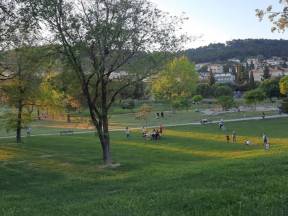
Welcome to Đardin, officially known as Strossmayer Park, a beloved city green oasis located just north of Diocletian's Palace, near the Golden Gate. Surrounded by the remains of 17th-century Venetian bastions, this park has been the city's main park since 1859 and has been a key gathering point for Split residents and visitors ever since.
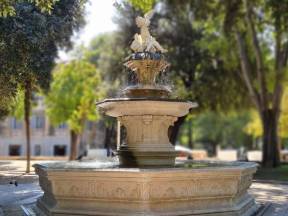
The park has been renovated several times throughout its history, with the last major renovation taking place in 2002. At that time, the surrounding walls were decorated with verses by Tin Ujević, and a modern fountain was installed in the western part of the park. In the center of Đardin is the famous fountain with the figure of "Putto" - an angelic figure from the stonemason workshop of Pavle Bilinić, which gives the park a distinctive visual touch.
Đardin is much more than a green area - it is surrounded by important city landmarks: there is a magnificent monument to Bishop Gregory of Nin, a sculpture by Ivan Meštrović, the remains of the medieval monastery of St. Euphemia, and the immediate vicinity of the Art Gallery further emphasizes the cultural value of this location.
Throughout the year, Đardin is a lively center of social and cultural events in Split: numerous festivals, concerts, exhibitions and fairs are held here. In summer, the park provides shade and peace, while in winter it is a place of colorful decorations and Advent events.
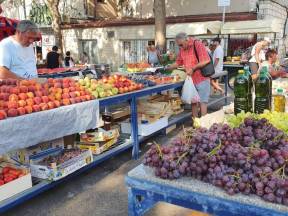
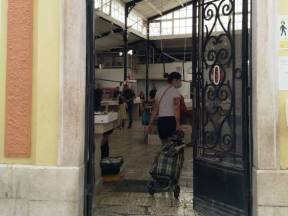
The Split Market, known as the Pazar, is located along the eastern wall of Diocletian's Palace, right next to the Silver Gate (Porta Argentea). This location is historically significant because even in Roman times, a space for trade and exchange of goods developed along the exits from the palace. Over the centuries, as Split grew beyond the palace walls, the Pazar retained its role as the main place for purchasing food and meeting residents.
The Pazar developed intensively during the 19th and 20th centuries, when the city was under Austro-Hungarian, then Italian and Yugoslav rule. During this period, its current appearance was formed - a series of stands, passages and permanent places for selling agricultural products, homemade products and seasonal fruits and vegetables.
The market is active every day, especially in the morning hours, and brings together local OPGs, small producers and resellers from the hinterland of Split, Zagora, the islands and the Dalmatian coast. In addition to fresh fruit and vegetables, the Market offers local cheese, olive oil, prosciutto, eggs, dried figs, flowers, herbs, and even clothing and footwear in the second part of the market.
Unlike large shopping malls, the Market still operates on the principle of direct communication between sellers and buyers. Bargaining, tasting, and personal recommendations are part of everyday life.
The Market has been in continuous use for over a thousand years and is considered a living part of Split's history. In addition to supplying the city with fresh food, it is also important for Split's identity as it represents a link between the rural surroundings and urban city life. Tourists enjoy visiting it to experience local everyday life and the authentic atmosphere of the city, and many local restaurants and caterers still source their supplies here.
You are standing on the most famous beach in Split – Bačvice. The beach is special for its shallow, soft sandy bottom that extends tens of meters from the shore. During the day, this is the most popular beach in Split, where families with children, athletes and holidaymakers come to enjoy the safe shallows, while in the evening it turns into a vibrant nightlife center, filled with bars and clubs. The bay is about 600 meters long, and the sandy part extends for about 180 meters.
The famous Split game of picigin was born here, which locals and guests play almost every day and for which Bačvice is known far and wide; so much so that the World Picigin Championship is regularly held here. The quality of the sea and facilities has also been recognized with the Blue Flag, and during the summer the beach can host more than ten thousand swimmers a day, which confirms its popularity. The shallows are safe for children and non-swimmers, and the famous Church of Our Lady of Pojišana is located near the beach.
Behind today's colorful and cheerful bustle lies an interesting history. The name Bačvice dates back to the Middle Ages, and was first mentioned in the 11th century under the name Butisello, or Botticelle during the Venetian era. At that time, there were vineyards, gardens and only a few stone houses on the outskirts of the city. During the 17th century, a fortress was built on the peninsula next to Bačvice (today's Mariner's Park) to defend the approach to the port, and the area of today's beach also served as the city cemetery during the plague epidemics at the end of the 18th century.
The first wooden bathing area was built in 1891, when the beach began to be arranged for public bathing, and it is interesting to mention that women and men bathed separately until the beginning of the 20th century.
The story of Bačvice is full of anecdotes, such as the one from World War II when locals, due to a shortage of firewood, set fire to old wooden football goals on the beach, or the story of the first woman in Split who wore a two-piece swimsuit on Bačvice, causing outrage at the time. Bačvice beach also gained a special charm thanks to the cult television commercial for the drink "Pipi" with Ana Sasso from 1983, which still symbolizes the cheerfulness and summer carefreeness of Split today.
You are standing in front of the Silver Gate, one of the four entrances to Diocletian’s Palace. Many visitors pass by without realizing its importance. This is not a gate for parades or for trade. It had a special purpose. Diocletian passed through it when he did not want attention, when he wanted to escape from the rules and politics of the court.
The gate was not named for its material or its splendor. The name comes from the simple orientation of the palace and the Roman custom of marking important points with directions. North – gold. West – bronze. East – silver. But what gives it its special value is not its name, but its use.
When Diocletian decided to leave power, this was the gate through which he went for his walks. He would look out to the sea, towards the space outside the walls. Here he sought peace. He no longer made decisions for the empire. Growing vegetables became more important to him than politics.
In the seventh century, when Salona was destroyed, people seeking salvation from wars entered the palace through this gate. They did not come with armies, they came with families. At that time, the gate lost its imperial function and became part of everyday life. The new role was simple – the entrance to what eventually became the city of Split.
In 1420, when the Venetians took power, the new administration did not require a special gate for entry. The Venetian governor passed through the Silver Gate. Some left the city through this same passage because they did not accept the new laws and rules. The gate was thus a sign of change.
Today, tourists, passers-by, students and merchants pass through it. The place that once served the emperor, and then refugees and governors, is now part of the city’s everyday life.
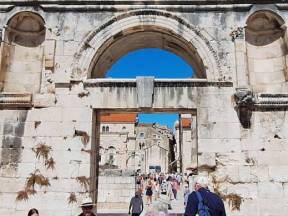
You are near the Iron Gate, the best preserved of all four gates of the imperial residence. Already in Roman times, they were called Porta occidentalis or Porta principalis sinistra, and their role was wider than an ordinary passage: they were used to enter the imperial sulfur baths and, less well known, it was the passage through which punished legionnaires were taken out to be flogged or stoned.
The gate stands right on the axis of the via decumanus, that main road that cut through the palace from east to west, ending with the Silver Gate on the opposite side. This very position provided them with the most everyday functions; it is the only door that was constantly open, practically from its construction until today.
With the entry into the Middle Ages, the space above the door takes on a new level of interest: a small church was built there, originally dedicated to St. Teodoru, later known as the Church of Our Lady of the Bell Tower. A pre-Romanesque bell tower was also erected, today the oldest preserved bell tower on the Adriatic, which gives the Iron Gate an additional ecclesiastical dimension.
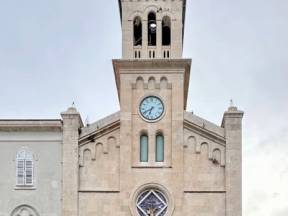
After the city expanded beyond the palace walls to the west, the Iron Gate became permanently open and has since been called the "free gate". On the left outside, another famous bell tower was erected, with a city clock divided into 24 hours, a unique attraction.
Another unusual fact: the relative height at the location of the corridor above the gate is as much as 15.75 meters, and this is the only place where the preserved stone covering shows the true top of the palace's perimeter wall.
This gate was not only a functional passage, but also the lifeblood of the city's daily and business life, without interruption throughout all periods of Split's history. Its original purpose was intended for the Romans, but the space was later taken over by craftsmen, merchants, judges, churchmen - everything you can imagine as the drivers of life in a Mediterranean city. With the arrival of tourists and the new age, traffic through them has never stopped – only the goods, language, and clothing of those who enter through the Iron Gates are constantly changing.
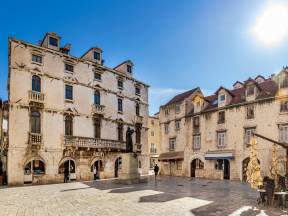
You are in the People's Square, which the people of Split simply call "Pjaca". It was created in the 13th century when life began to move out of Diocletian's Palace. Beneath its stone surface, traces of ancient buildings, early Christian mosaics and a Roman aqueduct have been found, meaning that this area was alive long before it became a medieval core.
On the west side of the square is the Old Town Hall, with its distinctive Gothic triforia, once the seat of the city government, but also the place that kept the original Venetian lion - a symbol of Venice, whose influence long defined the political and cultural framework of Split. That lion was later removed, during the changes of the late 18th century, but its history remains one of the untold chapters of the Pjaca. From this same spot in 1424, the city statute was publicly read, officially published and available to the people for the first time - a moment that clearly demonstrated how this space is not just a square, but a stage for political shaping.
The clock that dominates the bell tower today was installed in 1450 and is considered the oldest public clock in Croatia. Its unusual dial with 24 numbers instead of the usual 12 reminds us that people in this city have always measured time in their own meter. When the French took over Dalmatia in the early 19th century, the Pjaca received a novelty that was incredible to many – the first nighttime public lighting. The administration at the time introduced a series of practical measures that enriched the city, but the fact remains in the collective memory that the night on the square was illuminated for the first time.
At the same time, right next to the Pjaca, the Morpurgo bookstore was opened, one of the oldest in Europe, and was not only a place to buy books, but also the center of the city’s intellectual energy. Journalists, professors, poets and the curious came to it every day, so it is no coincidence that the first electric light bulb in the city allegedly appeared here.
In the past, every merchant from the Pjaca had to report the exact prices of his products to the city administration every morning – a system of early market supervision that modern states are proud of today. Here, knightly games, public competitions, punishments, and even debates between nobles were held, which the citizens followed as if they were the news of the day. Everyday life was so closely tied to this space that city news, decisions, and affairs began or ended right here.
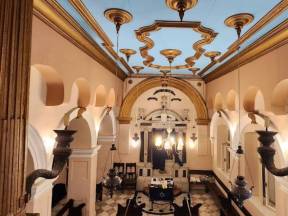
The Synagogue in Split is one of the oldest synagogues in Croatia and Southeast Europe that is still in operation, and its historical and cultural features make it an important monument of Jewish and Split heritage. It was built in the 16th century by adapting medieval houses on the site of the then Jewish ghetto, in the Jewish Passage, right next to the western wall of Diocletian's Palace. Although it is often considered the oldest synagogue in continental Croatia, it is actually the oldest active synagogue in Croatia after Dubrovnik and one of the oldest active in Europe, while the oldest synagogue in Central Europe is in Prague.
The Jewish community in Split has a very long tradition that dates back to late antiquity, although it experienced significant development in the 16th century when, after being expelled from Spain and Portugal, numerous Sephardic families found refuge in Dalmatia. At that time, the community grew to several hundred members, and the geographical center of its life was the northwestern part of Diocletian's Palace, known as the Geth. The synagogue has a modest exterior, reflecting the position of Jews in society at the time and the need for discreet use of space, while the interior is distinguished by details resulting from modifications in the 18th century, such as decorated walls and a wooden ceiling. A special feature of the Split synagogue is the Aron Hakodesh, a sacred niche for Torah scrolls, which is carved directly into the ancient rampart of the palace, oriented towards Jerusalem and made of black and white marble.
During World War II and the Holocaust, the community was severely affected, the synagogue was devastated, and sacred objects were destroyed. However, after the war, it was rebuilt and reopened for religious life in 1948. Today, there is a small but vibrant Jewish community in Split, which continues to use the synagogue for religious ceremonies, cultural programs, workshops and exhibitions dedicated to Jewish heritage. The synagogue has also become a significant tourist attraction, and visitors often visit the Jewish Museum of Split, located on the same street, where a valuable collection of historical documents, books and objects is kept. An additional treasure trove of Split's Jewish history is the old Jewish cemetery on Marjan, founded in 1573, which is one of the oldest preserved of its kind in the world.
Traces of the places where mezuzahs once stood can still be seen in the stone doorposts of some houses in the old city center, while among the famous members of the community was Daniel Rodrigo, a Sephardic merchant and benefactor during whose time Split experienced an economic boom. Despite all the historical adversity and tragic losses, the Split synagogue managed to maintain its function and became a proud witness to the Jewish presence in this part of the Mediterranean.
Fruit Square, officially the Radić Brothers Square, in the heart of whose historic core you are now, is located, among other things, between the Riva and Diocletian's Palace. Although the market no longer exists today, it has retained its name from the time when women from the surrounding villages sold fruit here. Today, it is a lively city area surrounded by cafes, shops and landmarks, popular with tourists and locals alike.
The most famous detail of the square is the bronze statue of Marko Marulić, created in 1925 by Ivan Meštrović. It was erected on the occasion of the Adriatic Exhibition and the opening of the Split–Zagreb railway, and the ceremonial unveiling was attended by the cultural and political elite of the time. Marulić (1450–1524), a native of Split and the author of the first Croatian epic poem, "Judith", was a symbol of national culture and humanism. The statue was placed here because Marulić's home was located in the immediate vicinity, and Fruit Square has always been an important city gathering place.
Behind the statue is the Milesi Palace, one of the most important examples of Baroque architecture in Split, built in the 17th century. In addition to its rich facade, it is also known for the fact that Don Frane Bulić, a prominent archaeologist and historian, occasionally stayed there. The palace hosted public gatherings, lectures, and events related to culture and science.
The Fruit Square thus connects several key periods of Split's history – from ancient and medieval to Baroque and modern times – and remains one of the most recognizable spaces in the city with a strong cultural and historical significance.
You are at Split's "peškarija", a place where not only fish has been sold for over a hundred years, but also a part of Split's identity. This building, built in 1890 according to a project by Ante Bezić, was built on the site of old wooden plank houses where fish had been sold since Roman times. The Austro-Hungarians built an elegant iron structure here, inspired by large European markets, with the aim of modernizing Split's trade, but in fact they created a cult place that became the heart of Split's gastronomic tradition.
The interior of the Fish Market has retained its original stone paving and fish counters, and the gabled roof with basilica-style lighting and ventilation ensured freshness even during the hottest summers, which was revolutionary for its time. The main entrance features the coat of arms of the city of Split, and the western door opens onto the square and Marmontova Street, making the fish market part of the everyday urban rhythm.
Interestingly, there are almost no flies in Ribarnica – this is thanks to the smell of sulfur springs from the nearby spa, which repelled insects and attracted Diocletian to build his palace here in Roman times. All the freshness of the Adriatic comes to the tables of Ribarnica every day, and the rules for selling fish have remained the same since Roman times: the freshest fish arrives from Matejuška as early as five in the morning, and by noon everything is sold out. There are no refrigerators or preservatives – just ice, salt and Split wisdom.
Split's Ribarnica has long been too small for today's Split, but it is so important to the city's spirit that no one wants to touch or move it. Today, Ribarnica is threatened by modern shopping malls, but the people of Split stubbornly hold on to their traditions.
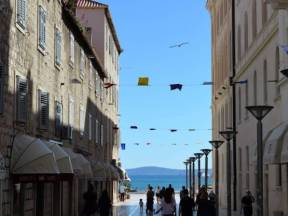
Marmontova Street in Split is the main pedestrian zone connecting the Riva with the Prokurative. It is named after the French Marshal Marmont, who had a significant influence on the development of the city in the early 19th century. Marmont initiated the modernization of Split: he opened the Beautification Office, built schools, theaters, roads and parks, and introduced new ideas from the French Revolution. The people of Split remember him as the person who brought progress to the city.
Marmontova is the first planned straight street outside Diocletian's Palace, cut through the old city walls, which marked a new direction for the city's development to the north. Today, the street is completely pedestrianized, renovated in 1996, and full of shops, cafes and restaurants. The fish market is located approximately in the middle of Marmontova and is famous for the fact that flies do not enter it, thanks to the smell of sulfur from the nearby spa.
Marmontova Street is also home to Split's first cinema, Karaman, which is still in operation today, and the Morpurgo bookstore, one of the oldest in Europe.
The Pirja fountain, installed in 1998, attracts special attention. The author is academic sculptor Kažimir Hraste. The sculpture depicts a bronze fist showing a thumb - the thumb is placed between the index and middle fingers. A stream of water comes out of the fist and falls straight into a large funnel, or pirja, placed on the sidewalk. This gesture, known as a "figa", symbolizes stubbornness and resilience. The fountain has become a recognizable symbol of Marmontova Street, and often arouses the curiosity of passers-by, especially when it is in operation, as this is not a common sight.
Croatian National Theatre
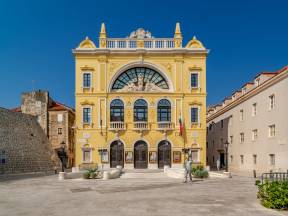
You have arrived in front of the Croatian National Theatre in Split, which opened on May 6, 1893. Immediately after its opening, it became one of the largest theatres in the Balkans, with around 1,100 seats. The first decades of its operation were marked by the arrival of travelling troupes from Italy, the Czech Republic and other Croatian cities, as there was no permanent professional ensemble. In the late 19th and early 20th centuries, performances were often divided into domestic and foreign troupes, and in 1920, the first professional drama ensemble was founded under the name National Theatre for Dalmatia, which did not last long.
In 1940, the theatre was renovated again and officially given its current name, and the first intendant was Ivo Tijardović. During the Italian occupation of 1941, the theatre's work was suspended, but after the war, from July 1, 1945, it continued without interruption. In February 1970, a fire destroyed the building, so performances were held in replacement venues until 1980, when a renovated building designed by architect Boško Rašica was opened.
Since 1893, the roof of the theater building has housed a statue of Apollo, which is a recognizable symbol of the Croatian National Theatre and is often the subject of debate due to its size and appearance. The Split audience is known for its clear reactions, which has influenced many performances and guest appearances - after the performances, both approval and disapproval could often be heard.
The theater is the organizer of the Split Summer festival, which features local and foreign artists and is held at various attractive locations around the city, such as the Peristyle. Today, the Croatian National Theatre Split operates continuously with a program of opera, ballet and drama, retains the status of a protected cultural asset and is the center of theatrical life in Dalmatia.
You are on Prokurative, a square that the people of Split also call Republic Square. This is a place that attracts the attention of everyone who passes through the center of Split. The square was created in the second half of the 19th century, and the main driver was the then mayor Antonio Bajamonti. His idea was to make Split a "city of the future", so he took inspiration from the Venetian St. Mark's Square. That is why the buildings around the square were built in the Neo-Renaissance style, with recognizable arcades that give the square a special look.
On the south side of Prokurative, the square is open to the port and the Riva, which makes it one of the few squares with such a beautiful view of the sea. It is interesting that the construction of the square lasted decades: first the western wing was built, then the eastern, and each part was built in different periods, which can be seen in the details on the facades. For example, on one side you can see richly decorated reliefs, while the other side remained simpler because the architect from Venice abandoned the project before completion due to homesickness.
Among the many stories that accompany this square, the one about Split's "Phantom of the Opera" - a man in a black coat who appeared on the square at exactly midnight - stands out. According to legend, he was in love with a singer from a nearby theater, but she rejected him. Although there is no evidence that this story is true, it is still told among the people of Split.
Today, Prokurative is a lively meeting place. Under the arcades of cafes, "peak hours" are held daily, when a large number of people change in a short time and all important matters are agreed over coffee. In the summer, the square becomes a stage for numerous concerts and festivals, the most famous of which is the Split Pop Music Festival, which has been held here for almost fifty years.
One less known, but interesting fact: a large theater building, Teatro Bajamonti, once stood on Prokurative, which opened in 1859 and was the center of Split's cultural life. However, its glory did not last long: in 1882, the theater was destroyed by fire, and its life at that location brought other stories – a cinema, various institutions, and soon a new theater for new generations. Today, the building is called the Split Youth Theater, where children and young people gather once again to discover the world of theater and art.
You are standing in front of the place where the famous Bajamontuša, or Monumental Fountain, once stood, which adorned the Split waterfront in front of Prokurative Square in the second half of the 19th and first half of the 20th centuries. This large fountain symbolized the arrival of the first running drinking water in Split – one of the most important events in the city’s history.
The fountain was initiated by the then progressive mayor of Split, Dr. Antonio Bajamonti, and was sculpted by the Italian sculptor Luigi Ceccon according to the order and design from the Milanese workshop F. Dall’Ara e Comp. The construction was a true civic work: funds were raised by as many as 1,322 donors, among whom were important citizens, artists and academics, and about 20,000 forints were collected – a huge amount for that time.
The fountain was opened in 1888, immediately after the city water supply system with a source on the Jadro River was built. It impressed with its rich decoration – allegorical sculptures depicted the Jadro River, the Adriatic Sea and various marine figures, while the top of the fountain was adorned with the figure of a young man pointing east with his raised hand, symbolizing the development and future of Split. Bajamontuša soon became a favorite motif on postcards and photographs and a proud symbol of the city’s urban and economic progress.
Unfortunately, in 1947, the fountain was demolished by order of the then authorities for political reasons – as an unwanted reminder of past regimes. Today, its preserved parts are kept in the Split City Museum, and the original location remains a permanent reminder of the era of great urban changes.
Although the original monument no longer exists, a new, modern, circular fountain has been installed in the same place. This minimalist modern fountain, designed in 1947 according to the idea of the architect Milorad Družeić, is distinguished by its unobtrusive design with its simple pool with a fountain and flower beds. Although aesthetically and historically it is not comparable to the original Bajamontuša, the new fountain symbolizes the continuity of the public function of this space.
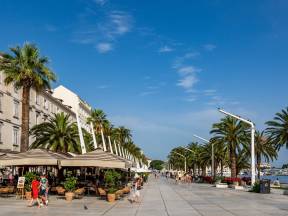
The Riva in Split is not just a promenade, but an area with a rich history and a key role throughout the centuries. As early as the 11th century, the port in front of today's Riva was an important center of maritime trade, connecting Split with the interior of the Balkans and the entire Mediterranean. In the 14th century, it was named the port of St. Nicholas, the patron saint of sailors, and even then the coast was protected by walls and fortifications from flooding and enemies.
During Venetian rule (1420–1797), Split expanded beyond the boundaries of Diocletian's Palace, and the coastal walls and towers further emphasized the importance of the Riva as the center of the city and port. At the beginning of the 19th century, during the French administration, Marshal Marmont ordered the demolition of part of the old fortifications in order to open the city to the sea. The material from the demolished walls was used to fill in and form the current coast, which gave the Riva its recognizable appearance.
The first palm trees were planted between 1920 and 1922, bringing a true Mediterranean atmosphere and additional appeal to the Riva. Today, a walk among the palm trees is the trademark of Split's Riva.
Throughout history, the Riva has been the center of important events and celebrations. Hajduk's greatest victories were celebrated here, when the entire city would come out to the Riva, sing fan songs and celebrate until late into the night. A special moment that will forever remain etched in our memory is the welcome of Goran Ivanišević after winning Wimbledon in 2001, when more than 100,000 people came to greet the Split tennis hero, and ships and boats created a bridge from the West Bank to the Port Authority.
The largest Split festival, Sudamja, gathers thousands of people on the Riva every year. The program includes cultural, sports and entertainment events, and the highlight is the procession and open-air concerts. Sudamja is more than just a celebration - it is a moment when Split shows its unity and tradition.
The Riva was the place where the first Split cafes and pastry shops were opened as early as 1786, confirming its long-standing role as the heart of social life. The Riva is also home to important historical buildings: the southern facade of Diocletian's Palace with the entrance to the Cellars, the Franciscan Monastery with the Church of St. Francis, the Bajamonti Dešković Palace and the Port Authority.
Even today, the Riva is a favorite place for walking and socializing, and its history and architecture make it one of the most important symbols of Split.
Church and Monastery of St. Francis
You are located at the western end of Split's Riva, on the site where the church of St. Felix, a martyr from the time of Emperor Diocletian, stood in the early Middle Ages. The Franciscan Conventuals arrived in Split in the 13th century and built a single-nave church on the site, next to which they founded a monastery, which also includes a medieval cloister.
Inside the church there are several altars, the most valuable of which is the painted Gothic crucifix by Blaž Jurjev Trogiranin from the early 15th century. Of particular note is the Roman sarcophagus depicting "The Crossing over the Red Sea", located in the main altar and one of the most beautiful examples of early Christian art in this area.
The monastery was built and expanded over the centuries; the cloister dates back to the 13th century, while its modern appearance dates back to the early 20th century after renovations. Some of the most prominent citizens of Split are buried in the church and monastery, including Marko Marulić and Ante Trumbić, whose sarcophagus was made by Ivan Meštrović.
The monastery library houses around 3,000 books, including materials from the 16th century, and the archive and treasury contain significant musical and sacral objects. The church bears the honorary title of "Small Pantheon of the Croatian People" due to its rich collection of art and significant tombs.
You are now at the Marjan Lookout, located above the western edge of the old part of Split, just above the street leading to the Church of St. Francis on the Riva. It is the city's most famous lookout, offering a view of the historic center of Split, Diocletian's Palace, the Split harbor, the Kaštela Bay and the Mosor mountain in the distance. In ideal weather conditions, you can also see part of the central Dalmatian islands.
You can reach Vidilica by taking stairs starting from the Riva, next to the Church of St. Francis. The stairs were built at the end of the 19th century, as part of the urban planning of connecting the city with Marjan. The lookout itself was renovated at the beginning of the 20th century, and in 1913 a café was built on that location – today's Vidilica restaurant – which is still open today.
Vidilica plays an important role in the everyday life of Split's citizens and in the tourist image of the city. In addition to being a popular spot for taking photos and taking a short break, it is also the entrance point to the Marjan Forest Park. From here, several hiking trails lead to the western and northern parts of the hill, including those leading to Prva vidilica, the Institute of Oceanography, Bene, the church of St. Nicholas and to the top of Marjan with the old Jewish cemetery and the church of St. George.
Vidilica represents a combination of urban space and nature, and has been an indispensable part of Split's identity since the end of the 19th century. Thanks to its easy accessibility and panoramic view, it is one of the most visited points in the city for locals, but also for all visitors.
In front of you is Matejuška – a place that the people of Split do not avoid, and every traveler can see how the city breathes here. This small bay, located between the western walls of Diocletian's Palace and at the foot of Marjan, has been the center of fishing life for centuries. According to some sources, the name Matejuška comes from the church of St. Matthew, but there is also an interesting theory that the name actually came from the brothers Mate and Joško, whom their mother called out to brunch every day from the window, and so the place was named after these calls.
Matejuška once served as a fishing port, while the main ancient dock was next to the palace itself. Fishing boats are still moored here today. Nearby is a large monument to fishermen – a huge fishhook, which reminds us of how important this part of the city is to the people of Split.
Colorful boats, often decorated with red and blue stripes, are not just for decoration. Fishermen painted them to make them easier to recognize in the fog and at sea. Over time, stories about the meaning of these colors emerged – red symbolizes the blood of Saint Duje, the patron saint of Split, and blue the sea that nourishes the city.
Throughout history, Matejuška has been the scene of everyday dramas and major events. In 1979, after Hajduk won the championship title, fans celebrated by jumping into the sea from these very walls.
A lesser-known, but very interesting fact is that at the beginning of the 20th century, healing sulfur springs gushed out on Matejuška, which is why Diocletian decided to build his palace on this very spot. The city's first hydroport with a line to Prague was also located here, which further increased the importance of this bay in the history of Split.
Today, Matejuška is a lively place, where tradition is still cherished. Fishermen, sea lovers and all those who care about the spirit of the city still gather here. In the evening, with the smell of the sea and the sound of seagulls, Matejuška becomes a gathering point, meeting places, stories and new memories.
The west coast of Split elegantly stretches west from Diocletian's Palace, connecting to the famous Riva. It is 623 meters long, and the entire promenade is paved with white Brač stone, which contributes to its modern and prestigious appearance. This part of the city has quickly become a new gathering place for Split residents and tourists, thanks to the luxurious marina with moorings for boats and yachts, restaurants and cafes, as well as the enchanting view of the sea and the panorama of the old town. Horticultural solutions are characterized by typical Mediterranean plants, and the urban space is also enriched with a bicycle path. Bronze plaques with the names of Split's Olympic medalists, which testify to the city's rich sporting tradition, give this area a special character. The west coast functionally and aesthetically connects modern architecture with the natural environment, and its accessibility by foot, bicycle, car and public transport makes it easy to arrive from all parts of the city. With its attractiveness and catering offer, this is an unavoidable place for walks, socializing and enjoying the Mediterranean atmosphere, and at the same time a strong symbol of the contemporary urban regeneration of Split, where tradition harmoniously intertwines with new amenities and experiences.
Zvončac is the western part of Split, located right next to the seashore, right at the beginning of Marjan and the West Coast. It is a spacious city park that the locals experience as a green oasis ideal for walks, recreation and relaxation with children and pets. The park is especially lively during the summer, when it becomes one of the centers of festival events in Split, among which the Split Park Festival stands out with concerts, DJ nights and various outdoor cultural programs. The history of Zvončac is associated with the bellflower plant, after which this part of the city was named, and the combination of the proximity of Marjan, the neighboring elite neighborhood of Meje, the marina and several cafes and restaurants makes this location very desirable among both citizens and numerous visitors. Zvončac has established itself as a place for everyday recreation such as running, cycling and sports activities, but also as a point for socializing and spontaneous outdoor activities, with sports fields nearby, among which the water polo club VK Zvončac stands out.
Sustipan is located on the southwestern edge of Split, between the western shore of the city port and the Zvončac Bay. Today it is a public park and promenade located by the sea, but the area has a rich and significant history that dates back to the early Middle Ages.
In the early Christian period, there was a Benedictine monastery of St. Stephen under the pine trees on Sustipan, after which the area was named (Latin sub Stephano – under Stephen). The monastery was an important religious and cultural center of Split, and was located next to the old church of St. Stephen. During the Middle Ages, the monastery was the center of spiritual life and owned significant land and influence in the city. It was closed in the 19th century, and today no major structures have survived from it, except for partial remains of the foundations.
In the 19th century, Sustipan was converted into a city cemetery, which was one of the most beautiful and well-maintained in Dalmatia. It was architecturally rich, with arcades, chapels and monuments, and many famous citizens of Split were buried here. The cemetery was, however, removed in the 1940s, in accordance with the then policy of urban redevelopment of the city. The monuments and remains were moved, and the area was converted into a public park.
Today, Sustipan is a landscaped green area with a pine forest, a promenade and benches by the sea. There is also a small neo-Romanesque rotunda, built in the 19th century as part of the former cemetery. The location offers panoramic views of the harbor, Marjan and the central Dalmatian islands.
Sustipan is a popular place for walks, relaxation and often organized weddings.
The Meštrović Gallery in Split is the most important gallery institution dedicated to the life and work of Ivan Meštrović, one of the most important Croatian sculptors and architects. It is located on the southern slopes of Marjan, overlooking the sea, in a villa that Meštrović designed and had built between 1931 and 1939 as his future home, studio and exhibition space. Today it is a representative museum space that preserves a large number of his works and provides an insight into his artistic and life legacy.
The Gallery houses more than 190 sculptures made in stone, bronze, wood and plaster, covering all phases of Meštrović's work - from early symbolist and Art Nouveau works to later classical and sacred themes. In addition to the sculptures, there is also a collection of drawings, paintings, architectural project plans, personal items and documentation related to Meštrović's life and work. The east wing of the ground floor is reserved for sacred works – such as the wooden Adam and Eve and the monumental Pietà – while the first floor features an exhibition inspired by different styles, from Art Nouveau to Art Deco, as well as cycles related to biblical themes. The gallery space consists of an indoor museum with exhibition halls arranged over two floors and an outdoor space with terraces and gardens where monumental sculptures are placed.
The gallery is particularly valuable because Meštrović personally participated in the design of the entire space, from the architecture of the villa to the arrangement of the sculptures, so the museum itself reflects his artistic vision and style. In the gallery courtyard there is also the Chapel of the Holy Redeemer, also known as Meštrović’s Crypt, which houses his wooden sculptures with religious motifs. Although it is physically located in the nearby Kaštelet, it is part of the same museum complex and is available to visitors as part of a tour.
The Meštrović Gallery has been open to the public since 1952, when Ivan Meštrović donated the villa and a large part of his works to the state. Today, it regularly hosts temporary exhibitions, lectures, concerts and cultural programs.
Welcome to Villa Dalmacija, whose magnificent residence on the southern slopes of the Marjan forest park hides the story of how a private villa became a presidential residence, and today it is a prestigious venue for the most luxurious weddings and events in Split. The story begins in 1914 when the Czechoslovakian entrepreneur Franjo Schiller built a villa on the Marjan coast and named it Villa Schiller. Schiller was a visionary who recognized the potential of Split as a tourist destination and conceived the villa as the first guesthouse in the city, a place where guests could enjoy Mediterranean life far from the wars that shook Europe. However, history had other plans.
After World War II, in 1947, the villa was nationalized and became the residence of Josip Broz Tito, the then president of Yugoslavia. Since then, the villa has been called Villa Dalmacija and transformed into a luxurious presidential residence. Tito used the villa as a place of rest and relaxation, and the rooms were furnished with luxurious furniture of that time, while the garden is decorated with Mediterranean plants and fountains. World statesmen such as Winston Churchill and Indira Gandhi also stayed on its terraces, and the villa was the scene of important political discussions and diplomatic meetings.
Today, Villa Dalmacija is an exclusive location for weddings and private events in Croatia. The romantic terrace by the sea with characteristic arches, fountains and stairs leading directly into the sea makes it an ideal place for ceremonial ceremonies. The complex extends over more than 57,000 square meters and includes the main building, auxiliary buildings and a spacious park with rich Mediterranean vegetation. A private beach and a sea berth further emphasize the exclusivity of this location.
What makes Villa Dalmacija special is its ability to combine luxury with history. The rooms are still preserved in the spirit of Tito's era, so guests have the opportunity to feel the atmosphere of the time when decisions that shaped the region were made here. Although it does not serve as a public location but exclusively for events, it is often cited as one of the most famous and sought-after wedding venues in Croatia.
You are on a hill that rises in the western part of Split, and has had the status of a protected area for more than a century. Today it has been declared a park-forest and is one of the most important places for recreation, rest and spending time in nature for the inhabitants of Split and visitors to the city. The area of the park-forest is about 340 hectares, including forest areas, paths, beaches and cultural and historical objects.
Historical records show that Marjan was inhabited since ancient times. During the Middle Ages, churches were built here, which are still preserved today - such as St. Nicholas, St. Jerome and St. George. In the 13th and 14th centuries, the area was used for grazing and vineyards. In the 19th century, organized planting of pine trees and greening of the area began, and in 1852 the first official promenade was built. The park-forest was officially protected in 1964.
Marjan has several well-maintained hiking and cycling trails, viewpoints, beaches and cultural spots. From viewpoints such as Prva and Druga vidilica, but also from the top of Marjan (178 meters above sea level), it is possible to see the whole of Split, the Kaštela Bay, Mosor and the central Dalmatian islands. On the southern slopes there are famous beaches (Kašjuni, Bene, Prva voda), while the northern side offers a view of Lora and the Kaštela Bay.
Within the park-forest there is also the Jewish cemetery from the 16th century, the church of St. Jerome next to the hermit's cave, and Meštrović's Kaštelet - an art space with works by Ivan Meštrović. In the western part is also located the Institute of Oceanography and Fisheries, founded in 1930.
Marjan also has an important ecological role. Several species of birds, mammals and plants live here, and the area is crucial for the city's microclimate. Although it has been subjected to urbanisation pressure in the past, Marjan is now managed by the Public Institution for Park-Forest Management, which carries out protection, maintenance and educational activities.
Marjan is seen as the "lungs of the city" and an integral part of Split's identity. Access is possible from several points, including the steps from the Riva towards Vidilica, the road entrance to Bene, or via the First and Second Peaks from the direction of Mejo and Spinuta.
The Jewish Cemetery in Split is one of the oldest preserved Jewish cemeteries in Croatia and the region. It was founded in 1573, located on the slopes of Marjan Hill above the city, on a site that was then outside the city walls. The cemetery was used for over 350 years, until 1945, and today is a protected cultural monument and a valuable historical site that testifies to the long presence of the Jewish community in Split.
The cemetery contains over 700 graves, the oldest of which date back to 1717, although it is assumed that many older monuments have disappeared or were made of materials that did not withstand the passage of time. The tombstones are mostly made of simple stone, often in the form of horizontal slabs with inscriptions in Hebrew, Italian and Croatian. Some are decorated with symbols, such as the menorah, the Star of David or floral motifs, while others are completely modest, reflecting the different social and religious customs within the community.
The cemetery was active until the end of World War II, after which it ceased to be used due to the drastic reduction in the number of members of the Jewish community in Split. Inside the cemetery is the tomb of the famous Split rabbi Morpur and several memorial plaques in honor of members of the community who perished during the Holocaust. Near the entrance is a small mortuary (tahara), which was once used for the rites of preparing the deceased for burial, and has now been restored.
A stone path leads to the cemetery that begins near Varoš, and the location itself offers a view of the city and the sea. Due to its location and historical significance, the Jewish Cemetery on Marjan is today an important point not only for members of the Jewish community, but also for all visitors interested in the cultural and religious history of Split. Although no longer active, the cemetery is occasionally used for commemorations and visits by descendants.
Poljud City Football Stadium
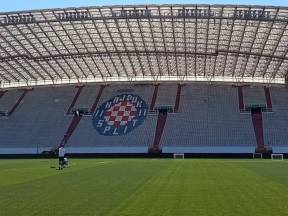
We are located on the northern coast of Split, next to the Poljud Bay, after which the stadium itself was named. It was built for the 8th Mediterranean Games held in Split in 1979. It was designed by Croatian architect Boris Magaš, and immediately after its completion, the stadium was recognized as one of the most innovative architectural achievements of its time.
The Poljud Stadium has a capacity of around 34,000 seats. It is unique for its shell-like shape and large arched roof made of transparent plexiglass, which covers most of the stands. The roof was technologically advanced at the time and one of the first of its kind in Europe. The construction was made without internal supports, which ensured maximum visibility from any place in the stands. Thanks to its shape and location, the stadium harmoniously fits into the landscape between the sea and Marjan Hill.
Since its opening, Poljud has been the home stadium of the Hajduk Split football club, which moved there from the previous Stari Plac. HNK Hajduk Split was founded on February 13, 1911 in Prague, when a group of Split students decided to establish a football club modeled after the leading European clubs of the time. Upon returning to Split, the club soon began operating and became an important part of the city's sporting, social and political life.
Throughout its history, Hajduk has been one of the most trophy-winning and popular clubs in the former Yugoslavia and Croatia. It has won numerous national titles, cups and supercups. The continuity of its activities is particularly noteworthy - Hajduk also played actively in wartime, including appearances in allied countries during World War II.
The club has a strong connection with the city of Split and its inhabitants. Its fan group, Torcida, was founded in 1950 and is considered the oldest fan group in Europe. Hajduk fans are known for their strong loyalty and involvement in the club's life, and since 2009 the club has operated under the "people's club" model, where members have the right to participate in its management.
Hajduk plays its home games at the Poljud Stadium, and the club is known for its large fan base throughout Croatia and beyond.
In addition to club matches, the stadium has hosted numerous sports, music and cultural events, including matches of the Croatian national football team, athletic competitions, concerts by world-famous artists, the Ultra Music Festival and various festive events.
Poljud has undergone several phases of renovation, including replacing the turf, modernizing the locker rooms, lighting and installing a security system. Despite these interventions, it has retained its original appearance and functionality. Since 2015, the stadium has been entered into the Register of Cultural Heritage of the Republic of Croatia as a significant work of Croatian modern architecture of the 20th century.
Poljud is today used for sports and public events and is one of the most visually recognizable buildings in Split. For Hajduk fans, especially Torcida members, the stadium also has a strong emotional significance. Thanks to its architectural value, location and function, Poljud is a symbol of Split in both the domestic and international context.