Amenhotep III - the magnificent
You are now standing at the entrance to the story of one of Egypt’s most magnificent rulers: Amenhotep III. Amenhotep III, often called “the Magnificent,” ruled Egypt during one of the most peaceful and prosperous periods in its history. He reigned for about 38–40 years in the 14th century BCE, as the ninth pharaoh of the Eighteenth Dynasty. Born as the son of Thutmose IV and Queen Mutemwiya, he ascended the throne at a young age – perhaps as early as six to twelve years old.
His reign was marked by stability, wealth, and international prestige. Instead of waging great wars, he built diplomatic ties with kingdoms across the Middle East and exchanged gifts with kings and princes from Babylon, Mitanni, and Anatolia. This peace allowed him to focus on art, architecture, and religion.
Under Amenhotep III, Egypt was transformed. He initiated enormous building projects: temples, statues, palaces, and sanctuaries. Many of the most impressive monuments in Luxor and Thebes were constructed during his time. His mortuary temple was one of the largest ever built, and at its entrance stood the monumental Colossi of Memnon – which still watch over the landscape today.
Amenhotep III left behind a kingdom in balance, an Egypt that radiated power and beauty. His legacy lives on in stone, in myth, and in the golden glow of an era often referred to as Egypt’s Golden Age.
Amenhotep III's mortuary temple
Welcome to Kom el Hettân – the site of one of the most magnificent temples of ancient times.
Over 3,300 years ago, Pharaoh Amenhotep III commissioned the largest mortuary temple ever built in Thebes. Spanning more than 350,000 square meters, the temple was larger than even the Karnak complex at the time. It was here that the pharaoh would be honored as a god both in life and after his death, and the complex was filled with courtyards, pylons, statues, and sacred rooms that sparkled in the sunlight from the Nile.
The architect behind the work was Amenhotep, son of Hapu – one of the most famous builders in Egyptian history. The temple faced east, so that the morning sun could fill the complex with light. At the entrance stood two colossal statues of the pharaoh – what we know today as the Pillars of Memnon.
But the temple was short-lived. It was built on a site with high groundwater levels, and large parts collapsed in ancient times. Later, blocks of stone were reused in other monuments, and earthquakes did the rest. For centuries, almost all that remained were the two colossi at the entrance.
Today, new parts of the temple are constantly being uncovered through archaeological excavations. Even in ruins, the site bears witness to the heyday of Amenhotep III – an era marked by wealth, peace, and monumental architecture.
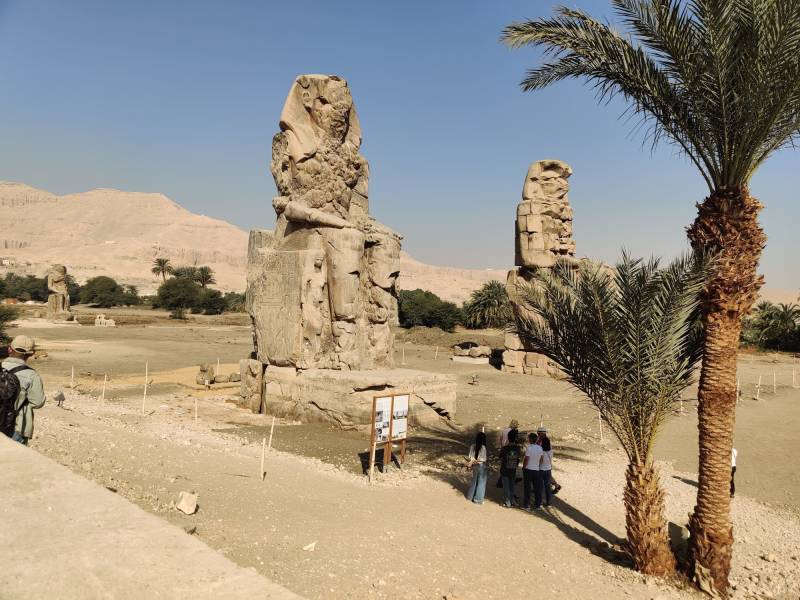
You are now standing in front of the Colossi of Memnon – two of the most impressive monuments on the West Bank of Luxor. More than 3,400 years ago, these colossal statues guarded the entrance to the enormous mortuary temple of Pharaoh Amenhotep III. Each statue is carved from a single block of sandstone and rises almost 20 meters above the ground.
The stone was taken from the vast sandstone quarries of Gebel el Silsila, about 170 kilometers south of Thebes. There, the gigantic blocks were first loosened from the mountain before being dragged down to the riverbank on sledges lubricated with water or oil. During the annual floods of the Nile, the blocks were loaded onto huge barges and transported northward with the current. It was an engineering feat that required precise timing, hundreds of workers, and a logistics that still amazes modern archaeologists.
The pharaoh sits on his throne, facing east and the sunrise, as a symbol of rebirth and eternal life. Although the temple behind them has long since disappeared, these two guardians still stand. They bear the marks of time – earthquakes, floods and erosion – but also a calm and dignity that has made them one of Egypt’s most iconic landmarks.
Take a moment to walk around the statues. See the smaller figures at the pharaoh’s feet, symbols of family and divine legitimacy. Also note the deep cracks and repairs that tell the story of thousands of years of natural forces and human admiration.
The sound of the northern support
This part of the story made the Pillars of Memnon famous far beyond Egypt.
In 27 BC, the northern statue was damaged in a powerful earthquake. After this, something strange began to happen: At sunrise, travelers could hear a faint, singing note from the statue. The sound lasted only a few minutes, just as the morning sun hit the cracked stone.
Greek and Roman visitors interpreted this as the voice of Memnon, a hero from Greek mythology who was killed in the Trojan War. According to legend, he greeted his mother, Eos, the dawn goddess, every day at sunrise. This is how the statues got their name.
The sound disappeared when the Romans restored the statue in 199 AD, but the rumor lived on. On the pedestals you can still see inscriptions from ancient travelers who came here to hear the “song”.
Today, the sound is gone, but the story of it lives on – a fascinating meeting of natural phenomenon, mythology and human imagination. Ibsen's Peer Gynt also travels to Egypt to find a deeper meaning outside himself, but he finds only emptiness and echoes, which reinforce his inner emptiness. The pillars are a symbol of a wisdom he is unable to grasp.