Loading ...
To find more content and listen to free audio guides, download the Guide To Go app.


To find more content and listen to free audio guides, download the Guide To Go app.
Welcome to Komiža! Komiža is a fishing town located in a bay on the western coast of Vis Island, at the foot of the island’s highest peak, Hum. The stone houses and narrow streets bear witness to a way of life that has endured here for over a thousand years. Since the 12th century, Komiža has been home to the bravest fishermen of the Adriatic. The local fishermen created the falkuša – a unique wooden boat designed for sailing to the distant island of Palagruža. These multi-week expeditions shaped the town’s identity and became a symbol of Komiža’s courage. Dominating the waterfront is the Komuna Fortress, built in the 16th century, which today houses the Fishermen’s Museum. There you can see original tools and learn more about the lives of Komiža’s fishermen, who for generations have faced the challenges of the sea. Komiža’s gastronomy deserves your attention. The Komiška pogača (Komiža pie) with onions and sardines is a perfect match for the local Plavac Mali wine. For lovers of natural wonders, the Blue Cave (Modra špilja) on the island of Biševo is an absolute must-see. When sunlight passes through an underwater opening, the cave is bathed in a mesmerizing blue light that takes your breath away. Throughout history, Komiža has been the stage for pirate tales, Venetian rule, and struggles for freedom. Here, every bay hides a legend waiting to be discovered. Welcome to Komiža – a place where the sea tells stories, and time flows at a different pace. ℹ️ Tourist Board of the Town of Komiža Tel/fax: +385 21 713 455 E-mail: info@tz-komiza.hr Address: Riva sv. Mikule 2, 21485 Komiža Office hours with visitors: In season (01 June 2025 – 30 September 2025): Monday – Friday: 09:00–20:00 Out of season (01 October 2024 – 31 May 2025): Monday – Friday: 09:00–13:00 🚢 Getting to the island: You can reach the island by ferry or catamaran, and travel around by bus or taxi. 🚕 More information: https://www.tz-komiza.hr/kako-doci ⛵ Nautical Center Komiža Address: Town Port Komiža, 21485 Komiža Phone: +385 21 713 849 Email: nauticki.centar.komiza@st.htnet.hr Open: 15 April – 15 October 30 berths with electricity and water connections, waste disposal, and access to sailing routes to Vis and other destinations. The center’s moorings are: Pul Guspu, Lučica, Lučka uprava (regular berths), Mezoporat pier, and Mezoporat anchorage. 🚑 Komiža Medical Clinic Address: Ul. Komiških iseljenika bb, 21485 Komiža Phone: 021 713 122 On-duty doctor (emergencies): 091 4010 148 The clinic provides general, family, and dental medicine services. ⚕️ Pharmacy of Split-Dalmatia County – Komiža Address: Ul. San Pedra 13, 21485 Komiža Phone: 021 713 445 Monday – Friday: 08:00 – 13:00 and 18:00 – 20:30 Saturday: 08:00 – 13:00 Sunday: Closed Note: The pharmacy is located near the medical clinic. 🏤 Komiža Post Office Address: Ul. Hrvatskih mučenika 8, 21485 Komiža Phone: 072 303 304 Opening hours: Monday: 08:00 – 17:00 Tuesday – Friday: 08:00 – 14:00 Saturday and Sunday: Closed Services available: “Bank at the Post Office” and Western Union. 🏦 Erste Bank – Komiža Branch Address: Ulica Barona Eugena Ransonneta 2/a, 21485 Komiža Phone: 072 373 659 Opening hours: Monday – Friday: 08:00 – 15:30 Saturday: 08:00 – 12:00 Sunday: Closed Note: An ATM is available at the branch. 🏧 Erste Bank ATM – Riva Svetoga Mikule Street Address: Ul. Riva Svetoga Mikule 38, 21485 Komiža Phone: 051 365 591 🧳 Travel Agencies: Alternatura Address: Hrvatskih mučenika 2, 21485 Komiža Email: info@alternatura.hr Offer: Environmentally oriented excursions to the islands of Biševo and Brusnik, visits to the Blue Cave and Medvjedica Cave, and educational programs about natural heritage. Srebrna Tours Address: Ribarska 4, 21485 Komiža Phone: +385 21 713 668 Mobile: +385 98 9487 332 Email: sandra.vitaljic@st.t-com.hr Working hours: 08:30–12:30 and 17:30–19:30 Offer: Organized boat excursions (Blue Cave, Biševo, Stiniva, Tito’s Cave), boat rentals, local transfers, and accommodation.

Located on the western part of the island of Vis, Komiža has grown for centuries along the sea, which has shaped its identity and everyday life. From the first records in the 16th century, through the immigration of families fleeing the Ottoman threat, to the fishing industry that has become the trademark of the place – history is intertwined with the sea and people. The visit of Pope Alexander III in 1177 is particularly memorable, when this was the first Croatian place visited by a pope. Legends such as the Route of Diomedes and archaeological traces testify to the thousand-year continuity of life and navigation, while tradition and nature preserve the story of the coexistence of man and the sea.
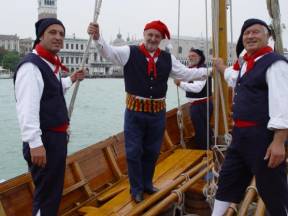
In Komiža, the sea is not just a space but also a destiny. For centuries, the people of Komiža lived alongside it and from it, carrying both its gifts and its dangers. Their lives were shaped by the ships they built, the language they spoke and the customs with which they invoked protection from heaven. Thus, a unique heritage was created – a combination of faith, knowledge and courage that still forms the heart of Komiža today. The fishermen and their boats were watched over by Saint Nicholas, the patron saint of travelers and the city, to whom they burned an old ship every winter as a sign of gratitude and prayer for the salvation of all others. From the need to survive on the high seas, the falkuša was born – a ship that hides two souls and which made the people of Komiža the first fishermen of the open sea. And in order to pass on all this knowledge, a special lingua halieutica developed, a fishermen's language intertwined with words about the sea, wind and catch. These are all threads of the same story – stories about Komiža, which for centuries has known how to love, respect and outwit the sea. Stories that today are not just memories, but living heritage, recognized and protected, and proudly carried into the future.
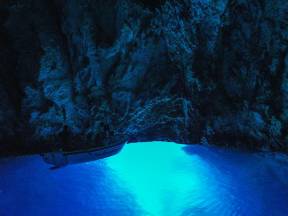
Komiža and Biševo preserve the unique heritage of the Adriatic – from natural wonders to cultural and historical monuments. The Blue and Medvidina caves bear witness to the beauty and power of the sea, while the Komuna Castle and the Fisherman’s Museum tell the story of centuries-old fishing tradition and the unique falkuša boats. The fortified monastery and church of St. Nicholas, known as Muster, have been the spiritual and defensive center of Komiža for centuries, and special rituals are still held there today. In the 20th century, fishing skills turned into industry – fish processing factories and the legendary Neptune have fed Komiža for more than a century. All these stories together form a mosaic of life in which the sea, faith and work have shaped the identity of this place.

From the small town of Komiža, a fishing village on the island of Vis, came people who have left their mark on the world's fishing history. Nikola Martinis - Fishman was the first to bring the spirit of innovation to America, creating the foundations of modern fishing. His fellow countryman Paul Martinis made his name in the cold waters of Alaska and the Aleutians, where he became the legendary "Salmon King", personally decorated by American President Eisenhower. Ivan Žuanić, an immigrant to Washington at the beginning of the 20th century, began building a fleet in San Pedro that would grow into the largest fishing force in the world, and his heirs turned the family tradition into the powerful "Zi Company". The pinnacle of this dynasty is Lawrence Zuanich, who in the 1980s commanded a fleet of thirteen tuna vessels and annually caught one hundred thousand tons of tuna - as much as thirty-fifths of the world's catch. His most loyal collaborator was Ante Dundov Kongo with his Kaljani, without whom this fishing empire would not have been possible. From Fishman to the Salmon King, from San Pedro to Guam, the people of Komiža have shown with their knowledge, courage, and tireless work that even a small town can produce the world's greatest fishermen.

In the middle of the blue Adriatic, far from the mainland, four islands of special power and stories emerge from the sea. Svetac, once a lively fishing island, preserves the memory of life in harsh conditions and the struggle of man with the sea. Brusnik and Jabuka, born from fire, are unique in their magmatic origin and black rocks that protrude from the open sea like sculptures. Brusnik slowly "grows" from the sea, while Jabuka, resembling a black pyramid, defies everything, offering no shelter to a single ship. The most distant and largest of them, Palagruža, has been a landmark for sailors for centuries, a mythical place of ancient stories and the scene of numerous shipwrecks. These islands are not just geographical points on the map - they are natural monuments, witnesses of geological processes, fishing ventures and maritime legends. Each of them tells a different story, and together they form a unique whole - the black pearls of the open sea, the precious heritage of the Adriatic.

On the islands of Vis, Biševo and Sveca, churches have been preserved that testify to the millennial presence of Christianity and the Benedictine order in this part of the Adriatic. The Church of Our Lady of Planica on Vis, with its rare circular shape, is reminiscent of the Church of St. Donatus in Zadar, while on Sveca, the small church of St. Andrew has been preserved – the remains of a former Benedictine monastery from the 13th century. On Biševo, in the settlement of Polje, there is the Church of St. Sylvester, built in the mid-11th century, known for the Madonna of Biševo, one of the oldest images of the Virgin Mary in Dalmatia. These valuable monuments of culture and religion, today protected cultural properties, connect the islands into a unique historical and spiritual whole.
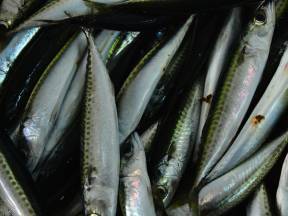
Dalmatian cuisine has always been a combination of sea, land and simple ingredients that are transformed into dishes rich in flavor and story. It smells of the sea in brudet, the warmth of home in Komiža pogača and the sweet festivity in Komiža cviti. Brudet is a dish of fishermen and farmers, born from the need to turn every catch into a delicious meal, while Komiža pogača speaks of togetherness and work around the table, when the dough is filled with salted sardines, onions and tomatoes. Cviti, on the other hand, bring a festive tone, because these crispy cookies are baked on special occasions and passed down from generation to generation as a sign of care and love. Together, the three recipes reveal the spirit of the island and the coast: simplicity, modesty, but also the richness of flavor that is created when tradition and nature come together on a plate.
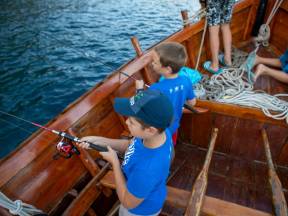
Komiža lives through a series of events that combine tradition, togetherness and love for the sea. The Biševo Trail connects sport and nature, and the Children's Kalanko Festival brings joy to the youngest through play and creativity. Fisherman's Night and Biševo Night celebrate the centuries-old fishing spirit and island customs, while Zalogaj velikog mora brings the entire island together around gastronomy, music and socializing. A special place is occupied by Rota Palagružona, the oldest regatta in Europe, which preserves the memory of the brave fishermen of Komiža and their maritime heritage. Together, these events create a unique story about the identity, tradition and life of the island of Vis.
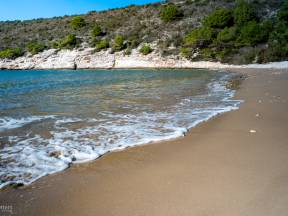
From pebble coves sheltered by pine forests to sunny stone terraces with crystal clear sea - there are beaches here for every taste. Some are ideal for family vacations and carefree swimming, while others offer peace and solitude far from the crowds. A special atmosphere is created by hidden coves that can only be reached on foot or by boat, where the sea takes on the most beautiful shades of blue.