Bygdøy - the Green Museum Peninsula
What makes Bygdøy so unique? This green peninsula has been a significant place for culture and history over the centuries. Once an independent island, and later royal property in the 1800s, Bygdøy has developed into one of Norway's most popular areas for recreation and museums.
The museums tell the story of Norway from the Viking Age to the present day. Bygdøy was once part of Oslo's outskirts, and large portions were transformed into a public park under King Carl Johan. The area boasts a rich cultural heritage, with buildings such as Oscarshall and Villa Grande, which reflect Norway's nation-building efforts and darker chapters during World War II. Due to its history and unique nature, Bygdøy is home to both nature reserves and protected cultural environments.
Today, Bygdøy is an oasis for both history enthusiasts and nature lovers. The best part is that these treasures are preserved for future generations.
In this guide, you can dive into the stories that connect the adventures of the Viking Age, the craftsmanship of the Middle Ages, the daring of polar expeditions, and Norway’s struggle for democracy and justice. Together, these narratives weave a red thread that stretches from the past to our own time.
You have now arrived at Bygdø Royal Manor, or Bygdø Kongsgård, an estate that covers more than half of Bygdøy’s total area.
Bygdøy has long been a popular retreat for the city's residents. In 1837, King Carl Johan purchased Bygdø Kongsgård, then called Ladegaardsøens Hovedgaard. Inspired by Djurgården in Stockholm, the king wanted to create a public park where people from Christiania could breathe fresh air and enjoy beautiful surroundings.
The public park was also intended as a place of cultivation, and over the years it was enriched with monuments, attractions, bathing areas, and dining establishments. Carl Johan’s son, Oscar I, continued the development by building the romantic-style summer palace Oscarshall. During the reign of King Oscar II of Norway and Sweden, the park was further expanded. Several old wooden buildings were relocated here to demonstrate the king's interest in Norway and strengthen the ties between the monarch and the nation. King Oscar II's Collection is considered the world’s first open-air museum and is now part of Norsk Folkemuseum, the Norwegian Museum of Cultural History.
Today, the royal family uses the manor's main building from 1733 as their summer residence and also has access to Oscarshall, while the Norsk Folkemuseum Foundation manages the forests, public park, and farm. You can book a guided tour to explore the farm, Oslo's largest organic milk producer. The estate’s nursery also features a farm shop and a café.
Here at Norsk Folkemuseum, or the Norwegian Museum of Cultural History, you can explore life in Norway from the Middle Ages to the present day. The museum features extensive exhibitions and one of Europe’s largest open-air museums.
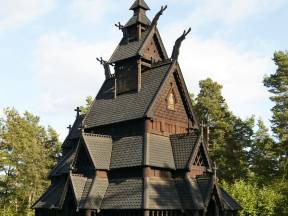
Just steps away, you’ll find an iconic attraction: the stave church from Gol, originally built in the 1200s, transported here, and reassembled in 1885. Stave churches are considered some of the world’s oldest standing wooden structures and are among Norway’s most significant contributions to the world’s cultural heritage.
In the late 1800s, interest in Norwegian history began to grow, particularly focusing on the early Middle Ages and Norway’s golden age. King Oscar II moved several old buildings to the public park at the royal manor, Bygdø Kongsgård, marking the beginning of the world’s first open-air museum, Oscar II’s Collection. When the congregation in Gol needed a new church, the "Society for the Preservation of Norwegian Ancient Monuments" purchased the stave church and gifted it to the king. It was then dismantled, transported from Hallingdal to Bygdøy, and rebuilt here as the jewel of the collection.
Today, Oscar II’s Collection is part of Norsk Folkemuseum, and the stave church is its most visited attraction. Step inside to admire the beautifully carved portals adorned with animal heads, dragons, and intricate vines, and experience a piece of Norwegian medieval history that has fascinated visitors for over a century.
Norwegian Maritime Museum
Welcome to Norsk Maritimt museum, or Norwegian Maritime Museum, where you can explore Norway's maritime heritage and more than a thousand years of maritime history through captivating stories about life on and by the sea.
In the Boat Hall here at Bygdøynes, you’ll discover a hidden chapter of Oslo’s history that lay beneath the city harbor’s surface for 400 years. Over the past decade, extensive archaeological excavations in Bjørvika, Oslo, have uncovered a wealth of artifacts offering a fascinating glimpse into life along Oslo Harbor from the Middle Ages to the 1600s.
Even centuries ago, Oslo was an important trading hub and a bustling meeting point for ships from near and far. In Bjørvika, archaeologists unearthed remains of over 50 boats, ranging from small vessels to larger merchant ships, showcasing the evolution of shipbuilding and trade through the ages.
They also found pottery, tools, weapons, and jewelry that tell the story of craftsmanship and the lives of those who lived and worked in the area. Tobacco pipes reveal smoking habits and international trade, while ice skates made from bones offer small glimpses into children’s winter play in old Oslo.
Step inside and dive into a past hidden beneath the waves. Experience Oslo’s untold maritime history up close.
Few people have put Norway on the world map like the man behind the Kon-Tiki Museum. Here, you’ll find Thor Heyerdahl’s famous raft, the Kon-Tiki, which crossed the Pacific Ocean in 1947. Did you know the raft arrived at Bygdøy via San Francisco and Antwerp? When it arrived in the autumn of the same year, there was no official welcome, but curious Oslo residents carved their initials into the soft balsa logs—marks you can still see today.
The raft was initially placed on the lawn at Bygdøynes before being placed in a small wooden structure, the Kon-Tiki House, where visitors could view this unique vessel. As the interest in Heyerdahl’s adventures grew, the museum had to expand. The current permanent building was completed in 1957 and has since become one of Norway’s most visited attractions.
Inside the museum, you can see the original Kon-Tiki raft up close and explore Heyerdahl’s other expeditions, such as Ra and Tigris, as well as the Easter Island excavations. Be inspired by tales of adventure, exploration, environmental activism, and the importance of collaboration and dialogue between people and cultures.
The museum is open year-round—welcome to a journey through the world’s oceans and history!
Villa Grande – a villa with a dark history
Times change, and so does Bygdøy. One of the area's most striking buildings, Villa Grande, has served many purposes over the years.
Today, Villa Grande houses the HL center - Holocaustsenteret, or the Center for Studies of the Holocaust and Religious Minorities. This magnificent building was originally started by Sam Eyde, the founder of the international company Norsk Hydro.
Over time, the villa has had many owners and functions, but it is perhaps best known as the residence of Norwegian Nazi leader Vidkun Quisling during World War II. Quisling had a high opinion of himself, claiming to be a descendant of the Norwegian saint Olav and believing this entitled him to a stately residence.
Quisling moved in during 1941 and renamed the house Gimle, after the golden hall in Norse mythology where humanity would reside after Ragnarok. During the occupation, Quisling and his wife Maria spent vast sums on renovations and luxury. Later, the building served as a training center for healthcare personnel before becoming home to the HL Center in 2005.
At the HL Center, you can explore exhibitions on the Holocaust and everyday racism, as well as the bunker Quisling built during the war. The center conducts research and education on the Holocaust, genocide, antisemitism, and racism. From housing Norway’s most infamous Nazi and traitor, Villa Grande has transformed into a hub of knowledge and a force in the fight against hate.
Be sure to visit, and enjoy Café Villa Grande and the villa’s beautiful garden!
Did you know that there were Vikings here on Bygdøy? This island must have been a beautiful place even 1,000 years ago, and during the Viking Age, it was actually a proper island, as the shoreline was different back then. Several Viking artifacts have been discovered here, including a well-preserved sword near Oscarshall, an axe found at Dronninghøyden, or the queens hill, and a knife, a ring, and a Frankish coin.
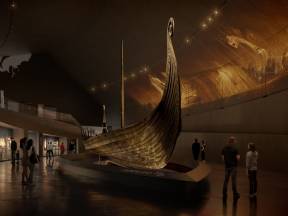
We don’t know how many Viking ships may have visited Bygdøy, but a particularly remarkable Viking voyage took place here as recently as September 1926. At that time, Norway’s national treasure, the Oseberg ship, was transported from Oslo city center to its then-new home at the Viking Ship Museum on Bygdøy. The transportation was an engineering marvel, involving both rails and a barge. Imagine the spectacular sight of the ship being carried through Oslo’s streets on tracks!
Since its opening, the museum has housed the Oseberg, Gokstad, and Tune ships, along with unique burial finds like ornamental sleds and animal heads. To preserve the ships for the future, the museum is now closed while a new facility is being built. The museum will reopen in 2027 under its new name, the Museum of the Viking Age, and will be three times larger and offering a modern, secure environment to showcase Norway’s greatest treasures.
You can look forward to a journey through the wealth and history of the Viking Age, right here on Bygdøy! In the meantime, feel free to explore more through the links below.
Norwegians have always loved to travel, whether as Vikings or as explorers discovering new worlds. Here on Bygdøy, you can learn about many of these adventurers and the vessels they used on their world-famous expeditions.
The Fram Museum is one of these treasures. It is home to the polar ships Fram and Gjøa—two of the most iconic vessels in polar exploration! Here, you can immerse yourself in the stories of Norwegian polar history and see the Fram that carried Fridtjof Nansen farthest north and Roald Amundsen to the South Pole.
Fram was restored and placed here in 1936, and the museum has since become a national attraction, welcoming hundreds of thousands of visitors annually.
The museum also houses the Hardanger sloop Gjøa, the ship that carried Amundsen and his crew through the Northwest Passage, marking a milestone in polar exploration. In 2013, a preservation building for Gjøa was inaugurated, thanks to contributions from several Norwegian foundations, and the museum continues to grow as a hub for Norwegian polar history.
The museum is also planning a new facility to address future challenges in the polar regions. The Fram Museum stands as a living symbol of Norway’s proud polar tradition, inviting you to delve into a world of expeditions, courage, and adventure.
Come along, step inside, and discover the stories behind the ships that conquered the ice!
Isn't this a beautiful area?
You’re not alone in thinking so. During a sailing trip in 1847, the sons of King Oscar I and Queen Josephine were captivated by the untouched, idyllic landscape here on Bygdøy. The King and Queen decided to build a palace, which they named Oscarshall.
Completed in 1852, Oscarshall holds a history deeply connected to both Norway and Italy.
In fact, the palace almost received the name Josephine’s Castle. Queen Josephine, born in Milan, contributed her own funds to its construction and drew inspiration from Italian architecture. When you look at Oscarshall’s flat roof and loggias, you can see clear references to Italian villas.
The building was designed by the Danish architect Johan Henrik Nebelong in a national romantic and neo-Gothic style, filled with references to Norwegian medieval traditions such as knightly castles and heraldry. At the time, Norway and Sweden were in a union, and the royal couple wanted to provide Norway with a monument that promoted Norwegian art and craftsmanship.
Oscarshall became both a summer residence and later a museum showcasing Norwegian values and traditions. The pleasure palace still stands today as a symbol of the national romantic area and is open to the public during the summer season.
Bygdøy – A Living History Book
Bygdøy is more than just a place for museums and natural beauty; it’s a gateway to the past that helps us understand who we are today. Every corner of this peninsula tells a story—whether it’s the Vikings’ expansion, medieval religious art, or the daring polar expeditions. But what can we learn from these stories? They remind us that human curiosity, perseverance, and adaptability have been essential to our survival and progress.
Today, we face our own challenges, such as climate change, social inequalities, and the fight for human rights. The stories on Bygdøy show us how past generations navigated crises and change. They underscore the importance of preserving knowledge, being courageous in the face of the unknown, and valuing community.
Take a moment to reflect on your own role in the history that’s still being written.
What legacy do we want to leave for future generations? Bygdøy is a reminder that we are all part of a larger story—one that continues to evolve, where each of us has an important role to play.
Welcome to visit a museum on Bygdøy, welcome to history, enjoy the scenery and enjoy your journey into the future!