Join us on this fantastic boat trip along the urban quays in Oslo and out into the idyllic archipelago. There lie the great treasures of the city's history, people and nature over thousands of years. And not only that!
You will see and experience with your own eyes the fantastic changes that Oslo's harbor areas have undergone since the start of the millennium. What was once a busy industrial and port city, has been transformed into an urban and vibrant fjord city for the people with attractive common areas, and good, living urban spaces that are inclusive and accessible to the general public. Here you will find walking areas, harbor promenades, cycle paths, restaurants, museums, galleries, sea baths, saunas and more.
You get to experience all this directly with good narration, pictures and text as the boat approaches or passes the places along the route.
And should you want more information, you will find links and other necessary information under each story.
We at The Fjords will do our utmost to give you a good travel experience. Enjoy the trip!
Click on the link below and use code 1874. The video is in English.
We are now sailing into Bjørvika, this is a new part of the city that has sprung up from the former container harbour which was previously located here.
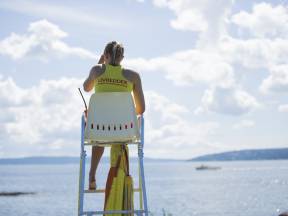
In the inner part of the bay, tower the row of characteristic high-rise buildings, known as the Barcode skyline, which gaze down on the beautiful cultural sights of the Oslo opera house and the Munch Museum.
Both of which are hugely successful and attract visitors from all corners of the globe.
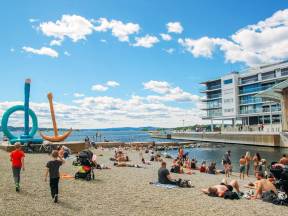
To the right of the Munch Museum, you can see Bispevika and Oslobukta, which run in to the brand-new district of Sørenga with its distinctive seawater pool at its tip.
On the opposite side of the bay, you can find Salt which is a new cultural village with six stages, inviting restaurants and steaming saunas.
The history of Oslobukta and Bjørvika is the story of Oslo. It was in this area that Oslo was originally founded.
Right up to the Middle Ages the city centre was located here, strategically placed on the waterfront as a hub for transport and trade.
After the dramatic city fire in 1624 the centre was rebuilt further west.
Today residents and tourists mingle here in this melting pot of food, culture, art, and events, here where the city meets the fjord.
If you are tempted with swimming and a sauna. Then we recommend one of the floating saunas which bob up and down on the fjord around us.
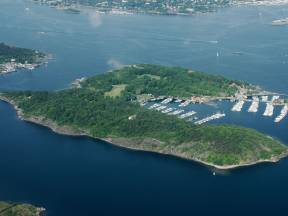
If you look towards the five islands to the east, you will see Hovedøya closest to the centre of Oslo.
The island has a permanent boat connection with Oslo and an abundance of inviting beaches surrounded by beautiful woodland and a rich cultural heritage.
You can wander freely through large parts of the island, but part of the island is a nature reserve where the rich fauna is protected.
Hovedøya, with its proximity to the city was a natural strategic position for an external defence, in addition to being used both as a recreational and residential area.
At one point around 1100 women who had been in contact with enemy soldiers during the second world war were interned on the island.
You can still see the remains of the canon batteries and gunpowder houses from the early 1800s which amongst other things were used during the Napoleonic wars.
At the north of the island, you will find the ruins of a Cistercian monastery, it was built by the English Abbott Philippus in 1147. On his arrival at Hovedøya he found a small church which he extended and also built a monastery dedicated to the virgin Mary. In 1532 the monastery was plundered and burnt down; the ruins were not excavated until the middle of the 18th century.
We are now passing Vippetangen, which is an old historic area in Oslo with a fascinating history.
The area has been in use since the Middle Ages as an important port and trading post. In the 17th century, a customs station was established here, and Vippetangen became an important hub for trade and transport.
During the 19th century, Vippetangen was developed into a modern harbor with quays and warehouse buildings. A passenger terminal, fish hall and grain silo were also built. Here you could take the local boats out to the islands or jump on board the "Americaboats".
During the Second World War, Vippetangen was heavily destroyed, but after the war the area was rebuilt and given new life. Today, Vippetangen is a popular destination for tourists and locals. Here you will find restaurants, cafes, boat trips and a great view of the Oslo Fjord.
The danish prince, Christian Frederik, landed here in 1905 and became the first king after Norway broke the union with Sweden. He changed his name to Haakon VII.
Akershus castle and fortress
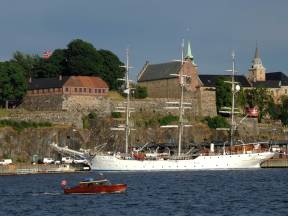
Up on the hill to the right, you now see Akershus Castle and Fortress. The construction of this majestic medieval royal stronghold began in the late 1200s, carrying a long and exciting history. Over the years, it has served as a royal residence, a defensive fortress, and a prison. Today, the Akershus Castle area houses the Defense Museum, Akershus Church, Norway's
Home Front Museum, Karpedammen, cultural agencies, and several restaurants.
Inside Akershus Castle, you'll find remnants of the original medieval fortress, rooms from the Danish-Norwegian kings' residence, grim dungeons, narrow corridors, and grand halls. It also houses the Royal Mausoleum where members of the royal family are buried. The Defense Museum exhibits the dramatic history of the Norwegian defense, focusing on the period from the 1400s to the present day. It provides insight into the rapid development of the defense forces, spanning technology, economics, and political decisions.
At the top of the area, perhaps the most exciting museum on the fortress, is the "Hjemmefront museet" or Home Front Museum. Here, you gain a solid understanding of the dark years from 1940 to 1945 when Norway was occupied. Nevertheless, the museum also pays tribute to Norway's men and women in the Home Front who worked tirelessly for freedom and democracy. The fortress area is open every day of the week. Check opening hours and activities on the links below.
Hjemmefront: The civil resistance movement in Norway during the Second World War.
The City Hall, National Museum, Nobel Peace Center
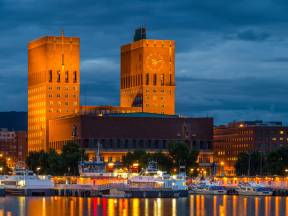
At the innermost part of the bay, you can see Oslo City Hall with its monumental sculptures guarding the impressive building. The City Hall is a gem and a symbol of Norwegian architectural history. Completed in 1950, it is known for its distinctive clock tower and beautiful brick facade. Many things are administered from this building in this beautiful northern metropolis, whether by the city's bureaucrats or the elected representatives in the Oslo City Council. The City Hall also proudly hosts the annual Nobel Peace Prize ceremony.
To the left of the City Hall is the Nobel Peace Center, a museum dedicated to the heroes who have received the Nobel Peace Prize for their remarkable work in peace and conflict resolution. The Nobel Peace Prize is perhaps the world's most prestigious award and is presented here in Oslo. The museum is surrounded by the largest art museum in the Nordic region, "Nasjonalmuseet" or the National Museum. It is simply an impressive and grand structure both externally and internally. Here, you can experience both classical and modern art, creative contemporary art, beautiful architecture, and enchanting design under the same roof and in entirely new ways.
The City Hall, National Museum, Nobel Peace Center, and the Nobel Prize are all important symbols of Oslo's history and the city's international significance, rooted in collaboration for peace and democracy.
Do you see the stylish people gathering around the fashionable restaurants and apartment complexes along the docks?
That's Aker Brygge. In the old days, there were no restaurants or apartments here, but there were just as many people. They didn't have as fancy clothes, and the pleasant smell of food was probably replaced with diesel, burnt steel, and scorched coffee.
Aker Brygge is built on what used to be the shipyard, Akers Mekaniske Verksted. The shipyard, initially a workshop, was established in the mid-1800s and eventually gained a large and central position in the Norwegian industrial environment that lasted for over 140 years. The shipyard was closed down in 1982, and the old factory buildings were either demolished or converted into modern homes. And just like that, the sounds that had characterized the city for so long vanished, the banging against steel, the trucks, and the countless signals for shift starts, breaks, or stops.
Extending from Aker Brygge is Tjuvholmen, which also has an interesting history. It was once an abandoned part of Oslo but has now been transformed into a modern and artistic area.
Here, you'll find many art galleries, a sculpture park, modern architecture, and a variety of excellent restaurants and cafes. Also located by the waterfront is the Astrup Fearnley Museum, a modern art museum.
Tjuvholmen is a beautiful gem today, but in the really old days (in the 1600s), the sight that greeted seafarers might have been a bit different. The area was once a sanctuary for the city's rogues. The name Tjuvholmen, or Thief Islet, originates from the time when the city's thieves were taken to the gallows on the islet and hanged. It was not uncommon for the loot from both small and large robberies to be buried out here, something the police quickly caught wind of, of course.
We are now passing Bygdøy to the left, here you can find world-class cultural heritage, such as Viking ships and other Viking treasures, the iconic exploration boats Fram and Kon Tiki, as well as Norwegian houses from a whole millennium.
Norwegians have always had a passion for travel and discovery with a determination to be the first.
The Vikings voyaged around the world and were the first to discover America.
Later the Norwegian flag was planted both at the North and South poles, but unfortunately, they did not make it to the moon first.
Alongside the idyllic beaches you can also find Bygdøy royal farm.
The monarchy has always stood strong in Norway and the motto of the Norwegian Kings has become “Alt for Norge” – ‘’everything for Norway”.
Popular, warm, and empathetic in the good times and a man of action in the bad times are descriptions of the King that contribute to the fact that the Norwegian people not only support the King but also look up to and admire him.
Should you be lucky enough to meet the King, you should address him as “Your Majesty”.
We are now on the peninsula of Bygdøy, where you can delve into Norwegian history. This picturesque area invites leisure, recreation, and learning. Here, you'll find the "Norsk Folkemuseum" or Norwegian Folk Museum, one of Europe's largest and oldest open-air museums and a national cultural history museum. There, you can become acquainted with how people in Norway lived from the 16th century to the present day.
Right by the fjord is the Kon-Tiki Museum, allowing you to get to know one of history's most famous explorers, Thor Heyerdahl, and his achievement when he and his team crossed the Pacific on the balsa raft Kon-Tiki. Four years later, he made a documentary that won the prestigious Oscar in Hollywood.
The Fram Museum focuses on other maritime explorers, but this time in colder regions. Brave men have embarked on polar expeditions to the Arctic and Antarctica, and the museum provides insight into Norway's pioneering polar history. You'll become familiar with pioneers like Fridtjof Nansen, Otto Sverdrup, and Roald Amundsen, and you'll get to see perhaps the world's most famous polar ship, the FRAM.
"HL - senteret" or the The holocaust Center is an important institution with exhibitions and events that convey the history and consequences of the Holocaust, genocide, racism, and other abuses against minorities.
Check the links below for more information on opening hours, events, and content.
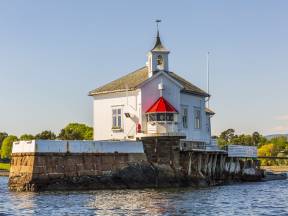
Now we come to the journey's most popular insta-moment, Dyna Lighthouse.
The lighthouse is one of Norway's 212 lighthouse stations throughout history. It was built in 1874 and consists, as you can see, of a fog bell, a beacon, and a residence for the lighthouse keeper and their family. A lighthouse keeper lived here, ensuring that the light was lit and the tower clock was wound up. The light alone wasn't enough when the infamous thick Oslo fog settled like a blanket over the fjord.
Today, we might romanticize the life of a lighthouse keeper out here on the islets, but it was also challenging, hard work with little room for movement. Five different lighthouse keeper families have lived here over time, and at one point, one of them had four children as lived simultaneously on this small, wind-swept islet! And imagine this – they also had pets like dogs, cats, pigs, and chickens.
It was dramatic at times too. In 1954, the gigantic 10,000-tonner "Sunny Queen" ran aground on the islet, and it's said that the lighthouse keeper could open the window and almost touch the stranded ship.
The lighthouse was fully automated in 1956, and that's when the lighthouse staff moved out. It stood practically empty until 1992 when some clever minds decided that the lighthouse could be suitable as an event venue. With a sense of the old days, Dyna Lighthouse reopened its doors for special events and fantastic dining experiences.
Dyna Lighthouse is now a protected cultural heritage site and a popular tourist destination.
It is easy to be awed by all the things around you as you travel through the beautiful Oslo Fjord, but have you thought about what can be found underneath us?
You might think of fish, crabs, and seaweed, but just as it is above the sea line, the underwater kingdom is also teeming with life, stories, and mysteries that we only know the tip of.
The water and seabed are a biological treasure chest which we need to protect and harvest in a sustainable way.
The environment and availability of food for the species that live here have changed. Attributable, both to man made changes and natural variations in the environment.
This can be seen here as cod have all but disappeared from the Oslo fjord. If the treasure chest is to be preserved then more regulations will be needed to restrict the effect of people on the fjord, which could for example entail a ban on the fishing of cod, lobster, and other species.
Other regulations include restrictions on boats. In Norway the cruise ship industry is in the process of being regulated, and new measures are ongoing.
At The Fjords we take the fjord, fish, and the environment seriously and they are at the forefront of our development. Our 3 newest boats meet and go beyond current requirements.
Do you dream of throwing off your clothes and swimming naked in summer? Well now you have the opportunity.
Towards the mainland you can now see Huk, where you will find one of Bygdøy’s most inviting swimming beaches, and it is here you will also find one of Norway’s most famous nudist beaches.
Here as in the rest of the world, nudist beaches are often combined with so called ‘clothed beaches’, or normal beaches where naked bathing is forbidden.
In Norway nudist beaches are usually marked with ‘naked bathing permitted’, but it is not obligatory to be naked.
You can also keep your shorts on, even though you are on a nudist beach.
The Oslo fjord is full of beautiful beaches, but according to international beach ratings, some of the world’s best beaches can be found in Vestland and in the harsh north of the country.
Why travel to Spain or the Maldives when you can experience several of the world’s most beautiful beaches here in Norway?
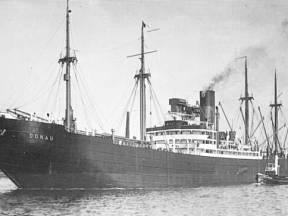
On the 26th of November 1942 the German cargo ship DS Donau sailed past this exact spot.
On board were 532 unsuspecting Norwegian Jews, crammed together into the cargo hold on their way to the concentration camp at Auschwitz, 303 men, 188 women and 42 children.
They arrived on the 1st of December 1942 and the women, children and elderly were sent directly to the gas chambers. Of those who left only 9 returned to Norway.
This assault meant that this was also the day that Norway suffered its greatest loss during the Second World War.
Three years later, in January 1945, the DS Donau was sunk by the resistance heroes Max Manus and Roy Nilsen, the ship sank right outside of Drøbak.
It was at that point retreating and was full of German troops and equipment heading towards the Russian frontline to fight against the allied forces during the final phase of the war.
The ship was raised and removed in 1952, but there are still remnants of the equipment on the bottom of the fjord.
Holmenkollen and Frognerseteren
If you turn your gaze towards the land and up, you will spot the impressive ski resort, Holmenkollen. It's a natural stop during winter, whether you have skis on or not. Here, professionals, hikers, and spectators from around the world gather for ski jumping, cross-country skiing and biathlon, whether it's a Sunday outing, a World Championship, or the Olympics.
But don't despair if you visit in the summer. During that time, the winter sports haven transforms into a green oasis for local hikers and visiting tourists. They enjoy the beautiful trails, visit the ski museum, learn about Norwegian ski heroes, and then venture up to the ski jump tower, where they can see large parts of Norway. Behind Holmenkollen lies Frognerseteren, a historic landmark turned into a living museum area, blending modern elements with the surrounding nature. In the middle of the forest, Roseslottet stands in gold, featuring over 300 monumental artworks dedicated to democracy, legal security, and humanism.
A little further up in Åssiden is Skimore’s facility at Tryvann, offering inviting alpine slopes for both adults and children. This is where Norwegians truly embrace nature. With a smile on their faces and the joy of outdoor life in their hearts, they explore these areas with the motto "Out on a hike, never grumpy." The nature around Holmenkollen and Frognerseteren is living proof that humans and nature go hand in hand.
Just give it a try!
As soon as you leave a city or town, you see them everywhere, small idyllic houses located along the river, on the waterfront, the mountainsides and in the forests.
These small houses are of course cabins and holiday homes used during the holidays and weekends.
We are now passing the islands of Nakkholmen and Lindøya which are home to 182 and 300 cabins respectively.
The islands were regulated for cabin use early in the 1900s with strict restrictions.
Life at the cabin is often characterised by its closeness to nature and a break from city life.
As early as the 17th century the upper classes had already begun to use country houses, but farmers and fisherman also took a break from their everyday life in summer farms or fishing cabins.
Increased prosperity, shorter working weeks and longer holidays led to an acceleration in cabin building beyond the 20th century.
Today there are almost half a million cabins and holiday homes in Norway and many small villages double their number of inhabitants when the cabin guests arrive.
Take a good look at the islands behind the lighthouse we are passing now. Believe it or not, but there was actually an airport here! When it was built in 1927, it was also Norway's first scheduled airport. Of course, it was shut down as these three small interconnected islands—Gressholmen, Heggholmen, and Rambergøya—are barely larger than a Boeing 747. Locally, all three islands are collectively known as Gressholmen.
Heggholmen Lighthouse was built in 1876 and has both a light and a fog bell to safely guide boats into the Oslo harbor. As you can see, the lighthouse is surrounded by idyllic nature and beautiful beaches. Both people and birds thrive here. The bay between the islands is an important nesting and grazing area for seabirds. Over 160 different bird species have been recorded, and 340 different plant species documented on the islands. Because of this, the area is registered as a nature reserve, and camping or lighting fires on the islands is not allowed.
However, it is possible to visit the island, and there is a very cozy inn that is beautifully situated and open during the summer. In 1865, the "Christiania Vaabenøvelsesforening" built a clubhouse and shooting ranges on the island. Members could buy milk, beer, and sandwiches in the shooting association's house. Additionally, they were served free tobacco!
Whether they also got free coffee with the tobacco is not known.
Today there are an amazing million pleasure boats in Norway, which equates to a boat per every sixth person.
No other country can match such a boat density!
Norway’s coastline could stretch 2,5 times around the equator, it therefore goes without saying that Norway has been a world leading boating nation since Viking times, when Norwegian Vikings spread fear and unrest across the continent.
During the second world war, Norway already had the world’s fourth largest fleet of ships, which were commanded by the Norwegian government from London.
34 000 Norwegian seamen sailed every day risking their lives on those merchant ships to keep the infrastructure running, but unfortunately, not without losses, around 3000 people fell victim to acts of war at sea over those tragic five years.
Today, this leading expertise is reflected in ship use, technology, design and production
The Fjords have several such ships which provide tours along the beautiful Norwegian fjords, and which have won prestigious titles including «Ship of the Year».
The People's Park Hovedøya
Now we're passing "Disney Norway." Check out the enormous roller coasters, pools, and water slides.
This is, of course, just nonsense, but it could have been a small reality if Oslo's politicians had the money and got their way. In fact, the plans for an amusement park went so far that the Oslo municipality quietly established a boat route here in 1963 to Hovedøya called "Folkeparken Hovedøya" (The People's Park Hovedøya).
Not many people noticed, but, of course, a Swede took the bait. After all, public parks or "Folkepark" in Sweden are something else than public parks in Norway. A "Folkepark" in Sweeden is more like an amusement park. The Swede was, of course, "disappointed." There were a few trees, some open paths, but otherwise, the island was closed as before to the Norwegian defense. No carousels, no roller coasters, and no kiosks. He couldn't even get a coffee.
Oslo City Council decided in 1954 that Hovedøya should become Oslo's new People's Park, and a bridge should be built from the city center to the island. The costs and consequences for boat traffic eventually became too much, and the project was eventually discontinued, but only after 1963.
From Kavringen to Ekeberg
We are now passing the charming beacon, Kavringen, which has been blinking year-round since 1892 to protect boats from the reef it stands on. The small stone plateau is a favored spot for numerous seabirds and, like many other places in the Oslo Fjord, is protected from human activity for most of the year.
The lighthouse holds a very special secret. Here, citizens of Oslo have written their greetings to future generations, to be opened only in 1000 years.
Soon, we'll be heading towards the city center, and you will be able to see one of Oslo's most famous vantage points, Ekeberg, located on the slope to the right of the center. There, you'll find "Sjømannskolen", an old and venerable sailor's school standing as a monument in front of Ekebergsletta, the venue for one of the world's largest football tournaments, the Norway Cup.
Next to the Sailor's School, there are traces of Oslo's first settlement from 5000 years ago, well-documented by carved rock art depicting animals and humans. From Ekeberg, there are beautiful roads and romantic paths leading down to the city center and Ekeberg Park, where you'll find some of the city's finest restaurants, viewpoints, and, most importantly, a fantastic sculpture park in perhaps Norway's most beautiful surroundings.
From there, you can follow the road all the way down to the Medieval Park and take a refreshing swim if the weather allows.
Then, you are just a stone's throw away from the opera house and our docking point in Bjørvika.