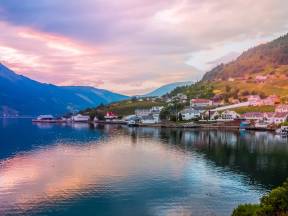
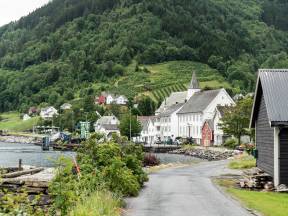
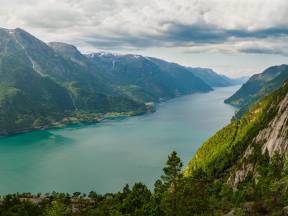
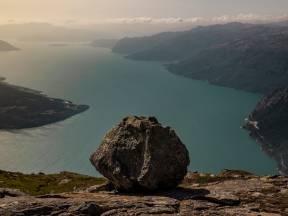
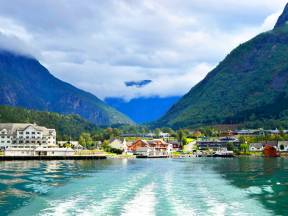
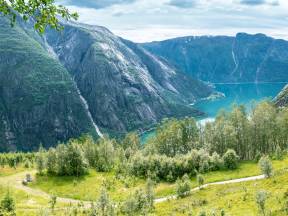
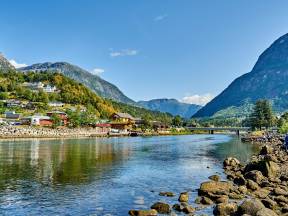
Join one of the world's most beautiful boat trips through the adventurous Hardangerfjord to the idyllic and national-romantic villages of Eidfjord and Ulvik.
Here, old history meets new modern infrastructure and energy innovation. The scents and flavors literally hang over you no matter where you turn.
In addition to the spectacular nature, where mirror-like glaciers and wild waterfalls meet sheltered fjords and mysterious mountains, the cultural landscape gives the area an extra dimension where old farms and summer pastures literally cling to the steep mountain sides.
On this boat trip, you will experience all of this directly on your phone with good storytelling voices, pictures, and text as the boat approaches, stops or passes the places along the route.
We at The Fjords will do our utmost to give you a good travel experience. Enjoy the trip!
Click on the link below and use code 1874. The video is in English.
The Worlds most tasty boat trip
This scenic boat trip between Odda and Lofthus, has been refered to as one of Europe’s most tasty boat trips.
And with good reason, this stretch of water has no less than four stops at world class cider producers.
The lush and beautiful nature is also a sight to behold, with visual gems coming one after the other.
In this audio guide you will become acquainted with the places, the exciting stories behind the cider production, and the spectacular nature.
All of this you can experience directly through the comprehensive narration, pictures and text as the boat approaches or passes the places of interest along the route.
We at the Fjords are working to do our utmost to deliver you an excellent travel experience. Enjoy the tour!
“If I had of known it was so beautiful, I would have visited before” those are the words of the famous
Norwegian author Bjørnstjerne Bjørnson, when he visited the beautiful village of Lofthus.
And many, especially artists agree with him. Many have found inspiration here for compositions, paintings and maybe even the national anthem.
So now you find yourself in the ‘Orchard of Hardanger’, which is how many people refer to the idyllic and beautiful town of Lofthus.
And with good reason! The town has been at the heart of Norway’s fruit production for hundreds of years.
It is therefore a great place to start becoming acquainted with the world renowned Hardanger Ciders.
Her Majesty Queen Sonja also finds peace of mind and inspiration here every year.
You can follow in her footsteps, by walking the Queen’s path or «Dronning Sonjas panoramatur», which will take you 1100 metres up the mountain between Kinsarvik and Lofthus.
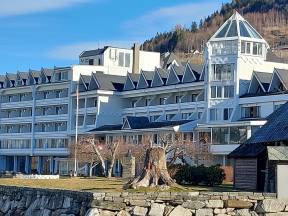
We also recommend a visit to the venerable and fashionable, Hotel Ullensvang.
Today, it is a modern hotel that promotes Norwegian and local traditions at a high quality, where you can follow in the footsteps of the world-famous composer, Edvard Grieg.
Believe it or not, children learn to spit here at the school in Lofthus.
Every year the town organises a cherry festival, and every year the title of the best cherry stone spitter is awarded in the junior, ladies, and men’s categories.
The official world record is over 15 metres!
Maybe you can try and beat it!
This journey is full of sensory experiences and maybe right now you are enjoying a glass of real Hardanger cider?
We are now in the heart of the Sørfjorden with a panoramic view over the industrial town of Odda.
As you can see, the town is surrounded by fjords and mountains with beautiful, lush valley sides, which perhaps stand in stark contrast to the slightly grey industrial history which the town was an exponent of.
Odda played a central role in Norwegian industry at the beginning of the 1900s, with Odda smelting works at the forefront. Today, the unused factory is a protected cultural monument and has been nominated as a UNESCO world heritage list site.
Today the town is a modern community and a meeting point for adventure enthusiasts who want to experience the Hardanger area whether that’s the majestic fjords or the wild rivers and waterfalls, the azure blue glaciers or the spectacular mountains or plateaus.
Here you also have a very rich and diverse literary culture, and every autumn there are festivals, literature symposiums, with the renowned Odda author Frode Grytten at the forefront.
We are now passing the village of Grimo to the north.
Here, like many other places in the area, most of the industries are based on fruit production combined with sheep farming. This way, they not only preserve the beautiful cultural landscape, but also promote local economic development and processing of local raw materials.
The climatic conditions, together with the rich soil, provide a basis for growing high-quality fruit. Cherries, apples, plums, and pears are the most important, but creative farmers are constantly finding new ways to use the land.
At Grimo, the soil and climate are particularly good, reportedly better than many other places in Hardanger. It is said that grain was grown and beer was brewed here in ancient times, and the beer was both tasty and good due to the high quality of the grain.
They also tried to grow grain on the opposite side of the fjord, but it was mostly suitable for making soup.
According to some old sources, the area was therefore named "Supastranda" or "Soup Beach" due to the poor soil.
According to local experts, Grimo enjoys half an hour more sunlight every day than the opposite side of the fjord.
«Here you can find fjords, mountains, glaciers, fruit, agriculture, fishing and world leaders in industry all in one municipality». This is the slogan of Ullensvang municipality, of which Odda is the centre of administration.
Hardanger is full of contrasts, but beautiful and charming contrasts!
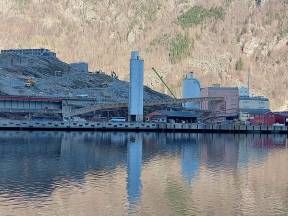
We are now passing the Boliden Odda smelting plant which is a world leader in the handling of raw materials and recycling of metals.
Copper, zinc and nickel are all necessary building blocks for society, but both the production and the product stand in stark contrast to the beautiful nature, the fragrant fruit trees and the fresh world famous Hardanger cider.
Nevertheless, cider and zinc have been produced side by side for hundreds of years. They complement each other and have created the beautiful community that you experience on your journey today.
We are now passing between the villages of Kinsarvik and Utne, which are served by several daily ferry departures. To the north, in the small charming village of Utne, lies one of Norway's oldest and best-preserved wooden hotels, Utne Hotel. A visit there not only provides peace and tranquility for the soul, but also an insight into the rich nature, art, and cultural history of Hardanger.
On the opposite side of the fjord, at the innermost part of the bay, we see the idyllic fjord village of Kinsarvik, which marks the outlet of the roaring river Kinso. It stretches almost fifty kilometers past several of Norway's largest and most spectacular waterfalls in the world-famous Husadalen, and almost 1500 meters up to Europe's largest national park, Hardangervidda.
Both the village, the valley, and the magical waterfall landscape make this area to one of the greatest natural pearls in Hardanger with activities for both young and old. The village's main attraction is Mikkelparken. It is a dream Eldorado for the children where they can indulge in various activities either alone or together with their family.
Here you can lean back and enjoy nature, wake up to the sound of the river and bird song, or if you're up for it, exhaust fumes and burnt rubber on Kinsarvik's own go-kart track.
The boat is now passing through the middle of Utnefjorden, Sørfjorden, and Eidfjorden, all part of Norway's second longest fjord, Hardangerfjorden. It stretches all the way out to the coast in various branches from Haugesund to Bergen.
The nature and culture you find here have enchanted visitors of all times, and the beautiful fjords are considered by many as the very symbol of Norway, the foremost fjord country in the world. Humans have taken root here since the ice retreated 10,000 years ago. They harvested what nature had to offer, whether it was in the fjord, on the valley sides, or in the high mountains.
For the last 150 years, scientists, artists, and tourists have flocked to the fjords to experience the dramatic, contrasting, and magical nature. The magnificent fjord landscape has made a strong impression on many and has inspired both poets and artists.
Perhaps Norway's most famous painting, "Brudeferden i Hardanger" , in english "The Bridal Procession in Hardanger" by Tidemand and Gude, was inspired by this area.
At Tysseldassida, around six kilometres towards the Hardanger plateau, you can find the village of Skjeggedal and the Ringsdalsdammen dam.
The latter is a whole 521 metres long, 33 metres high and built of hand chiselled granite. This makes it the largest dam of its type in Norway.
Unfortunately, such constructions can’t be made without dramatic effects on the surrounding nature.
At one time, Norway’s highest free fall waterfall stood here - Tyssestrengene.
Together with Ringedalsfossen, they were close to becoming a major tourist attraction before they were forced into pipes for power production.
Across the valley there are several experiences for both body and soul.
People from all over the world come to Hardanger to experience the mountain spring Trolltunga which is one of the most spectacular viewpoints in Norway.
Not far away you can also find the protruding Preikestolen (The pulpit rock), which is a slightly smaller version of the famous Preikestolen in Lysefjorden.
It is recommended to take a stop in Skjeggedal on your way, to visit the power station and accompanying buildings that house several hundred years of history.
The name ‘Sjeggedal’ originates from a time when an outlaw from Telemark settled in the valley. He let his hair and beard grow and consequently got the name ‘skjegge’ which means beard.
Tyssedal and Power Museum
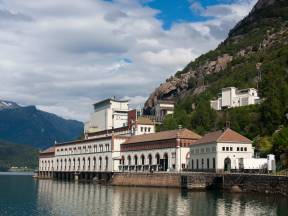
We are now arriving at the industrial town of Tyssedal where you can see the protected power station down by the fjord.
It is a powerful monument to the hydro-power and industrial adventure that started here at the beginning of the 1900s.
A visit to the power station can give an insight into the period when Norway was transitioning from a farming to industrial society.
The museum gives a vivid insight about the life of, the workers, or rallars as they were called, the engineers and architects and how modern towns and cities grew in the middle of the beautiful and sometimes impassable nature of Vestland.
From the village you can continue up to Europe’s highest high mountain plateau and to a myriad of other magical and spectacular natural experiences such as the trip up Himmelstigen to Trolltunga.
Here at Tyssedal they have been producing clean, green, and renewable energy for 100s of years.
This is to our delight as we are dancing silently across the fjord with the ‘Vision of the Fjords’, which is a premium environmentally friendly hybrid vessel which in 2016 won the prestigious prize of ‘Ship of the Year’.
Hardanger has world-class apples, cider, mountains, waterfalls, and bridges.
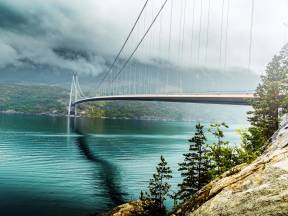
We will soon pass under the bridge called "Hardangerbrua", When it was opened in 2013, it was the tenth-longest suspension bridge in the world with Norway's longest main span of almost 1,400 meters. It's actually 30 meters longer than the slightly more famous Golden Gate Bridge.
The bridge literally goes straight into the steep mountainsides on either side of Eidfjorden, where almost three kilometers of tunnels distribute vehicles further through roundabouts to the Norwegian cities of Oslo, Bergen, and Stavanger.
The roundabouts inside the tunnels are an attraction in themselves and appear almost like magical fountains of light, wishing motorists a good trip ahead.
By the way, the Hardanger Bridge was also the location for filming action scenes in the well-known thriller "Thunder", which took place in Odda.
It's not difficult to understand why everyone is dazzled by the magnificent and beautiful nature that greets us here inside the fjords. Nonetheless, something happens when darkness descends or when thick fog hangs like an impenetrable blanket between the valley sides.
Then, myths and legends arise about both hulders, trolls, sea serpents, or goblins. This is also the case in this area, and many tellings have taken root in local communities and are still exciting stories for both children and tourists.
We are now passing the steep mountain sides where we can see, among other things, "Blåfjell" or "The Blue mountain", and the name may come from an old legend that circulated in the area.
It is said that a man named Vigleik Tveito buried a copper kettle with gold coins in the stone piles in the steep and inhospitable landscape. According to the legend, a blue light shines over the spot where the gold is buried every day at 12 o'clock.
Many claim to have seen the mysterious blue light, but no one has found the great treasure yet.
Perhaps you would like to try?
Towards Tyssedal you can see pipes running 300 metres up the mountainside, if you follow them up you will find the Lilletop viewpoint. From there you can enjoy the beautiful view and scout out over large parts of Sørfjorden and out to the fabled tourist attraction Folgefonna on the other side of the fjord.
The protected pipe road belonged to the former power station at Tyssedal, and at one time an amazing 50,000 litres of water per second roared through the pipes to the old power station.
It is highly recommended to take a tour to Lilletopp where you can get a closer look at the guard house or visit the charming café which serves delicious artisan coffee, sveler and hotdogs. At the same time, you can learn about the history of the pipes, the power plant and life in the kingdom of the Rallars inside the mountain.
The boat was a traditional means of transportation between villages and the rest of the world in olden times. Eventually, wagon roads were built between the villages before postal roads were constructed towards the cities.
Then came the first narrow and charming roads that wound their way between rivers, lakes, mountains, and villages, before magnificent year-round roads with gigantic bridges and miles-long tunnels took over the traffic.
We still see traces of many postal roads, and several old venerable road stretches are still maintained by the authorities under the concept of the National Tourist Route.
In Eidfjord, the National Tourist Route Hardangervidda starts and takes you 6.7 kilometers and 1241 meters up the mountain to the high mountain village of Haugastøl. Parts of the old trail are only open to pedestrians or cyclists and follow the mountainsides up to Hardangervidda, and must be considered as a wild, beautiful, narrow, and very airy experience.
The road is a spectacular and contrasting journey, from the lush fjord landscape in the west to the rugged and bare high mountain in the east.
On the way, you also pass "Vøringsfossen", which is one of Norway's most important and most visited tourist attractions, and probably the country's most famous waterfall. At the top, you can walk across bridge elements with a great view of the waterfall and down into the deep valley bottom, 182 meters straight below you.
Are you fascinated by wild plunging waterfalls?
Then you should look towards land now.
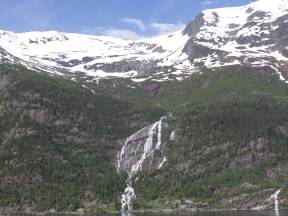
You can see Ædnafossen, or Sagfossen as it is also known, it has a total fall of over 320 metres.
Which makes it a medium sized waterfall in Norway, but also perhaps one of the most beautiful due to its special shape, at its widest it spreads 170 metres and narrows beautifully both above and below the fall.
It is continuously fed from Folgefonna, which is one of the largest glaciers in Norway.
The Hardanger area is teeming with beautiful waterfalls and few places in the world can boast such a diversity of large, beautiful, thundering waterfalls. Låtefossen, Espelandsfossen, Langfossen, Vidfoss, Strondsfossen, Tjørnadalsfossen, Skrikjofossen, Nyastølsfossen Nykkjesøyfossen, Tveitafossen, Søtefossen and perhaps Norway’s most famous Vøringsfossen, to name just a few.
In Norway, we have long traditions of living in close harmony with nature. The Fjords have several of the worlds most innovative and environmentally friendly boats, and the tourists can enjoy both the fresh fjord air and the natural sounds of nature.
Norway is a world leader in environmentally friendly power, technology, and development, and we are almost self-sufficient in renewable energy.
This has required brave politicians who have had to allocate large areas of land to gigantic dams, or piped rivers and waterfalls, and endless wind farms, and it has definitely not happened without a fight.
Nevertheless, many people enjoy the energy that is created, whether it is in the form of cleaner air or slightly cheaper electricity.
The people in Hardanger still live in close harmony with nature. They still harvest what the land and fjords offer, thereby also preserving the beautiful cultural landscape and biological diversity that Hardanger is so well known for.
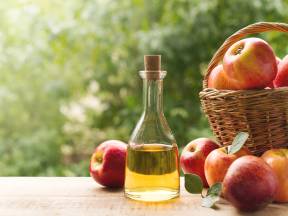
A trip through the beautiful Sørfjord is not solely about experiencing the beautiful nature, but also about tasting experiences. Hardanger cider is a place bound and protected trademark on par with French champagne.
And rightly so!
The lush nature and the unique climate along the Hardanger fjord give especially favourable conditions for growing high quality apples.
Monks were the first to discover that the area was suitable for fruit production in the 14th century.
Over the following generations, the famous Hardanger fruit has been pressed and processed to perfection, but it was not until the end of the 20th century that farmers began commercial production.
Over recent years its popularity has reached new heights and Hardanger cider has won many national and international prizes.
Do you spell cider with an s or a c? Here in Norway, we write it with an s. but regardless of the spelling the name originates from Hebrew and means strong drink.
Do you like apples?
At least they do on the Rondestveit farm that is passed now.
Here, they actually developed a completely unique and tasty apple variety which of course got the name Rondestveit. The mother tree was cut down in 1937 and was then about 70 years old. A good apple tree in the right place yields up to 1000 apples each season. Here in Hardanger, the apples mature throughout the warm summer before they are harvested from August until December.
And apples are obviously good! In Norway, we eat about 10 kilos of apples on average each year. In addition, apples are used for both cider, juice, nectar, and juice.
That fruits and vegetables are healthy, or that "an apple a day keeps the doctor away," are old sayings that have withstood the test of time.
For example, several studies have shown that just one extra serving of fruits and vegetables per day reduces the risk of cardiovascular disease by 4-5 percent.
Cider production flourished in Norway around the 20th century, but partly stopped until the establishment of the Vinmonopolet in 1920.
But more and more Norwegians began to brew their own alcohol for personal use, both beer and cider.
It was this home brewing that kept the tradition alive, and today it is an increasingly popular drink amongst Norwegians and tourists.
And has received global recognition on several occasions.
Unlike most countries in the world, Norway is subject to strict alcohol sales laws.
Up until only a few decades ago the sale of beer, wine and spirits was regulated through government outlets.
Today, wine and spirits can still only be distributed through Vinmonopolets.
Today, the Vinmonopolet is also established in most small municipalities and beer and cider can be purchased over the counter in regular supermarkets.
The vinmonoplet also stocks cider and in 2020 over 325 000 litres of cider were sold, a formidable 38% increase.
It is not surprising, Hardanger cider is a versatile drink that can be enjoyed as an everyday drink or at a party.
Norwegian dietary tradition
The Norwegian dietary tradition established itself in many ways throughout the 19th century based on the men's daily routine at the farms.
At the beginning of the 19th century, they had four meals where breakfast consisted of flatbread, butter, old cheese, and coffee. For "daurs" or lunch, they ate "vassgraut" which is barley flour boiled in water and homemade "skyr" which is a kind of yogurt. The porridge was eaten from a pot where everyone had their own wooden spoon. In the afternoon, there was "Nonsmat", or dinner as we say today. It usually consisted of meat and potatoes from their own farm as well as fish from the fjord.
Supper usually consisted of cold leftovers from earlier meals.
This culture persisted until the beginning of the 20th century when bread made its entrance and replaced both porridge and flatbread. Towards the end of the century, Norway also became more international and thus imported food habits from all over the world.
Many of the old Norwegian food traditions are today only kept alive by schools, museums, and others who showcase Norwegian history.
Now we are soon arriving in Now (Nå)! where there will be a short stop.
Those who wish to disembark at Nå, are warned of a fantastic experience that will never be forgotten.
Here cider farms sit as tightly together as the pubs on Aker Brygge in Oslo, behind every apple tree there is a laugh, smile and something that will appeal to every palate.
In the neighbouring hamlet of Vikebygd you will find the juice and cider producer Alde Sider, which was voted Norway’s best in 2018.
In Nå you can also find Edel Sider based at Åkre Farm where they have been growing fruit for 8 generations, but in recent years the spotlight has been on the production of apple juice, spirits, and cider from Hardanger under the brand name Edel Sider.
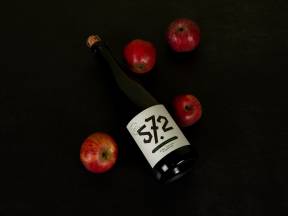
It is also recommended to take a visit to the farm with the plot number 57/2.
There they produce cider with the catchy name 57/2, the cider is produced by the ‘Store Nå Siderkompani’ who have their premises at the Stor Nå Farm which has the plot number 57/2.
And it doesn’t stop there.
Here you can also find Kvestad Cider which went right to the top of Norwegian modern ciders with its tasty 1808 variety.
Down by the harbour, the restaurant Siderhuset Ola K, serves a large variety of the fantastic local produce that Hardanger has to offer, everything from cider steamed mussels to locally baked goods.
Join one of the world's most beautiful boat trips through the adventurous Hardangerfjord to the idyllic and national-romantic villages of Eidfjord and Ulvik.
Here, old history meets new modern infrastructure and energy innovation. The scents and flavors literally hang over you no matter where you turn.
In addition to the spectacular nature, where mirror-like glaciers and wild waterfalls meet sheltered fjords and mysterious mountains, the cultural landscape gives the area an extra dimension where old farms and summer pastures literally cling to the steep mountain sides.
On this boat trip, you will experience all of this directly on your phone with good storytelling voices, pictures, and text as the boat approaches, stops or passes the places along the route.
We at The Fjords will do our utmost to give you a good travel experience. Enjoy the trip!
We are now passing by the Isklar water factory at Hovland, which gets its water from the 6000-year-old Folgefonna glacier on the opposite side of the fjord.
The water is tapped directly at source a few hundred meters under the glacier and runs in pipes down the mountainside, and out to the 300-metre-deep fjord, in fact right under where we are sailing now.
The pipes come up next to the factory you can see on land, and there are piped directly into the bottles.
Therefore, the water reaches the consumer without ever having been exposed to the outside world.
In Norway we are very lucky to have such good drinking water, and the tap water is both healthy and nearly free.
Regardless, Norwegians still buy many millions of litres of bottled water every year. Whatever the reason, there is no doubt that water is healthier than both juice and fizzy drinks.
In Norway the dinner plate has traditionally been filled with what people had on their doorstep.
In the olden days most small holdings had a cow that grazed in the garden, some sheep on the hillside and some bustling hens clucking around the farmyard.
Both the salt and fresh water are bulging with delicious fish whilst game such as elk, deer and hare lurk in the woods around the farms.
In the earth they grew potatoes and vegetables, planted trees and fruit bushes.
Animals provided eggs, milk and were slaughtered for meat. The food was dried, salted, canned, refined and stored.
In the past, the farms were self-sufficient, and the food was therefore, locally produced and of the highest quality.
Fresh and delicious.
Here in Hardanger these traditions and knowledge of raw materials have been preserved and passed down over hundreds of years.
This knowledge is also the secret to the excellent cider that is produced here, and Hardanger was one of the first places to seriously cultivate apples for cider production.
The recipe for a successful cider is good raw ingredients and lush soil combined with the knowledge that has been passed down through the generations.
Locally produced food and drink are popular like never before, and the popularity of cider, especially that from Hardanger has exploded in recent years.
We are now passing several buildings located on steep slopes without road connections.
In the early 19th century, the population grew explosively along the small villages we are passing, and in the middle of the century, the first signs of overpopulation appeared. Life expectancy increased while the number of births remained consistently high.
The farmers in the villages had secured the good plots for centuries, but new generations also needed a roof over their heads and a small patch of land. Therefore, they built homes "where no one would believe anyone could live", often on a small island or a mountain shelf on the steep fjord sides.
It was certainly tough living, but when news about the klondike in America spread in the Norwegian villages, more and more people packed their bags.
Between 1830 and 1920, 800,000 Norwegians left their homes and moved to another country. Most went to America, but many traveled to other continents. In some villages, up to 40% of the inhabitants emigrated.
The result was, of course, that many buildings and places were left empty and without people. Today, many of these places have been fortunate enough to be restored and used for both recreation and tourism.
Here, at the innermost point of the Hardangerfjord's fjord arm, "Ulvikfjorden", lies the true pearl of Hardanger, Ulvik.
For more than 150 years, tourists have found their way to this beautiful village in search of spectacular nature and cultural experiences of world-class standard.
In Ulvik, you will find the only fruit and cider route in Norway, a variety of diverse hiking trails, and a rich selection of attractions and activities.
It is also the birthplace of the well-known writer Olav H. Hauge, who, like many other artists, was inspired by the uniquely Norwegian national-romantic landscape. You can learn more about him and other great poets at the Hauge Center here in Ulvik.
Beautiful nature not only provides pleasure for the eyes and ears but also for the mouth and stomach. The lush western Norwegian nature conjures up fantastic ingredients, and the local population has learned to process and refine these delicious ingredients over centuries.
And to our delight, just a short walk from the pier, you will find the famous fruit farms Ulvik Frukt & Cideri, Syse Gard, and Hardanger Saft- og Siderfabrikk, as well as several exciting eateries.
Bon appetit!
Have you heard about the Hardangergutane? We will shortly be docking at the modern production facility and store at Børve, founded by two locals Kristian and Karl Magnus.
In 2015 they established the «Hardangergutane» brand name after having learnt cider production from childhood.
They have a strong focus on local traditions, knowledge, and history, and use several types of apple and other fruits in the production.
The adventure began a long time ago when they made apple juice for family, friends, and acquaintances.
The feedback was simply so good that they decided to start a commercial business and soon grew out of their farm premises in the village of Sekse, which lies three kilometres away in the direction of Odda.
In their new and modern premises, they produce both apple juice and cider.
Visitors are very welcome to drop in.
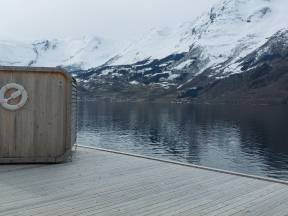
You can probably see the small wooden building at the end of the quay.
It is actually a sauna where up to 6 people can enjoy the spectacular fjord view in the steaming heat followed by a fresh dip in the fjord.
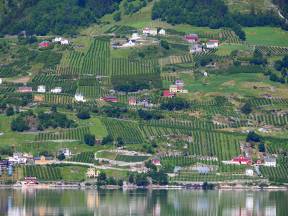
The lush valley sides dotted with idyllic farms and surrounded by colourful fruit trees are picture postcard perfect.
The local farmers soon found out that the apples and fruit cultivated here, were exceptionally good and tasty.
Which leads of course to the question of why?
The answer can be found in the deep fjords that reflect the light up the steep valley sides helping the apples to grow, but at the same time provide light and shade so the climate is a bit cooler in the summer months.
Whilst the warm water and air currents through the Gulf stream help to keep the temperatures warmer in the winter months. All these factors combined, create the ideal environment for the cultivation of tasty fruit!
Today the villages of Hardanger produce 40% of all Norwegian fruit, the main reason being the special climate that is found here.
"If you live by a waterfall, you won't hear it." These words belong to the Ulvik poet Olav Hauge.
Hardanger is one of those places in the world where you will always see, hear, and experience something beautiful, no matter where you turn. Therefore, enjoy every minute! Those who live here are caught up in their daily routines and may have stopped appreciating it.
We are now passing through a characteristic Hardanger landscape, where lush valley slopes rise up from the mighty fjord and stretch majestically almost 2000 meters upwards.
Behind Ringøy camping to the south lies the 1600 meter high "Storeflåtten", and on the opposite side lies the popular peak destination, "Oksen", or the bull.
The hike to "Oksen" is one of the most beautiful activities that the West Coast has to offer, but it is demanding because many meters of altitude have to be climbed. "Oksen" can be tamed and climbed in good weather, but hikers are advised to stay away when the weather is bad.
Those who reach the top are rewarded with a panoramic view over the Hardangerfjord, Granvinfjorden, Sørfjorden, and Eidfjord, and can see large parts of the Hardangervidda, Folgefonna, Vossefjella, and the Raundalsryggen peaks in the northwest.
We are now in the beautiful, idyllic village of Eidfjord, which connects perhaps Norway's finest natural destinations, Hardangervidda, the Hardangerjøkulen glacier, Måbødalen, Vøringsfossen waterfall, the Eio river, and the Hardangerfjord.
Here, you can participate in a myriad of nature experiences, either organized or on your own. You can also simply enjoy the village's lovely atmosphere, whether you want to camp, glamp, or stay more comfortably at a hotel. All eateries here prepare food with heart, the premises have soul, and the dishes served are a delight for the palate.
We recommend everyone, regardless of age, to visit the Hardanger Nature Centre, which offers an exciting, enjoyable, educational, and unique experience of life along the fjords, mountains, rivers, and waterfalls.
History enthusiasts are also recommended to visit Hæreid Terrace, which is Western Norway's largest prehistoric burial ground, with almost 400 grave mounds from the Iron and Viking Ages. You can get there by car, on foot, or with Eidfjord's very own and very special Troll train.
We are now sailing into Aga where there will be a short stop to set down and collect passengers.
In Aga there are numerous things to experience.
From here you can visit both Hardanger Cidery and Aga Cidery, in addition to museums and the famous cultural heritage site of Agatunet.
At Agatunet you can witness history as far back as the early 13th century, and see how the farms, houses, and life in the Hardanger villages has changed from then to the present day.
The oldest building the Lagmannstova, was built by the family of the knight, landowner and law speaker Sigurd Brynjulvsson, and is the only one of its type in Norway.
It is also the oldest courthouse in Norway, it was here that Norway’s first registered sentence was handed out, as early as 1293.
You can find out more about the history of Agatunet on their website:
We are now halfway between Aga and Lofthus and you can now see the Ullensvang Church which was built in the 13th century. Many claim that the church was the subject for the iconic national painting “Bridal Procession on the Hardangerfjord”, painted by Tidemann and Gude in 1848.
After the Christianisation of Norway in the 12th century, monks began arriving from England and put down roots in many places in Norway.
In Lofthus it is said that the Opedal Monastery was where the monks first used their knowledge of growing fruit in England to establish fruit orchards here.
The fruit needed to be harvested and transported and at the time there were few roads.
The steadfast Monks began to develop paths, roads, and stairs up the high and steep mountains.
There are many place names in the area that document this, and in Lofthus the ‘munketrappene’ (monks’ stairs) are a tourist attraction which are a specific example of this.
The monks lay 616 stones in a stair formation right up to the top of the mountain of «Nosi».
It is not known if they used Hardanger cider as the altar wine in Ullensvang Church, but unlike other church communities who can only use wine made from grapes, protestants can use any wine for communion.
Cheers!
We are now passing the Simadalsfjord which takes you into the Sima Valley and the Sima hydroelectric power station at the foot of Norway's sixth largest glacier, the Hardangerjøkulen. The power plant supplies electricity to over 150,000 households and consists of a huge power hall, 6 miles of tunnels, as well as several dams and regulated waterfalls, including the national icon, Vøringsfossen. Sima is Norway's second-largest hydroelectric power plant, measured by output.
At the innermost part of the fjord and about 600 meters up the steep mountain side, lies the famous mountain farm Kjeåsen, almost like a hovering eagle's nest. "Kje", meaning small goat kids, has given its name to the place, probably due to the difficult terrain that was most suitable for goats.
Whether it was the view, protection from the taxman, or the very good hunting resources that drew the first people there in the mid-1600s, is unknown. It was probably a strenuous life to live "where no one would think that anyone could live". Kjeåsen had a feature in the popular NRK TV-series with the same name.
The farm has been called "the world's most inaccessible," but that was before. Today, Kjeåsen can be visited by car on perhaps Norway's narrowest and most expensive farm road. The five-kilometer-long road is open to traffic either for downhill or uphill driving at scheduled times.
Glaciers and national parks
This somewhat national-romantic tour through perhaps the world's most beautiful fjord between the villages of Eidfjord, Ulvik, and Lofthus gives many souls visual chills. Nonetheless, there is a real cold lurking around the corner. These municipalities house or border large parts of two of Norway's coldest, inaccessible, and hardy areas, Hardangervidda and Hardangerjøkulen.
The former is Europe's largest high mountain plateau and Scandinavia's largest national park. Hardangerjøkulen is Norway's sixth-largest glacier. It is about 300 meters thick at its deepest point and has a larger area than Manhattan in New York.
The name "jøkulen" comes from "jøkul," which means icicle or glacier. With its azure blue ice, it is a beautiful sight that reveals itself as you approach the glacier, especially in the summer when the ice sparkles in the sunlight.
There are over 1,500 glaciers in Norway covering almost 1% of the country's land area. Since the beginning of the 2000s, most of the glaciers in Norway have melted back significantly, mainly as a result of warm summers.
The earth is getting warmer, and if climate projections prove true, according to Norwegian researchers, there will be only 28 glaciers left in the country in 100 years.
“If I had of known it was so beautiful, I would have visited before” those are the words of the famous
Norwegian author Bjørnstjerne Bjørnson, when he visited the beautiful village of Lofthus.
And many, especially artists agree with him. Many have found inspiration here for compositions, paintings and maybe even the national anthem.
So now you find yourself in the ‘Orchard of Hardanger’, which is how many people refer to the idyllic and beautiful town of Lofthus.
And with good reason! The town has been at the heart of Norway’s fruit production for hundreds of years.
It is therefore a great place to start becoming acquainted with the world renowned Hardanger Ciders.
Her Majesty Queen Sonja also finds peace of mind and inspiration here every year.
You can follow in her footsteps, by walking the Queen’s path or «Dronning Sonjas panoramatur», which will take you 1100 metres up the mountain between Kinsarvik and Lofthus.
We also recommend a visit to the venerable and fashionable, Hotel Ullensvang.
Today, it is a modern hotel that promotes Norwegian and local traditions at a high quality, where you can follow in the footsteps of the world-famous composer, Edvard Grieg.
Believe it or not, children learn to spit here at the school in Lofthus.
Every year the town organises a cherry festival, and every year the title of the best cherry stone spitter is awarded in the junior, ladies, and men’s categories.
The official world record is over 15 metres!
Maybe you can try and beat it!
Join one of the world's most beautiful boat trips through the adventurous Hardangerfjord to the idyllic and national-romantic villages of Eidfjord and Ulvik.
Here, old history meets new modern infrastructure and energy innovation. The scents and flavors literally hang over you no matter where you turn.
In addition to the spectacular nature, where mirror-like glaciers and wild waterfalls meet sheltered fjords and mysterious mountains, the cultural landscape gives the area an extra dimension where old farms and summer pastures literally cling to the steep mountain sides.
On this boat trip, you will experience all of this directly on your phone with good storytelling voices, pictures, and text as the boat approaches, stops or passes the places along the route.
We at The Fjords will do our utmost to give you a good travel experience. Enjoy the trip!