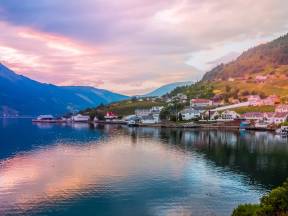
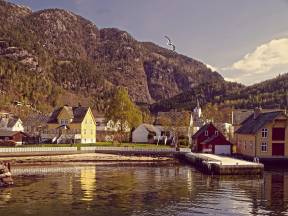
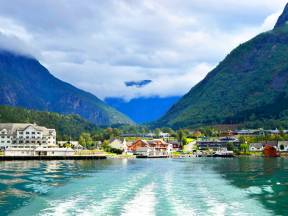
Now you find yourself in the ‘Orchard of Hardanger’, which is how many people refer to the idyllic and beautiful town of Lofthus.
And with good reason! The town has been at the heart of Norway’s fruit production for hundreds of years.
We also recommend a visit to the venerable and fashionable, Hotel Ullensvang.
Today, it is a modern hotel that promotes Norwegian and local traditions at a high quality, where you can follow in the footsteps of the world-famous composer, Edvard Grieg.
The Hardanger cider route
Thank you for choosing The Fjords.
We wish all passengers a pleasant day, either your cruise is ahead or if you're leaving the boat for new experiences in the beautiful town, Odda.
Please follow the crew’s instructions on departure and arrival.
We are now passing the village of Grimo to the north.
Here, like many other places in the area, most of the industries are based on fruit production combined with sheep farming. This way, they not only preserve the beautiful cultural landscape, but also promote local economic development and processing of local raw materials.
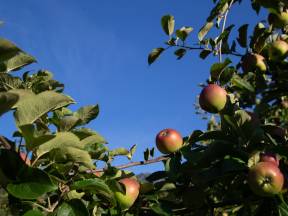
The climatic conditions, together with the rich soil, provide a basis for growing high-quality fruit. Cherries, apples, plums, and pears are the most important, but creative farmers are constantly finding new ways to use the land.
This trip is full of sensory impressions and maybe you now enjoy a glass of real Hardanger cider? We are now in the heart of the Sørfjorden, with a panoramic view of the industrial city of Odda.
As you can see, the city is surrounded by fjords and mountains with beautiful and lush valley sides.
Both the story and the experiences are diverse, and you can learn more about them if you download our free audio guide app, Voice of Norway.
We are now passing between the villages of Kinsarvik and Utne, which are served by several daily ferry departures. To the north, in the small charming village of Utne, lies one of Norway's oldest and best-preserved wooden hotels, Utne Hotel.
On the opposite side of the fjord, at the innermost part of the bay, we see the idyllic fjord village of Kinsarvik, which marks the outlet of the roaring river Kinso. It stretches almost fifty kilometers past several of Norway's largest and most spectacular waterfalls in the world-famous Husadalen, and almost 1500 meters up to Europe's largest national park, Hardangervidda.
«Here you can find fjords, mountains, glaciers, fruit, agriculture, fishing and world leaders in industry all in one municipality». This is the slogan of Ullensvang municipality, of which Odda is the centre of administration.
Hardanger is full of contrasts, but beautiful and charming contrasts!
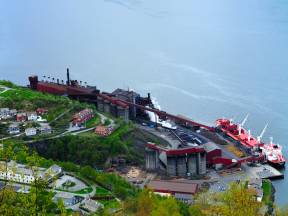
We are now passing the Boliden Odda smelting plant which is a world leader in the handling of raw materials and recycling of metals.
At Tysseldassida, around six kilometres towards the Hardanger plateau, you can find the village of Skjeggedal and the Ringsdalsdammen dam.
Across the valley there are several experiences for both body and soul.
People from all over the world come to Hardanger to experience the mountain spring Trolltunga which is one of the most spectacular viewpoints in Norway.
Not far away you can also find the protruding Preikestolen (The pulpit rock), which is a slightly smaller version of the famous Preikestolen in Lysefjorden.
The boat is now passing through the middle of Utnefjorden, Sørfjorden, and Eidfjorden, all part of Norway's second longest fjord, Hardangerfjorden. It stretches all the way out to the coast in various branches from Haugesund to Bergen.
The nature and culture you find here have enchanted visitors of all times, and the beautiful fjords are considered by many as the very symbol of Norway, the foremost fjord country in the world. Humans have taken root here since the ice retreated 10,000 years ago. They harvested what nature had to offer, whether it was in the fjord, on the valley sides, or in the high mountains.
Tyssedal and Power Museum
We are now in Tyssedal where you see the protected power station down by the fjord. It is a powerful monument to the hydropower and industrial adventure that began here in the early 20th century.
Here it will be only a short stop.
Please follow the crew's instructions in case of departure.
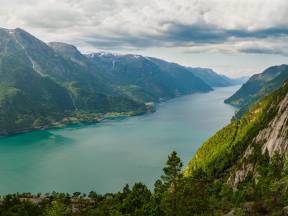
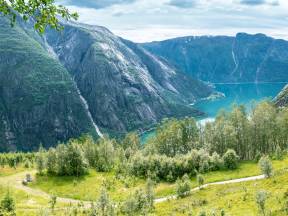
We are now passing through a characteristic Hardanger landscape, where lush valley slopes rise up from the mighty fjord and stretch majestically almost 2000 meters upwards.
Behind Ringøy camping to the south lies the 1600 meter high "Storeflåtten", and on the opposite side lies the popular peak destination, "Oksen", or the bull.
The hike to "Oksen" is one of the most beautiful activities that the West Coast has to offer, Those who reach the top are rewarded with a panoramic view over the Hardangerfjord, Granvinfjorden, Sørfjorden, and Eidfjord, and can see large parts of the Hardangervidda, Folgefonna, Vossefjella, and the Raundalsryggen peaks in the northwest.
In Norway, we have long traditions of living in close harmony with nature. The Fjords have several of the worlds most innovative and environmentally friendly boats, and the tourists can enjoy both the fresh fjord air and the natural sounds of nature.
Norway is a world leader in environmentally friendly power, technology, and development, and we are almost self-sufficient in renewable energy.
The people in Hardanger still live in close harmony with the nature and harvest what the land and fjords offer, thereby also preserving the beautiful cultural landscape and biological diversity that Hardanger is so well known for.
Towards Tyssedal you can see pipes running 300 metres up the mountainside, if you follow them up you will find the Lilletop viewpoint. From there you can enjoy the beautiful view and scout out over large parts of Sørfjorden and out to the fabled tourist attraction Folgefonna on the other side of the fjord.
It is highly recommended to take a tour to Lilletopp where you can get a closer look at the guard house or visit the charming café which serves delicious artisan coffee, sveler and hotdogs.
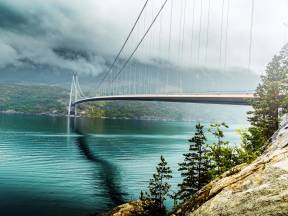
We will soon pass under the bridge called "Hardangerbrua", When it was opened in 2013, it was the tenth-longest suspension bridge in the world with Norway's longest main span of almost 1,400 meters. It's actually 30 meters longer than the slightly more famous Golden Gate Bridge.
The bridge literally goes straight into the steep mountainsides on either side of Eidfjorden, where almost three kilometers of tunnels distribute vehicles further through roundabouts to the Norwegian cities of Oslo, Bergen, and Stavanger.
The roundabouts inside the tunnels are an attraction in themselves and appear almost like magical fountains of light, wishing motorists a good trip ahead.
Are you fascinated by wild plunging waterfalls?
Then you should look towards land now.
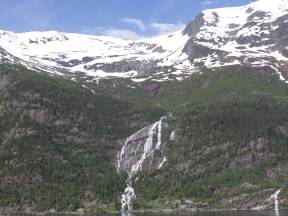
You can see Ædnafossen, or Sagfossen as it is also known, it has a total fall of over 320 metres.
This makes it a medium sized waterfall in Norway, but also perhaps one of the most beautiful due to its special shape, at its widest it spreads 170 metres and narrows beautifully both above and below the fall.
It is continuously fed from Folgefonna, which is one of the largest glaciers in Norway.
A trip through the beautiful Sørfjord is not solely about experiencing the beautiful nature, but also about tasting experiences. Hardanger cider is a place bound and protected trademark on par with French champagne.
And rightly so!
The lush nature and the unique climate along the Hardanger fjord give especially favourable conditions for growing high quality apples.
Over recent years its popularity has reached new heights and Hardanger cider has won many national and international prizes.
The Norwegian dietry history
The Norwegian dietary tradition established itself in many ways throughout the 19th century based on the men's daily routine at the farms.
At the beginning of the 19th century, they had four meals where breakfast consisted of flatbread, butter, old cheese, and coffee. For "daurs" or lunch, they ate "vassgraut" which is barley flour boiled in water and was eaten from a pot where everyone had their own wooden spoon. In the afternoon, there was "Nonsmat", or dinner as we say today. It usually consisted of meat and potatoes from their own farm as well as fish from the fjord.
Supper usually consisted of cold leftovers from earlier meals.
Do you like apples?
At least they do on the Rondestveit farm that is passed now.
Here, they actually developed a completely unique and tasty apple variety which of course got the name Rondestveit. The mother tree was cut down in 1937 and was then about 70 years old.
And apples are obviously good! In Norway, we eat about 10 kilos of apples on average each year. In addition, apples are used for both cider, juice, nectar, and juice.
Cider production flourished in Norway around the 20th century, but partly stopped until the establishment of the Vinmonopolet in 1920.
Unlike most countries in the world, Norway is subject to strict alcohol sales laws.
The vinmonoplet also stocks cider and in 2020 over 325 000 litres of cider were sold, a formidable 38% increase.
It is not surprising, Hardanger cider is a versatile drink that can be enjoyed as an everyday drink or at a party.
In Eidfjord, the National Tourist Route Hardangervidda starts and takes you 6.7 kilometers and 1241 meters up the mountain to the high mountain village of Haugastøl. Parts of the old trail are only open to pedestrians or cyclists and follow the mountainsides up to Hardangervidda, and must be considered as a wild, beautiful, narrow, and very airy experience.
The road is a spectacular and contrasting journey, from the lush fjord landscape in the west to the rugged and bare high mountain in the east.
On the way, you also pass "Vøringsfossen", which is one of Norway's most important and most visited tourist attractions.
We are now in NÅ.
Here there will only be a short stop for on, and disembarking passengers to Alde Sider, Edel Sider, Store Nå Siderkompani or Siderhuset Ola K.
Please follow the crew's instructions in case of departure.
Down by the harbour, the restaurant Siderhuset Ola K, serves a large variety of the fantastic local produce that Hardanger has to offer, everything from cider steamed mussels to locally baked goods.
Here, at the innermost point of the Hardangerfjord's fjord arm, "Ulvikfjorden", lies the true pearl of Hardanger, Ulvik.
For more than 150 years, tourists have found their way to this beautiful village in search of spectacular nature and cultural experiences of world-class standard.
In Ulvik, you will find the only fruit and cider route in Norway, a variety of diverse hiking trails, and a rich selection of attractions and activities.
And to our delight, just a short walk from the pier, you will find the famous fruit farms Ulvik Frukt & Cideri, Syse Gard, and Hardanger Saft- og Siderfabrikk, as well as several exciting eateries.
Bon appetit!
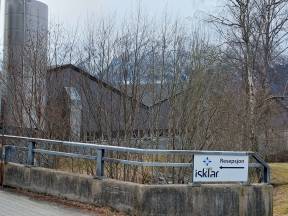
We now pass the water factory Isklar, on Hovland, which collects its water from the 6000 year old glacier Folgefonna, on the opposite side of the fjord.
The water is tapped directly from the source a couple of hundred meters under the glacier and led in pipes down the valley side, and further out into the 300 meter deep fjord, right below where we are now driving.
The treasure in Blaafjell
We are now passing the steep mountain sides where we can see, among other things, "Blåfjell" or "The Blue mountain", and the name may come from an old legend that circulated in the area.
It is said that a man named Vigleik Tveito buried a copper kettle with gold coins in the stone piles in the steep and inhospitable landscape. According to the legend, a blue light shines over the spot where the gold is buried every day at 12 o'clock.
Many claim to have seen the mysterious blue light, but no one has found the great treasure yet.
Perhaps you would like to try?
In Norway the dinner plate has traditionally been filled with what people had on their doorstep.
In the olden days most small holdings had a cow that grazed in the garden, some sheep on the hillside and some bustling hens clucking around the farmyard.
In the past, the farms were self-sufficient, and the food was therefore, locally produced and of the highest quality.
Locally produced food and drink are popular like never before, and the popularity of cider, especially that from Hardanger has exploded in recent years.
We are now in Børve, at Hardangergutane's production facilities. .
Here there will only be a short stop.
Please follow the crew's instructions in case of departure.
glaciers and mountain plateaus
This somewhat national-romantic tour through perhaps the world's most beautiful fjord between the villages of Eidfjord, Ulvik, and Lofthus gives many souls visual chills. Nonetheless, there is a real cold lurking around the corner. These municipalities house or border large parts of two of Norway's coldest, inaccessible, and hardy areas, Hardangervidda and Hardangerjøkulen.
The former is Europe's largest high mountain plateau and Scandinavia's largest national park. Hardangerjøkulen is Norway's sixth-largest glacier. It is about 300 meters thick at its deepest point and has a larger area than Manhattan in New York.
There are over 1,500 glaciers in Norway covering almost 1% of the country's land area.
We are now passing several buildings located on steep slopes without road connections.
In the early 19th century, the population grew explosively along the small villages we are passing, and in the middle of the century, the first signs of overpopulation appeared. Life expectancy increased while the number of births remained consistently high.
The result was, of course, that many families emigrated. Between 1830 and 1920, 800,000 Norwegians left their homes and moved to another country.
Many buildings and places were left empty and without people. Today, many of these places have been fortunate enough to be restored and used for both recreation and tourism.
The local farmers soon found out that the apples and fruit grown here were exceptionally beautiful and tasty.
The result is of course good cider!
Read more about this in our audio guide!
We are now in the beautiful, idyllic village of Eidfjord, which connects perhaps Norway's finest natural destinations, Hardangervidda, the Hardangerjøkulen glacier, Måbødalen, Vøringsfossen waterfall, the Eio river, and the Hardangerfjord.
Here, you can participate in a myriad of nature experiences, either organized or on your own. You can also simply enjoy the village's lovely atmosphere, whether you want to camp, glamp, or stay more comfortably at a hotel. All eateries here prepare food with heart, the premises have soul, and the dishes served are a delight for the palate.
We also recommend everyone to visit the Hardanger Nature Centre.
We are now at Aga where there will be a short stop for boarding or disembarking passengers.
At Aga, the experiences come like pearls on a string, where you can visit both Hardanger Cideri and Aga Sideri, as well as the museum and the famous cultural heritage site Agatunet.
Please follow the crew's instructions in case of departure.
You can find out more about the history of Agatunet on their website:
We are now halfway between Aga and Lofthus and you can now see the Ullensvang Church which was built in the 13th century.
Many claim that the church was the subject for the iconic national painting “Bridal Procession on the Hardangerfjord”, painted by Tidemann and Gude in 1848.
We are now passing the Simadalsfjord which takes you into the Sima Valley and the Sima hydroelectric power station at the foot of Norway's sixth largest glacier, the Hardangerjøkulen. The power plant supplies electricity to over 150,000 households.
At the innermost part of the fjord and about 600 meters up the steep mountain side, lies the famous mountain farm Kjeåsen, almost like a hovering eagle's nest. "Kje", meaning small goat kids, has given its name to the place, probably due to the difficult terrain that was most suitable for goats.
Lofthus, Ullensvang hotel
Thank you for choosing The Fjords.
We promise to do our best to give you an unforgettable experience.
Please follow the crew’s instructions on departure and arrival.