

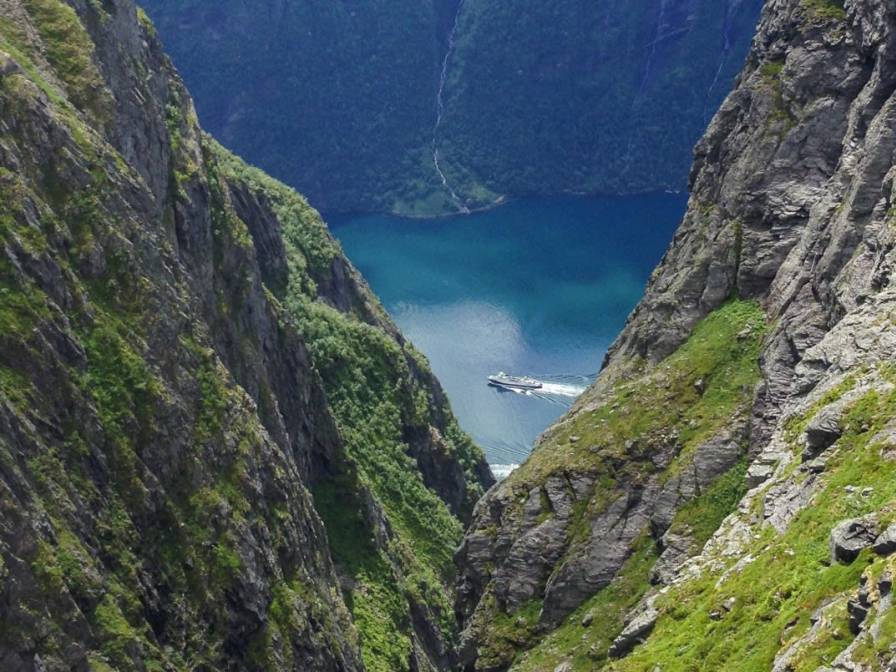
Devils Gorge
0
The deep ravine in the mountain we are now passing is called Hell’s Gorge. Legend says that one night long ago when the devil came to the Geirangerfjord he slipped into the gorge at sunrise to hide, to avoid being turned into stone. Huge forces have been at work to form the towering mountains. Most of the bedrock in Norway consists of Gneiss, which is a type of rock formed through high-temperature and high-pressure metamorphosis. This means that these mountains are made from molten magma that once – more than 400 million years ago – smouldered deep inside the Earth’s mantle, but later was pushed to the surface and folded by the movements of the Earth’s crust. This, of course, took many millennia. Water and rivers were then left to work on carving deep gorges in the mountain ranges that were formed, but the ice ages took care of the really hard work. The more than one kilometre thick ice that covered the continent for many millennia continued to dig out the gorges made by rivers. When the ice started to retreat well over 10 000 years ago, the canyons it had made became filled with sea water, forming the fjords that we can see today. But the process continues. Wind and weather continue to erode the landscape, and a sudden rockslide or two also add the tiniest of changes. Over many millennia, however, huge transformations can occur.