The most beautiful village in the world!
Join us on this fantastic walk around this idyllic fishing village between the roaring sea and the majestic mountains of Lofoten.
Here, tough northerners, both women and men, have stayed for thousands of years with nature’s bounty right on their doorstep.
Now you can get to know the history, the people, the nature, the animals, the food and much more, and you can experience it all here where the people lived, had their houses, and processed the delicious local ingredients.
Reine has been voted Norway's most beautiful place, and for good reason. Just take the tour, listen, smell, and see! And maybe there will time for a taste or two.
You start here in the very centre of historical Reine. Nowadays, Reine Rorbuer is located here and offers a magical stay in historical and uniquely authentic fishermen's cabins, called “rorbuer” or “rorbues”.
All our cabins are newly restored and combine the atmosphere of the original fishermen's dwellings with modern comfort.
Rorbu’es- fishermen's cabins
You are now safely positioned between some of the many “rorbues” you will find here on beautiful Reine, and you may be wondering why they are called “rorbues”? The first part of the word refers to rowing, and the second part, “bu”, refers to a small house where tools were kept.
The first known Lofoten fishing started as early as the 9th century, and the first “rorbues” were set up some 100 years later.
These rudder houses were thus seasonal homes and equipment storage for fishermen, especially at that time when they had to row out to the fishing grounds in open boats without sleeping quarters.
The “Rorbues”, or cabins, usually had two rooms, a smaller part was a living room where the fishermen could cook and sleep, and a work and storage room. 8 – 12 fishermen lived here under tough conditions sharing only four small bunk beds.
Some cabins have divided roofs, one part of the roof was clad with a turf roof, which provided more insulation for the living room.
You may be wondering why the “Rorbues” are painted red? In the olden days, they were painted with cod liver oil, a by-product of cod liver which was coloured with red iron oxide they found in the iron-rich soil.
How it smelled is not 100% known. You can try painting your house with cod liver oil, to find out!
Reine was established as its own trading post in 1743. The king and the church largely ruled over Norwegian land since the Middle Ages, but they eventually sold off areas to landowners.
This also happened here in Reine, and in 1874 the Sverdrup family took over the fishing village.
They established both a fish factory and the necessary infrastructure for fishing, production, and trade.
There were great differences between the landowners and the fishermen, but they were equally dependent on each other.
Today, the fourth and fifth generations of the family still produce dried fish, salted fish and fresh fish, among other things, from the buildings in front of you.
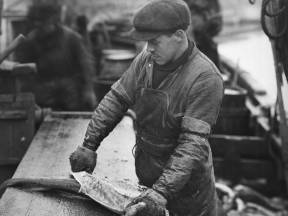
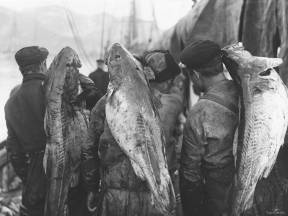
Stockfish, or “Tørrfisk” in Norway, is produced in the same way today, as it was during the Viking Age.
The cod is hung to dry all around in the fishing village in February and March and is dry in June. It is hung gutted without a head and is naturally salted from the sea.
By the way, did you know that “Tørrfisk from Lofoten” is a protected trademark in the same way as Champagne and Parma ham....at least now you know!
Every winter, large numbers of cod, or “skrei” as it is also called locally, come from the Barents Sea to Lofoten to spawn. This has provided a basis for life in the area for many thousands of years.
In other words, the Lofoten fishery is an ancient livelihood. Eventually, the scale became so large that it also became important for people far beyond northern Norway. For the past thousand years, the famous seasonal fishery has been of decisive importance for the entire nation.
Here from Reine, the fishermen set out to the fishing grounds in droves, most often in open boats, and set out fishing nets and lines. You may study the boats under the “Rorbues”.
The weather in winter is mildly harsh in these areas and could change quickly. What was good weather and calm winds could in the next moment be turned into “ragnarok”, an ancient Norse hell, with storms, rain and snow, and waves as big as houses.
It was difficult to predict the weather in the olden days, but they could see some weather signs by studying clouds, light and the sun. There was also some superstition. Cats, women, broken glass and cut flowers were taboo on-board boats in the olden days. Nor was anyone allowed to whistle in the boats. It caused a storm.
On 11 February 1849, several hundred fishermen from the fishing village in Lofoten perished in such a sudden storm.
The harsh living conditions of the fishermen in Lofoten were widely known. The work was of great importance for the economy of Norway, which before the discovery of oil deposits, was a poor country. This house in front of you, was created to improve the fishermen's living conditions run by the religious organization "Den indre Sjømannsmisjon".
The house became one of several similar houses in Norway, all of which were named Havly.
Havly became a meeting point for both local and seasonal fishermen and was also popular with the local youth.
Sunday school also took place in the building. Over the years, fishermen came here to eat a good meal, and meet the other fishermen.
Some old locals still carry memories of the dances, and of course, the cream cakes and meatballs, which were served there.
Today, the building serves as accommodation for the staff at Reine Rorbuer.
You've probably seen them before and wondered what they are? These triangular stands, or scaffolding, which appear all along the coast of Northern Norway.
They are called “Hjell”, or fish “hjell”, and are racks intended for drying fish. Unsalted gutted fish are hung here and dried with the help of the wind and the sun. The final product is called stockfish.
Drying food is the world's oldest known preservation method, and stockfish can be kept for years without refrigerating
Locally, this was important to secure the food for the rest of the year in addition to making it a solid export product. Norwegian stockfish is most popular in Italy and Croatia, and believe it or not, Nigeria.
Today, stockfish is mostly used as a snack or as a delicacy and is considered by chefs to be a wonderful raw material. If you want to try it yourself at home, allow yourself plenty of time. The stockfish needs to be drained for seven to eight days, unless you choose to buy already drained fish at the store.
Whatever the method, we guarantee you a taste pleasure out of this world!
Bon Appetit!
A visit to Reine is a magical moment, no matter what time of day or year you are here.
Here, the midnight sun sparkles 24 hours a day, but at the opposite end of the year, it sparkles just as much with its absence. Here you will see magical sunsets reflected in spectacular lights and colour combinations from the beautiful and wild nature.
Here you can experience four seasons in one day, fish or meet busy migratory birds from the south.
Perhaps the Northern Lights, or aurora borealis, are one of the most wonderful moments you can experience here on Reine.
Even a hard-nosed Northerner can have tears in his eyes when this magical light dances in the sky. This is the light show of all time, and something you just must experience at least once in your life.
Every day, every week and every season offers new experiences and new moments, magical moments.
And do you really think the northern lights are magical? In any case, it has been the subject of superstition since ancient times and many different myths arose around it.
Children were told that if you waved a white scarf at the northern lights, it would come to get you. Do you dare to try?
Close your eyes and try to imagine a few hundred years back. Then you might be able to imagine a couple of hundred people in full vigour among the tillers, factories, fishing huts and boats.
Strong odours of cod liver oil, fish, tar, and smelly socks literally hang over the small fishing village, whether from the cod liver oil pots, the factory, the fish waste, or the newly tarred boats.
And everyone talked, in many dialects, or argued, discussed prices, laughed, or cried, yes, and sometimes some hot sounds of love emerged from the “rorbues” or the surrounding stone piles.
Reine was a vibrant society, a male-dominated society with the fisherman at the centre, but as you probably know, behind every strong man there is an even stronger woman. The "women" were the glue that kept the infrastructure going, either here or from the commuting fishermen's homes.
The work at home on the farms with livestock, the house and children was a full-time job for the woman, and it was also a matter of honour for the women, whether they were wife, mother, or sister, to make the man properly equipped for winter fishing. They packed fine Lofoten chests with homemade woollen clothes, a special Norwegian flatbread, and other equipment they needed to survive for many weeks.
At the time, there were no ready-made pizzas, vacuum cleaners, nurseries or washing machines. The effort the women put in is at least equal to the effort of the men and must never be forgotten.
Now you have arrived at the “Smia” or the forge or smithy. It was often at the heart of old rural communities in Norway, including fishing villages like Reine.
Here fishermen and local people could buy, order, and have knives, nails, lamps and various types of wrought iron repaired. Later, the smithy was also used as a salmon smokehouse.
Before 1981, when the ferry route opened, there were no roads here, and boats were the only means of communication with the outside world.
Reine therefore had to be as self-sufficient as possible. In addition to the orge, there was a “krambu”, a small store and a bakery here. Eventually, a separate post office and a new telegraph line were also opened for several fishing villages in Lofoten, which made communication with the outside world efficient, especially when it came to weather conditions and the result of the catches.
All land and all properties on Reine were once owned by the landowners.
All other families on Reine were tenants and were called "husmen" or "strandsittere". They paid the rent with hard physical work equivalent to 20 – 26 days for the owner's businesses.
So, it was tough in the olden days. Later, both the fishing village and ordinary people's rights have developed in step with the times, volving into what you see today.
Are you tempted by crispy fried cod tongues or fried stockfish a la Reine?
Then you have come to the right place.
Here at “Gammelbua”, which is the oldest building on Reine, you will find a traditional restaurant with world-class local food from both the sea and land.
The “Gammelbua” as an old general store or “krambu” in Norwegian, which was a small shop where you got the most necessary things.
Here you will find an old American cash register from the 19th century, a small rowing boat, fishing nets, whale bone and the characteristic round glass floats that kept the fishing nets afloat. A float can be made of cork, wood, plastic, or glass.
The glass float is a Norwegian invention, the first glass floats were bottle-shaped, before the round glass rolls or glass balls took over the market. The balls were covered in a woven net of sisal or hemp so that they could be attached to the fishing nets. They went out of production around the middle of the last century and were eventually replaced by plastic buoys.
The “Krambua” was a necessary institution in the fishing village, on an equal footing with the telegraph, the police, and the church. Although the fishermen had brought clothes, food, snuff, and tobacco from their wives at home, there was occasionally a need for places where they could get both physical and spiritual replenishment.